ANALYSIS: The bizarre story behind the Ford GT's first win
Only in the bizarre world of sports car racing can we accurately credit a broken gearbox in January at Daytona for Ford's breakthrough win in May at Monterey. More on that in a moment.
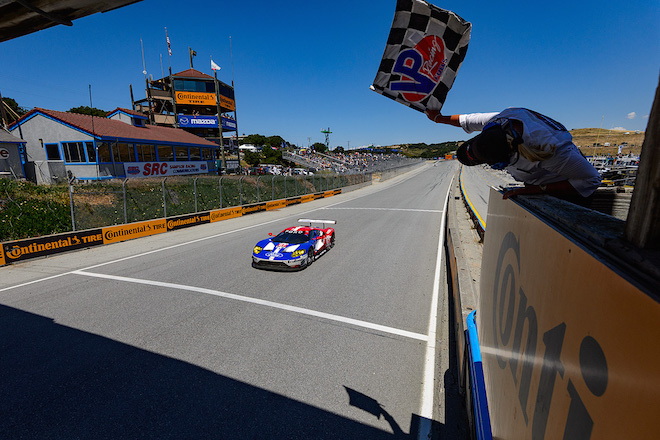
Ryan Briscoe and Richard Westbrook made history on Sunday when they drove the No. 67 Ford Chip Ganassi Racing GT to Victory Lane at Mazda Raceway Laguna Seca.
The Blue Oval's win was delivered in its fifth race (four IMSA rounds and one in the WEC) during the brand's high-profile return to sports car racing, and for the American side of Ford's GT program, it serves as the perfect primer for their next race: The 24 Hours of Le Mans.
Briscoe and 'Westy' used the craftiest of strategies to beat factory teams from BMW, Corvette, Ferrari, and Porsche in Northern California, and it's fair to say their success in the two-hour Continental Monterey Grand Prix was due to miserly fuel-saving instead of overwhelming speed.
In fact, it looked exactly like something taken from Chip Ganassi Racing's IndyCar playbook. Ganassi's four-time IndyCar Series champion Scott Dixon - the king of fuel saving - is famous for using his otherworldly ability to lead while avoiding the gas pedal, and I actually sent him a text after the race to ask for proof he wasn't hidden in the No. 67 working the throttle while Westy turned the steering wheel ...
Speaking with FCGR's Brad Goldberg (right) after the race, the engineer of the No. 67 Ford GT let me in on the secret of how Briscoe and Westy completed the race with a single fuel stop and, amazingly, how Westy stretched that tank to last 52 laps while maintaining a race-winning pace.
"We knew that it was going to be a tight fuel-saving race, so we actually went out in the third practice session on Saturday and practiced exactly what we did on Sunday," Goldberg told RACER.
Interesting. As the sister No. 66 driven by Joey Hand and Dirk Muller worked on their own session plan, the No. 67 team dedicated their session to finding the limits of lapping quickly while sipping fuel.
"We wanted to see what we could do because we knew that dilemma of trying to do the race on one stop instead of two might happen," he said. "And, of course, there's multiple variables because you have a new tire from Michelin, so what is that tire going to do when you extend that period of time running on it if you only make one tire change?
"And then I sat down with Ryan Van Klompenburg, the 67's assistant engineer, and we just went over the numbers before the race to see what kind of mileage you would need to get to the end if a caution came out with an hour and 30 minutes go. And we also did a strategy for an hour and 20 minutes to go. Lo and behold, the hour and 20 minutes' yellow comes out and our mind was decided at that point on what we need to do to make it to the end on one stop. We had already done a lot of our homework in practice."
To be accurate, the fuel-saving test run performed by Briscoe and Westy at Monterey wasn't so much homework as it was preparing for a final exam. The real homework, Goldberg reveals, was done in Florida.
"It goes back even further than Laguna; this all really came about at the Daytona 24," he said. "We had a problem in the race and had to change the 67's gearbox (left). You always hope you have a chance to win the race, but if you spend three hours in the garage changing the gearbox, chances are it's not going to happen.
"So it becomes like when people say the race then turns into a test. We have the gearbox problem, we need to go out and run to the finish, but what are we going to do? What can we learn from here on out besides just running laps? Then Ryan [Briscoe] came up with an idea.
"He said, 'I'm just going to go out and I'm going to do what I can to save fuel and see how to drive this Ford and save fuel - see what it needs for a driving style.' Did it need an IndyCar style, or a different style? He wanted to find the driving style that would make for the best fuel economy with the Ford GT."
With plenty of time left in the race and a brand-new race car to learn, the former IndyCar pilot began exploring from inside the No. 67.
"So he goes out and does it and he is out there and trying and trying and trying to see what he could do," Goldberg said. "And he's trying different methods. And then the next guy in is Westbrook and he comes up to the top of the timing stand and says, 'how is Ryan getting on?' Richard had never really done anything like that kind of fuel-saving before. He'd never really had time to practice it.
"So I said, 'here's what Ryan is doing. If we do this, it will pay off down the road. I know we don't need to [save fuel] right now, but this is a test session. We need to figure out what we can do mileage-wise.' And then he sat there and studied the telemetry on how Ryan was doing it for 20, 25 minutes before he got out of the car. And he said, what was Ryan's best [fuel usage per lap] number? And what was Ryan's best lap time?"
With a challenge presented by Briscoe and the team, Westy became engrossed with learning a new driving technique.
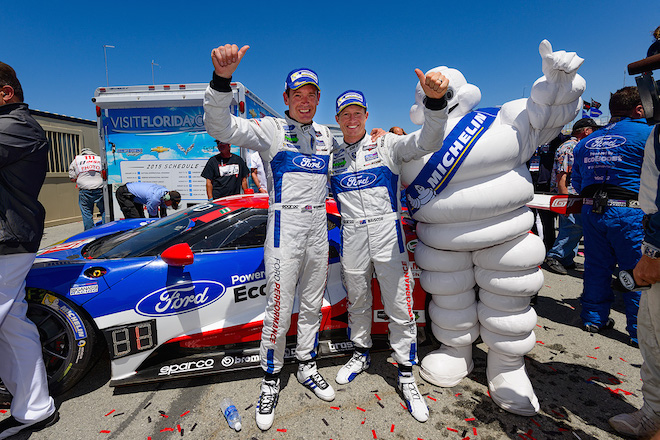
"Ryan had done the fuel-saving game in IndyCar for a long time, so he knew how to apply the same type of things in the Ford," Goldberg said. "It was more Richard learning than Ryan, but he was definitely analyzing telemetry and analyzing numbers and analyzing lap times that Ryan was doing. He could see how he was doing it, and had an idea of what to try when it was his turn."
And leave it to Westy - in the middle of IMSA's longest race - to turn fuel-saving into a personal competition with his teammate.
"Ryan pits, Richard gets in the car, and right away, you can see he's working and working and working," Goldberg said. "He's like, 'this is pretty difficult.' And then they started challenging each other on how to do it better. After the race he said, 'I went out there with the mentality of, I'm going to learn how to beat that guy'. And then he goes out there and did it. That really impressed everyone."
With time to kill and an internecine duel to win, Goldberg says his drivers rose to the challenge and put some valuable knowledge in their toolkit for future use. Little did they know it would pay off so soon.
"After the Daytona race, I very distinctly remember telling Richard, 'look, this is going to pay off. I can't tell you when it will happen. I can't tell you if it will happen next year, but at some point that work that you guys did is going to be winning us a race'," he said. "That is where everything we did at Laguna really came from."
Faced with the same kind of challenge - one that would take Daytona's lessons and push them to the extreme— Westy found a way to survive each lap on an impossibly small amount of fuel. Taking it easy on the throttle also helped the Ford GT to preserve its Michelin tires as their rivals used copious amounts of fuel and rubber to keep pace.
"Fast-forward to Laguna, and the fuel number we asked Richard to hit ... I mean, he's going to tell you he thought we were drunk when we told him," Goldberg said.
"It was going to be really hard to get, but we thought it was an achievable number. And because we weren't punishing the tires to produce our lap time, we knew their fall-off rate was going to be better than the other cars.
"It ended up that those guys were pushing really hard and they struggled to keep tires underneath them. And with 20 minutes to go, we just gave Richard a lap time target and a fuel mileage number, and said, 'hit that and you'll win the race.' And that is exactly what he did."
Coming off of three punishing races to start Ford's return to sports car competition, Chip Ganassi Racing managing director Mike Hull sees the result in Monterey as a turning point for the young program.
"What winning does is, it is a motivator, but more important it is a validator," he said. "It validates what the team does as a group of people together. It proves to each of those people that being a part of an organization and how hard they work together within that organization makes a difference. And I think that is what winning at Laguna Seca did."
If Hull has any trepidation after last weekend, it's centered on the timing of their first win. The team's greatest challenge arrives in six weeks when it spearheads Ford's 24 Hours of Le Mans program, where it will face most of the GTLM teams it races against in IMSA, and a few more featured in the WEC's GTE-Pro category.
"That's what really worries me a lot, because it's not just the race teams; it's who the race teams represent," he said. "And, so it's not like in IndyCar racing where it's Ganassi versus Andretti, or Ganassi versus Penske. That's not what this is all about in the category we are now in. This is Chevrolet versus Ford, Ford versus Porsche, and other major auto manufacturers. These are big people. They are big organizations. They have huge resource.
"And what scares me about winning is how these people come back stronger the next race because they have massive resources. We also have resources, but we are in the infancy as a team. We're trying to utilize the resources that we do have and we're trying to learn how to race at the same time. Winning this early might not be a good thing - you're poking the gorilla."
After securing the victory, the best part for Hull, Goldberg, and I suspect most of the team came when Henry Ford III, whose presence in Monterey came as a surprise, was invited to join Briscoe and Westy on the podium (above, far left) to receive the Entrants' trophy.
"We didn't know Mr. Ford would be there, and with Chip [Ganassi] in Talladega for the NASCAR race, we asked him to receive the trophy, which made the day more special than it had already become," Hull said. Goldberg was also moved by the achievement.
"To be part of it, and to welcome Ford back to victory in GT racing, with Henry Ford there, and the EcoBoost engine - it's the fuel efficient engine, right?" he said. "I couldn't be happier for all the men and women who've put in the work to make this program grow so quickly. I can only hope and pray we carry and continue this momentum forward. This was a two-hour race. The 24 Hours of Le Mans is a whole different story."
The funniest part of the win belongs to Hull's reaction after Westy took the checkered flag.
"I was a little bit upset!" he said. "Richard was able to complete the cooldown lap, which tells me we saved too much fuel. He could have gone faster!"

Latest News

Comments
Comments are disabled until you accept Social Networking Cookies. Update cookie preferences
If the dialog doesn't appear, ad-blockers are often the cause; try disabling yours or see our Social Features Support.