Indy Lights celebrates 30th anniversary at Phoenix
The forerunner of today's Indy Lights series presented by Cooper Tires made its debut almost 30 years ago this weekend in Phoenix. Celebrating the series' start and continued success is among the overriding sentiments as open-wheel racing returns to Phoenix International Raceway for the first time since 2005, and with Indy Lights' 30th anniversary coinciding with the event, RACER spoke with the driver who earned the series' very first victory.
On April 6, 1986, driving for the Truesports team, New Zealand's Steve Millen became the inaugural winner in what was then known as the American Racing Series (ARS), leading Cary Bren and eventual series champion Fabrizio Barbazza home in a 76-lap contest.
Although the Kiwi is often remembered for his later sports car exploits in America where he won multiple IMSA GT championships and legendary endurance races as a factory Nissan driver (RIGHT), Millen also made history in the brand-new CART IndyCar feeder series.
"It was a great event for me because I had been running open-wheel cars for many years in New Zealand and throughout Southeast Asia, and Japan, and I thought my single-seater career was over when I moved to America," Millen said. "Then in early 1986, I got a call from Steve Horne, who was running Truesports at the time. And I had done some races for them in [IMSA] GTP with Jim Truman, who owned Truesports. Steve called and said, look, this is a new Indy Lights series, they had bought a car, and they were going to use Jim in the series but Jim's health deteriorated earlier in the year. And they said, 'Look, we want to do some testing with the car and learn a little bit about it. Will you come down to (the Arizona road course at) Firebird and drive it?'"
Under SCCA sanctioning, the ARS championship was assembled using 1985 March F3000 cars tailored to use hefty 4.2-liter naturally-aspired Buick V6 engines tuned by George Montgomery, Goodyear tires, and would visit short ovals, road courses, superspeedways, and street courses – a tradition maintained by today's Lights series.
"We feel that we have put together a schedule which matches the goals of the American Racing Series perfectly," ARS founder and president Pat Patrick said during its launch.
Millen's first taste of the 1986 ARS package also turned into a job audition when another driver was invited to sample the red No. 5 March-Wildcat.
"I went out and spent two days driving at the Firebird Raceway," he continued. "Then they had Ross Cheever come in town and drive for the two days after. I was so disappointed because Ross was running formula cars in Europe at the time and I thought, s**t, any chance of me getting back in single-seaters is gone.
"Well, it turns out that Ross was a bit slower than I was so Steve called me and said, 'Jim is not going to do Phoenix on the oval, would you do that? I was sort of hesitant about it because Alan Jones and Chris Amon, famous guys from Down Under [who raced on ovals in America], they said they hated doing them."
With no oval experience, and the negative views expressed by Jones and Amon, Indy Lights' first race winner almost turned down the opportunity. Thankfully, he overcame his initial hesitations.
"It always stuck in my mind, 'Man, this could be really difficult,'" he said. "You know, I don't mind telling you, it was daunting. It was really, really daunting at Phoenix. Initially, I was so out of my depth, I really felt like I never sat in a racecar before I was done. By the end of the first day, we did a lot of laps, and Steve Horne came to me and said, 'Steve, is the car starting to push or is it loose?' I said, 'Look, I haven't got a bloody clue.'
"At the end of the first day, I thought, 'Man, I can't do this. It's just beyond me.' But the next day I woke up and it really started to click. Before very long it got loose and that was a big fright for me. So I came in the pits and immediately dialed some wing to the rear and got it where it would push. And when I did that, then it was good, then I could just progress and get quicker and quicker.
"It is just amazing because initially I would come down the front straight, put the brakes on, go back to fourth gear and all that, and then in the end, by the time I got to qualifying, I'd come down the front straight, turn left, leave it in fifth, and you're just hard on the gas all the way through."
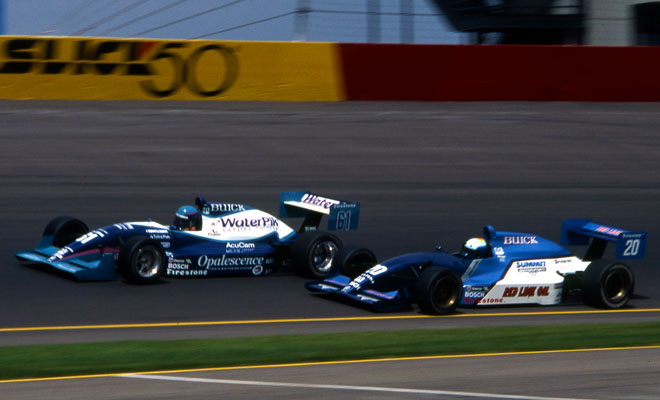
The incredibly talented – and adaptable – Millen placed the car fourth on the grid of 14 entries with a lap of 26.050 seconds. SCCA Super Vee ace Kim Campbell secured the first Indy Lights pole with a 25.607-second lap. Compared to the fastest lap of 21.872s set last month in Indy Lights testing at Phoenix by RC Enerson, the old March-Wildcat (BELOW) was not particularly swift or agile.
Its significant rearward weight bias and relatively short wheelbase meant finding an adequate chassis balance was often a challenge. To assist the early ARS drivers in their quest to extract speed from the cars, an unbelievably tall and canted rear wing installation was devised that aided cornering stability.
"They had that big lump of a Buick in the back and the wing that was crazy high – but that crazy high wing gave it a lot of downforce, which was good on that little one-mile oval," Millen explained. "I so enjoyed the cars; I drove them for two years and I really did enjoy it. I'm sure it got a heck of a lot better once they got more balanced and so on.
"I was just so pleased to be back in single-seater racing. That win meant a lot to me, and it did help to get the attention of other people in America. I jumped at the opportunity and we did it. And we had a fantastic weekend. I wish I could have gone on to race in Indy cars after the ARS, but I still managed to have some great things come afterwards from being in the series."
The ARS series not only held its first race at Phoenix, it went on to open its season for the first five years at PIR, and continued racing at the 1.0-mile oval when it was renamed as the Indy Lights series in 1991. Millen's win at Phoenix was followed in 1987 by Jeff Andretti, future CART champion Paul Tracy would score his first Indy Lights win at Phoenix in 1988, Mike Groff won in 1989, and Tracy repeated in 1990.
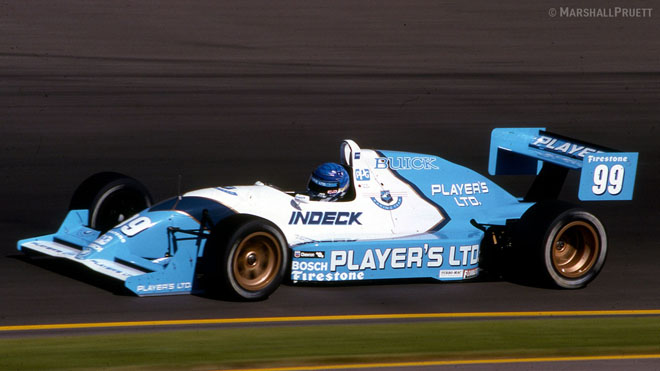
"It's an honor for me to be involved in the Indy Lights series, and to see the quality of the kids coming through the series right now; our entry list this weekend is filled with impressive young drivers who are aiming for the top," said Dan Andersen, whose Andersen Promotions company runs the Mazda Road to Indy ladder system and commissioned the new Dallara IL15-Mazda turbo that has revitalized the Lights series.
"Lights has a great legacy," he continued. "If you look at the names of the people who've come through the series, all the IndyCar champions and Indy 500 winners, going all the way back to when Roger Bailey ran the series, it tells us Indy Lights is a necessity. I'm particularly proud to have a part in continuing the legacy Roger and many others had with the series when I look back to its start 30 years ago here in Phoenix."
As much as Millen wanted to be in Phoenix this weekend, a previous travel engagement in Australia means the inaugural Indy Lights winner will have to celebrate the anniversary from afar. One thing is for sure: With so many young drivers carrying the Indy Lights torch these days, Millen says he's happy to see the next generation leading the series into the future.
"I was 36 years of age when I won!" he said with a big laugh. "The kids that will be racing this weekend will be probably half that age, won't they? I'm glad it won't be a bunch of old buggers like me; Indy Lights is a young driver's game and it's clearly in good hands."
Click on the thumbnails below for larger images of 1980s and '90s-era Indy Lights.
{igallery id=4574|cid=485|pid=9|type=category|children=0|addlinks=0|tags=|limit=0}

Latest News
Comments
Comments are disabled until you accept Social Networking Cookies. Update cookie preferences
If the dialog doesn't appear, ad-blockers are often the cause; try disabling yours or see our Social Features Support.