IHRA: Why drag racers do burnouts – and why everybody else does now, too
Plenty of race fans insist that the tire-smoking "burnout" was invented by IndyCar racer Alex Zanardi in 1997 after he made a remarkable back-to-the-front charge to win the Cleveland Grand Prix.
Afterwards, and exuberant Zanardi did some smoky doughnuts on the track (which was much wider than the usual street course) and the crowd went wild. Shortly after that, NASCAR drivers picked up the trick, and a Sprint Cup race isn't complete without a tire burn-down after the checkered flag, often to the point where the tires blow or, as with Jack Sprague at Richmond in 2001, when he set the newly-applied track sealant on fire.
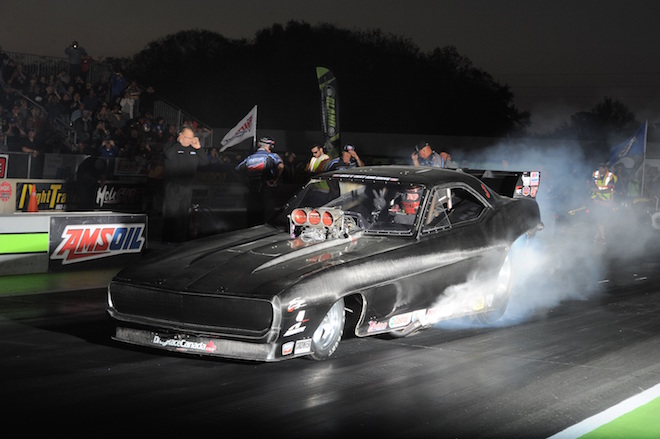
Of course, drag racing discovered the burnout decades before Zanardi, but those drivers do it at the start of the race, not after. As most every race fan knows, the burnout is done to generate heat, and therefore stickiness, in the rear tires before each run. Practically every driver does at least a brief, tire-squealing burnout, with the possible exception of front-wheel-drive racers, but sometimes even those racers light 'em up.
The main reason for burnouts, though, is to remove any non-rubber material the tires might have picked up in the roll from the pits to the line. As the tires are relatively soft, it doesn't take much to penetrate them.
"It is important to remember that one purpose of a burnout is to remove foreign matter," said Bryce Jones, Goodyear's sales-account manager for drag racing, in a story in Car and Driver magazine.
"There's no standard optimum temperature for the surface of the tread to reach during a burnout. "You could safely estimate the tread's temperature at about 400 degrees immediately following a burnout," Jones continues, "but even that depends upon the length of the burnout. John Force, for example, prefers a long, hard burnout."
And the final reason: To hopefully lay down a strip of your own rubber that you can drive over when the green light shines.
Executing a proper burnout is an art, and if you are new to IHRA drag racing, find a veteran who will help you get started, or lacking that, there are tutorials on YouTube. We'd tell you how, but we don't want to be responsible for any "Exhibition of acceleration," or whatever your local law enforcement agency calls learning how to do a proper burnout, in an improper place.
Don't forget, though, burnouts are hard on a street car – the transmission, clutch (if you have one), U-joints, driveshaft and the engine itself – YouTube is also full of instructive videos on burnouts that went horribly wrong.

Latest News
Comments
Comments are disabled until you accept Social Networking Cookies. Update cookie preferences
If the dialog doesn't appear, ad-blockers are often the cause; try disabling yours or see our Social Features Support.