INDYCAR: Drivers react to F1 halos
With the development of an IndyCar cockpit safety device taking place behind the scenes in America, IndyCar drivers have followed recent testing of halo cockpit devices in Formula 1 with particular great interest.
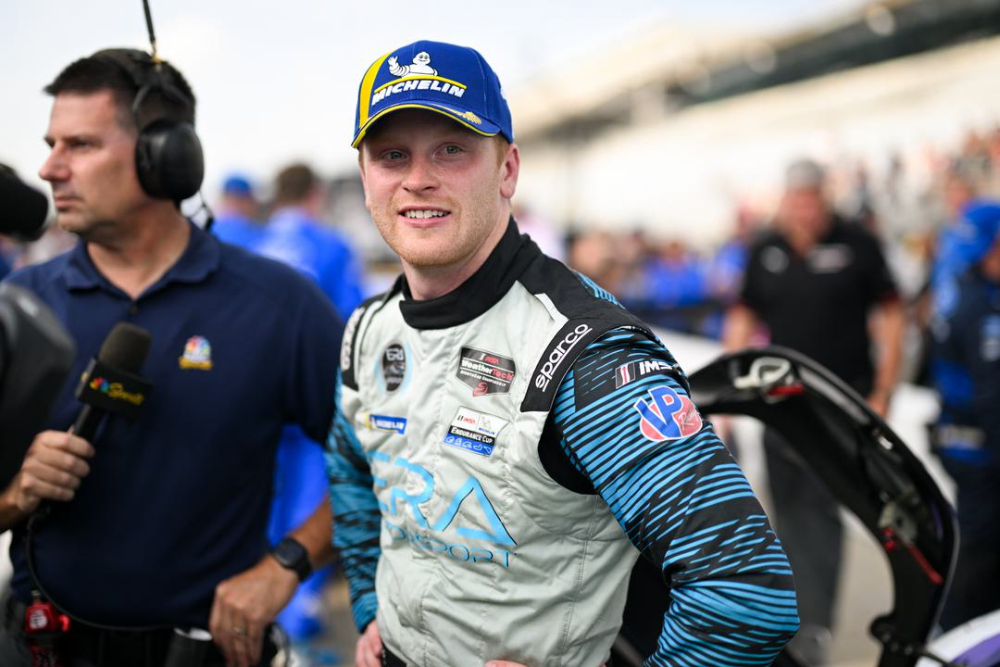
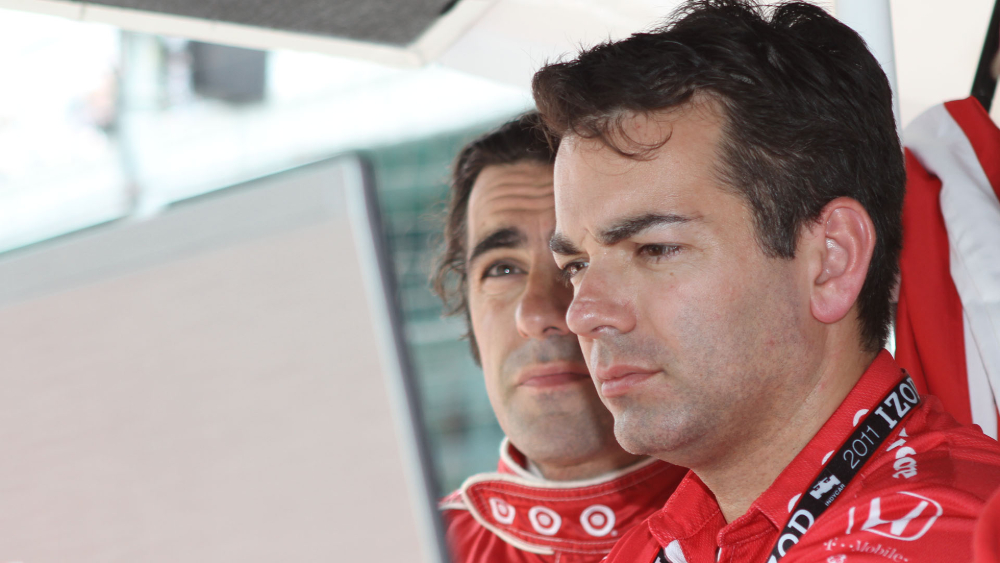
Within the IndyCar Driver's Association, James Hinchcliffe and Charlie Kimball have liaised with IndyCar as the yet-to-be-revealed device is developed, and with the Ferrari halo recently breaking cover in testing (RIGHT), Chip Ganassi Racing's Tony Kanaan, Schmidt Peterson Motorsport's Hinchcliffe, and driver/engineering major JR Hildebrand shared their thoughts on the F1 unit.
"My first thought was it wasn't as ugly as I thought it was going to be," Hinchcliffe told RACER. "I've got kind of two main thoughts on it. The first being that while it will do lots of stuff to stop things – tires and big debris, which obviously is the most important thing to stop, it still does leave some opportunity for things like the end plate that knocked me out at Indy or the spring that hurt [F1 driver Felipe Massa]. There's still a possibility of things like that getting through."
Hildebrand was impressed by the visibility afforded to Ferrari's Kimi Raikkonen, who was the first to sample the halo.
"I closely followed the first couple of tests with Kimi and I thought it was interesting watching the onboard footage to see that you could very clearly see through the thing," he said. Certainly, it would affect an impact on anything close to something that's going to be direct. You think about how it's very nearly impossible to get something coming in from the side unless you're already in a significant accident and in some sort of weird positioning because of it. We're talking about high kinetic energy impacts because you're hauling ass going toward something.
"So I think functionally, it makes sense to me as a minimum step in what I can only assume – I think what we can all only assume – is going to be a progression of developments along that direction. I am of the opinion that if we can generate something that is like a full cockpit, I just think that there's a lot of cool and awesome things about that. I think this is a reasonable option as something that can be introduced right away."
All three drivers provided identical feedback on one limitation the halo design would create on ovals.
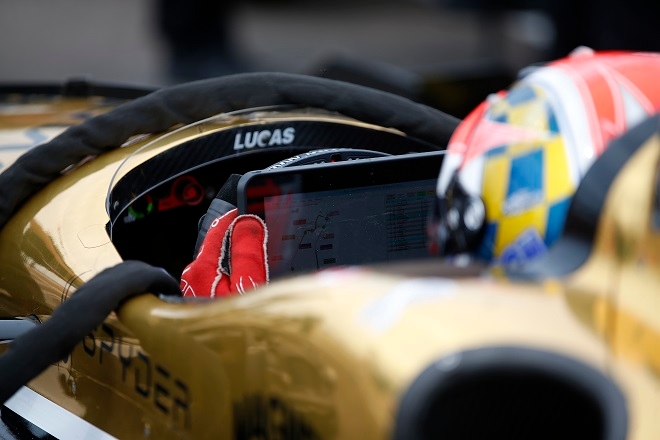
"Anything that tries to prevent intrusion is a good idea, but we have to be careful, obviously, because the difference between F1 guys and us, we have banking in some of the tracks," Kanaan said. "When you go to the banking, you're never actually looking ahead, you're looking on the side and up. That would be my question, is that going to block our view? Is that going to restrict our view when we get to the banking?"
"When you're in the banking," Hinchcliffe added, "your car is already sitting at a 25-degree angle, whatever it is, and to look around the corner you are actually looking above you. You're only looking 10 feet in front of you; if you want to look a hundred feet in front of you, you have to look up and around the corner. So that would be a big problem for us.
"I have seen some very early stages of renderings for a system that IndyCar is looking at that I think would be much more suitable for our style of racing. It could even be more beneficial for some of those smaller objects that I've talked about. I think the Halo design is definitely a good start and it is something that can be easily implemented in the short term. And absolutely, let's get it on the cars, and just continue the quest to find more and better solutions to this problem."
All three drivers say they have bristled at negative comments about the halo system – or any new cockpit safety device – because of its looks.
"It is the most asinine argument ever," Hinchcliffe continued. "To be fair, in 2009 the Formula 1 regulations ruined the look of the cars. You compare a 2008, 2009 car and you actually think somebody threw up on Adrian Newey's design pad and that's what came out. But guess what? Now, here we are seven years down the road and they look like Formula 1 cars, and you almost forget what they looked like in 2008.
"A lot of people think the DW12s are ugly compared to the cars in the mid-'90s cars. It's just evolution. I mean, we used to not have wings on formula cars. Did adding wings to it ruin the aesthetic appeal? I'm sure to the old-timers back in the 1960s or 1970s, they would say, yes, they did. But, guess what? It was faster so they stuck them on. We used to not have seatbelts in racecars. So this is what we should be doing?
"The traditionalist argument is actually the most insane thing from people that just don't get it; they haven't actually thought about it. I'm not mad at them. They just actually haven't thought about it. As soon as you put some time in and think about it logically you understand how ridiculous that argument is."
"From an aesthetics perspective," Hildebrand said, "which I think is where a lot people's opinions come from, I just rule it out. I'm not even going to comment on it because everybody has a different view on the thing. I guess it doesn't make the car look more awesome, but I don't think personally that it is ridiculous. And this isn't being done for looks."
Hildebrand (RIGHT) would like to see IndyCar follow Formula 1 and get prototypes into the field for track testing.
"At this point, it is just about collecting data, both human data and scientific data, to really figure out what makes sense," he said. "And I think in the big scheme of things, the question is what are the varying steps along the way that we can go through without going to a full fighter jet-style canopy? Is it like a halo, or something similar, without having to go full-canopy?
"Because it may end up turning out that along the way you realize that you don't need to go quite that far. And you can get all the protection that you would get from that type of a scenario, and then not have to deal with trying to figure out ingress/egress if there is a fire, or the car's upside down. More than anything, we need to get moving and get testing going."

Latest News
Comments
Comments are disabled until you accept Social Networking Cookies. Update cookie preferences
If the dialog doesn't appear, ad-blockers are often the cause; try disabling yours or see our Social Features Support.