INDYCAR: C.J. O'Donnell on 2016
IndyCar is a high-speed work in progress. The series has never hidden from the fact that it does not have the same popularity or exposure that CART enjoyed a generation ago, and it has also been honest about the difficulties involved with trying to regain some of that stature in a world where the sports and entertainment landscape has changed beyond recognition. What worked in the 1990s won't work today.
But there have been encouraging signs. TV numbers are up - admittedly, there wasn't much room left for them to go in any other direction - the racing is good, and in Phoenix, Road America and Boston, the series has added a suite of new races that strike a perfect balance between the sport's history and its future.
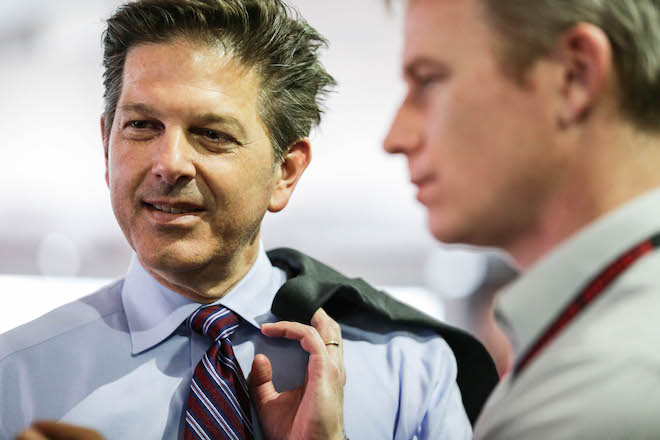
So is IndyCar out of the forest? Not quite. But it's starting to piece together a map, and there appears to be a bit of light shining through the trees up ahead. IndyCar's chief marketing officer C.J. O'Donnell is one of the key figures working to chart the series' new course, and RACER.com spoke to him on the eve of the new season to get a snapshot of where things are at.
MARK GLENDENNING: How does it feel to work in a job where everybody thinks they know what you should be doing better than you do?
C.J. O'DONNELL: I'm kind of used to that. It didn't come as a surprise that everybody has an opinion. Some of them are better-formed opinions than others. What I find interesting – and the same thing happened when I was at Jaguar – is that when somebody is really passionate about a brand or a sport, it comes through loud and clear in what they want to see in terms of the future and our success and progress. So it's to be expected that you're going to get really passionate people giving really emotional answers. And frankly, we should be happy for it, because if they didn't care so much, we wouldn't hear so much from them.
Where does the series fit into the sporting landscape now? What is IndyCar's place?
That's an interesting question. We are obviously the premier form of open-wheel racing in the United States. That's a starting point. And we're trying to re-establish IndyCar as the premier overall form of motorsport in the country; taking on a higher-end, more prestigious position relative to the competition. As we move forward and develop our strategies I think that's going to become more evident, particularly our audience, and the growth of our audience, versus fans of NASCAR and other areas.
So that's the anchoring point. But what we'll ultimately have to do is not only bring back the last fans that we've missed over the past few years – and that's where most of our success has been; bringing back those past fans of the sport - and also bringing the series to a more youthful, energetic audience. That bit of it is probably going to be the most important step in the plan as we move forward and not just engage people that you'd expect to be IndyCar fans based on our history, but start to attract new fans to the sport.
They're very different groups, aren't they? The people that were fans of CART in its heyday are not the tech-savvy Millennials that you also need to target.
Our current target audience are somewhat older, professional, well-educated, more fluent when you compare them to [fans of] most other forms of motorsport, especially NASCAR. They're a pretty sophisticated crowd. If you look at the average income for a person coming to the Indy 500, it often exceeds $90,000. So it is a pretty affluent crowd.
They have a generation below them that has a lot of common characteristics. They're probably our next and best opportunity for growth in television and other areas. And eventually we have to start thinking about Millennials and where they are going to fit. But each of these steps as we go forward takes us younger and younger, and the brand and our communications and a lot of what we do – maybe even the product – is going to have to change.
What sort of changes could we see in the product?
It's not a surprise to most people that we get our youngest and most diverse audience in the cities, at places like Long Beach. And we have to grapple with what that means for us and the future of the sport. I'm not saying that we're about to go and change the schedule overnight, but when you look at the statistics ... if your goal is to attract a younger audience, you've got to go fishing where the fish are. And there are some indications that we would have to change a bit of the product, especially in terms of location, to meet these younger, affluent, potential future fans of IndyCar.
So, a medium-to-long-term drift towards more street races and fewer ovals?
Yeah. I'm thinking maybe 10 years down the line, but as the sport unfolds and as strategies become more clear, we're going to have to grapple with questions like that. I think you'll find that as we get through this year we're going to have much clearer views, because we're going to start doing some very in-depth research with audiences that we reach today, as well as audiences that we don't reach, to try to figure out and unlock the mysteries of how to grow the sport with a new and younger demographic.
We're now a couple of years into the newer-format calendar with the early finish to the season. How difficult has it been for you to keep momentum up through such a long off-season and ensure that IndyCar doesn't fall off the radar?
I think we're getting better at it. The last two years, we've seen good momentum for the sport. Combined, viewership is up 40 percent over the last two years; we've seen two consecutive years of increases in audiences on television and in followers on social media, and growth in coverage in the press. And I think that is the sign of a healthy sport that is on the right track. We have a hell of a lot of work to do ahead of us. But if we can keep growing the way we have in each of these areas, during the racing season and the off-season, we will prove to deliver against the objectives we set at the beginning of this project. I think we're doing well. I look very careful at analytical data for off-season coverage and I can tell you that Q4 this year was better than Q4 2014, by at least ... I think it was 10 percent in total number of articles published. So we're moving things in the right direction. We just have to keep working at this. If anybody thinks this is an overnight fix, they've got their timing wrong. This has always been a five-year plan, and we just have to keep the momentum headed in that direction and at the pace we have already.
One of the big storylines you've got to work with this year is the 100th running of the Indy 500. Is that both an opportunity and a tripwire? How do you find a balance between making an appropriately big deal out of the occasion without it overshadowing the rest of the season?
It's actually proven to be a huge opportunity for us. And that's probably not surprising. The 100th running will draw massive amounts of national and international attention to IndyCar, and we want to take advantage of that. The trap that you were worried about is that it's one event, and we need to spread the attention across the entire season. Our communications strategy is really one that leverages the 100th running of the Indianapolis 500, but we deal with it in a way where we're going to talk in terms of what I would say is a legendary season. We've managed to make some adjustments within the calendar in that we've brought back to IndyCar a number of really important venues; places that have a level of historic significance. Phoenix is back on the calendar for this spring. This will be, if I understand my data right, the 62nd time we've raced at Phoenix. [ED: That figure includes USAC, CART and IndyCar/IRL-sanctioned events]. It's second to Indianapolis Motor Speedway in the number of events that it has hosted. It's a key thing to bring back a venue of that significance to the calendar.
And you can say the same about Road America. It's another great venue with deep roots for IndyCar and a large fan base, and it makes the season stronger. And that's a post-500 event, which is important because it keeps that momentum going. Then you have Boston, which we talked about earlier. It's an all-new venue, an all-new city for us, reaching new fans and new markets.
The season may include the Indy 500, but there are so many other great places like Long Beach that we want to make sure don't fall through the cracks. We're going to be running an advertising campaign that deals with the fact that it is a legendary season and that the cars and stars of the Indy 500 will not just be racing at Indy, but in every market that we go to across the country.
When you look at the IndyCar calendar and the formal title of the events, you see a lot of stuff like 'Angie's List Grand Prix of Indianapolis', or the 'Iowa Corn 300', or the 'Chevrolet Dual in Detroit'. None of them include the word 'IndyCar'. Why?
Fair point. I believe different contracts were negotiated at different times, and ... not very consistently. I have to admit that it may be helpful for us if we included 'IndyCar' in each. I remember raising that at the beginning of my tenure. Didn't get a lot of traction, to be honest. There was a belief that it wasn't as important to us as I seem to think it is. If you look at the events we have, some of them are labeled as grands prix, some of them are labeled as IndyCar races ... What we're trying to do with our local advertising and co-op programs is make sure that no matter what the title sponsor and [event] name is, by the time the TV spot ends, or when the print ad runs, it's pretty clear that it's us. I believe that's working.
Is IndyCar still actively working with the Boston Consulting Group?
We're not actively working with them. It was a very well-known and sometimes criticized study, but it's not an ongoing piece of work. They made hundreds of recommendations, a percentage of which were strongly supported and continue to form part of our plan right now. But we haven't gone back to them in recent months or years to follow up on that work.
Presented by:

Latest News

Comments
Comments are disabled until you accept Social Networking Cookies. Update cookie preferences
If the dialog doesn't appear, ad-blockers are often the cause; try disabling yours or see our Social Features Support.