BUXTON: F1's search for the Magic Bullet
I'd like to start with an apology. I had hoped this week to write to you with talk solely of the first test of the 2016 F1 season. After the long winter months, this week just past was, after all, what we all as Formula 1 fans had been waiting for. New cars driven in anger for the first time. The first hints of a competitive order. That all-important gut feeling of a driver.
Instead it's going to be another piece about regulations. Sorry.
what I hoped the rule-makers would take into consideration for next year's technical regulations
, but the outcome of Tuesday's meeting was, instead, yet another agreement to not actually agree technical regulations save for a general overview that cars would be made wider and longer, about three seconds a lap faster (whatever on that means) and have fatter, grippier tires.There were only two real points of agreement, with both looking set for implementation as soon as the first race of the 2016 season next month in Melbourne.
The first is a public vote for Driver of the Day. This vote will take place during each race, with the result being made public afterwards with the bestowing of a trophy which will hitherto be known as the "Rio Haryanto Award for Giving it a Jolly Good Go." The Indonesian will win this award even on the occasion that his car breaks down on the formation lap, or he crashes out at the first corner.
GP2 and GP3's Director of Communications Alexa Quintin knows only too well how highly mobilized the Indonesian race fans are as a collective, and became used to Haryanto and his teams scooping the majority of fan-voted awards during his time in the feeder categories. This is due to the fact that Indonesia is the fourth most populous country on Earth and, it would seem, motorsport-mad. Only about one one-hundredth of third placed America's public watch F1, leaving Rio's closest rivals from Brazil about 50 million votes in arrears and Russia's Dany Kvyat lagging just 100 million potential votes behind.
It will likely be little more than a popularity contest, a hair's breadth away from Formula E's Fan Boost. But, you know, top marks for trying.
the one made to qualifying
. And if you've got all huffy over it then, again, I'm sorry because you will read only positive reflections from me over the shift in regulation.The first day of testing arrived amid quotes from Bernie Ecclestone that Formula 1 as a product had never been worse. I found it sad that a season in which I have so much expectation should be launched to such a dismissive narrative from the man charged with promoting the sport. But if the product is unsatisfactory – and I don't believe that it is or indeed that it will be this season – then we must ask why he believes it to be so.
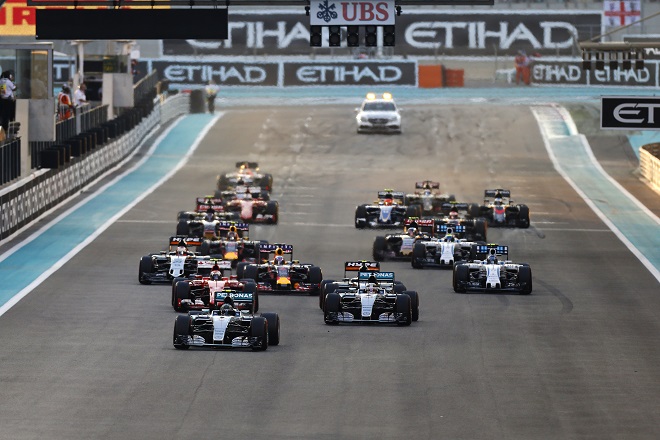
And so it follows that the races we have come to remember over recent years have been the ones that have not stuck to the script. So we ask once again how the shift in the story occurred. And more often than not, the root cause raised its head in qualifying. Sometimes a team got its sums wrong and failed to send its driver out at the right moment, relegating a favorite to the back of the field. Once or twice, a quick driver pushed too hard too early and binned it. Perhaps a technical problem reared its head as the quickest man of the weekend to that point saw his brakes or engine explode. Sometimes weather played its part and gave us a jumbled-up grid.
In each event, the ensuing race held our interest because those we expected to see at the front were, instead, forced to fight their way through from the back of the field. More often than not the race result would be nigh-on as one would have anticipated simply due to the fact that over the course of 300-odd kilometers, the competitive order tends to shake itself out. But the manner in which we got there left us enthralled.
Ecclestone arrived at this week's rules meeting with a master plan of time ballast. Starting with the championship leader with the largest lump of time (believed to be four seconds) and working backwards with incrementally diminishing time penalties, each driver would have a time added to his fastest qualifying lap in order to give us a grid. Convoluted at best, it amounted to negating the very point of qualifying. One might just as well have started the race in reverse championship order and have been done with it. But such a concept has never sat well with the traditionalists. Apparently, reverse grids are just too contrived.
A few years ago, over a few glasses of red wine and some rather fantastic steak at The Meat Company restaurant in Manama, Bahrain, some colleagues and I debated this very topic. A jumbled-up grid, we ascertained, was the genesis of almost every truly memorably exciting race we could pick out from the past few years. With that as a starting point, how could we reach such an eventuality without making qualifying itself meaningless? How could we keep interest in the one-hour slot on a Saturday afternoon which is so important to the global televisual market, while not taking anything away from the race itself?
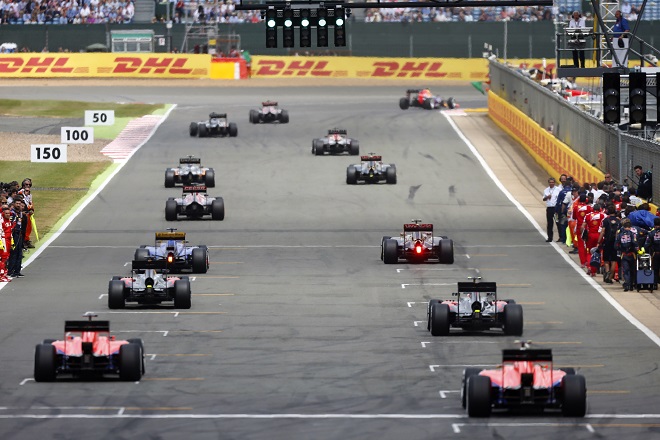
We would start a 22-lap race in reverse championship order and at the end of each lap eliminate the driver in last place. The onus would be on the faster cars to make swift progress through the field, because the grid would be set from the order in which cars were eliminated. First driver out would start last, and so on, until just one driver was left in the lead, to take pole.
Our concept, we thought, would keep interest in Saturday afternoon and crucially would give us the jumbled-up grids which we had agreed was the genesis of exciting races.
But we had a problem. Saturday's action would be a qualifying race. And again, for purists, Sunday's actual Grand Prix should never be simply one of multiple races. It has to be the only race.
What the Strategy Group has agreed, and what I truly hope is put into effect for 2016, keeps qualifying as qualifying but takes the main points of what we dubbed "The Meat Co. Accord" in order to provide the possibility of a mixed-up grid.
Factor in also that despite Pirelli's new tire regulations for 2016 promising multiple strategies, the reality seems to be that almost every team will opt for the same or a very similar allocation of tires at each event. If qualifying becomes an eliminator, the tire choice for the teams may have to shift slightly in order to factor in the new requirement of when to be fast and the fact that getting one's sums wrong in an eliminator now has accentuated ramifications.
The opening minutes of qualifying sessions will become a free-for-all. There will be no sitting in the garage, no dithering. Low fuel runs, the softest tires available, every lap counting. It'll be bedlam. It will be brilliant.
And yet, much of the fan reaction to the move has been negative. Given the undesirable light into which the first day of testing was thrust, it should perhaps have come as little surprise that so much of the reaction to this potential change has been similarly adverse.
"Qualifying was the one thing that worked," came the comments from the twitterati. "Nice work F1. You've messed up the one thing that didn't need touching." "If it ain't broke, don't fix it." Etc.
But if the reality of qualifying was that Mercedes started almost every race over the past two years having locked out the front row of the grid en route to recording another 1-2 finish on Sunday, while those behind often finished in relatively the same order in which they had started, is a change in qualifying really such a bad idea? It doesn't take too great a leap to conclude that predictable qualifying begats predictable racing.
In my time of loving Formula 1, both as a fan and for the past 15 years as a journalist and broadcaster within its paddock, I've seen multiple qualifying systems. From the unlimited Friday and Saturday sessions to the 12-lap restrictions, the one lap specials, qualifying on race fuel to various versions of the current three-part quali. So the supposedly purist arguments of thinking about the history of the sport, the records and how things should be simply don't hold any water for me. Senna's quali record was beaten long ago under a qualifying system which never made any sense. And as drivers will always tell you, it doesn't really matter because no points are awarded on Saturday.
We should be saluting this proposal for change, not dismissing it. Three-part qualifying has always been about elimination against the clock. This proposal simply ramps up the pressure.
While we must not over-emphasize the potential for shaking up the order in that the fastest cars are still going to be the fastest cars, the proposed qualifying system ensures a thrilling hour of qualifying on Saturday where the slightest mistake and the smallest of margins could result in at least one real shock every weekend. Probably more.
We are all guilty of jumping on the sport and giving it a damn good beating every time its decision-makers do something stupid. Sadly, in recent years, both we as the media and you as the fans have been granted far too many opportunities to give them, and by association the sport we love, a good slap.
But in this case, I think they've got things just about right.
I hope, beyond hope, that this proposal is approved and implemented for 2016. A little bit of unpredictability could be the magic bullet we've been searching for.
Presented by:


Latest News
Comments
Comments are disabled until you accept Social Networking Cookies. Update cookie preferences
If the dialog doesn't appear, ad-blockers are often the cause; try disabling yours or see our Social Features Support.