INDYCAR: Series increases engine lease price limit
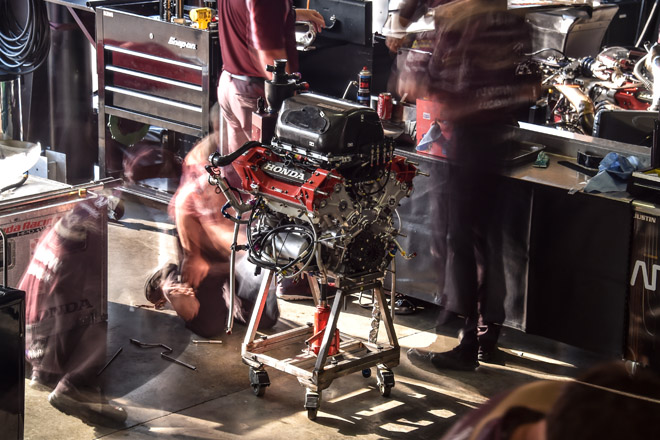
A change to the 2016 pricing structure set by the Verizon IndyCar Series will allow engine suppliers to charge up to $1 million per year for an engine lease. The previous limit was $750,000. The $250,000 hike is included in new multi-year supply agreement between IndyCar and Honda, and has also been applied to Chevrolet's agreement with the series.
Under the series' most recent sole supplier pricing structure in 2011 with Honda, teams paid $1.1 million per lease. The move to new turbocharged engines in 2012 came with a significant reduction in lease price as $649,000 became the new norm. Due to the higher costs from a proper engine war between multiple manufacturers, Chevy and Honda reportedly lost almost $500,000 per lease, and even with the increase to $750,000, the losses were significant.
By moving to the $1 million mark, it's possible the costs to supply the IndyCar field have been tipped closer to a break-even point for each brand.
"I don't think the engine manufacturers are being greedy," GM Racing director Mark Kent told RACER. "I think if you look back at IndyCar history, teams were paying in excess of $1 million a year for a spec engine when there was only one manufacturer in the series. I think the rates that are in place for 2016 are fair, especially to the manufacturers who have to look at the return on investment. So anything you can do to either increase the revenue coming in or decrease the expenses going out is all directionally correct for not only manufacturers in the series, but also it's more attractive for new manufacturers to look at the series. [It's] definitely a step in the right direction."
Honda Performance Development vice president Steve Eriksen echoed Kent's sentiment.
"I think you just have to look back at historical numbers," he said. "If you look at what engine leases used to go for, and then we went to sole supply from 2006 to 2011, we were very aggressive in trying to bring the cost down and brought the cost down quite a bit [in 2012]. But even in the sole supply era, the lease price was higher than last year's lease price. So if you did a projection of what lease prices were before the sole supply era and you carried on to what maybe it should be today, we are a long ways off."
In an era where many IndyCar teams struggle to find adequate sponsorship, the lease increase was not met with universal praise by team owners.
"We understand, we know that, but there is good reason for [the increase] because the economic environment doesn't support those kinds of [lower] lease prices, just in the same way the sponsorship isn't as plentiful as it once was," he added. "There's a number of economic factors why the lease price is artificially low and subsidized. It is really to try to grow the sport. The lease price change that the series put into place is a change in the maximum, it doesn't mean that everybody is paying that price."
As Eriksen stated, although IndyCar has increased the maximum amount manufacturers can charge per lease, the minimum price, which is said to be $750,000, provides some flexibility when it's time to decide on a final number. It gives Chevy and Honda the option to work within a range that could be influenced by the competitiveness, effort, or strength of relationship with each team. Simply put, some IndyCar teams might pay the bottom number while others pay the full premium.
"That is correct," Eriksen said. "It is at each manufacturer's discretion of what they charge an individual entry within the limits of what is established by IndyCar. I think a big part of the [final price] is certainly you see the programs that are really investing a lot in R&D and personnel and things like that as a promising activity. You want to try to help those activities, so you can use [lease price] as an encouragement. That is what we like to see."
Presented by:


Latest News

Comments
Comments are disabled until you accept Social Networking Cookies. Update cookie preferences
If the dialog doesn't appear, ad-blockers are often the cause; try disabling yours or see our Social Features Support.