F1 now 'easier' for new engine manufacturers, Mercedes' Cowell claims
Mercedes' Andy Cowell claims it is "easier" now for a new manufacturer to enter Formula 1 in comparison to the old V8 and V10 eras.
Cowell, managing director of Mercedes AMG High Performance Powertrains, believes the current 1.6-liter turbocharged V6 system represents a perfect and accessible platform for new manufacturer entrants.
"The V10s and V8s were so specialist, 20,000 or 18,000rpm naturally-aspirated engines were very peculiar, just to Formula 1," said Cowell. "There were no other motorsport categories doing that, not even road cars.
"For company X, that currently sells cars around the world and is doing the efficiency and technology drive, to go 'We want to come in and compete in F1, so let's do it', is easier [with the current rules]. If we go back to 2000, the regulations fitted on one page, and now it's about eight pages, but it actually prescribes a lot of it.
"Twenty years ago you used to spend days working out what the bore size should be, or how many cylinders you should have, but now it's in the regs, so I think it's easier."
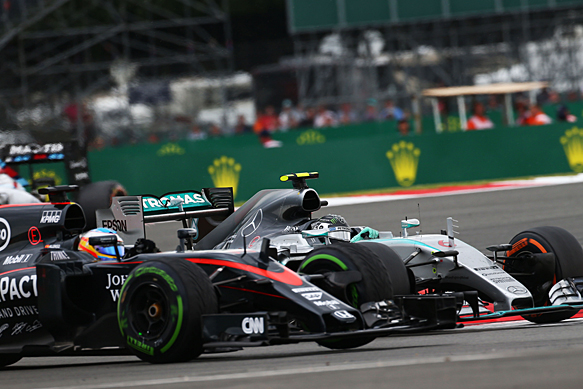
Honda entered F1 last season but endured a tough season on track with partner McLaren. Despite that, Cowell feels Mercedes' own experiences with parent company Daimler show how worthwhile F1's current package can be for manufacturers.
"We do still learn from Daimler, so those initial communication links we set up with their experts on this technology are still in place. The dialogue is two-way. We're picking up and feeding back new bits of technology. So as long as that's in place, I don't see why Formula 1, with this set of regulations, isn't interesting to all the motoring manufacturers around the world."
Cowell does not see anything in the technology required that should deter new manufacturers, despite the fact a current power unit comprises around 10,000 individual parts, compared to the old V8's 3000-4000 components.
"There's no 'unobtainium' in there, no Kryptonite. You don't need to travel to Mars," argued Cowell. "There are steels and aluminums that are used in aerospace and the automotive industry, the fasteners are unremarkable, and while the shapes are evolved, they are all shapes everybody else can come up with.
"Electrical machines are also evolved, but there aren't any magic magnets in them. They are all magnets you can read about on Wikipedia and source from three or four manufacturers around the world. The cables have copper in, the connectors are unremarkable, so it's all doable.
"Do you need to get yourself set up with the right group of people that have the right ambition and attitude? Do you need four or five dynos, some machines and to connect with some of the key suppliers? Yes you do, but it's not impossible. And I think it's easier to do than it was in the V10 and V8 era."
Presented by:


Latest News
Comments
Comments are disabled until you accept Social Networking Cookies. Update cookie preferences
If the dialog doesn't appear, ad-blockers are often the cause; try disabling yours or see our Social Features Support.