FE: Driverless designs ready soon, Agag says
The design of the first driverless car to be used in the new Formula E support series Roborace could be revealed as early as next month.
Roborace's launch included a plan to put on one-hour races, held on the same circuit as Formula E races in each city, with 10 teams entering two cars. Formula E CEO Alejandro Agag said the exact format has yet to be finalized.
"I think some details will probably transpire in February or March," he said. "First the design of the car, then the detail of the races – how long they are, things like that. And then hopefully a prototype should be ready in 10-12 months."
Roborace's debut was tipped for some time during Formula E's 2016-'17 season when it was launched in late November 2015. But with a prototype not due until the end of 2016, that could be delayed.
Agag believes it is important for Formula E to encourage such technologies, and although he has insisted it will not become driverless itself he has expressed an openness to autonomous technology being adopted by the championship.
"Maybe the cars going to the grid on their own is a possibility, or other elements," he said, "but not the main element."
OPINION: Will it add to the show?
Scott Mitchell, Formula E reporter
One of the biggest question marks over Roborace is the type of car investment company Kinetik, which is behind the initiative, opts for.
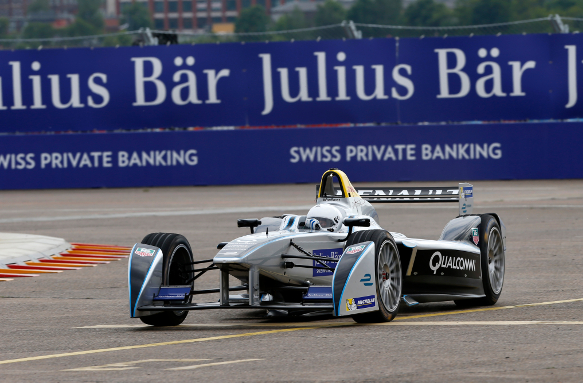
Formula E is based on a conventional open-wheel racecar and while it is feasible for the current Dallara-built chassis to be adapted, it is highly unlikely this will form the first Roborace machine.
As it will be driverless, the car does not need a seat or a rollhoop, and while it will need space for the battery it has quite a lot of design freedom. That means its final form will likely depend on how Kinetik wants to market the series. Will it be a little touring car? Will it be life-size? Will it be closer to a remote-control racer? Whatever it opts for, FIA boss Alejandro Agag seems hooked.
"I've seen some designs," he said. "They look really cool."
Once we have a clearer picture (literally) of what Roborace will be, and we have a better idea of when exactly the cars will be ready to race, the anticipation will switch to performance and how the cars behave on track.
If they are small, the show could be quite something. Especially as on paper, creating algorithms that make a car follow an optimal line and proceed at optimal speeds, and thus result in a quick lap time, isn't the stuff of science fiction. But what happens when you have 20 cars unable to follow an optimal line? What happens when the cars convene on the first corner in pack for the first time?
There are many, many questions remaining over Roborace. But the first answers do not seem to be very far away.

Latest News
Comments
Comments are disabled until you accept Social Networking Cookies. Update cookie preferences
If the dialog doesn't appear, ad-blockers are often the cause; try disabling yours or see our Social Features Support.