How JR Hildebrand and a virtual IndyCar might change the world
The IndyCar rulebook is a land of tight technical restraints. Paradoxically though, the paddock is developing into a wellspring of potentially game-changing technical and engineering innovations. In this third in our series, RACER takes a look at some of the groundbreaking STEM (Science, Technology, Engineering and Math) programs being developed within IndyCar's orbit.
JR Hildebrand reaches into a black backpack and pulls out a Samsung smartphone and a virtual reality kit. And in that simple act, he shows how far immersive technology has come over the past few years.
Virtual reality is on the verge of becoming the next technological achievement to make the transition from bad 1980s sci-fi films to suburban living rooms.
Industry leader Oculus – which was bought by Facebook for $2 billion two years ago – has just started taking pre-orders on its much-anticipated Rift VR system, which will feature a virtual reality headset with microphone and speakers, along with Xbox One sensor and controller compatibility. For $599, you can have a world-class VR system hooked up to your computer at home - provided that your PC is powerful enough to handle the graphics.
At the lower end, the GEAR VR system will plug straight into a Galaxy phone. And at the most rudimentary end of the spectrum, this author recently received a Google Cardboard VR viewing device as a free insert with a magazine.
Virtual Reality has become, well, reality. Or more specifically, it has become a commercially-viable reality, scalable for a mass market. And while it stands to huge impact on the gaming world, there are plenty of other people looking into other places that the technology might be able to gain a foothold.
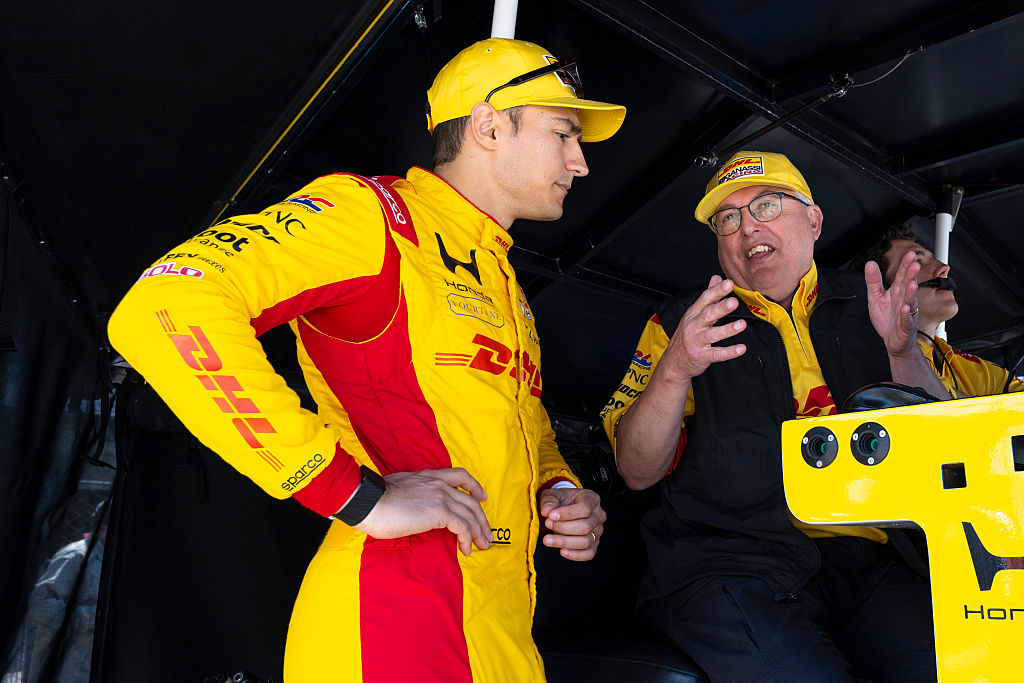
Anyone who knows Hildebrand (LEFT) will not be surprised to learn that he is one of those people. This is a guy who graduated from high school with a 4.12 GPA; who received offers from UCLA, UC Berkeley and Massachusetts Institute of Technology. He turned down all of those offers to become a racing driver, and nearly won the Indy 500 at his first try. Hildebrand is one of those annoyingly capable people that make you feel like they would pick up a guitar for the first time and accidentally hash out the main riff from Jane's Addiction's 'Mountain Song'.
While many VR projects have used the technology as their starting point, Hildebrand has been integrating it into a program that he has been occupying most of his non-racing time over the past couple of years. Essentially, it's about using motorsport – and IndyCar in particular – as a way of demonstrating the real-world value of math and science for high school students.
"Part of this is based on my own educational experience," he says. "I had a unique educational experience as far as race car drivers go in that I started racing a little later, so I was really committed to my education in high school before anything got serious enough to the point where I was juggling my commitments.
"I was on AP [Advanced Placement] Honors math and science classes, and once I got to that stage I realized how relevant the stuff we do day-to-day at the track is to the stuff that students are learning as part of curriculum-based math and science. I mean, I took BC Calculus as a senior in high school and I was one of only a handful of kids [from that class] who even considered applying to college in an engineering field. And I felt that was out of whack if all of these really highly-motivated math and science students aren't seeing the light in terms of there being a career path and a real relevance to the subject matter down the road. So I had the experience while I was in school of seeing how the context of what was happening at the track was relevant, and a lot of other kids didn't.
"And also, while I was racing with National Guard sponsorship at Panther, I became more aware of this as a nationally-recognized issue. The number of home-grown engineers graduating with degrees from U.S.-based colleges has been on the decline for quite some time, and that's a big issue in itself. And in addition to that the performance in math and science at the younger levels – middle school, high school – really wasn't stacking up against the international numbers."
Right from the beginning, Hildebrand recognized that the only way he was going to be able to get the sort of content that he'd envisioned into classrooms on any sort of meaningful scale was to ensure that it was based on low-cost, accessible technology.
"There was always a focus on looking at the tech space generally; looking at smart phones and the types of technology that we perceive to be in normal use on a regular basis," he says.
"And then that, as we started digging a little more into that, VR was becoming a bigger part of the landscape, so we decided that in a way, just because it was the most cutting-edge thing available and presented some different opportunities to visualize and experience content, that's was kind of our jump-off point in terms of that phase of development.
"As a type of technology, VR has just reached that cusp of where it is becoming consumer-available. Sony, HTC, Samsung ... every couple of months another big tech firm is coming out with their VR hardware and software. It's been around for 15 or 20 years or whatever, but up until now it seemed like a very Star Trekky-type thing to people. It's just now reached that catalytic point where you're starting to see it pop up all over the place."
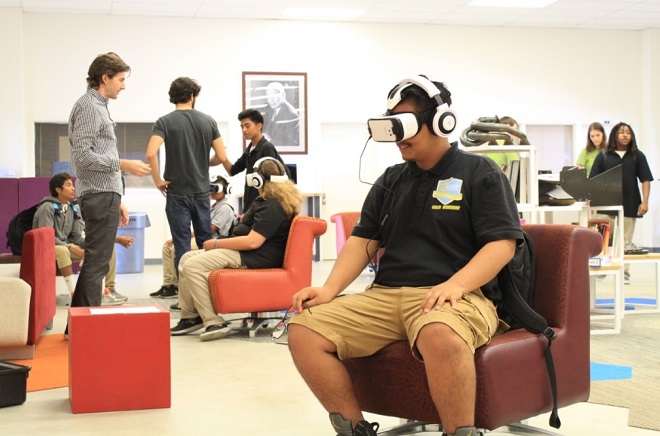
"VR promotes the best and probably only strategy that allows students to learn from non-symbolic first-person experience. Since a great many students fail in school because they do not master the symbol systems of the disciplines they study, although they are perfectly capable of mastering the concepts that lie at the heart of the disciplines, it can be concluded that VR provides a route to success for children who might otherwise fail in our education system as it is currently construed."
Subsequent studies highlighted that the technology allows students to learn at their own pace, and have demonstrated that lessons delivered in a VR environment hold students' attention for substantially longer periods than conventional classes.
So the theory behind Hildebrand's VR emphasis is sound, but that's of little value if he can't deliver his program in a way that teachers can easily integrate into their classes. One of his priorities right from the start was making sure that his material was completely compatible with current curriculums.
"Education is a very structured system, which at times makes it difficult to penetrate and implement something," he says.
"It's not a particularly flexible system as it stands right now. I mean, there's a lot of reform and movement to change that, because I think it has been realized that that is maybe part of the problem, particularly as the world around the education system changes so rapidly in terms of technology that the system can't keep up.
"I also looked at that as just part of the challenge. When I became introduced to the space and decided to start looking at what I could do and how IndyCar and motorsports could fit in, the immediate challenge that I took on was, can we create something that's 'plug and play' in the current system?
"We didn't jump into it and say, 'We're going to make this awesome tech-based stuff that's going to be the craziest and most awesome thing you've ever seen – here, figure it out.' We realized that we have to create that strategy for how to make it fit into the existing system. It has definitely presented a challenge. But since we were aware of it going in, it has played a role in how we develop everything that we've worked on."
So when a student puts on a VR headset and prepares to enter Hildebrand's world of IndyCar-science-awesomeness, what do they actually experience? The current demo version of the program has three parts.
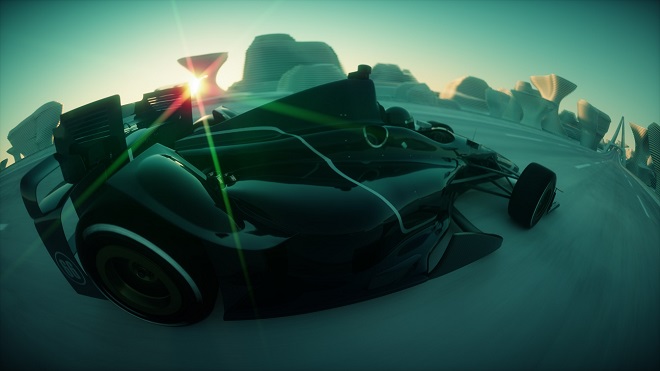
"The idea is that the student would be able to get into the VR headset, they'd have different units from different topics that they could choose from that we would pull from existing units in a physics curriculum at a ninth-grade level.
"So they would be things like ... what we have demoed is forces, so we talk about things like downforce, airflow over the car, how those forces are generated, how they relate to gravity, how they impact the performance of the vehicle. Thermodynamics would be another one, talking about heat and energy, around the fuel that goes into the car and into the engine. Energy as a singular topic – velocity and acceleration, momentum and impulse ... those things are all physics units at basically any level.
"You'd pick one of those units, you'd be introduced to a curriculum-based topic from that unit, learn about that topic, and having learned about the topic, be presented with a performance-based challenge. So, we need the car to do X, Y or Z, and you'd have to manipulate the engineering of the car, so we would pose some different options for you to change something on the car. As it relates to forces, we'd say we need an increase in downforce, and you'd have to decide what wing angle to put the car at, and then we'd see the result of your changes in action. Then you'd come back out, go into a different unit, learn something else, try something different, see how that responds.
"It's basically trying to recreate a clearer and simpler version of what is a very complex engineering scenario at the race track, as it relates to curriculum-based topics straight out of the textbook. For how that would exist in a classroom, we would also be developing low-tech materials around that to ensure that it's easily implemented."
The demo has been designed primarily as glimpse into the concept and a hook for potential investors rather than something for students to sample, although it has been tried out in some schools in Los Angeles.
"We've run it in a few classrooms, had a bunch of kids in it, had a bunch of teachers in it, and the reception is resoundingly, 'This is an awesome way to learn,'" says Hildebrand.
"And that's certainly been the reaction that we're looking for. We have confidence that we can create a real tool and an implementation strategy. That's not what the demo itself was, but we're already getting really good feedback just on that. It will take some design and strategy to make sure that we can get into classrooms and make it something that's usable for teachers and students in a meaningful way, and isn't a gimmicky extra piece that's distracting from people getting through their normal lesson plan."
Finding that balance is key: the game-like feel of VR is directly linked increased attention levels and content engagement from students, but that's only productive if all of that immersion translates into them having actually learned something at the end of the lesson.
"If we increase the immersion in the content, we increase the attention level," Hildebrand says. "If we increase the attention level, we're increasing engagement. And if we're increasing engagement, hopefully we're increasing the level of investment in the content itself.
"That's where we start to see these types of technologies being capable of changing the amount that students are getting from their content, from their lessons and from their experience. At the end of the day, if we can't do that with technology then maybe there's not a place for it in the classroom. If getting to that stage is a major hassle and there's just as many distractions or whatever then the teachers aren't going to use it and it isn't going to be something that works. So that's why we looked at VR as potentially being a game-changer there, because it does answer a lot of those questions."

"IndyCar is part of my narrative; it's part of my story," he says. "And also, it has been very closely based on hard data from the track, and I obviously have better access to [IndyCar data] than I do to anything else. As we move forward there are a variety of directions that this thing can go, but right now it's IndyCar-focused, and I'd be happy to keep it that way."
Aside from making his program work within existing school environments, the other main challenge that Hildebrand and his team face lies in the current limitations of VR technology. While the VR world is gaining momentum, it is still a relatively young technology, and there is still scope for development. In a way, Hildebrand's position as one of the pioneers for finding mainstream VR applications outside of gaming makes his project as valuable to the nascent VR industry as the industry is to him.
"The visual quality of what you can create is of a higher quality than the interactive quality of what you can create right now," Hildebrand says. "That's lagging a little bit on that side.
"But we have a real purpose for why we're using VR and what we're doing in the space, and the fact that we can create specific use cases around VR being better technology is an exciting thing to people. We have a lot of interest in it, not just in the STEM and motorsport and education communities, but also on the industry side. We're very motivated to turn this into a really legitimate, ongoing project."
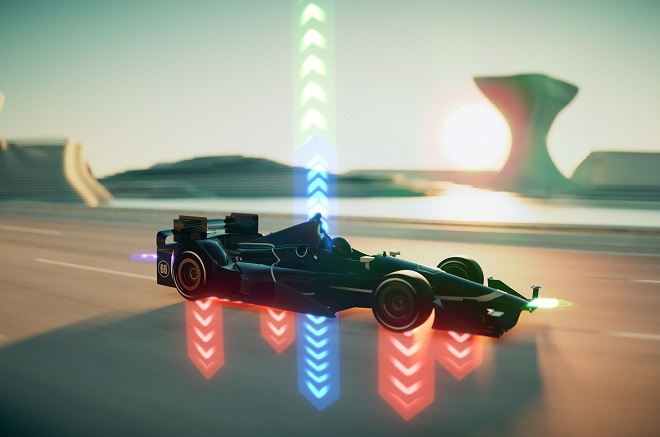
If Hildebrand has his way, a virtual version of the DW12 IndyCar could potentially inspire an entire generation of new engineers, and in the process, millions of students who might otherwise have never even heard of an IndyCar could spend their lessons making minute wing adjustments in the quest for a perfect virtual lap at Indianapolis.
While the DW12 produces better racing than any other open-wheeler on the planet, it's not going to be remembered as a technical trailblazer. And yet it here it stands: the centerpiece of an idea that might end up revolutionizing the way that high school kids learn science.
Presented by:


Latest News

Comments
Comments are disabled until you accept Social Networking Cookies. Update cookie preferences
If the dialog doesn't appear, ad-blockers are often the cause; try disabling yours or see our Social Features Support.