Why Grace Autosport is about more than gender
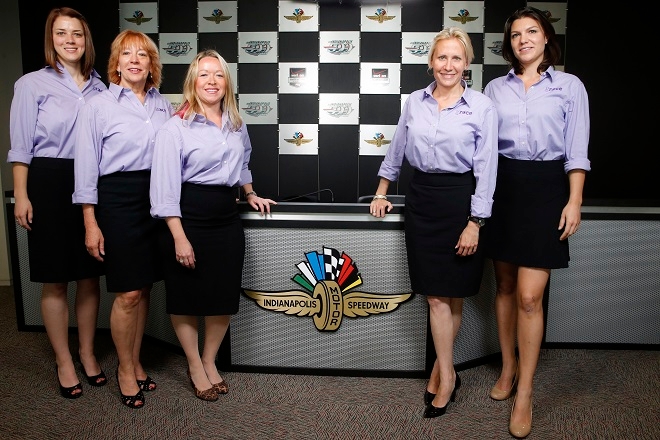
ABOVE: At the Grace Autosport introduction – engineer Jessica Rowe,
communications professional Barbara Burns, aerodynamicist and engineer
Catherine Crawford, Team Principal Beth Paretta and driver Katherine Legge.
The IndyCar rulebook is a land of tight technical restraints. Paradoxically though, the paddock is developing into a wellspring of potentially game-changing technical and engineering innovations. In a series of features, RACER takes a look at some of the groundbreaking STEM (Science, Technology, Engineering and Math) programs being developed within IndyCar's orbit.
Grace Autosport knows what it is up against.
Fielding a competitive car in the Indianapolis 500 is a heck of a challenge for any team, never mind one comprised of people who have never worked together before. Finding the money? Hard. Securing a good technical partnership? Hard. Navigating the whole thing through the month of May? Hard. When it's time to roll up the sleeves in Gasoline Alley in a few months, the last thing anyone on the team will be thinking about is the X/Y chromosome count on the pit wall.
But it's going to be an intense point of focus for many on the outside. And not only is that cool with the Grace crew, it's entirely by design. Spearhead Beth Paretta, who formerly headed marketing and operations for the SRT Motorsports program, does not need to be told that an all-female IndyCar team is going to be a conversation point. That's why she's doing it.
Paretta announced her plans for Grace Autosport at IMS in May, when she laid out a vision for an IndyCar team with women holding all of the senior technical, engineering and management roles. (And driving the car, with Katherine Legge (LEFT) having already being secured for her third appearance at Indy).
The whole thing is propelled by a bunch of stats like these ones: despite roughly equal numbers of males and females taking math and science classes in high school, U.S. Department of Labor statistics indicate that female workforce representation in electronics engineering and mechanical engineering stand at just 8.3 percent and 7.2 percent, respectively. Paretta hopes that Grace Autosport will open more females to the possibility of pursuing a STEM career.
According to Paretta, the main barrier is simply one of perception. There's no system of institutionalized sexism preventing women from taking following STEM careers, at least where motorsport is concerned: look at Chevrolet's NASCAR program manager Alba Colon, or Audi's three-time Le Mans-winning race engineer Leena Gade, or former Mercedes F1 aerodynamicist Valerie Diederichs (who has since left racing to start her own business), or Antonia Scott, who has worked as a mechanic for several F1 teams.
The problem is that most of these roles are invisible to the public. Grace Autosport hopes that branding itself as a "female team" will give young women exposure to potential career paths that they might not have considered otherwise.
"We know that there are other women who are in racing," Paretta says. "It's 2016; it's not like it was 10, 15 years ago. There are women in lots of places, and they've been holding those positions for years.
"[But] the average fan doesn't know that, so when we're putting this team together, we're getting women who already have experience, and putting them all on the one team together creates this strong visual. Women are already here and doing this; we're not just taking people off the street and teaching them how to be on a race team. But I think that visual will be very powerful. The other thing that happens with racing is that women can be side-by-side with men without it having to be like the WNBA. So that's a nice bonus.
"I have to figure out how to say this politically-correctly. I think there are some women drivers who get seats because they are women. You'd be harder-pressed to say that a female engineer got her job because she's a woman. Being a woman didn't enter into the equation. We got the jobs because of our ability and experience.
"So I don't think there are any particular barriers right now. It's more that women don't know that it's an option. So while we're using racing as the sizzle, the story is broader and it's that women can work in technical careers."
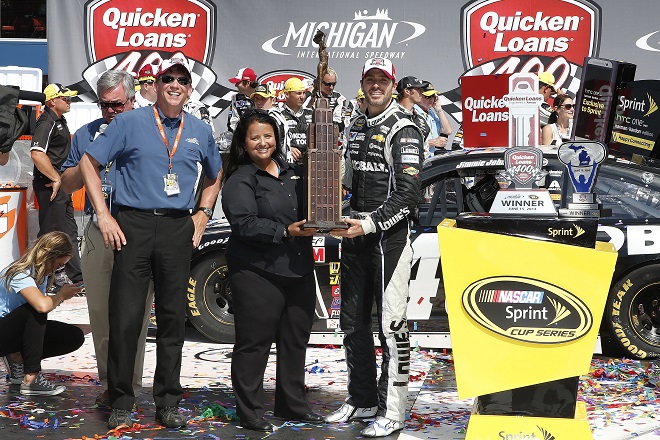
Colon did not have an engineering role model when she was growing up. Her childhood ambition was to become an astronaut like Sally Ride, who became the first American woman in space when she flew as a member of the Challenger crew in 1983. But she agrees with the need to bring STEM careers out of the shadows for women.
"People need to see somebody that makes them think, 'I can be that someday. I can emulate that,'" says Colon. "I've been to many schools and talked to young girls, nine, 10 years old. That age is when they are starting to get an interest in different careers, and I can say, 'Hey, you can be this someday.' It helps. They never realized before.
"It's amazing how many things young people don't realize exist until they start to see examples of some of them. With racing, they usually only see the drivers. They don't realize at that age how many people are in the background to make things happen. That's what's good about programs like Grace Autosport. I've learned from my own experience that the younger you can reach these girls and the earlier you can give them exposure to these possibilities, the better."
LEFT: Beth Paretta representing Grace Autosport at the recent Society of Women Engineers WE15 Expo in Nashville. Photo courtesy of Grace Autosport.
The "get them young" angle forms a core part of the Grace Autosport strategy. Paretta is primarily targeting fourth and fifth-graders ("the most influential time for career trajectory, for both girls and boys, is age 10"), and is in the process of finalizing a partnership with at least one high-profile program geared toward getting girls involved with coding. Grace Autosport will also be working with Discovery's Education division to produce content that will be watched in classrooms. When you consider that that material will reach 38 million students, it becomes easy to see how a project like this could open doors to potential sponsors that might otherwise remain closed.
"We get calls back," Paretta says. "People answer the phone. I'm not sure that happens for every team. Regardless of whether they say yes or no, at least you can get a call back or a meeting that you might not have otherwise had."
Schmidt and the Arrow SAM Project
might be the only exception – it has largely cornered the market on the STEM storyline as well. Tapping into sponsors that could derive value from an association with either of those fields offers opportunities far beyond merely trying to sell someone on the chance to see their logo flash past a hospitality unit at Indy.If there is a downside to a program like this, it is the fine line that divides being a unique and being a gimmick. Paretta is acutely aware of the danger that some outsiders could dismiss the entire team as an example of tokenism gone mad.
"I was very conscious of the messaging, even in the way that the original press conference was worded," she says. "We know that there is going to be extra scrutiny. People are going to expect you to fail. So you have to be very careful, and that's true of any new team. You're going to see us fumble. But the story is how we pick ourselves up and improve. This is going to take time.
"It's like any start-up team. Let's set your expectations. But we want to be here in perpetuity. And that's the point. And every time I've said that to somebody, it immediately puts them at ease because they realize that we're realistic, and therefore it's not a gimmick. Warts and all: 'It's going to be bumpy, do you want to come along?'"
The next big step is locking down the various partnerships needed to actually put a car on the grid. Paretta said from the start that Grace Autosport will initially work with an existing team, and she is still exploring options in both manufacturer camps.
"All along we said that we would work with an established team," she says. "Once we get our legs on us we can see what happens, but from the get-go it was always going to be with an established team. Some of the women that we are hiring are coming in from other series, so we need to have that association for education's sake, and having a page out of an existing team's handbook.
"What I will say too is, credit to the fans and credit to the paddock, because I wasn't sure how this would be received. This goes back to the point about it being a gimmick. But I already had a relationship with a lot of people in the IndyCar paddock, and everyone has been really supportive. And shame on me; I didn't really know what to expect and I didn't assume that they would be. But they have been extremely supportive and welcoming, because the smart money is, what's good for IndyCar is good for everybody."
It's roughly 20 years since the Spice Girls made the term "Girl Power" mainstream, and almost 15 years since the phrase first made it into the Oxford Dictionary, where it was defined as "Power exercised girls; spec. a self-reliant attitude among girls and young women manifested in ambition, assertiveness, and individualism." It worked for popular culture. Whether motorsport is involved or not, it's overdue in tech. And if everything pans out as Paretta hopes, then the IndyCar grid will eventually feature its first new full-time team since Ed Carpenter Racing.

Latest News
Comments
Comments are disabled until you accept Social Networking Cookies. Update cookie preferences
If the dialog doesn't appear, ad-blockers are often the cause; try disabling yours or see our Social Features Support.