PRUETT: The Linda Ludemann Rule, Part 1
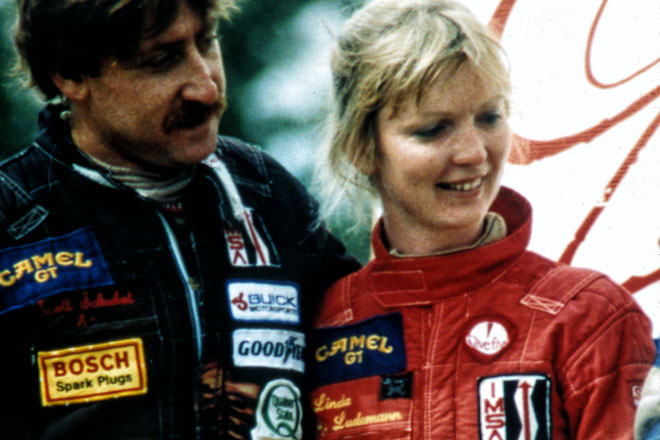
ABOVE: Scott Schubot and Linda Ludeman.
Most aspects of the original IMSA series were amazing. And yet, as with many beloved things – and IMSA's GTP era certainly qualifies – there are also a few unsavory items that are forgotten or ignored with the passing of time. One unpleasant remnant from late 1980s sports car racing in America was the "Linda Ludemann Rule," which can be loosely credited as the forerunner of IMSA's modern day driver rating system.
The use of single-driver entries became increasingly popular during the mid-80s as shorter, three-hour race lengths began to fill IMSA's calendar. With so many street races on the schedule, many teams opted to save time in the pits by eliminating driver changes. It also produced a number of individual class champions instead of having teammates crowned together, which is the norm today.
Driver changes back then were nothing like the fast, slick routines we see in modern IMSA, or the FIA WEC, and by eliminating driver swaps during pit stops, going solo with a Geoff Brabham or Davy Jones was a significant tactical advantage. Not only was the fastest driver in the car for the entire race, but precious seconds were saved on pit lane compared to the teams that continued using two drivers per car.
And while the single-driver routine led to incredible head-to-head battles between icons of the era, it also hurt some team owners who felt the single-driver trend was driving paying drivers away. It wasn't an issue at the long races – the Sebrings and Daytonas – where multiple drivers were a necessity, but the lack of second-driver income was cited as a problem by some at the other 13 events.
Up to that point, IMSA's rulebook placed no demands on using multiple drivers for its three-hour races, yet with a budget shortfall, some members of the IMSA paddock asked the series to change the regulations to include at least one mandatory driver change. In the name of business – namely protecting its driver-funded teams – IMSA complied for 1989, added compulsory driver change, and included a secondary requirement for each driver to complete a minimum of two laps.
"In our minds back then, that was us dictating how teams and business models should be," said IMSA's Mark Raffauf, who was the series' president in 1989 and explains that IMSA resisted the driver change request for a few years before finally conceding.
"[Prior to the change] we consciously did not want to be stating what that business model should be," Raffauf continued. "It was simply there was no rule. Under three hours, you could drive the whole thing yourself, and many guys did."
From that simple rule modification, owners were given the ability to sell seats and provide a reasonable guarantee – barring a breakdown or crash – that paying drivers, usually non-pros, would be part of the game.
"The basic concept was to force a pit stop with a driver change, and at that point, there was no requirement to do those two laps under green," said Marty Kaufman, who served as IMSA's chief steward during the GTP era. "Most of the teams that had two drivers had drivers who were pretty astute."
The rule change had everything to do with fostering business opportunities, but in a sport where every advantage is exploited, one enterprising team used the rule to improve its odds of winning in the three-hour races. Enter the "Linda Ludemann Rule."
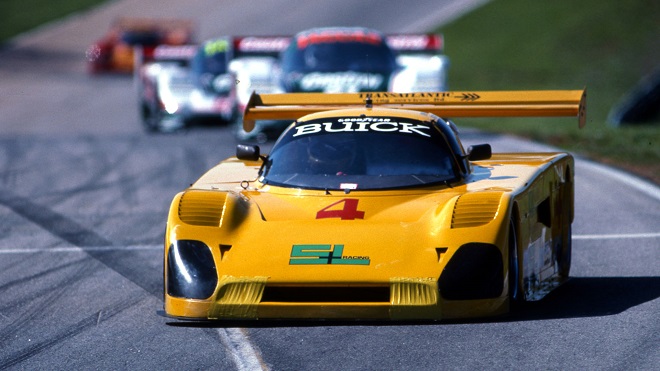
ABOVE: Schubot/Ludemann Spice-Buick
Under the S+L Racing banner, the boyfriend/girlfriend driving duo of Scott Schubot and Ludemann entered GTP-Lights together in 1987, and while they had a modicum of success, the tandem's fortunes didn't take off until 1989.
Along with Phil Creighton, owner of the Transatlantic Racing Services team that ran the S+L program, they quickly realized the rule change created something new: an incentive to minimize Ludemann's driving time. With the rapid Schubot covering the expenses, and a new loophole to manipulate, Lights racing for the couple went from a shared experience to one where keeping Ludemann out of the car for all but those two laps was the key to victory.
As Kaufman noted, IMSA failed to state when those two laps must be completed, so Creighton – a sharp strategist – waited for caution periods where he'd pit Schubot, install Ludemann for two laps under yellow, then have Ludemann pit and hand the car back to Schubot to take the green.
The routine did come with one disadvantage. As other teams made one stop for a driver change, S+L did two and gave up track position under the caution, but with the best chassis and engine package that season – a Spice-Buick – Schubot was often the fastest Lights driver on track.
Compared to some of the gentleman drivers who climbed in and spent a fair amount of time in their Lights cars, the S+L team willfully surrendered track position to game the system and reap the benefits from having today's equivalent of a pro in the car for all but two laps. From 15 rounds, Schubot captured 11 poles, eight wins, and cruised to win the Lights championship on his own thanks to the legal diminishing of Ludemann's time behind the wheel.
Ludemann was entered in the majority of S+L's Lights races in 1989 (but not all), and was credited with five wins as Schubot's teammate. Most of those wins, however, were not awarded points by IMSA. Schubot scored 223 points to capture the Lights title, yet Ludemann, with five victories to her name – more than any driver other than Schubot – placed a lowly 12th in the standings with 48 points. Why the discrepancy? Although her two-laps-and-out routine complied with IMSA's rulebook, she did not complete enough laps to score points in the final six races where she and Schubot won four times.
"Linda was also a good shoe, but Schubot, being Schubot, wanted to do most of the driving," Kaufman added. "[The rule] was an effort to equalize the Lights group and give them a way to put a second driver in. Looking back on it, without putting in the requirement for those two laps being under green, it screwed the whole thing up."
Ludemann may have lacked Schubot's outright pace, but she was by no means slow. Rather than being remembered as a skilled Lights driver, or as one of few women racing in IMSA at the time, she's best known as the personification of IMSA's short-sighted rulebook that allowed Schubot to pummel paying non-pros when they were on track. I'm hesitant to refer to Ludemann as a scapegoat; she chose to sacrifice her time in the car and her reputation to aid Schubot, but I'm semi-confident she and Schubot could have won the title without playing games.
At the time, teams that needed to keep its slower, paying gentleman drivers in the car for greater portions of the race were less than pleased with S+L and Transatlantic, and even IMSA, which has always been big on downplaying its mistakes, could not entirely avoid the topic in its official 1989 yearbook.
Although it was rather vanilla in its tone, I couldn't help but laugh at the understated entry that read: "Schubot and Ludemann's crafty pit strategy was the focus of much attention during the hard fought 1989 [Lights] campaign." As my father was fond of saying, "No sh*t, Sherlock."
Fast forward to 2015, and the Ludemann Rule made a surprising return at IMSA's season finale.
IMSA's GT Daytona Drivers' title was on the line at Petit Le Mans, and due to the silly FIA driver rating system IMSA chooses to use, and the rules it writes to specify how many pros and non-pros are required in each car, Scuderia Corsa's Bill Sweedler, a non-pro, who also funds the program, was allowed to complete a single lap (in a race that almost lasted eight hours), which satisfied the minimum drive time regulations.
With full-time pro driver Townsend Bell (LEFT, with Sweedler), and pro driver Jeff Segal (who was mis-rated by IMSA as an amateur) drafted in to share the car for the finale, IMSA's driver rating rules allowed Bell and Segal – we'll call them B+S – to turn back the clock to 1989 and take a page from the S+L playbook.
Like S+L, B+S followed the rules implicitly, gamed them to perfection by using Segal, its fake amateur, to displace Sweedler, the team's real amateur, and kept Bill out of the car for all but one lap of Road Atlanta. The rest of the GTD teams weren't as fortunate, and had to use their slower non-pros for longer stints. Once the checkered flag waved, Bell and Sweedler were crowned IMSA GT Daytona driver champions.
26 years after it fell victim to the Ludemann Rule created by old IMSA, new IMSA allowed itself to be duped by a perfectly legal piece of driver rating B.S. by B+S.
S+L would have been proud. And it's going to continue happening until IMSA has a Come to Jesus meeting with itself.
(For the sake of clarity, I know it's the FIA's system, but IMSA chooses to use it instead of controlling its own destiny, so I'll refer to it as their system going forward. And while diehard fans may know all about the current system, it's worth quickly covering the basics for those who are learning about the endless intricacies in sportscar racing.)
New IMSA created a matrix in the rulebook where it lists the required number of non-pro drivers in each of its GT Daytona and PC entries. It also lists the maximum number of pros that can drive with them. To formally separate (and designate) pros and non-pros, IMSA takes its entire field of drivers and subdivides them into four classes: Bronze and Silver for non-pros, and Gold and Platinum for pros.
The rating system methodology itself is contained within a 1987-word document penned by the FIA, and each of the four rating levels comes with a mix of specific list of criteria (age, success, which series they've driven in, recent championships, length of time since a major win, etc.). The system also has judgement-based areas that are used to assign a Bronze, Silver, Gold, or Platinum, and once the specific and opinion-based criteria are reviewed, a rating is assigned.
The final step from IMSA involves establishing the minimum amount of time a non-pro must drive in order to score points, and for his or her car to be scored at each race. The ratings system, and the accompanying pro/non-pro matrix, along with the minimum driving time specification, was devised to create space – guaranteed space – for non-pros in the sport. The system was also brought to life to help GTD and PC teams which, for the vast majority, rely on funded non-pros to stay in business. Although there is nothing in the rules that says a non-pro must pay to drive, it's an assumption – and also the reality in most situations.
In 1989, IMSA took its first stab at stoking the driver market by forcing a driver change, yet left it up to its teams to decide whether they wanted to place two pros in the car, or seek a paying driver to partner with the pro. For the teams that could afford it, two pros were paid to drive. It still allowed teams to take on a paying second driver, but as long as wealthier teams could hire two pros, teams needed that non-pro money were at a competitive disadvantage. For some, taking money from a slower driver to keep the team afloat was more important than winning, and money changed hands accordingly.
Just like the old days, most of the teams in question are owned by small businessmen and women who rely on paying non-pros to survive. The big change from 1989 to now is IMSA has written its rules – using driver ratings as the principal tool – to eliminate (or at least drastically reduce) the competitive disadvantage. And that's not a dig at those drivers; there are some non-pros who are quite quick, but few would be mistaken for the hired guns that set track records and dazzle fans with raw speed.
Today, the rules prohibit GTD and PC teams from hiring all-pro lineups, and by guaranteeing each car has the same minimum number of non-pros, IMSA has engineered a form of competitive driving balance in GTD and PC. The veracity of the system, however, as we've come to learn, is only as strong as the accuracy of those driver ratings.
Just as GTP-Lights teams found in 1989, and GTD teams were reminded of two months ago at Petit Le Mans (ABOVE RIGHT), IMSA's driver rating system can be manipulated. Drivers can be given the wrong rating – most notably with Segal-esque situations where a pro is given a non-pro classification, and it puts teams using genuine non-pros at a clear disadvantage.
And then there's the more familiar situation where pro-caliber drivers are given non-pro ratings because the rating system, or those making judgement calls on the rating review board, decide they should be downgraded.
IMSA's GTD and PC classes contain quite a few pro drivers who are mislabeled as non-pros, and as we've experienced since the preliminary 2016 driver ratings were revealed in November, and once more last week when the final ratings were released, the system is still highly flawed.
my first piece on the problems and possible fixes to the driver rating system
, a rating change can put people out of work overnight. Inaccurate ratings also diminish the integrity of any series that uses a system it knows is failing to achieve its purpose.The buzz since the final ratings were made public has been to ban them altogether. IMSA only introduced ratings in 2014, and those inside the sport continue to call on IMSA to take its driver rating system, drop it into a Viking funeral ship, set that sucker alight, and let it sail from the shores of Daytona Beach. I've said it, drivers have said it, team owners have said it, and frankly, most I've spoken to in the last two seasons have shared the same opinion. Granted, you won't find universal agreement on the subject, but the "for" column has plenty of space left while the "against" column is overflowing.
Knowing that IMSA has no intentions of abandoning the system – at least in the short term – I'm left to look into the one area I believe has eluded IMSA's decision makers. Why does the system exist?
While contemplating IMSA's driver rating system, I can't find a tangible, legitimate problem it solves. The problem it needs to fix is nowhere to be found. I know answers have been given for its existence: It safeguards paying non-pros from being marginalized – from getting the Ludemann treatment. And yes, it's also supposed to create business opportunities for teams.
But are we to believe gentleman drivers were preyed upon for decades until the rating system was created? Or gentleman drivers didn't know where to find teams to spend their money? And sports car teams that rely on funded non-pros only sprang to life for the first time two years ago? It's as if IMSA, which was formed in 1969, suffers from a wicked case of pre-2014 sports car amnesia.
Along with all the things we've discussed so far, IMSA also saw the value in adopting FIA driver ratings to align itself with the co-organizers of the 24 Hours of Le Mans and WEC. The thinking went: Le Mans requires its drivers to have ratings, so if IMSA drivers want to race at Le Mans, let's make it easy and rate them here. The FIA already had a system in place where IMSA drivers – or any drivers throughout the world – could apply for ratings.
There was no need for IMSA to implement the system in America, but it did. Completing the introspective theme, adopting driver ratings solved no known problems and answered a question no one was asking.
"I'll give you a good example," said veteran IMSA team owner Alex Job, who fields entries for paying non-pros and pros. "Back in the '90s, there were no driver rating systems. Throughout the '90s I had customers, even Charlie Slater, who at that time owned IMSA, who raced for a championship. We raced with the [non-pro/pro] lineup and raced for a championship, we did it again in 1999 with Darryl Havens, and it was done for years in Grand-Am."
And it happened for decades before Job formed his own team. Classifying drivers by age or success is a new thing in sport car racing, which makes reverting back to the ratings-free ways that worked without issue a very real option for IMSA.
"And there were amateur drivers that won championships in Grand-Am without driver ratings and did it against Pro-Pro lineups," Job continued. "We do it today, and my clients aren't here because of a rating system. They want to race, just like they did before we had ratings. I think the original intent of the ratings had some good merits, but now it has become over governed, over complicated, and I think it is time to get rid of it. Make it simple, go back to the way it was."
We'll hear more from Job tomorrow in Part 2, where he's joined by Scott Pruett, Ryan Eversley, Butch Leitzinger, Mike Hedlund, Marty Kaufman, and Stefan Johansson as they share thoughts on the current system and whether it should remain or be cast into the sea.

Latest News

Comments
Comments are disabled until you accept Social Networking Cookies. Update cookie preferences
If the dialog doesn't appear, ad-blockers are often the cause; try disabling yours or see our Social Features Support.