Throwback Thursday: Jim Hall changed the face of racing with aerodynamic innovations
Texan Jim Hall wasn’t one to follow the crowd.
Developing his Chaparral racecars at his shop and Rattlesnake Raceway in Midland, Texas, Hall pioneered many of the aerodynamic developments that have changed the face of motorsports. Hall purchased a pair of Chaparrals from Troutman and Barnes for racing in 1962. Driving the original Chaparral 1, Hall finished third in the inaugural Daytona Continental. But he quickly decided he wanted to build his own racecars.
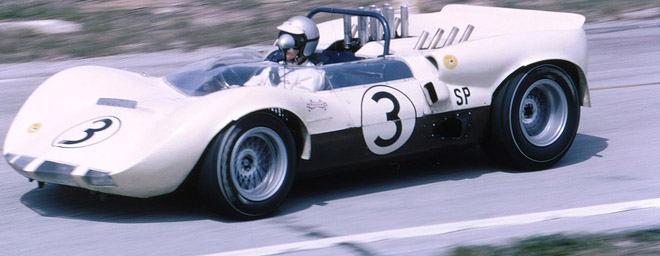
Partnering with Hal Sharp, Hall obtained the Chaparral name for his new racecars – all of which bore the designation “Chaparral 2.” Debuting the new car at Riverside, Calif., near the end of 1963, Hall won the pole with a new track record and led the race before dropping out with an electrical problem. The following year, Hall won the 1964 United States Road Racing Championship (USRRC), with the Chaparral winning seven of the 15 races.Hall took a new Chaparral to Sebring in 1965, challenging the new Ford GT40 in its publicized battle with for Ferrari for supremacy in international endurance racing. But the Blue Oval and the Prancing Horse were forced to take a back seat in what has been recognized as one of the greatest races in Sebring’s long history. Hall was the fastest qualifier with a lap of 105.41 mph, and then broke the race lap record, running 104.41 mph. Torrential rain that fell later in the event ended the opportunity for additional records, with Hall and Sharp holding on to win by four laps in an all-American victory. The Sebring car had innovations, including a fiberglass monocoque and a torque-converter transmission that allowed drivers to shift without using the clutch. The following year, that would allow Chaparral racers to control Hall’s innovative wings with the left-foot pedal. Chaparrals went on to dominate the 1965 USRRC, winning 16 of 21 races.While the early Chaparrals featured aerodynamic innovations including front winglets and an adjustable rear wing, Hall changed the face of racing in 1966 with the introduction of the Chaparral 2E. The new car featured a high-mounted rear wing. Hall finished second behind American Formula One World Champion Phil Hill in a 1-2 finish for the new cars at Laguna Seca, with Hill winning a 1,000-kilometer race at the Nurburgring that year with Jo Bonnier.Hall continued to modify his winged cars over the following years, taking advantage of the airflow over the race car at speed. He also began experimenting with the airflow under the car. His next breakthrough was the Chaparral 2J, introduced in 1970. Better known as the “Sucker Car,” it had Lexan skirts on both sides to seal the car against the ground. At the back, it had two fans to create a partial vacuum under the car, providing tremendous downforce and maneuverability. While the “Sucker Car” struggled with mechanical issues and was outlawed after its first season, “ground effects” would eventually dominate Formula One competition. Hall later built the Chaparral 2K, a ground effects car that won both the Indianapolis 500 and CART championship for fellow Texas Johnny Rutherford in 1980. Through his career, Hall enjoyed success in Indy cars, Formula 5000, Can-Am, Trans-Am and endurance racing through 1996. His seven remaining Chaparrals are on permanent display at the Permian Basin Petroleum Museum in Midland, while he now resides in Palm Springs, Calif.
IMSA

Latest News

Comments
Comments are disabled until you accept Social Networking Cookies. Update cookie preferences
If the dialog doesn't appear, ad-blockers are often the cause; try disabling yours or see our Social Features Support.