Q&A with Asian Le Mans Series manager Cyrille Taesch-Wahlen
Marshall Pruett: What do you see as the biggest challenges facing the Asian Le Mans Series, and what areas have you highlighted to grow the series?
Cyrille Taesch-Wahlen: Understand and adapt to the Asian market. This is what we must do because this series is meant for the Asian teams in principal. Of course, having moved the calendar to a more winter-oriented season, we would like to attract European teams, and why not U.S.-based teams as well? But we almost start from scratch. We have restarted the Asian Le Mans Series since the ACO has taken over the organization.
It was a very important move because the ACO and the Le Mans 24 race means something, even if the endurance racing and prototype racing culture is very diverse in Asia. It's moving. The momentum is there. There is an interest for that I feel. We have a short, mid, and long-term plan. The short-term plan is to make sure the 2015, 2016 season is a good one. The midterm plan, which is a three-year plan, is to make sure that we establish a very attractive and sustainable platform for endurance racing.
Michelin renews tire supply deal with Asian Le Mans Series
LEFT: Taesch-Wahlen (second from left) at the announcement of 2014 Asian Le Mans Series GT class champion Team AAI entries for the 2015 24 Hours of Le Mans.
The ACO's committed 100 percent to make sure that it is a success. As they did with the deal in America with Don Panoz and now the France family, and with the WEC and ALMS, they would like to build a strong championship in Asia, because as a market, it is a hugely important pillar of their endurance racing pyramid. The ACO is aiming at becoming the reference when it comes to endurance racing. That's why I love to say the Asian Le Mans Series' goal is to become the endurance racing platform for Asia.
The series has been through a number or management shakeups and uncertainty since it was launched, which has limited its growth as a result. That leaves you essentially starting from scratch. Do you see the fact that you have to build an endurance racing culture as the first priority, or do you need to create the foundation for endurance racing with Asian teams and drivers before that can happen? Or do you see importing established European and American teams to jumpstart the process as the key to the series taking off?
It's a combination of all three elements. The culture in Asia when it comes to prototype or endurance racing, including GT cars, is different. Japan is fantastic for that. They love Le Mans, they love prototypes. Meanwhile, in the rest of Asia, you only have endurance races established for quite a while. We can see a growing interest for a three- or four-race format as we grow. And of course the third element is that the European teams are really, now the ACO has taken over the organization, more interested. To join the Asian series, to enjoy the winter series and also for some of them to get a chance to win the Le Mans invitation that is awarded for the class winners is a good strategy.
Of course, with the communication plan that we have announced, I hope that it will help to create more awareness, not only for the Asian Le Mans Series as a international series, but also for endurance racing in the ACO ecosystem. Because some of our partners are going to create features and content, video content, and do teams and drivers profiling. We're going to use the digital platform as a very strong tool to reach the community and the fans and spread the word, all over the world. This is something we're working hard on now.
Within the Asian Le Mans format, you have the exact class of cars that race at Le Mans, and you also have classes that are not eligible to race at Le Mans or in the WEC. Do you expect to continue with that mix of international specifications and the unique domestic classes to populate your grid as you grow the series? And is there a point where you would drop the domestic classes in favor of a full WEC class structure?
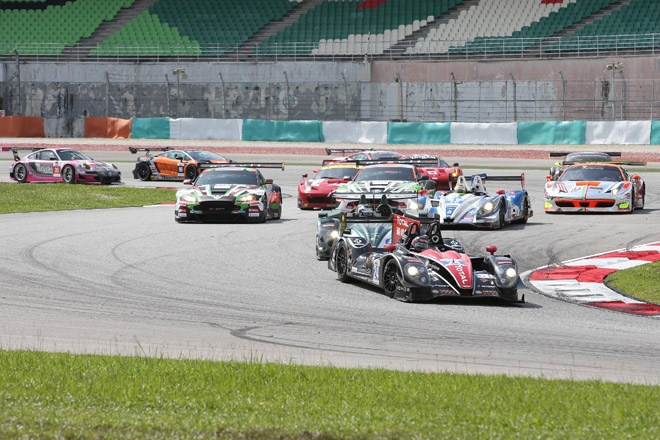
The Asian Le Mans Series opened the type of cars that are eligible, LMP2, LMP3 (ABOVE RIGHT, LAT photo), GTE, these cars are under ACO written and designed regulations for a long time. The thing that is different compared to other championships is that we also welcome the CN cars, some cup cars, as well as the Japan 300 GT cars. So it's not different specifications in terms of the ACO technical regulations. They stick to the same ACO regulations. We have more cars eligible.
One of the main goals is to make sure that the Asian Le Mans Series as a racing platform fits and matches with the Asian market and the Asian demand. We have announced a technical regulations stability, meaning that all cars that are currently eligible will remain until 2018, the 2018-2019 season. It gives more confidence. You know that if you buy a car now it can race in the Asian Le Mans series with that very same car for the next four years. After this period, I cannot say which classes will change, or if any changes will be made.
Enticing sports car teams outside of Asia to ship their cars and compete in the Asian Le Mans Series could be a tough sell unless travel costs are covered, etc. Have you established a network of rental opportunities for drivers or teams that might have an interest in joining your grid, but would prefer to do so without the big production it might require?
We are exactly working on that. On both sides. But so far, we haven't had any specific demand from the U.S. Of course, from Europe we are working on putting together, hopefully, an unbeatable offer to give the European teams the opportunity to ship their equipment and cars at a very good price, thus giving them even more chance to join, an opportunity to join.
There's great potential here, and if the ACO can provide the stability that has been missing from the Asian Le Mans Series, it definitely feels like it could become something bigger than what it has been.
It's a very exciting challenge. The ACO is really committed. So we're doing, of course, our best efforts to make sure that not only people have confidence again in the concept, but join us. I consider all these teams my stakeholders. I would like to create an ACO Asian family. We enjoy growing together, and we are trying to make this series a very strong series over the years.

Latest News

Comments
Comments are disabled until you accept Social Networking Cookies. Update cookie preferences
If the dialog doesn't appear, ad-blockers are often the cause; try disabling yours or see our Social Features Support.