.jpg?environment=live)
BMW of North America 40th anniversary special: The Wonder Year
In 1983, Nelson Piquet's Brabham-BMW BT52 earned Formula 1's first turbocharged World Championship. With continual development, the same 1.5-liter, four-cylinder M12/13 that powered that historic deed was pushing out an outrageous 1,300hp by '86.
By then, a different version of the engine was competing in North America. Nestled in the back of the spectacular BMW GTP, it raced in IMSA's Camel GT Championship against the Porsche 962, Jaguar XJR-7, Nissan ZX-T, Ford Probe and Corvette GTP.
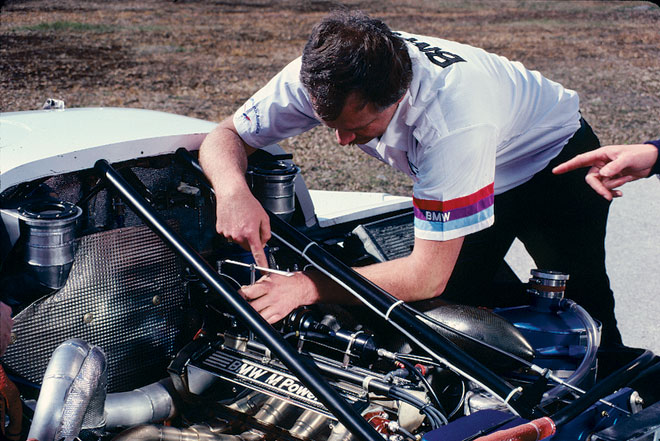
"The two-liter version had a bit less horsepower than the F1 engine, but a lot more torque," remembers Steve Charsley, who'd worked on M12/13s at the Arrows and Brabham F1 teams, before becoming chief mechanic for the No. 18 Davy Jones/John Andretti car from the middle of '86. "We had about 850-900hp in race trim. In qualifying, 1,100hp sounds about right...
"But a lot of people think the BMW GTP was all about horsepower, and that's not true. The team had really done its homework and we had massive tunnels underneath the car that helped create 5,000lbs of downforce. A very impressed Al Holbert told me, 'Your guys are able to carry so much speed into corners and brake so late.'"
The GTP's toe-in-the-water debut was the 1985 IMSA finale at Daytona, and although it retired with a gearbox glitch, it had started on the front row. While the experienced David Hobbs set that qualifying time, it was 21-year-old Davy Jones who'd emerge as the BMW team's star in '86.
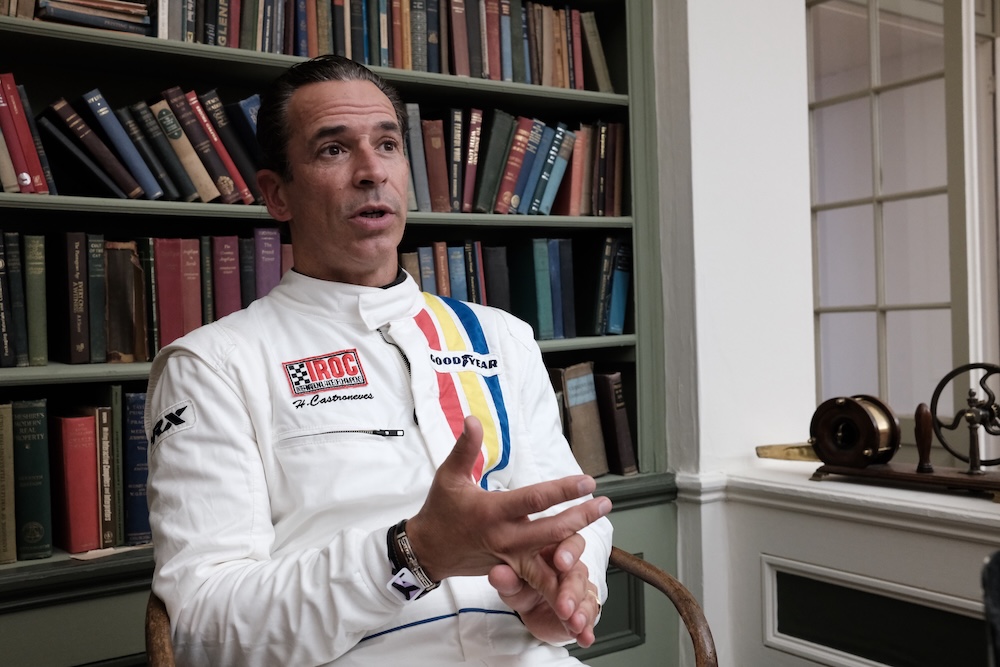
"The BMW GTP was far different than anything I'd driven," recalls Jones (LEFT). "I was used to Super Vee, Formula 3, Atlantics – nimble open-wheel cars. I'd never raced something large and powerful like the GTP.
"A four-cylinder engine with a big turbo meant a lot of lag, so it was work in progress to get the power more subtle and progressive. BMW of North America and McLaren Engines worked diligently on that, and also on improving the car’s aerodynamics. I enjoyed all the testing and working with those guys. And right from our first race with the ’86 car, we felt we could match anyone on pace. Everyone at McLaren and BMW of North America were working to reach a goal and each race we felt the car improving.
"Road America and The Glen were great for our car – not many slow corners, so turbo lag wasn’t an issue – and there’d never been anything wrong with our top-end power! And the medium- and high-speed turns lent themselves to our chassis. Obviously, my Road America shunt wasn’t good, but we dominated at The Glen, so I did the classic thing of going from chump to champ in the space of two races!"
Charsley rates Jones as the fastest driver he ever worked with (from a list which includes F1 ace Gerhard Berger, no less). So the driver lineup was strong – Jones partnering with Andretti in the No. 18 and Hobbs with five-time F1 GP winner John Watson in the 19 – and the car was clearly very quick, but development of the chassis and engine was initially stymied in testing and on race weekends by typical new-car niggles. Engine harmonics caused parts to fail, while detached bodywork caused extra driver Bobby Rahal to crash at Sebring.
The cars were briefly withdrawn and solutions came swiftly. Returning at Watkins Glen mid-season, the BMWs ran reliably to fifth and sixth, followed by fourth at Portland, and fifth at Sonoma. But at Road America, Jones crashed on the second lap as he lost downforce behind the leading Nissan. If that was a severe low, the next round, at Watkins Glen again, saw the highest of highs.
Jones set a sensational pole, a full second ahead of teammate Hobbs, who in turn was 0.8sec clear of anyone else. In the 500km (311 miles) race, the second BMW overheated at two-thirds distance, but Jones, Andretti, and then Jones again had enough pace to pull out a huge gap on their opposition, make an extra stop in the closing laps, then slice past two Porsches for the win. A great day...and yet bittersweet for Jones.
"Just as the program came together and we got that win, we learned it was all over," sighs Davy. "For 1987, the budget was reassigned. A real pity because everyone on that team was so good and the car had evolved into something really special."
"Yeah, the BMW GTP car was ready to do battle for '87," agrees Charsley, "and I think it could have been the car to beat."
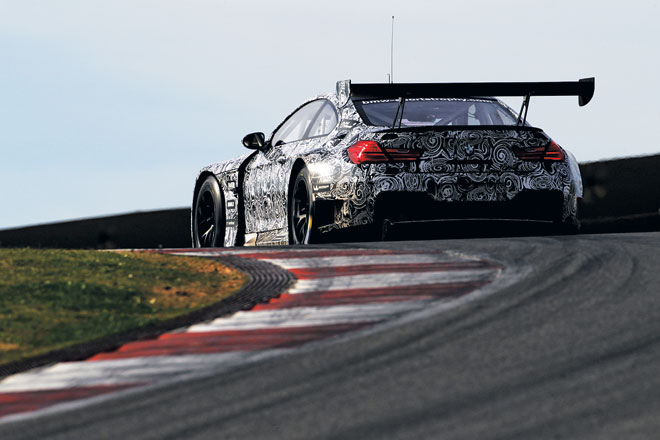
#HELLO FUTURE: BMW M6 GT3
Soon, BMW will unleash the latest in an illustrious line of production-based racecars that stretches back to the 3.0 CSL that won the 12 Hours of Sebring 40 years ago. The forthcoming M6 GT3 (ABOVE) will spearhead BMW's global racing efforts from 2016.
The car "incorporates all the experience we've gained in recent years on the endurance and GT racing circuits," says Jens Marquardt, BMW Motorsport Director. Sculpted in BMW's wind tunnel, the GT3 version of the M6 is powered by a 4.4-liter TwinPower Turbo production engine that punches out more than 500hp.
Given the endurance nature of most series where it will compete, BMW engineers placed a lot of emphasis on reliability and serviceability. BMW Motorsport starts taking orders soon, so start saving those pennies...

Latest News
Comments
Comments are disabled until you accept Social Networking Cookies. Update cookie preferences
If the dialog doesn't appear, ad-blockers are often the cause; try disabling yours or see our Social Features Support.