Throwback Thursday: Gurney’s All American Eagle Fastest Ever At Daytona
Next Thursday, Dan Gurney will be checking the results of qualifying for the Rolex 24 At Daytona from his office in Santa Ana, Calif.
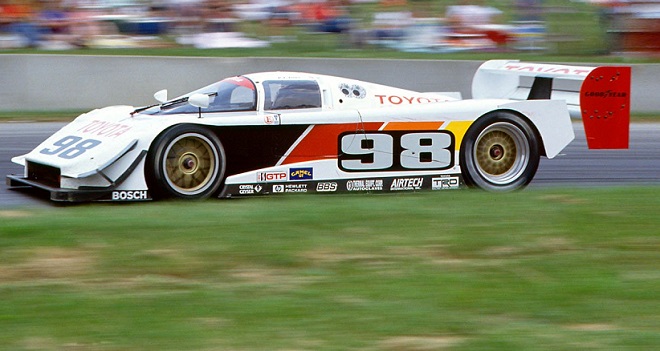
Chances are, the track record set by his All American Racing Toyota Eagle back in 1993 will stand up for another year.P.J. Jones won the pole for that event with a lap of 1:33.875 (136.52 mph), breaking the record set in 1992 by teammate Juan Manuel Fangio II by two seconds. Jones – son of the legendary Parnelli Jones – was joined on the front row by Fangio, who ran 135.38 mph.“We thought that Juan would have been able to go just as fast, but he had an engine head gasket problem during his qualifying run,” Gurney said. “I was thrilled that P.J. did it. I don’t think anyone’s come closer than five seconds slower since then. Actually, the track is slightly faster from the pavement standpoint and also the chicane was straightened out a little since then. I’m surprised no one’s gone after it.”Gurney’s son Alex won the pole for the 2014 Rolex 24, running 1:38.270 (130.416) in the GAINSCO Corvette DP – the fastest qualifying lap for the event since his father’s car set the record.“I’ve noticed that,” Gurney said of his son’s pole. “I’ve seen that in practice (last weekend’s Roar Before the Rolex 24 testing) they have not beaten Alex, either.”Jordan Taylor led the three-day Roar with a lap of 1:39.181 (129.218 mph) in the No. 10 Konica Minolta Corvette DP.Gurney’s Eagles did more than win the pole and set the record at Daytona in 1993. Joined by Mark Dismore and Rocky Moran in the No. 98 Eagle, Jones went on to win by 10 laps over the Roush Racing Ford Mustang of Wally Dallenbach, Robby Gordon, Robby Buhl and Tommy Kendall.Jones and Fangio had their cars running 1-2 for four hours, lapping the field, before Fangio pitted with electrical problems that led to that car’s demise. Jones’ car encountered transmission problems on Sunday morning, allowing the Bud Light Jaguar and Momo Nissan to get by, but both challengers went out with engine problems of their own. With the transmission repaired, Jones and company came back from 32 laps down to cruise to victory.That victory set the tone for the season. The team won all 10 races it entered, with Fangio taking the driver title and Toyota the manufacturer crown for the second straight season. It also ended All American Racers’ five year run in GTP – the only manufacturer still running in the once-crowded class. After winning the IMSA Camel GTO championship in 1988, All American Racing set its sights on the premier Camel GTP category. Racing against an ultra-competitive field that included the Porsche 962, Nissan GTP and TWR Jaguar, AAR won nine races over the next three seasons, racing a-Toyota powered Dome chassis while developing the Toyota Eagle Mk II. After winning at Watkins Glen in the Mk II in 1991, Juan Fangio II ended 1991 with victories at Portland and Del Mar in the Eagle new Mk III. That began a run that saw the team win 21 of 27 races – including its final 17 straight – complemented by 10 1-2 finishes.As a result, the Eagle Mk III takes its place as one of the greatest racecars of all time. “It had a lot of different strengths, and very few weaknesses,” Gurney said. “It had quite a few fathers and mothers, and it was especially good from the standpoint of aerodynamics and cooling.“Aerodynamically, it had a giant sweet spot. Unlike most of the other cars, it did not have to be really close to the ground. Our Eagle ran probably an inch higher than most of the other cars, and we could deal with rough tracks really well.“We also had all of our cooling taking place back of the driver’s compartment, so it didn’t have any hot radiator water and other stuff heating up the cockpit. Our guys never had to use cool suits, and right away that probably did away with 75 pounds of weight, along with eliminating all the things that could go wrong if the cool suit system didn’t work perfectly.”The Mk III was powered by a 2.1 liter, four cylinder, iron-block, aluminum-head turbocharged engine developed by TRD.“Drino Miller was in charge of that little engine, and he took no prisoners,” Gurney said. “In fact, he blew up three dynamometers building those engines.”Gurney drove the car once, at a test at Willow Springs in California. Despite using about 20 percent of what the “real drivers” were using, he said “it was astonishing. … The brakes were beyond belief.”“One wonders why did it stop?” Gurney said looking back at the GTP era. “A lot has to do how the economy was doing. I defy anyone who was there to say it wasn’t fantastic racing – it was. But you got to have somebody to race.”
Read full article on Press Room IMSA

Latest News
Comments
Comments are disabled until you accept Social Networking Cookies. Update cookie preferences
If the dialog doesn't appear, ad-blockers are often the cause; try disabling yours or see our Social Features Support.