.jpg?environment=live)
Dodge Challenger SRT 392: In a league of its own
There’s one moment in my 3000-mile journey in the 2015 Dodge Challenger SRT 392 when I wish to be in a different vehicle. That vehicle? The pickup truck coming the other way, running on ridiculously outsized tires which give it a 2-ft ground clearance. The moment? As I approach a lake where once had been visible the US-84.
Or if it ever will. The rain is unstoppable, the edge of the road indistinguishable, my confidence imperceptible.
And so I chicken it, throw a U-turn and stop. In three hours, it’s going to be light – more visual aids, more traffic by which to judge the depth of the water. The parking lot outside one of those charmless but useful AmPm stores is home for a sleepy writer and his precious car. Unable to escape the pinky-orange glow of the adjacent Arco gas station, I nonetheless nod off while wondering how the hell Kerouac made these kinds of scenes sound aspirational.
As with most predicaments in life, I have no one but myself to blame. I’m drawn to the modern-era muscle cars like TMZ is to meaningless gossip. This is only the fourth Challenger SRT I’ve driven, but I’ve made sure to use each one as Dodge intended – a lot and with enthusiasm – and every step on its evolutionary path has been an improvement.
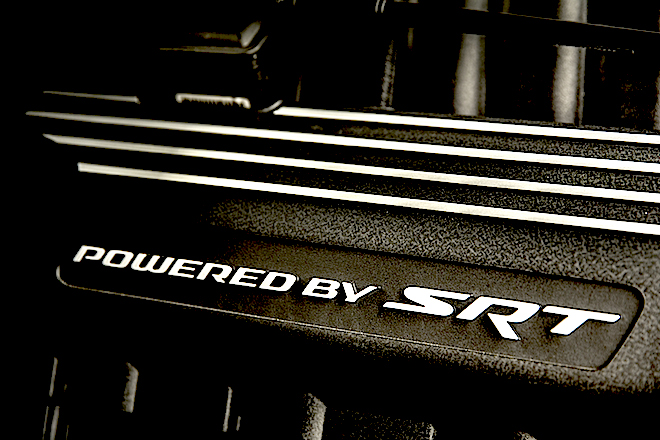
But the 2015 Challenger makes as big a step forward as the ’11 model because it mates a further 15hp increase to the long-awaited – let’s be honest, long-needed – eight-speed automatic. The old five-speed auto unit was tough but also rough; large steps between ratios meant upchanges let the revs fall too far when gassing it, and the clunky downchanges defeated a driver’s attempts to be smooth when braking from high speed. This was true in the SRT models of the Challenger, Charger and Chrysler 300, but at least the Challenger had the option (in my case, always taken) of the six-speed manual. Meanwhile, Hemi addicts could only look yearningly at the eight-speed autos given to V6 variants of each of these models from late 2012…
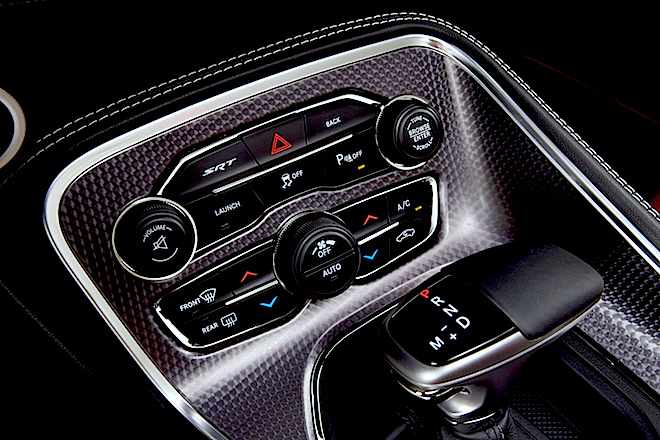
Worries are alleviated within a few miles of the RACER offices – a long shallow gradient and, even in fully auto form, the car stays in eighth. Good. Of course, switching to the semi-auto mode and utilizing the paddle-shifters as I do 90 percent of the time means the question marks are eliminated altogether as the car just does what it’s told. And the cog-swaps themselves? In Normal setting (more of which later) upshifts are crisp, swift and gentle while downshifts are refined yet still provide enough engine braking that you can avoid dabbing the six-piston Brembos, even on decreasing-radius turns.
If that last comment makes the Challenger SRT sound a bit soft, it’s worth remembering that it's not in the same class as Ford’s Mustang or Chevrolet’s Camaro. This is a bigger car all around, and so automotive magazines’ regular comparisons between the three are driven only by their retro names/looks/heritage. The Challenger is a genuine 2+2, its back seat capable of carrying two smallish people on a longish journey. Try the same in a Mustang or Camaro, and you should expect a call from Amnesty.
Dodge leaves blatant clues that it’s set different priorities for Challenger drivers than GM and Ford did for their retro-hungry customers. Those clues are called “dimensions.” A Challenger is 198 inches long with a 116-inch wheelbase – measurements that are respectively 10 and nine inches greater than a Mustang. In terms of trunk space, the Camaro has 11.3 cu. ft., the Mustang 13.5, the Challenger 16.2. And Dodge occupants are also provided more generous head, leg and shoulder room.
These observations aren’t implied criticisms of Camaro and Mustang: my point is, for people to then moan that the Dodge is 450lbs heavier than the GM and Ford equivalents-which-aren’t-equivalents, seems as facile and foolish as complaining that your 1,000cc bike isn’t as nimble as your 500cc one. Like, duh…
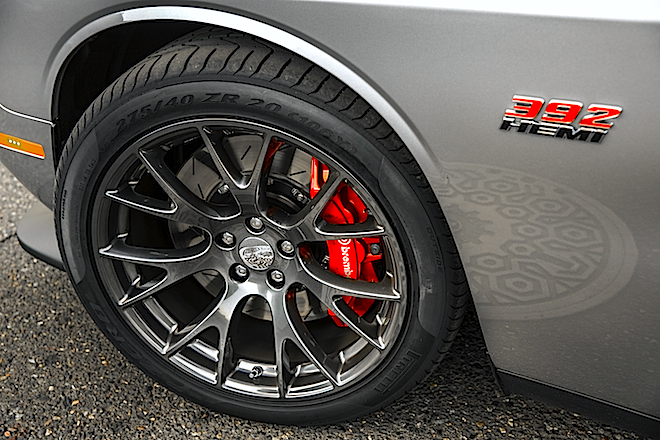
And yes, that floodwater is deep. Not as deep as I’d blindly feared a few hours earlier, but deep enough for me to seek the crown of the road, only veering off into the rocker-panel-high depths at the approach of an oncoming vehicle. These conditions induce the traction control system – which, as with any car, automatically switches back on when you fire the engine – into working overtime, even though I’m surfing along at a mere 45mph. Rather than put up with this confusing sensory overload, I turn it off and instead zero in on the tail of a big-rig cruising at 55. With the Challenger’s 275/40/ZR20s running in the channels cut by the tires of the semi ahead and with the gearbox solidly in top to avoid wheelspin should the car go light, I have a good and faithful automotive companion once more.
As the highway surface resurfaces and I can set my own pace, I go back to simply enjoying the Challenger SRT and reflect on its maturation over the past six years. One of the things I’ve respected about Chrysler-Dodge-Jeep this century is that the quest for new customers has never led to neglect of existing ones. For example, the SoCal LX forum (held here in Irvine, Calif.) – where an ’04 Dodge Magnum is as welcome as a brand-new Chrysler 300C – is almost always attended by SRT senior veep Ralph Gilles and other management staff from Auburn Hills, MI. And that same determination to establish brand loyalty is also apparent in Dodge’s decision to not update the Challenger’s externals every year. It’s a policy I wish was followed by more manufacturers: leaving your existing customers to drive around in cosmetically out-of-date cars, just 12 months after they’ve pledged five figures of hard-earned to your company, has always struck me as inconsiderate.
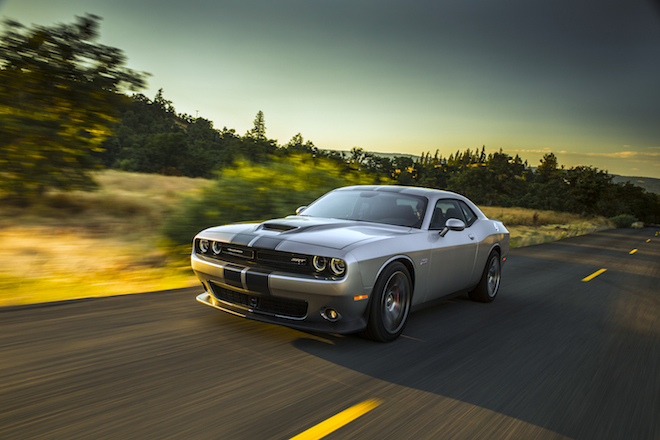
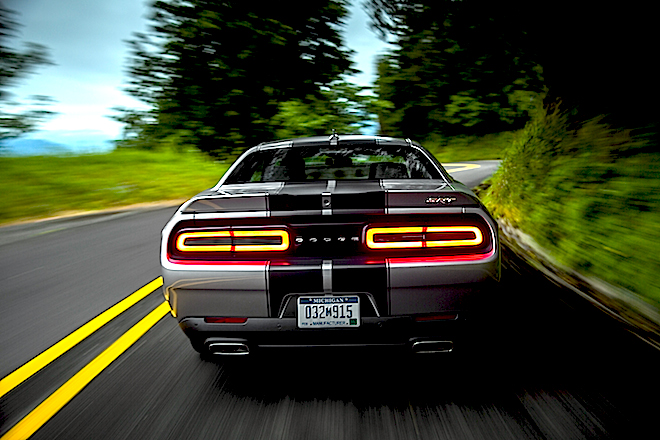
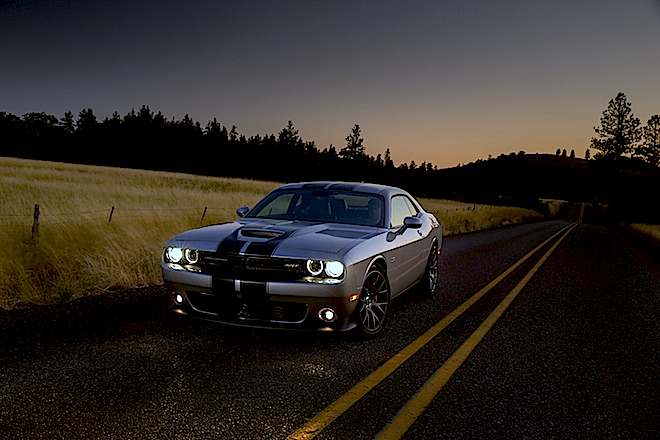
The strip of tail lights that paid homage to the ’69/’70/’71 Challenger has been replaced by LED units set in a black panel, that more subtly evokes the ’72-’74 models. The front grille, however, has moved on from echoing ’69/’70 cars to closely resembling the ’71 model year, with two distinct inset frames – silver on some models, black on others – between the quad HID halo headlamps. Perhaps even more noticeable is that the old SRT hood, with two rearward-set vents on either side of the bulge, has been passed down to its less powerful siblings, and the new SRT hood acquires the prominent and functional central scoop of the Hellcat model.
So “facelift” is too strong a word; let’s say the Challenger has had new war-paint tastefully applied but has retained its unique and special identity. Oddly enough for a machine so distinctive and unapologetically retro, it doesn’t seem to polarize opinion; it just attracts favorable comments. Maybe even people disinterested in cars have gotten tired of seeing Jaguar XF copy-Cats filling our roads.
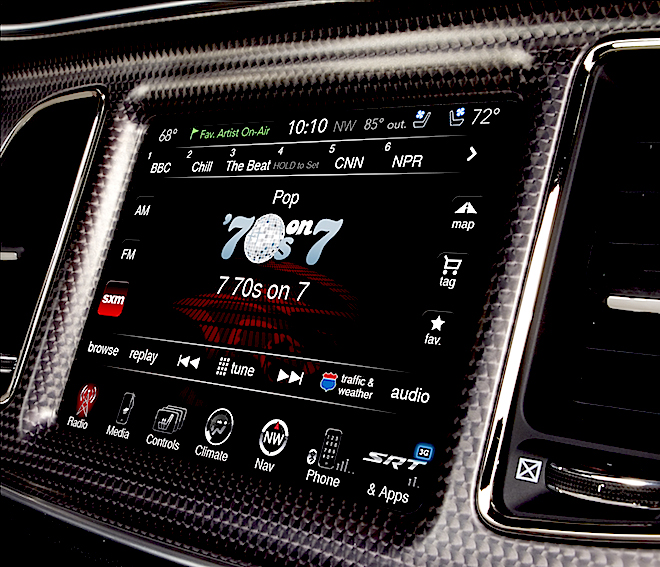
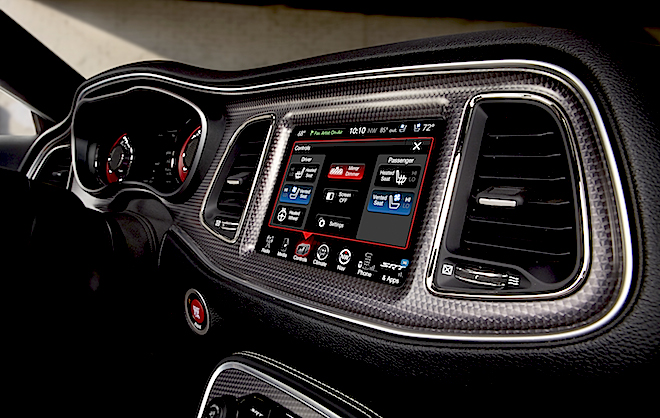
Perhaps most impressive is the voice command facility for the Bluetooth phone hookup, which actually comprehends the driver’s contact request. Forgive my emphasis on such an innocent joy. Recently I experienced a car with a more primitive voice-activated phone system that seemed only to understand when I swore at it. Consequently, “Mother” received five inadvertent calls within three minutes.
The Dodge’s touchscreen also provides control over luxury items such as the heated/ventilated front seats, heated steering wheel, 18-speaker Harman Kardon stereo and dual-zone temperature controls. But more interesting to RACER readers will be the configurable driving mode which, between Normal, Sport and Track, alters the Challenger’s damper settings, steering weight, throttle response and gearbox behavior, making the SRT tauter and more responsive. Operated as a semi-auto, the difference in upchanges is readily apparent – they're said to take 160 milliseconds in Track mode – yet the downchanges seem even more vigorous. However, unless your journey is blessed with roads as smooth as a pool table, the dampers in Track mode should be left for… wait, you guessed it – the track.
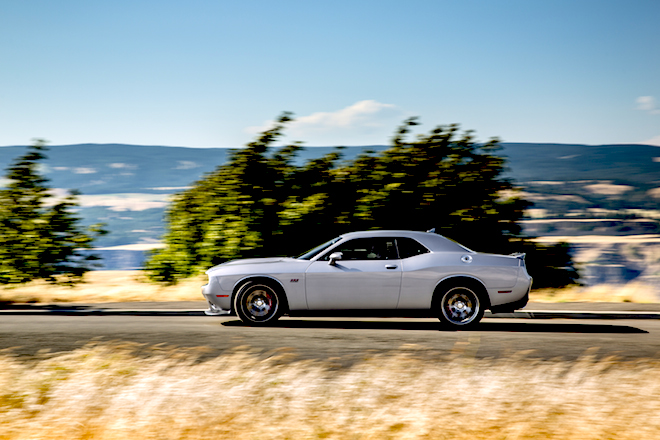
The long barren stretches of the I-40 provide plenty of room to not only experiment with gadgets, but also extend the engine a little. Not for the first time on this trip, my heart melts a little at the Hemi's combination of basso profundo and a pleasingly hard, metallic edge to its alto as it approaches the 6,400rpm redline. Given that the SRT has a 0-60mph time of little more than four seconds, 0-100mph in 10sec, and could go on to a top speed of 175mph, my behavior is relatively restrained. Still, I can’t deny knowledge of those figures induces a grin, even 1,000 miles into the return leg of a journey to Austin, Tx., and even when, with approximately half as many miles still to go, potency is less of a priority than winding down windows, turning up Sirius XM and focusing hard on the road ahead.
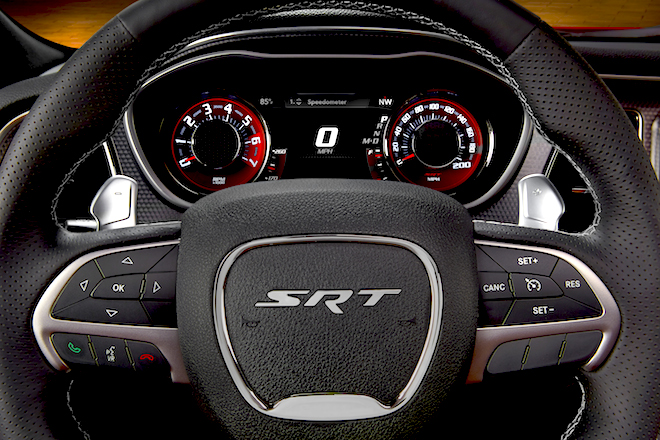
Crossing the state line from Arizona into California provides an adrenaline boost of false hope, because there’s still four and a bit hours to go. The Challenger is now so bug-spattered that I doubt its central “eye” – containing the gizmos for its optional adaptive cruise control and forward collision warning – would even work. No matter, I’m in no mood to find out; this car is all about involving, not insulating, its driver, and that interaction is exactly what I need at 2 a.m. after 17 straight hours on the road. It’s a struggle to think of any other modern car that possesses enough inbuilt allure to hold my concentration so long while also avoiding the tiring traits, discomforts and dysfunctions of a genuine supercar.
Rumbling into the RACER parking lot at an hour too late for bed but too early for the office, I’m mildly peeved to realize that an extra stop in the final 150 miles – ostensibly to down a couple of coffees but also to marvel at the puréed insect collage across the Challenger’s front air-dam – extended the journey to 21.5 hours and thus knocked my average speed below 70. Still, 69-point-something isn’t bad.
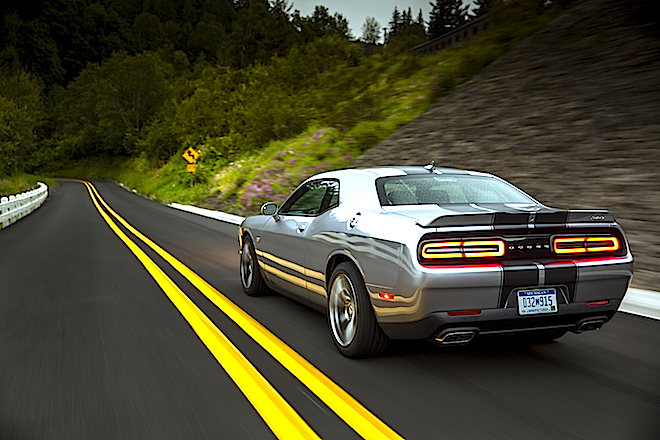
Esteem! That’s the word I summon when I wake 90 minutes later, although I’m not sure even “high esteem” does justice to the bond that’s been formed here. The next day, refreshed and thinking more rationally, I turn to the Challenger's spec sheet and it’s the extreme value for money that hits hardest. Our car’s base price was under $45,000, and even with a few optional tech goodies (some of which I didn’t use), it was still less than $50k. More remarkably still, for around a mere $40k, the R/T Scat Pack model offers the same engine but it’s stripped of frippery in much the same way as the Core of yore.
There are some 2015 cars that can match a Challenger SRT’s straightline performance and some that are faster still, but can they hold 4/5 people and their luggage? If so, they’re more than double the price. Alternatively, use purchase cost as the parameter, and you’ll find some far less capacious GT cars that are slower in a straight line but are apparently quicker at weaving in and out of traffic cones. Ummm… with all due respect to those who set such abilities as their gold standard, so the hell what? Who actually does that? And if you catch their license plate, shouldn’t you report them?

Latest News


Comments
Comments are disabled until you accept Social Networking Cookies. Update cookie preferences
If the dialog doesn't appear, ad-blockers are often the cause; try disabling yours or see our Social Features Support.