.jpg?environment=live)
YOUR favorite racecars – 8. Lotus 49
Back in January, we ran a story about favorite racecars and asked RACER.com readers to select their top five. Your votes flooded in and, in the end, we had more than 400 different racecars to consider… but 10 clear favorites emerged.
Many of you had found it tricky to narrow your favorites down to just five, yet some of you had a clear No. 1 and no others. And, like ours, many of your selections were ones that fulfilled multiple criteria from a personal point of view – aesthetic beauty, period when you were first becoming addicted to racing, success, livery, piloted by your heroes. We understand, completely!
8. Lotus 49
TOP The great Jimmy Clark heads for his fifth grand prix win in the Lotus 49, at Kyalami in ’68. It was the 25th GP win of his career and tragically, it would prove to be his last. Fittingly, he took pole and set fastest lap on his way to victory. ABOVE Zandvoort in ’67 and the 49 is about to make its debut…and win. BELOW Clark with Keith Duckworth, father of the immortal DFV Cosworth engine. LAT photos
Hardly surprising that so many of you voted for this car: its combination of looks, technical ingenuity, success and longevity make it irresistible to many of us, even 47 years after it made its grand prix debut and blew the opposition away.
Back when auto racing fans just appreciated fast cars driven hard by the best racers, and wouldn’t express disgust or boredom when one team had a major technical advantage, the Lotus 49 was a source of wonder. From the company that brought us the monocoque Formula 1 chassis came a machine whose monocoque stopped right behind the driver’s seat, with its engine serving as a stressed chassis member.
And what an engine it was! The Ford-funded Cosworth-built DFV – Double Four-Valve – V8 pushed out 408hp from the word go, at a time when the V12s of Ferrari, Weslake, Honda and Maserati and the V8s of Repco had between 370 and 390. (OK, BRM’s ridiculously complex and overweight H16 was supposed to also top 400hp but rarely did it for long enough to render this anything other than a moot point).
For tax reasons, Jimmy Clark had been unable to enter the UK to test the Colin Chapman/Maurice Philippe-designed stroke of genius; those duties had fallen to Graham Hill, and so it was the Englishman who took pole on the car’s debut, the third round of the 1967 season, at Zandvoort. Meanwhile, Clark spent practice growing accustomed to the engine’s abrupt power delivery, a learning process not helped by a couple of mechanical gremlins, and so he lined up eighth for that race. Yet from the drop of the green flag, the Scot was on the move and by lap 16 he had the lead and held it to the checkered flag. A new era for F1 had begun. So too had the reign of a classic F1 car.
Watch this video of the Lotus 49's debut.
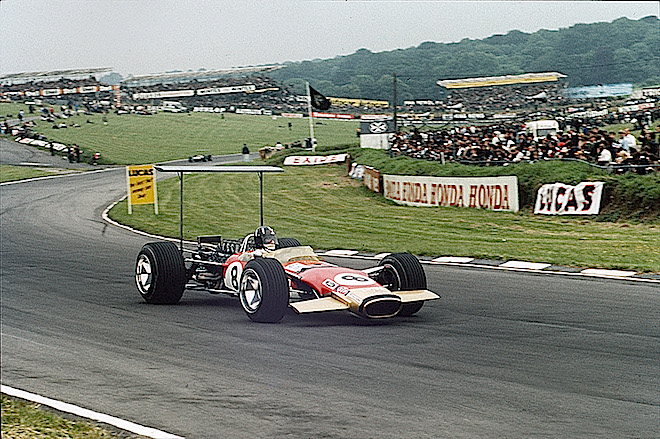
TOP Graham Hill won the 1968 World Championship, despite a DNF here at Brands Hatch. As usual, he won Monaco (BELOW). Note the beautiful wedged rear of the car here, compared with the wild aerofoils used at Brands. Colin Chapman was forever experimenting. LAT photos
But by now, the Cosworth DFV was also powering McLarens and Matras, and in ’69, Brabham also joined the Ford horde. With that technical advantage neutralized therefore, the 49 had to evolve. Some aesthetic purity was lost – although you could argue that happened when Gold Leaf’s red-and-gold colors replaced the original green-and-yellow – but the various appendages and reshapings certainly added visual drama to the car. And as a fan, you never knew what you were going to see from one race to the next, sometimes from one day to the next over the course of a race weekend. Downforce-providing wings were still in their infancy in F1 at this time and, inevitably, experimentation was rife. Figuring out the trade-off between drag and downforce was a truly dark art.And so, at the rear, Chapman and Phillippe tried wedges, duck-tails, whale tails and those incredibly fragile-looking high wings. At the front, the 49 acquired ducts on top of the bodywork, trim trabs, which evolved into larger, adjustable aerofoils and, yup, sometimes those high wings, too. The car’s wheelbase grew by two inches; its wheels went from 12in to 13in. The variations were intriguing…and they worked. In ’69, Hill was able to grab one win (Monaco, inevitably) and young fast and furious teammate Jochen Rindt also finally made the breakthrough into the winner’s circle; together they pushed Lotus to third in the Constructors’ Championship, which was impressive for a car in its third year.
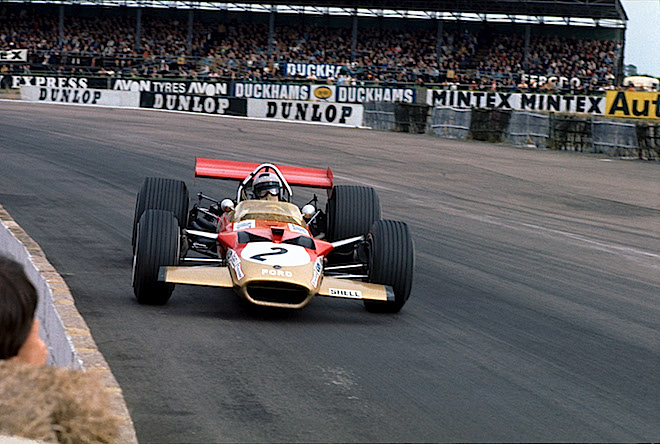
ABOVE The 12th and final win for the Lotus 49 came at Monaco in ’70, courtesy of Jochen Rindt. BELOW Rindt in the 49 at Silverstone was an awesome sight. He could have won the British GP in ’69, but a rear-wing endplate started loosening, and threatening to slice a tire. In fact, rubber and metal look very close in this pic. LAT photos
And still it wasn’t done! With Chapman’s newest brainchild, the Lotus 72, still not regarded as ready for the third race of the 1970 season at Monaco, a disinterested Rindt qualified his 49 eighth. However, as the race progressed he started turning up the heat and climbing the order until it was just Jack Brabham left ahead. Setting fastest laps some two seconds quicker than he’d managed in qualifying, Rindt pressured Brabham into a mistake on the final lap, and clinched the 12th and final win for the 49.Sure, it was the inspired genius at the wheel who’d earned the triumph rather than a technically superior car, but it was very fitting that the great Lotus 49’s final GP victory was earned in such memorable fashion.
Some of your comments…
Jim Hatfield: “The original from 1967. A car pure in line, the green & yellow color scheme a classic, technologically advanced for the day with a highly effective engine as a fully stressed chassis member with full monocoque forward. Doesn't hurt that it was driven by my favorite driver of all time, Clark, and that it was devastatingly successful.”
Rick Baumhauer: “The ultimate expression of pre-aero open-wheel road racing. If only it had a bit more reliability so that Jimmy could have won another championship before he left us.”
Steve Daniels: “Whether with traditional British Racing Green or Gold Leaf livery, with or without wings, this is the classic shape for an era.”

Latest News

Comments
Comments are disabled until you accept Social Networking Cookies. Update cookie preferences
If the dialog doesn't appear, ad-blockers are often the cause; try disabling yours or see our Social Features Support.