.jpg?environment=live)
OPINION: Helio Castroneves' 2013 IndyCar season - the Team Penske verdict
It seems some of our commenters are convinced that myself and, to a lesser extent, Marshall Pruett, were too critical of Helio Castroneves this past season. Our post-race commentary videos were cited as examples of us ?hating on? Helio, but given that we only started those videos from Sonoma onward, I stand by our views: at that point of the season, the Brazilian's natural tendency appeared to be toward caution, and we felt it served him poorly. But, yes, there is of course a contrary view that playing it smart is what got him into that title-fighting position in the first place?
For what it's worth, we love Helio as a person and admire him as an ambassador for IndyCar racing, for Indianapolis Motor Speedway, for Team Penske and for Chevrolet. We also have a huge amount of respect for all his racing achievements. For all these reasons, he's been a regular columnist in magazine for the past four years.
And yet none of this is relevant; our affection for Helio doesn't alter the fact that we think 2013, while a fine year for the three-time Indy 500 winner, with admirably improved consistency, was not a season where we saw him consistently at his best. Having seen how others would yo-yo up and down in terms of results, Castroneves figured regularity would win the day and seemed to lapse into conservative points-collecting mode too early in the season. In short, I and many others wanted to see him be more combative, more often. (In his defense, I do realize that a racer with his first championship right in front of him will drive on the track like I drive on the road with a cop right behind me.)
Age has not withered Helio any more than it did Dario Franchitti. He's smart to go for consistency but it needs to be a consistent level such as he produced in 2010 and 2012, unafraid to take it to the edge. The IndyCar Series has become too close to treat its races any other way.
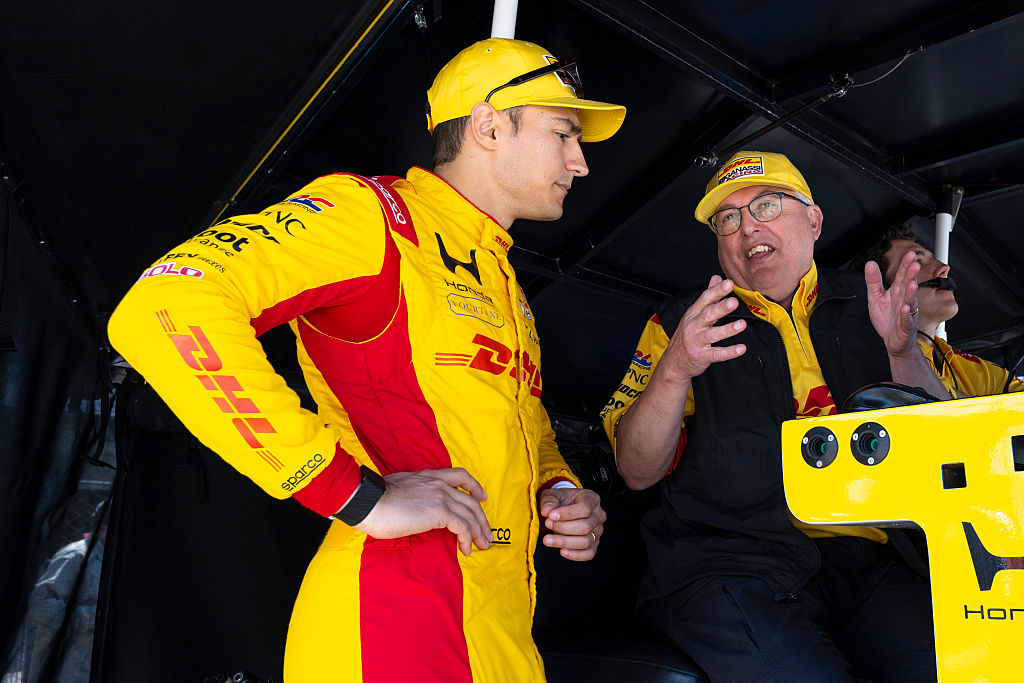
However, that's an outsider's take on the situation. To get an insider's view on Helio's 2013 season, we spoke to Jonathan Diuguid, race engineer for Team Penske's No. 3 car, and then team president Tim Cindric.
No, I think we knew it would be tough, and when Andretti won three of the first four races, there was no shock as such. What it did do though, is cause us to rethink a lot of developmental areas that we'd been looking at and go back and do more homework. Based on Detroit and Toronto, I think we definitely closed the gap. Ryan Hunter-Reay faltered with mechanical issues, and as tight as the series is, if you have reliability problems and then miss out on setup one weekend, it will hurt you and then it's very difficult to make those points back up.
Not at tracks where Helio had historically looked strong, no. If you look at the record books, he's been traditionally strong at Barber, St. Petersburg, but struggled at Long Beach and Brazil. So at tracks where he's performed less well in the past, we went in with the mindset that, ?OK, we're not going to be the fastest but don't try to make something that's not going to happen. Sao Paulo was a wake-up call in that I think he crashed four times in that race, and had he not been pushing so hard, that might have been a top-five finish. That was a turning-point because thereafter, if he was fifth in the closing stages of a race, he'd be smart and take those points rather than risking the car by trying for fourth.
I think that's a fairly accurate read on the situation. Our progress was gradual, because the way our weekends are set up now, it's very risky to make large departures from the setups you have, even if you're not where you need to be. Time and tires limit you to where deviating radically, if it doesn't work, can be costly in terms of performance. If you have a problem, you can screw it up further as easily as you can make it better, and not have time to correct it. So it takes days like Ganassi had down in their Sebring test to totally change an approach and then implement it, which they did very successfully at Toronto and all the street courses after that.
So that's why you saw teams move forward in different ways and at different times, according to the breaks in the race schedule and their testing schedule.
Funny you should ask that, because that's something that changed this year with Helio. In the past, he's been a driver who says, ?This is what it's doing, please fix it.? Now, it's more of a conversation, where he'll tell me what the car is doing and I come up with suggestions to remedy it, and he gets more involved in thinking it through, asking the pros and cons of making this change or that change. So he's getting a better understanding of the car and how certain changes affect the car a certain way, and toward the end of the season he was also making suggestions. That definitely changed over the course of the year.
No, he's been in IndyCar for what, 16 years? He's pretty set in his ways so it's easier to set up the car around his driving style than try to get him to change. If your driver has to think too much about what he's doing, he'll just start making more mistakes than if he was doing what comes naturally.
I'd say the development process that a lot of the larger teams had in place was quickly applied to the DW12, so where it took four or five years to develop the old car to where it was as good as you could make it, we're probably halfway there with this one already. But we're still finding things we can apply. For instance, we tested at Fontana before the finale and made progress, and we ended up qualifying 1-2-3 so there's still a decent amount of performance to be found.
Well, to Will's point, yes: on the ovals Helio can live with a less secure rear end to the car whereas on the road and street courses it's Will who can tolerate a less secure rear on turn-in. Helio does really have the drive to push to the limit and really has the drive to compete with the guys. He's not content being slower than Will, just as vice versa. So it's special for him to be able to do that after all he's achieved.
Well, I'd say his racing outweighs his qualifying performances on a lot of occasions and so maybe if he can't get the absolute maximum from the car for one flying lap, when it comes to racing he can go fast over a whole stint. And where you see conservative, I see a guy using all his racing knowledge and knowing when to take a chance and when not to. I don't think he's given anything up.
He's fairly even-keeled, I think. In Detroit this year, John Erickson at one point had to say, ?Hey, be quiet. This is what we're doing. This is no longer a discussion!? But normally Helio is fairly content, doesn't try to manage his race from in the cockpit, and puts his trust in the team around him and on the timing stand.
Hmmm?I'd say their driving styles are fairly similar and look for the same thing from their cars. Briscoe is obviously very strong on mile-and-a-half ovals and so his tolerance for oversteer on those is similar to Helio's. As far as personality is concerned, I would say Ryan has a more technical approach, delivers more matter-of-fact feedback, really focused. Helio is as focused but his feedback is less technical and is more about the behavior of the car. But ultimately, both know how to get in and drive it to whatever that limit is.
Like you said, this was my first season with Helio after working with Ryan Briscoe last year, and yeah, I'd say it was pretty successful. The consistency in his results showed he really applied himself this year, concentrated really hard on his performances and getting to the finish. Without the extremely unfortunate weekend in Houston, I'd say it would have paid off, so yes, I'd consider that a success.
I'd say the point of comparison would be that in most of those cases, there was a commanding lead in the championship into the final couple of races that then disappeared pretty quickly. The principal disappointment is to come so close and then " for whatever reason " it doesn't happen. Aside from that, I don't think there is much of common theme.
This year, I would say the reason that Helio didn't win the championship is that we didn't win enough races. If someone had said to you before the start of the season that the champion was only going to win one race, you'd say there was no way that could happen. And as we saw, you'd have been proven right. But the anomaly is that there a championship up for grabs for someone who'd only won one race but who was very consistent. That opportunity doesn't come around very often, and when it does, you'd really like someone like Helio to capitalize on that after all he's done for the sport of IndyCar racing. Regardless of what team you're on, he's been great for IndyCar. Obviously I have a personal relationship there and I'd have done anything to see that happens.
But like I say, we need to win more than one race in order for him to get the championship. The opposite was true of Will's three runner-up finishes in the championship, because he had title-winning numbers but his bad days were too bad " we didn't have the consistency. So the outcomes are the only link between these losses; the circumstances and statistics were pretty different between Will's losses and Helio's loss.
Had Helio's unfortunate weekend at Houston [gearbox failure in both races] happened at one of the earlier events " say, the double-header in Detroit in June " it wouldn't be so hard to take, because the points difference between Scott Dixon and Helio throughout the season would have been much closer for longer. And the way Scott closed out the season, we'd have held our hands up and said, ?OK, fair enough, that's how it was going to be.? Instead, that one weekend in Houston, with just one more event after that, there was a huge shift in the championship.
I feel terrible about Houston because I feel we let Helio down. In the first race, we had a mechanical failure that wasn't necessary. Would Helio have won the title if he'd finished where he was capable of finishing those two races? Probably not, but we can't be certain. Maybe if we'd left Houston tied on points, perhaps Scott would have run a little harder at Fontana whereby he dropped out rather than just limping it to the finish. Who knows?
Well, that's difficult to say too because a lot of these races come down to where you qualify, and in qualifying he wasn't too conservative. I honestly think Helio was as aggressive as he would have been in any title race, regardless of the points situation. That's my opinion. I certainly don't think he backed off to the extent where it would have made any difference in the championship outcome. But I do think there was the potential of Scott having to run harder at Fontana if they had arrived there much closer on points.
But who knows? At the end of the day, Scott was a deserving champion, he won the races and the bad days they had " like at Texas, I don't know what caused their gearbox failure " were compensated for by how they ran at the end. When they needed to execute, they did.
Hmmmm? When I looked at it, I didn't get that feeling. OK, at Baltimore, when a lot of people were making errors and the race had turned into a mess, he gave up quite a few spots, but I still say that the difference in the championship points, 27 points, is way bigger than gaining a few places here and there. We're not talking about a championship lost by three points, like in 2006. Maybe if he'd finished one of the Houston races, we could talk about the positions lost at other places as being crucial. But Baltimore, where Dixon went out with Will, was the only place where you saw Helio make just finishing the race as his priority and gave up a few spots. He'd been bounced around all day and also had a lot of near misses, so he was extra careful not to get pushed out by others being more aggressive.
Not really. The results would suggest that, but I honestly don't feel there were many races where we didn't have the potential to win. Will could easily have won some of those early races and no one would have made those comments. St. Pete could have been his " certainly a podium " until we got taken out, and Sao Paulo was one he would have run away with, even coming from the back. And he turned the fastest laps at Indy all month, but we shot ourselves in the foot by running too little downforce in the Fast Nine shootout.
So no, I don't feel like we were ever behind another team " or at least, not to the extent where we couldn't win. I felt like we had an opportunity to win almost every race we were in, and as long as you feel that way, you're in a good place.
DM: Those gearbox problems at Houston?can we be any more specific regarding their cause(s)?
Well the Saturday issue was a mechanical failure that I feel we could have avoided. Sunday's is still a mystery to us, because after the Saturday problem, we went through the gearbox and rebuilt it overnight. In retrospect you could say that maybe we should have replaced the whole thing, but at the time there was no indication that we should do that. So running two green-flag laps before the gearbox completely split in half?I struggle to think that he hit that big bump enough to cause such a major issue. But when we look at the gearbox and where it broke, it doesn't look like there was a crack that had been wearing; it just looks like there was a catastrophic failure. Common sense tells you that some point during the weekend it cracked and that was the final result, but the pieces tell you different.
So whether it was something that could have been avoided by Helio driving more on the left or whether it was something that was going to happen whatever line he took, I don't know. I do know that the end result was the same.
Well, going on past experience " and we've had a couple of these situations when things have gone against us in the final rounds " Helio has always come back the same guy. He shows remarkable resilience. As you get further on in your career, it's natural to think, ?Man, am I ever going to get the chance to do that again?? but I think he'll come back the same team player he's always been.
Helio just loves the sport. He enjoys the challenge and the camaraderie, and we enjoy having him there; he's a catalyst in our team, the one who, on our worst days, can remind you there are a lot worse days we could have. He gives us a sense of perspective with his own unique perspective, which has improved over time. He wasn't always that way, but he's matured and learned from what he's been through. He taught me how to laugh at myself, he teaches others how to enjoy the moment, and he's genuinely a guy who comes awake in the morning glad to be alive, glad to be ready to go, glad to have somewhere to go to! You'd almost think he was artificial but no, he's really like that and it never changes. If that ever goes away, then I'd give a different answer to your question about how he bounces back, but for now he's just constantly full of this enthusiasm.
I do, I do. If anyone had cause not to be pleased, it's Helio, knowing that his in-laws are Colombian so now he's only their second-favorite IndyCar driver. It's true! He says there are members of Adriana's half of the family who have never bothered to come and see race before but they're now already wanting tickets for next year?
But seriously I think he regards Juan as another challenge and he's taken it in the right spirit.
Presented by:


Latest News
Comments
Comments are disabled until you accept Social Networking Cookies. Update cookie preferences
If the dialog doesn't appear, ad-blockers are often the cause; try disabling yours or see our Social Features Support.