Kyle Cox/Getty Images
Nearly six months later, Kyle Busch is still far from forgotten
One moment, late in the NASCAR season, had Bubba Wallace thinking about Kyle Busch.
“I wish we still had his sarcasm to give his commentary on some of the stuff that’s gone on,” Wallace said. “I would have loved to have seen his comments after Bristol with [Ryan] Blaney and Carson [Hocevar].”
Busch, who built his career on rivalries and scraps as much as he did on success, would undoubtedly have enjoyed seeing Blaney and Hocevar throwing hands late on that late Saturday night in September. And he certainly would have had an opinion about it, and about those involved. If there was one thing Busch talked about more than his race cars the last few years, it was the lack of respect on the racetrack.
But the voice of the two-time Cup Series champion and the sport’s winningest driver is gone. Busch unexpectedly passed in late May at the age of 41 from severe pneumonia that quickly progressed into sepsis. Since then, Busch’s competitors have felt his absence in many ways, going half a season without him on track as the six-month anniversary of his passing approaches on Friday.
“It’s still like you have to almost pinch yourself because it doesn’t feel real,” said Joey Logano. “Whether it’s on the track you see the [No.] 33 or in the bus lot and they have flowers or roped off where Kyle’s bus typically was. One of the last memories I have with Kyle that wasn’t us competing on the track was us here [at Talladega] at MRO playing basketball with [our kids].
“We were shooting hoops yesterday, and I was thinking about it like, ‘This doesn’t seem right.’ It still feels weird.”
Logano, of course, was no stranger to what it was like to get into it with Busch. It still makes him laugh how often they butted heads, and Logano wouldn’t even try to lie about it.
One memorable moment came in 2017. Busch took exception to contact from Logano at Las Vegas Motor Speedway and marched down pit road afterward, seemingly without saying a word, before throwing a punch. The two ended up on the ground when the crews got involved, and Busch was left with a bloody forehead. A week later, it produced the “everything is great” viral moment when Busch answered nearly every question that way after a meeting in the NASCAR hauler.
“He was a fair competitor,” Logano said. “Obviously, you miss competing against him, and you think of the memories of what it was like competing back and forth, and you know that’s not going to happen anymore. I don’t know if either one of us enjoyed competing against the other. I think we saw each other as arch enemies on the racetrack, but we could put it away off the track. I think that was one of the special parts.”
In a way, Busch was perhaps as feared as he was respected by his rivals. Given a choice, it wouldn't have been surprising to hear they would take racing against him because Busch made everyone better and beating him was the ultimate accomplishment. But it would have been no less surprising to hear them say not having him entered was just as nice, because when in the right equipment, Busch was going to be the driver to beat without question.
There was no question about his talent behind the wheel and his determination to beat everyone in anything that he raced. It made him the gold standard.
Chris Buescher felt like he knew what he was going to get when racing Busch: hard but clean. No matter how hard the two raced over the years, and even with tire marks left on doors, Buscher doesn’t recall any major incidents.
In the final years of his career, Busch went from usually being at the top of the leaderboard to fighting further back in the field. Chase Elliott always thought he and Busch shared mutual respect, and it didn’t matter where they were when they raced each other. Elliott admitted there were plenty of times over the years that was for a win or just to stay on the lead lap.
“It’ll always be weird to not be racing against a guy that you assumed you’d be racing with for a long time,” he said.
For many, there's a strangeness in not seeing Busch but still seeing his sponsors. Or seeing what many still refer to as Busch’s car, but with a different number. Austin Hill did an admirable job in the renumbered 33, but he even acknowledged it was not his team or car.
“It’s been different the times when I’ve been racing around the 33 now, and it’s, ‘Oh, yeah, that’s Kyle’s car,’” said Wallace. “I still have those moments.”
Blaney goes through similar emotions, saying that, “It still messes with me a little bit when the 33 is out there.” Busch made the No. 8 his own in the four years he drove it at Richard Childress Racing.
“I miss his presence on and off the racetrack,” said Blaney. “Ever since I started in NASCAR, he was there on the track. Even before I got into NASCAR, when I was racing late models, he was there and always had a presence. Yeah, it’s been weird.”
Another word is bizarre, as used by Christopher Bell. It’s less on the racetrack than in the camaraderie between drivers off it, when they spend so much time together at driver meetings, in competition meetings with NASCAR, and in media scrums.
Daniel Suarez cannot believe how quickly time has flown since Busch’s passing. As one of those most affected in the days afterward, Suarez, who raced against Busch and was once a teammate and mentee, thinks of and misses him every Sunday.
“Because that guy – even though the last year or so that he was racing he wasn’t as strong as the normal Kyle Busch – his personality, expressions, he was a strong guy,” said Suarez. “I always had a huge amount of respect for him; probably the most of anyone, respect-wise … I’m so glad that [everyone] continues to remember him because he wasn’t just another driver. He was a legend of the sport and someone that I think about because he was one of those people at driver intros I was going to talk to about different things.
“Obviously, that doesn’t happen anymore.”
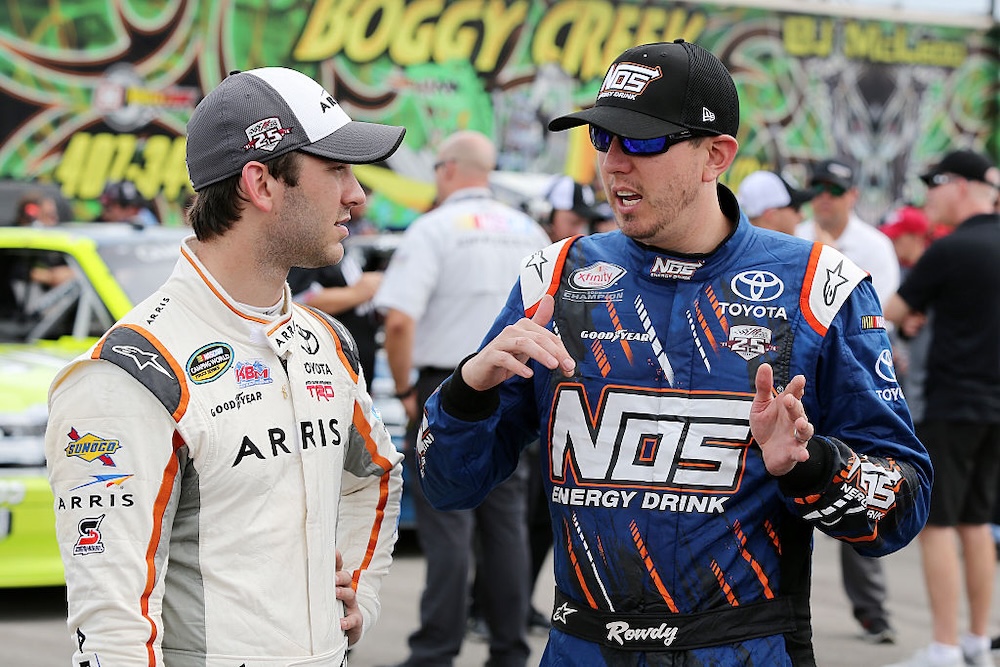
"I’m so glad that [everyone] continues to remember him because he wasn’t just another driver," said Daniel Suarez of his late teammate and mentor. "He was a legend of the sport."
Richard Childress Racing lost yet another legend, and someone they leaned on heavily for input. Austin Dillon was largely responsible for bringing Busch into the organization and developed a close relationship with him; after his passing, in a letter Dillon wrote to Busch, he promised to look out for his wife, Samantha, and their two children Brexton and Lennix. A few months before his death, Busch called Dillon one of the best teammates he’d ever had.
Dillon misses the ideas he and Busch bounced back and forth about their cars, and how aligned they were. The progress had been slow going, but it was there, and Dillon said they had started building a delta between the two of them of what was needed.
“So, that’s what I miss the most,” said Dillon, “and being able to talk shop with him - his knowledge about race cars and ability to give information.”
NASCAR has been left with a huge void that will never be filled. A voice that will never be replicated.
Busch was one of a kind. A future inductee into the NASCAR Hall of Fame.
And someone who left a lasting impression on his rivals that will be felt for years to come.
“It didn’t matter if you raced for 30th or the win; he was one of those guys who had this presence of like, ‘That’s Kyle Busch,’” said Chase Briscoe. “I’ll never forget the 2017 race at Atlanta. I pulled onto the racetrack in the Truck Series, and that was the first time I’d ever been on the racetrack with a Cup guy, and of all people, it was Kyle Busch, and just being like, ‘Holy smokes, that is Kyle Busch.’
“Nothing against Joey [Logano] or some of these other guys, but they didn’t have the presence for me, at least in my life. For me, growing up, Kyle Busch was the guy. So, yeah, I miss that presence on the racetrack because, as I said, it didn’t matter where we were racing; for me, every time it was like this pinch-me moment of, ‘You’re racing in NASCAR and against Kyle Busch,’ and that was a crazy thing to be a part of.”
Kelly Crandall
Kelly has been on the NASCAR beat full-time since 2013, and joined RACER as chief NASCAR writer in 2017. Her work has also appeared in NASCAR.com, the NASCAR Illustrated magazine, and NBC Sports. A corporate communications graduate from Central Penn College, Crandall is a two-time George Cunningham Writer of the Year recipient from the National Motorsports Press Association.
Read Kelly Crandall's articles
Latest News
Comments
Comments are disabled until you accept Social Networking Cookies. Update cookie preferences
If the dialog doesn't appear, ad-blockers are often the cause; try disabling yours or see our Social Features Support.