Images courtesy of Ford
Endurance testing and a second car: Ford gears up for more Hypercar testing
Ford Racing’s ORECA-based LMDh Hypercar test program is ramping up, with the American manufacturer’s first endurance test scheduled for next month and a second test car set to be introduced.
The 5.4-liter V8-powered prototype has completed running at Circuit Paul Ricard, Portimão, and Silverstone since making its track debut in early August. Its next outing is scheduled for Monza, where the program will reach another milestone with the introduction of a second car.
Ford Racing plans to run two cars at every test from that point forward as preparations continue for the car’s FIA World Endurance Championship debut in the 2027 season-opening Qatar 1812KM.
The second test car will be the third chassis produced for the yet-to-be-named Hypercar. The program currently uses one chassis for track testing and another for wind tunnel work.
“The beauty of having two cars at the test is that we can focus one on control systems and such, and one can do pure mechanical setup work,” program manager Dan Sayers told reporters. “We can learn twice as much, twice as quickly.”
Following the two-car milestone at Monza, the program’s next major on-track moment will be its first endurance test at Motorland Aragon, Spain. Although it will be the first time the car has tackled an endurance test, it has already completed some night running at Portimão.
“We did a bit of night running in Portimão,” Sayers confirmed. “I think Motorland will be interesting when we run through the night because that’s going to be a continuous test.
“All the learnings from that, and I’m sure there will be some, will be put into place for the later endurance test in Sebring, which is in the new year.”
Sebring International Raceway will headline the upcoming North American phase of the test program, which will also include a visit to Circuit of The Americas.
“The primary reason for going to the States is Sebring,” explained Sayers.
“As we all know, it’s a decent car breaker, so we want to go there and test it for durability. That’s relatively late in the test program for obvious reasons, but to go and test around Sebring, and then go back in the new year for an endurance test there, we think is the best sign-off.”
Although the program has yet to reach North America, Ford Racing’s U.S.-based engineers are already contributing to the development effort. During the car’s recent two-day test at Silverstone, they took advantage of the time difference to work overnight while the European-based team was at the track.
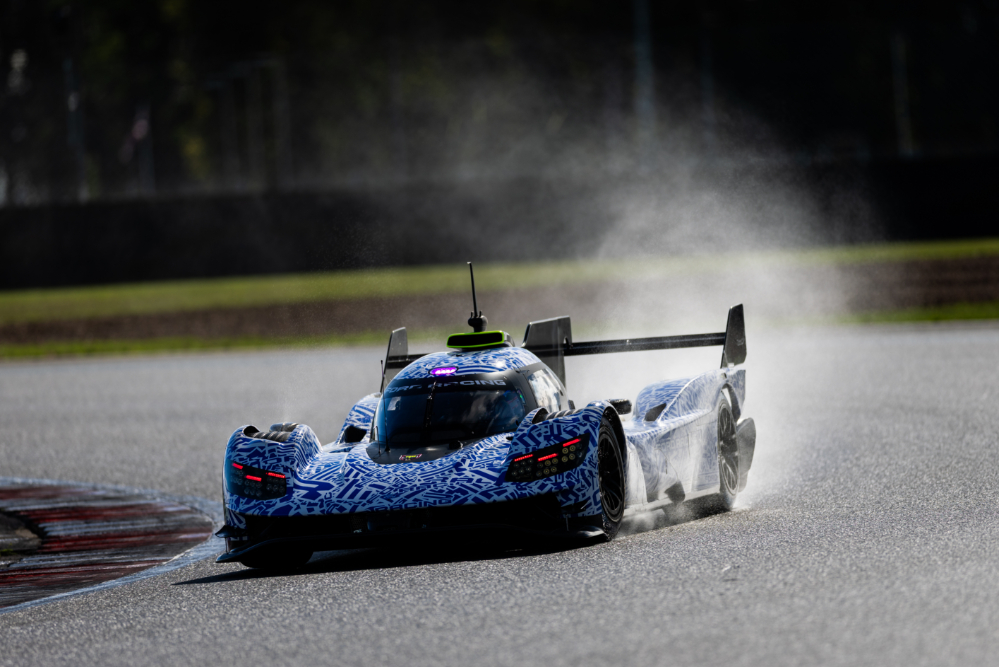
Testing at Silverstone allowed the team to work across multiple timezones and in varied conditions.
“The time offset is definitely a benefit and something that we didn’t make use of the first two tests because we just wanted to take things in our stride,” Sayers admitted.
“But at Silverstone we had people hitched up to the intercom and basically part of the team. The great thing is they join for the afternoon. They get a grip on what’s happening, they catch up on the morning, and they can be working through the evening when we’re trying to get some sleep.
“They can be working on updates, on analysis, whatever it might be for the next day, so that’s proving really beneficial.”
Homologation target remains on schedule
Ford Racing is targeting the end of this year to have the car ready for homologation, potentially allowing the homologated version to participate in the final stages of testing.
Although the prototype is approaching its final form, work continues to determine the precise specification of the LMDh challenger that will compete next year.
“In terms of homologation, we’ve gone through all of the CFD running so far,” Sayers explained. “We’re gearing up towards the final homologation at the end of the year, including the wind tunnel test, and that’s what we’re getting ready for now.
“Making sure we are in the [aerodynamic] box, making sure everything is final, all of the durability updates and everything that we will find throughout the testing, which will update the homologation. But we’re on track with that, so that’s all good.
“It’s mainly durability parts that we’ll be updating. So whether it be the engine specification, the exhausts, anything to do with the powertrain. We can update quite late as we find these things. But the rest of the spine is pretty much fixed, it’s all homologated already.
“Brakes is another one which we’re getting close to finalising, but brakes can be hugely influential on control systems. That’s an important one to get right, so we’re leaving those quite late.”
The first three outings have each served distinct purposes as the development program has gathered momentum.
At Circuit Paul Ricard, the priority was to give the team time to analyze its findings and implement improvements between track sessions. The program began with four half-day shakedowns at the circuit’s driving center, followed by three one-day tests on the main layout, with rest days between outings.
“[The shakedowns] were all very successful,” Sayers said. “The car started, pulled away, drove round. We did all of the systems checks, and it was invaluable time before we hit the main track.
“We then did three days at Paul Ricard, which were intentionally spaced apart. We did one day, then we had a second day, which had a gap in between, and then we had a third day with four days in between, just to allow us to dig into the data to make improvements.
“The rate of development is obviously rapid at this time, all in dry conditions, three drivers sharing duties, and we came away from there very positive.
“We then moved on to Portimão, which was far more challenging. It was four days consecutively, which is pretty brutal with a new car, so we had quite a few late nights, but again some good weather and solid running, and we’re still learning a huge amount about not just the car, but the systems, and Ford Racing in-house powertrain. Again, we came away with very good mileage, and we’d advanced the braking systems, the hybrid control systems and the calibration of the engine.
“Everything’s moving forward at quite a rate. We’re obviously having to pack these tests in quite quickly because time is of the essence, and it’s quite a compromise to try and pack them in but also give yourself enough time in between the tests to do due diligence, make the upgrades, analyse the data, test on the simulator and offline simulations for all the software, and then go to the next test.
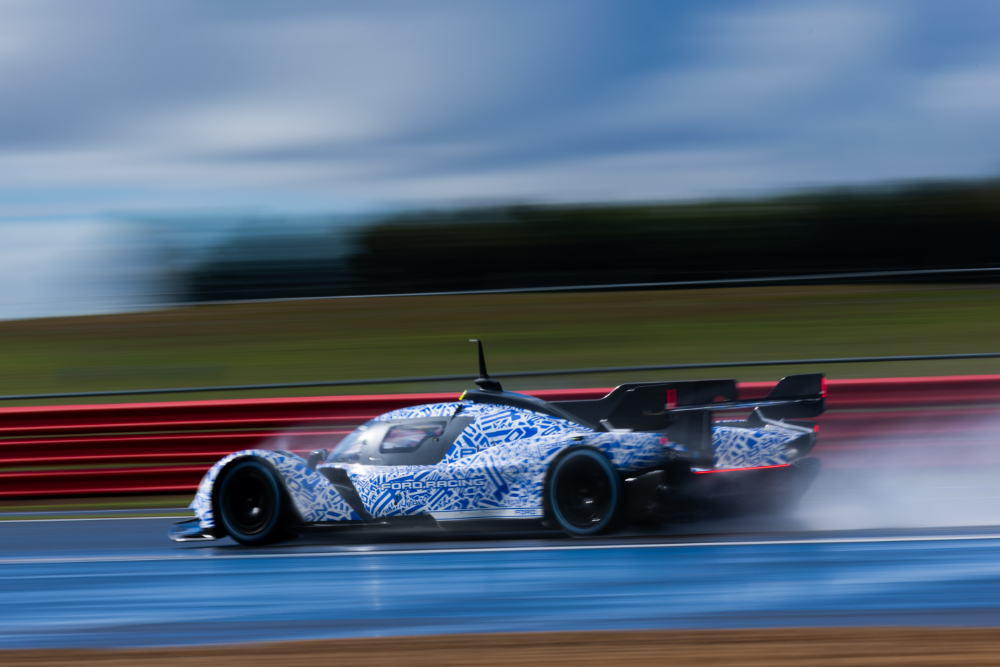
“Recently we came to Silverstone, and that was typical UK weather, which was actually quite good at that point. We had all of the seasons both days, and that really allowed us to move quite far forward with all of the different tire compounds and understanding all of the slicks.
“We ran on all the compounds to understand how the car behaves in the wet, and tested all of the car control systems in the wet just to prove that they were functioning as expected in all conditions. We covered close to 1,300 kilometres in two days, so a very positive test.”
The wet-weather running at Silverstone was not the only significant development. The test also brought together, for the first time, all the personnel who will form Ford Racing’s FIA WEC program.
“We eventually had the full structure there, all team members, and that made a massive difference in how we operated,” Sayers said.
“If you operate seamlessly, then you can get a lot more done in the days, so that was shown in the mileage we managed. Obviously that’s not the only metric we use, but if you’re doing good mileage, normally you’ll learn each time you’re going out the track.
“So the way the team performed was very good, but also the systems are developing all the time. The trackside tools, all the software, the analysis techniques, everything’s advancing. One of the hardest things is bringing three groups together [Ford Racing in Detroit, Ford Racing in Charlotte and Venture Engineering in the UK] from three different sites and functioning as a team, so that’s something we’re working quite hard on at the moment, and something that is improving each time we go out.”
Ford factory driver Matt Campbell did not participate in the latest test at Silverstone but has already driven the new prototype at both Paul Ricard and Portimão. The Australian has been particularly impressed by the car’s drivability and reliability at this early stage.
“It’s been going very well,” he said.
“To be honest, the Paul Ricard test especially went almost too smooth for the first ever time for an on-track test. It was a fantastic first time in the car for myself.
“Portimão was much more challenging, four days and a lot of late nights, but I think we really started to understand a few areas that we need to focus on. Everything around the systems and hybrid side of things will take a long time to develop, there’s no question about that, and that will also go into next year.”
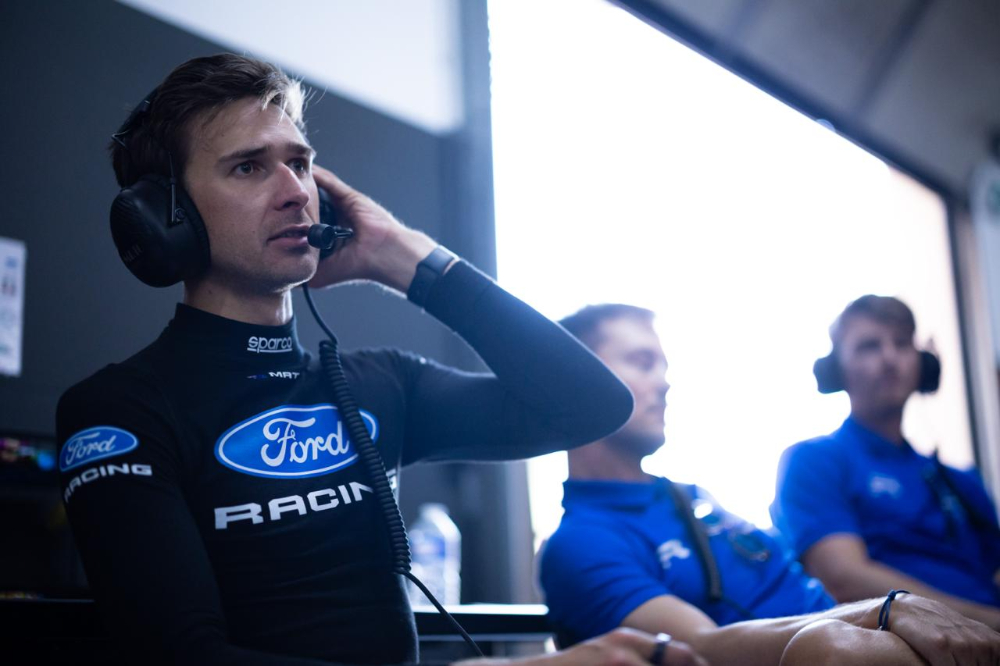
Matt Campbell has been getting seat time in Ford's new Hypercar.
Campbell brings considerable experience with the LMDh regulations, having been involved in the Porsche Penske Motorsport 963 program from its inception. His move to Ford Racing, however, has also meant adapting to a different chassis architecture, with ORECA replacing Multimatic as the supplier.
“I’ve been working already with the team since January, in the simulator and so forth, trying to develop as much as we can off the track in terms of systems and from my past learnings from somewhere else,” Campbell said.
“Coming from a different spine has been one of the most noticeable things, and that’s in many points of view, whether that’s driver comfort in the car, different ergonomics and so forth, and obviously the system side of thing.
The 31-year-old has been particularly taken with the Ford’s Coyote engine, which has been developed in-house for this program.
“The strength so far has been on the engine side, the feeling that we get, and the usability of the engine from the driving point of view,” he said. “I think it’s going to integrate very well with all the systems when we get them more or less sorted.
“I don’t think there’s necessarily one huge weakness at the moment; it’s just all those one percenters that add up. This process has been very rapid going into the start of next year, but I know from my past experience how challenging the systems can be, and definitely for me this is a huge focus because it takes time.
“It’s not going to be perfect by round one, and there’s going to be continual development through year one and even into year two. This is such a huge aspect of these cars, and can really funnel down to the mechanical feeling of the car if you get it wrong, so this is the most challenging, but it’s also the same for everyone on the grid.”
Campbell will be joined next year by Tom Blomqvist, Sebastian Priaulx, Mike Rockenfeller, Logan Sargeant and Nick Yelloly in Ford’s driver line-up. How the group will be split across two cars, however, is still to be determined, with November’s Motorland Aragon endurance test set to play a key role in this decision.
“We haven’t decided who’s in which car at the moment,” Sayers added.
“That will come towards the end of the year when we’ve done the first endurance test and seen how they operate together, even down to the ergonomics in the car. There are several factors that go into it, so it’s something we’re not rushing. We don’t feel the need to decide that straight away.”
The next news update from Ford Racing in the coming weeks is set to confirm the name of its new Hypercar.
Stephen Kilbey
UK-based Stephen Kilbey is RACER.com's FIA World Endurance Championship correspondent, and is also Deputy Editor of Dailysportscar.com He has a first-class honours degree in Sports Journalism and is a previous winner of the UK Guild of Motoring Writers Sir William Lyons Award.
Read Stephen Kilbey's articles
Latest News
Comments
Comments are disabled until you accept Social Networking Cookies. Update cookie preferences
If the dialog doesn't appear, ad-blockers are often the cause; try disabling yours or see our Social Features Support.