Clive Rose/Getty Images
For F1 drivers, even the summer break is something to be optimized
If you are regularly on social media, you might have seen George Russell commandeering the Mercedes channels during the Hungarian Grand Prix weekend to ask different team members what their summer break plans are.
The majority responded with outlines of vacations in a variety of international locations – something that is almost enforced due to the mandatory factory shutdowns prohibiting certain work from continuing. Russell almost certainly will be heading away, too, but at the start of the video he declined to disclose his own itinerary.
That’s largely out of a desire for privacy, but it isn’t a time of year where drivers are solely heading off on holiday with no consequence. The summer break offers a chance to both reset – something particularly important for Russell at this stage – but also refresh mentally in order to tackle the rest of the season. And there’s much more science to that than you might think.
“We need to understand that these people are among the highest performing individuals that we have, which means that they're always on the go,” explains sports psychologist and physician Dr. Elina Haukipuro, a former Mercedes and Williams F1 team doctor who has worked with Russell, Lewis Hamilton and Valtteri Bottas among others.
“Their brains are always working. Like when they're doing their sim work, when they're in the car, during the breaks in between the races. And especially this season, the last eight weeks have had six races.
“And I know that from myself as well, if you're doing a lot of things and then suddenly to just switch off and do nothing is maybe the worst thing that you can do, because your mind is still racing and you're very much in the momentum of the season.
“Also, depending on how well your season has been, or how bad it's been, the more you're usually engaging in it. So a sudden switch-off without preparing for it in any way is really, really hard.
“That's why the first thing that we do during a summer break is exactly this kind of detachment and trying to focus on other things and try let go of the season, the results and so on. And these are trainable skills that we're doing, because it's not something that most people can do on a whim without any preparation.”
Training to let go of poor results or outcomes and focusing on the task at hand rather than the bigger championship picture is something that Haukipuro often worked on with drivers through a season. But those skills are then transferred to focusing on the first part of the break so the drivers can get the recovery she says they “desperately need.”
“We actually do a fair bit of planning in terms of, what does the summer break look like?" she says. "Because unlike what some people might think, I don't let the drivers go and say, ‘I'll talk to you in three weeks,’ because that would generally not create the best results.
“So the more effort and time we put into planning, also how the break will look, this is the way that the drivers will get the most out of it and impacts how successful it's going to be.
“So what I like to do, for example, is that we divide the summer break into three phases. And the first one is the complete recovery, detachment. Then the next phase is this intermediate phase, and then we have a ramping up phase at the end.
“And what that means, is that the first week, the goal in that is just to completely detach from the season, not think about racing at all. And these are the skills that we're practicing as well. And that goes into detail, such as not looking at media, not looking at social media, completely detaching from what everyone around them is saying, and really just focusing on themselves.”
Often we’ll see drivers out and about on jet skis or tackling other recreational activities during the break, which can appear like they’re just chasing their adrenaline fix without racing. In one sense, that is true, but it’s also a planned aspect of energy management and fitness.
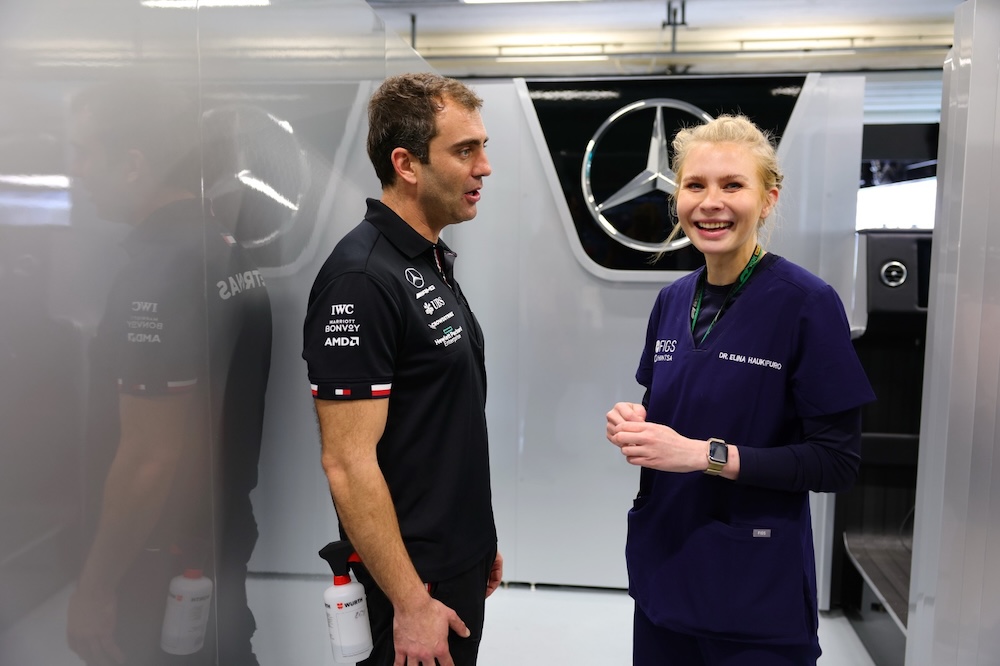
As a team doctor, Haukipuro (right) ensures that the drivers get the maximum physical and mental benefits from the summer break. Photo courtesy of Elina Haukipuro
“We really scale down training during this first week," Haukipuro says. "But for active individuals, it doesn't mean that they're completely still. It usually means that you need some kind of movement, but then doing something that's non-racing related, like going kite surfing, or biking, or something just to get the endorphins and good feeling from moving the body without there being anything competitive about it. You're not measuring any results, just to try and come down from it.
“And we do a little bit of the mental work, mental training, especially to try and keep the focus in the present and not think too much about what is about to come or what has been. And depending on how easy or hard the season has been for the driver, we will do more or less of that. But I would say, even though someone has had a good season, everybody needs that kind of break and detachment.
“It can be from two or three days to up to a week. But if there's a lot of lingering thoughts about, let's say, several races in a row that haven't gone that well, then it's even more important to analyze the emotional parts, the data, and just try to understand why something has happened and how we can prevent that.
“Or, if it's been completely out of your control, like if the car is breaking down, gearbox issues or things like that, to have this kind of acceptance of what has happened in order to be able to move on.”
This is a phase that Haukipuro says can prove a little more challenging for rookies who feel like they’re losing momentum as they tackle their first year in F1, and don’t yet have the experience to know it’s OK to throttle back, and that the rest is an actual requirement to perform well later in the year.
Once that reset has been achieved through switching off during the opening part of the break, the aim is then to ensure that a standard of fitness and mental sharpness is maintained through the middle of it. Plans become far more individually tailored at this stage.
“The last phase, we're kind of ramping up everything,” Haukipuro says. “So we're trying to build up strength. We're trying to build up the same momentum that we've had during the season, and do so more actively with mental training. The drivers will be doing sim work and so on and trying to prep their headspace already and going back to the training.
“But a big key thing, especially this summer break, is to bank up on recovery, bank up on the sleep, because we know what the schedule looks like now after the summer break – nine out of 11 weeks that we're racing to end the season, starting with this very intense triple-header that's coming that is going to include two really hot races [in Malaysia and Singapore]. So heat training for that is also something that we already started doing during the summer break.”
This year, that heat preparation is likely to start even earlier given the recent change in the schedule that was confirmed with the Bahrain Grand Prix being held in Malaysia, also taking away what was due to be a weekend off and creating a triple header. That means plans for each driver’s break had to remain fluid, but making the best use of it for both recovery and training becomes even more important.
“If we're looking at what the F1 schedule looked like 10 years ago, 15 years ago, it's such a big difference," Haukipuro says. "Now, there seems to be a trend where we do get changes in the schedule for different reasons. So we need to also be more adaptable, knowing that things might change and when, for example, we now suddenly have three hot races after each other and we don't have a break in between, that changes massively how much more important it is that we are properly recovered, we're properly rested and that we start heat training way in advance, too.
“And if you look at the mental load that the drivers have during the season, there's an entire day dedicated to media on Thursdays. So there's constantly less time for that natural recovery, rest and also just living life in between as well, which is so important to feel balanced.
“That's why I'm also telling everyone during the summer break, ‘see your friends, see your family, really bank up on that social support and not having to like constantly perform’. Anyone will be tired if we're constantly having to show up and do our best, and we're on camera the whole time when we do good races and bad races.
“It's a very taxing place to be. So the more recovered we are throughout the season, the easier it is to manage through the remainder of the season, even though it is very hard.”
In a sport where small increments can add up to major differences, that even applies to the work being done by drivers during their summer breaks before tackling the business end of the year.
Presented by:

Chris Medland
While studying Sports Journalism at the University of Central Lancashire, Chris managed to talk his way into working at the British Grand Prix in 2008 and was retained for three years before joining ESPN F1 as Assistant Editor. After three further years at ESPN, a spell as F1 Editor at Crash Media Group was followed by the major task of launching F1i.com’s English-language website and running it as Editor. Present at every race since the start of 2014, he has continued building his freelance portfolio, working with international titles. As well as writing for RACER, his broadcast work includes television appearances on F1 TV and as a presenter and reporter on North America's live radio coverage on SiriusXM.
Read Chris Medland's articles
Latest News

Comments
Comments are disabled until you accept Social Networking Cookies. Update cookie preferences
If the dialog doesn't appear, ad-blockers are often the cause; try disabling yours or see our Social Features Support.