
The RACER Mailbag, July 8
Q: As a Scott Dixon and Ganassi fan for as long as I can remember watching IndyCar, the news of Dixon’s leaving is sad to see. This has made me realize that the era of IndyCar that I grew up on is over.
Watching Dixon battle Newgarden for championships is no more. RHR, Helio Castroneves and Takuma Sato are all doing one-offs at Indy. Kanaan is working with McLaren. Due to injury Pagenaud can’t even drive a go-kart, sadly. Power and Dixon have both moved teams. It didn’t work for Power, and unfortunately I don’t think it will work with Dixon. Rossi has been switching teams, but he has been more consistent.
The only drivers truly left are Rahal and Newgarden. I wish all of these drivers the best, but it is sad to see that they have mostly moved on. It is overwhelming to witness the IndyCar I grew up on crumple before my eyes.
Reid Edmondson, Yorktown, IN
MP: I hear you. I was fortunate to grow up at a time where Mario, A.J., Johncock, Rutherford and more were still active in mid-1980s CART, but Mario was the only one of the icons who remained genuinely competitive until the end. It was sad to see some of the all-timers lose their edge or dropping deep into the field with lesser teams, but it’s inevitable for the majority of drivers.
For newer fans, they’re on the clock with their favorites – Malukas, O'Ward, etc. – who will follow the same arc years from now and move to second-tier teams, and possibly third-tier programs after that. Even now, with Newgarden turning 35 later this year, and Rosenqvist and Rossi who’ll be 35, and Ericsson who’s headed towards 36, are within 5-10 years of reaching their finish lines. It’s part of life.
Q: I would like to clear this misinformation about Colton Herta's possibilities of getting that super license. People are thinking he needs to get his super license this year, because he would otherwise lose his 30 super license points for finishing second in the 2024 IndyCar season. But that is actually incorrect!
FIA Article 13.1.5 clearly states when a driver is applying for super license, they will look at results from that driver either from the current year and previous two years, or previous three years. So if we assume that Herta would apply for a super license during next year, he can still use his results from 2024-26, which includes that second place from the 2024 IndyCar season.
Why is this relevant? I think due to the confusion of how Franco Colapinto got his super license, FIA updated their rules regarding super license points from free practice sessions. The updated rule states this:
"Any such points awarded will be counted on top of his sporting results, calculated under Art 13.1.5 and shall be independent of the calendar year in which the free practice session(s) was completed."
FIA will only look at those results from three years and then add whatever points the driver has been awarded from free practice sessions regardless the year they were awarded.
If we assume that he only gets four super license points from free practice sessions this year, Herta would get his super license next year by simply getting two super license points from free practice sessions. Because by then, Herta can use his results from the previous three years (2024-26), where he has gotten at least 34 super license points. And then FIA adds the six points from free practice sessions, which adds up to a total of 40 super license points.
Funnily enough, with this method, two points from free practice sessions next year would be enough for him, but finishing fifth in the F2 championship would not be, as by then, Herta would not be able to use both 2024 and 2027 results for getting his super license.
How much should Cadillac take this path into consideration? Considering both Perez and Bottas signed a multi-year contract, I think it would make sense to give Herta another year in F2 and not rush him into F1 for next year. As long as he gets those points from free practice sessions, Herta's championship position in F2 doesn't matter, and the results from F2 aren't exactly 100% representative to F1.
Would this method make more sense rather than try to rush Herta to get his super license this year? Or if they really want Herta to have that super license this year, should they just give him a fifth free practice session, which would give him that 40th super license point before next year?
Kalle
CHRIS MEDLAND: Excellent digging, Kalle. You’re right that this is a way of using the FP1 points to top up the super license application, even if this year isn’t enough on its own from an F2 POV (although I’m pretty sure Cadillac might just go for six FP1s this year to get that box ticked anyway).
But I also don’t see the team waiting, because if the F2 results aren’t coming then he will have learned from this year regardless, and it will be Colton’s potential in the F1 car that guides whether he gets a race seat. If the team feels he can perform in the F1 car, I’m pretty confident it will put him straight in so he can build up his experience there, rather than doing so in F2 for a further year.
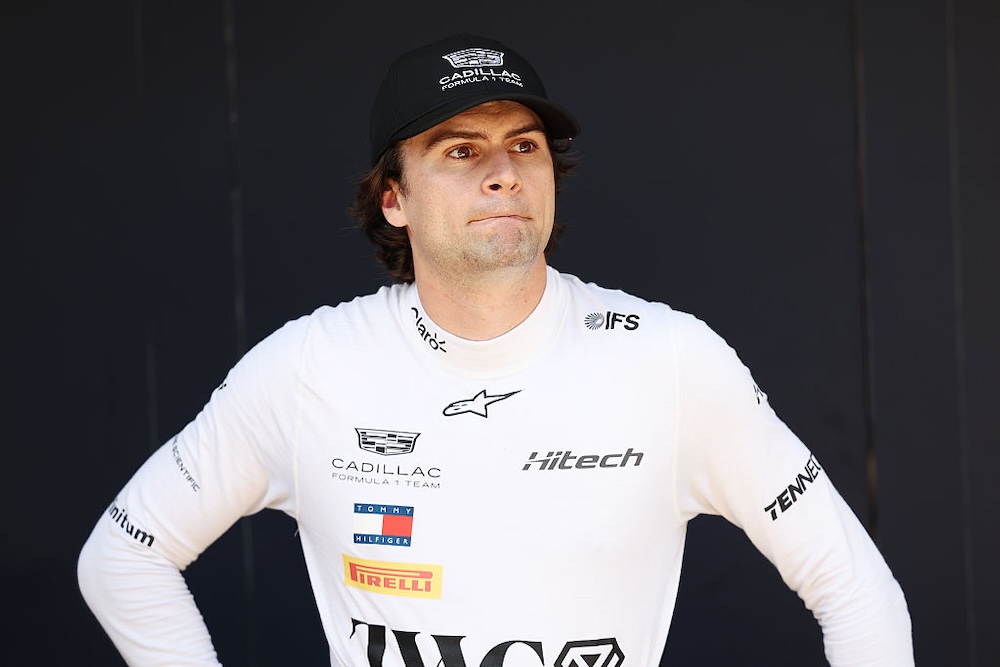
We have the same expression when we're going into the weeds on super license points. Dom Gibbons/Getty Images
Q: Might be a big ask – I think you'd have to ask the FIA – but can you find out how many super license points Herta has? Is it 35 or 36? Here's why there is confusion:
Points applicable in 2026:
2023: One point (10th in IndyCar)
2024: 30 points (Second in IndyCar)
2025: Four points (Seventh in IndyCar)
2026: One point FP1 (F1 Barcelona, three more scheduled but not including those here)
Total: 36
Okay, but the one point from 2023 expires at the end of this year, yes? Here's what the FIA regulations say:
13.1.5 The driver must also satisfy at least one of the following requirements: a) Have accumulated at least 40 points. The FIA will consider the number of points accumulated in either (i) the three-calendar year period immediately preceding the year of the date of the application, or (ii) the two-calendar year period immediately preceding the year of the date of the application in addition to points accumulated in the calendar year of the application, whichever is higher. All points are listed in Supplement 1.
And then Supplement 1 says regarding free practice points:
"Any such points awarded will be counted on top of his sporting results, calculated under Art 13.1.5 and shall be independent of the calendar year in which the free practice session(s) was completed."
I am confused! Would he need to apply for a super license in '27, with the one point from '23 expired, or can he apply in '26, therefore keeping the one point from '23?
My basic question is this: Assuming he does not score any points in the F2 championship this year, how many more free practices does he need to do in order to get his super license? Does he have 35 points and needs five more free practices, or does he have 36 points and needs four free practices?
And to completely nerd out on this, I know he will get two points from F2 if he has a clean record at the end of the season – commonly called the fair play rule – but we won't know that until after the last F2 race.
If you can find this out from the FIA, I owe you a beer (or several!). Thanks!
Nikki
CM: Nikki, you can partly just look at Kalle’s question above to help answer this! But I have it as, he needs four more clean FP1 outings from here, as he can use 2023-2025 as his super license application, topped up by the FP1 appearances from this year.
Of course, getting points in F2 would also simplify that equation, as he only has to score a top-10 finish in the championship (10th providing three super license points) to exceed the 2023 IndyCar total.
Marshall Pruett
The 2026 season marks Marshall Pruett's 40th year working in the sport. In his role today for RACER, Pruett covers open-wheel and sports car racing as a writer, reporter, photographer, and filmmaker. In his previous career, he served as a mechanic, engineer, and team manager in a variety of series, including IndyCar, IMSA, and World Challenge.
Read Marshall Pruett's articles
Latest News

Comments
Comments are disabled until you accept Social Networking Cookies. Update cookie preferences
If the dialog doesn't appear, ad-blockers are often the cause; try disabling yours or see our Social Features Support.