Mamola looks back on 47 years of MotoGP and to what's next
Randy Mamola first joined the FIM 500cc World Championship in 1979 and 47 years later, the four-time 500cc runner-up is still prominent in the MotoGP paddock. A spectacular, fiercely determined racer, Mamola ultimately won 13 Grands Prix and stood on the podium 57 times throughout his 13-year career. After the Californian called time on his career, he formed Two Wheels for Life and Riders for Health to deliver healthcare in Africa. This weekend, Mamola s attending the Monster Energy Grand Prix of Czechia at Brno, a race he has a long affiliation with.
“It just so happens that I still was one of the youngest guys to be able to ride on the track in Brno when it was the old circuit and almost seven and a half miles long,” said Mamola. “Parts of that circuit still exists and goes through the town and up through the road.
"You have to imagine someone like me back then. I’m 19 years old and I’m in the back of a caravan that’s being towed by a Mercedes and racing for a guy called Serge Zago in the 250cc class and the 500cc class. When we got to the border there it was a four and a half hour crossing to get through, because it was an Eastern Bloc nation where East Germans could come and see the races. There were armed people around the paddock. There were armed people when you had to pull your passport out.
"The first practice, I go through the town and it is literally just hay bales making chicanes. We were going through these apartment blocks and going into the forest. It was amazing on Sunday. I opened up the caravan that we were sleeping in and there were 250,000 people there. I’ve never seen anything like that. The colors, the vibrance and everything. Riding on that type of circuit, and it was still a street circuit, it was something very, very special and something that I will never forget.
“When they built this track here at Brno, the closed circuit, it is something that is spectacularly beautiful. I flew in this morning from Barcelona to Prague. Prague is one of the most beautiful cities inside of Europe. The old buildings and old churches and things like this, it is just really, really beautiful. Everybody is really looking forward to this weekend’s race.”
Mamola explains how his place in the paddock has evolved.
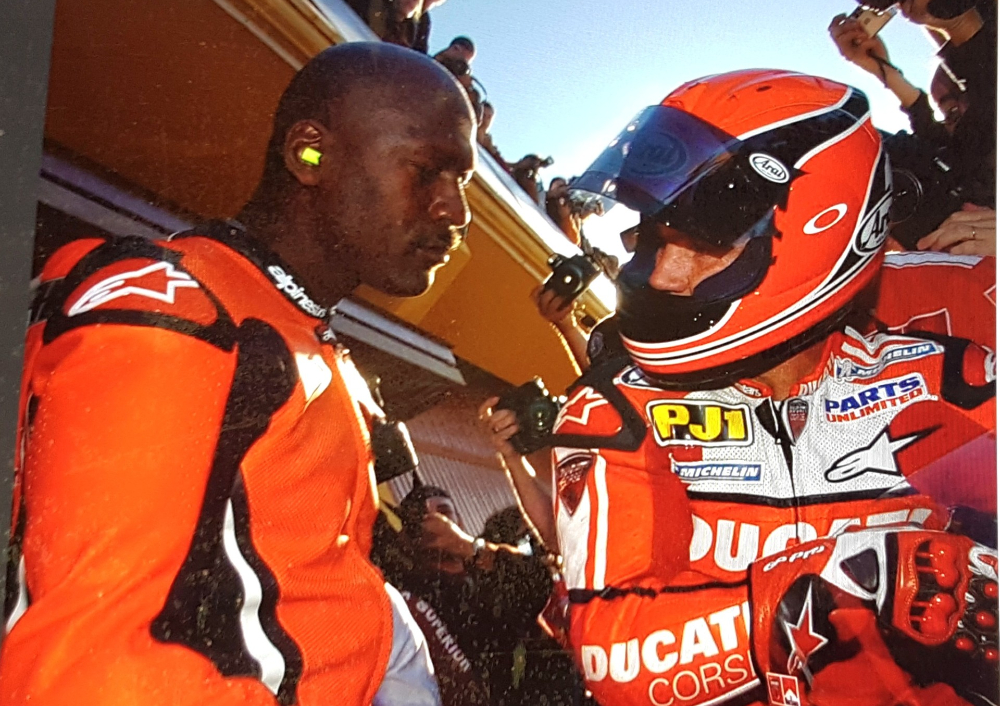
“It’s now 15 years that I’ve been with Monster Energy,” he said. “Before that, I was doing a lot of testing and things like that. Then it was riding the two-seat bike for nearly 20 years with Ducati. I did more than 6,000 passengers in the 20 years that I did it. One of the things that I love is that during the practice sessions on Saturday, I get to take two journalists out. I take them out one at a time on a scooter and we get to get to go see these guys drag their elbows, their shoulders, and sometimes their helmets if they go down. There is nothing like it that I know of.
"Anyone that is outside of our sport I love because that’s who we’re trying to reach. We’re trying to reach more people. I’ve also been working with Gabriele Mazzarolo and Alpinestars for 49 years.”
He's aware that not everything in modern MotoGP suits everyone, but feels things are heading in the right direction.
“Listen, it’s a sport. I mean, there are things that I dislike and there are a lot of people talking about the things that we should change and not change," Mamola said. "I just think that we all have to wear a seatbelt and hold down and slowly but surely these things will change. Let’s see what happens in 2027 when the 850s come out. Maybe there will be different riding styles and different performances amongst the original OEMs and machinery. That’s going to be exciting to see what Honda can do and what Yamaha can do against the Aprilia and the Ducati and the KTM.”
MotoGP machinery has changed a lot in his near half-century of involvement, he notes.
“We started in 2002 with the four-strokes," said Mamola. "The Honda five-cylinder was just a blessing. On the racetrack you could just smoke the tire and everything. Unfortunately, we don’t get to see too much smoke anymore out of the tires because the wings are trying to hold these things down. Let me just tell you... Imagine riding your motorcycle and you’re doing 358 kilometers an hour, which is 228 miles an hour. The amount of aero that is pushing the front end down is the equivalent of 90 to 100 lbs. So imagine going down the straight and trying to swerve to miss something when you’ve got something that has 100 lbs pushing down on the front tire.
"When you think about the accidents that we’ve had lately, like the one in Barcelona and the one that was in Budapest just a couple of weeks ago, things are definitely going to change. Before the end of the summer, I believe they’re going to take away the way they push the fork down and make it much more human to be able to do the starts, as opposed to something that’s artificial.
“I came in here in 1979 to ride a 250 and a 350,” he continued. “I end up riding 250 and 500. I only finish six races in the 500 class and I have two second-place finishes alongside Kenny Roberts and Barry Sheene. I’m still the absolute youngest ever to be on the podium. It’s funny because recently Pedro Acosta, asked me, ‘How did you do that? How were you so young to be there?’ Because when we came over here, we did not have the Red Bull Rookies Cup. We did not have Telefonica Movistar 125s. We didn’t have anything. We came over here and Kenny won in his first year riding a 500 knowing maybe one or two tracks out of the 15. It was the same with me when I came over.
“The cool thing about my career is that, yes, I finished second in the world championship four different times. Two times with Suzuki, one time with Honda and one time with Yamaha. I’ve beaten every World Champion that beat me. Kenny beat me in 1980 and I beat him in 1981, however I finished second to Marco Luchinelli. In 1983 Freddie Spencer won, Kenny was second, I was third and Eddie Lawson was fourth. You try to beat that. That was the energy we were up against. And the cool thing about it is were all still very close friends with Wayne Rainey and Kenny and Eddie and Kevin Schwantz and even Doug Chandler. I think the Americans brought so much character inside the sport. You just know how we were. Looking back at that, it was great. There was tobacco money. It was about the rider and talent, not about you bringing money. That was super important. It was just something very, very special.
“Like Casey Stoner’s story, like Mick Doohan’s story, like my story and Eddie’s story, we had to come from Australia and America to live in an area of Europe somewhere to race tracks, cultures and everything that we didn’t know. But one diamond can be created out of a stone. It just takes time to get these guys up there and running.”
Having lined up for 151 races during his 500cc career, Mamola has collected an extraordinary number of memories along the way.
“My first win was in Zolder, Belgium in 1979,” he recalled. “I won twice that year. The second win was the British Grand Prix. Silverstone was an amazing racetrack. I’d been there in 1979, and now in 1980 I’m up against Kenny and everybody with a factory Suzuki. It was my parents’ 35th wedding anniversary, so I flew them over in first class. I wanted to thank them for everything they had done for me. And I won the Grand Prix. It was something very, very special to have them.
“And we talk about racing, we talk about safety. I think Eddie, myself, Kenny, Freddie, along with Barry Sheene and the rest of the guys that were out of Italy, we were doing things for safety. But the amount of safety that is being put in now still needs to be worked on because everything can change at a moment’s notice, especially at the speeds that they’re doing now. So 2027, we’re hoping to slow them down a bit. I don’t know how much they’ll slow down because I still think the corner speed on an 850 is going to be quite high.”
His charity work continues to be a high priority for Mamola too.
“Two Wheels for Life and Riders for Health, we now have roughly 1,600 bikes out in the field and we are responsible for health to 247 million people in Africa. There are three of us that are the founders. Barry and Andrea Coleman and myself. Princess Anne is still our patron and is always helping us out. We’re doing enduro rides in 2027 starting this February.”
In 2018, Mamola was inducted into the MotoGP Legends Hall of Fame, adding to his legacy.
“I’m proud of the things I was able to do,” he said. “I was not a single rider that stayed in the world championship with just one manufacturer. I was lucky enough to be on the podium with four different manufacturers in the 500 class. Looking back at all that, I’ve had a full circle and then somebody that has a charity that’s the charity for MotoGP, DORNA and the FIM has been remarkable.
“And the guys I raced against, they were all such unique people. Like Kenny. I still have a photograph with him when he was 21 and I was 15. We were at the Cow Palace in San Francisco doing the indoor race. And then actually having to face to face against Kenny in the 1980s was amazing. I still say he’s the absolute best when it comes down to riding a TT at the Houston Astrodome or Ascot. Those kind of races were just insane. That’s what I was up against. That was just something very, very special.
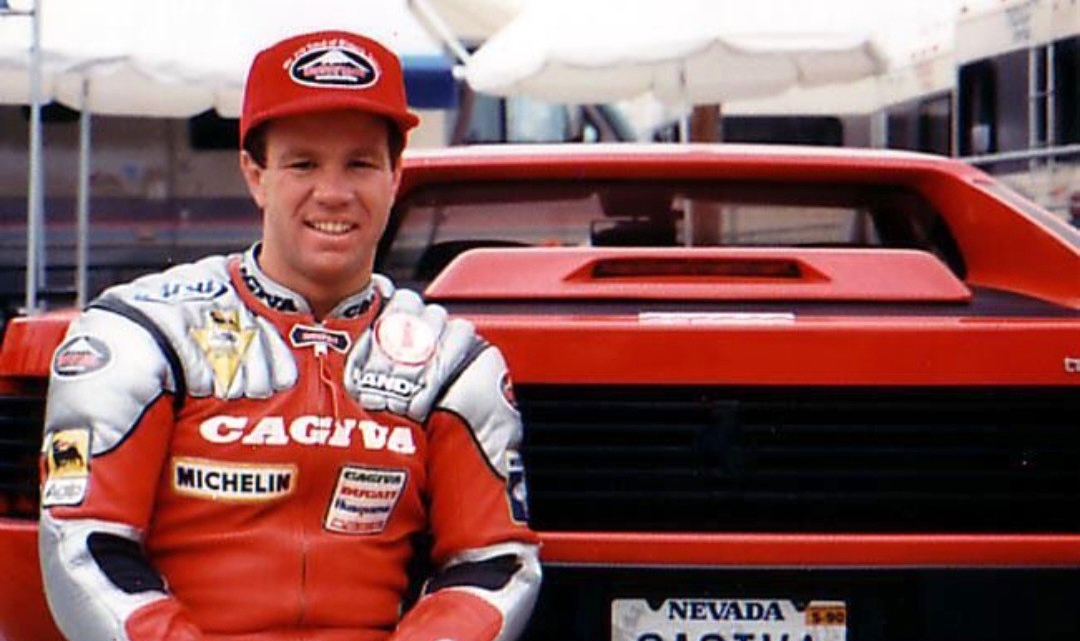
"My life has just been full of expectations and happiness. I know there are people ho will always say, ‘Yeah, too bad you just never won a world championship.' Listen, there are people that never even get a medal. There are people that never even get on the podium and I’ve been up there 57 times. And not many people got a Testarossa from Ferrari for finishing in third place at Spa-Francorchamps. That was from Cagiva.”
Eric Johnson
Born and raised in the rust belt to a dad who liked to race cars and build race engines, Eric Johnson grew up going to the races. After making it out of college, Johnson went into the Los Angeles advertising agency world before helping start the motocross magazine Racer X Illustrated in 1998. Some 20 years ago, Johnson met Paul Pfanner and, well, Paul put him to work on IndyCar, NASCAR, F1, NHRA, IMSA – all sorts of gasoline-burning things. He’s still here. We can’t get rid of him.
Read Eric Johnson's articles
Latest News
Comments
Comments are disabled until you accept Social Networking Cookies. Update cookie preferences
If the dialog doesn't appear, ad-blockers are often the cause; try disabling yours or see our Social Features Support.
.jpg?environment=live)