Pikes Peak flashback: Electrifying Dumas and VW break the eight-minute barrier
Officially, a great result for Volkswagen and Romain Dumas at the 2018 Pikes Peak International Hill Climb would be if the ID.R Pikes Peak, an all-electric prototype conceived to showcase the German marque’s ID. road car range – and to send out positive vibes in the ongoing rehabilitation of a reputation left in tatters after VW’s “Dieselgate” controversy – beat Rhys Millen’s 9m07.222s EV record set with the eO PP03 in 2015.
Unofficially, but certainly not discounted, it would be incredible if the low-line, dual motor, battery- and braking regen-powered machine could get close to Sebastien Loeb’s overall record of 8m13.878s – a breathtaking benchmark set in 2013, when the WRC G.O.A.T. ripped up the 14,115ft mountain in Peugeot’s twin-turbo, 3.2-liter V6-powered 208 T16 Pikes Peak in 8m13.878s.
But as testing ramped up and VW’s engineers began to join the dots on the section times they were seeing, there was a dawning realization that this lightweight, barn door-winged bolide just might – and, please, not a word to anyone else, guys… – break the eight-minute barrier come the June 24 race day on the 12.42 miles, 156 turns and 4,720ft of elevation change of “The Race to the Clouds.”
Under promise and overdeliver…
A mere 250 days earlier, the ID.R had been just one line item on the agenda at a VW board meeting.
Once approved, VW Motorsport Director Sven Smeets set about locking in the in-house team and the partners that would turn the notion into record-setting motion. “FX” Demaison, who’d masterminded the wildly successful Polo R WRC, and Willy Rampf, ex- of Sauber F1 and the go-to guy for the program’s high-downforce, low-drag aero puzzle, were the leaders of an in-house group of around two dozen engineers and fabricators. Key partners included Michelin and its expertise on the vagaries of tire pressures at high altitudes, Integral Powertrains for the motors, and sister brand Porsche for its LMP1 aero and packaging expertise. But with time as the essence, no way could they build a mountain-beater from scratch in a little over six months.
Enter Romain Dumas…
The two-time 24 Hours of Le Mans overall winner was already a three-time King of the Mountain and, crucially, his 2017-winning Norma M20 – a car that, in its ICE-powered format, had dipped below the nine-minute barrier, but probably wasn’t capable of much more in the hands of Dumas’ plucky band of privateers – was a potential short cut to meeting the deadline.
Having Dumas at the wheel for the ID.R project was a no-brainer, and the Frenchman was enthused by the prospect of a car that didn’t run out of grunt at higher elevations. But taking his M20 as the already well-sorted starting point for taking out weight, adding downforce, reducing drag (including fitting a svelte, closed cockpit), and placing the motors, energy-recovery systems and batteries was an inspired decision, given the time restraints.
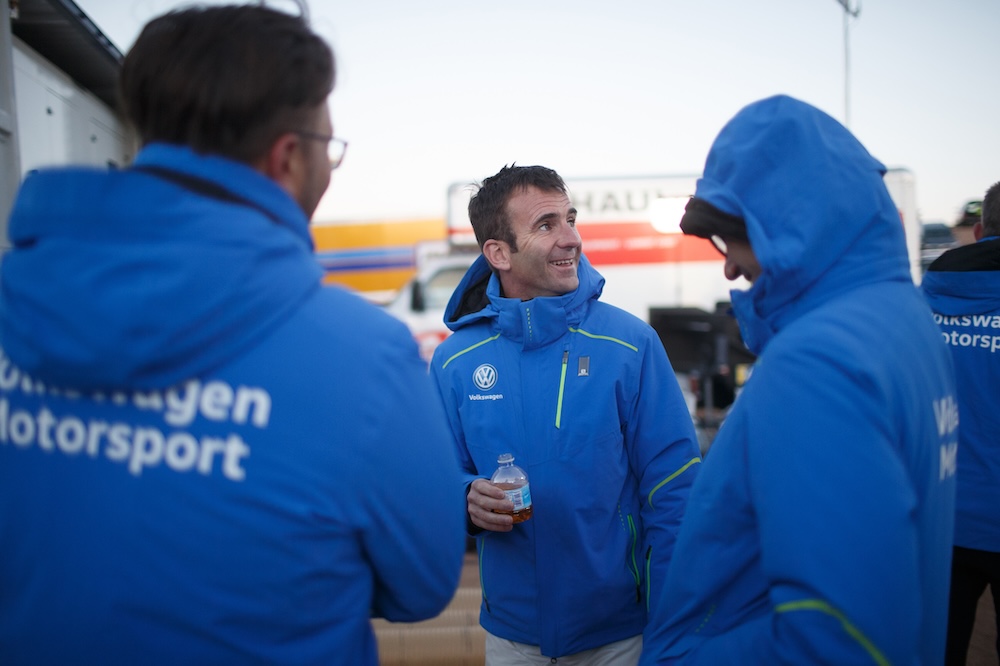
With his Pikes Peak-winning record and experience, Romain Dumas was a key addition to the VW ID.R program.
Back in 2015, Millen had set the EV record with a purported 1,600hp and 1,850lb.ft of torque on tap. VW had run the numbers and, with low weight, low drag, gobs of downforce (which would fall off with every foot climbed) and regenerative braking to supplement the battery charge, believed it could reset the benchmark with just 680hp, 475lb.ft of torque and 100kg (220lbs) less weight than the 1,200 kilos (2,650lbs) of the eO PP100.
Pounds and ounces were shaved from every part of the baseline Norma, with the decision to fit a single motor to each axle, rather than one at each corner, making a significant contribution to the weight saving. The cars drag was systematically reduced via CFD runs and time in the Porsche wind tunnel and the massive rear wing – wider than the car itself – tuned to deliver more than 2,000lbs of downforce at the 9,390ft startline.
Initial testing of the ID.R at the Alés circuit in the south of France in late April hinted at the potency of the package, albeit with the caveat that grin-inducing performance at 600ft above sea level wouldn’t necessarily translate to the same at 10, 12 or 14,000ft. Sure, the motors would still be cranking out near-700hp, but until the team headed to Pikes Peak and tested in thinner air, the complex matrix of reduced downforce, less-efficient cooling of systems and subtle, altitude-related tire pressure changes made predictions something of a guess.
The car and team arrived in Colorado at the end of May, with Dumas first carrying out systems checks and setup guesstimates in the mile-high altitude of Pikes Peak International Raceway before heading up the mountain for a first real taste of what might be possible.
Through the first week of June, testing the ID.R on sections of the actual Pikes Peak course, optimism turned to borderline incredulity as Dumas and the VW engineers began to explore the performance envelope. OK, the race day weather and course conditions could throw in an almighty spanner – and often had – but if conditions stayed somewhere close to behaving themselves, forget a mere electric record. Instead, it would be Loeb and Peugeot’s outright record that the gray machine would be tilting for.
“The ID.R Pikes Peak is the best car that I’ve ever driven up this mountain,” said Dumas, struggling to keep his excitement in check.... “The acceleration and cornering speed are really impressive. Thanks to the electric drive, I don’t need to change gears and can focus on the line instead.”
And, ominously, Dumas felt there was more to come, noting: “It goes without saying that there is always room for improvements. In the remaining test drives, we will continue to optimize the tuning.”
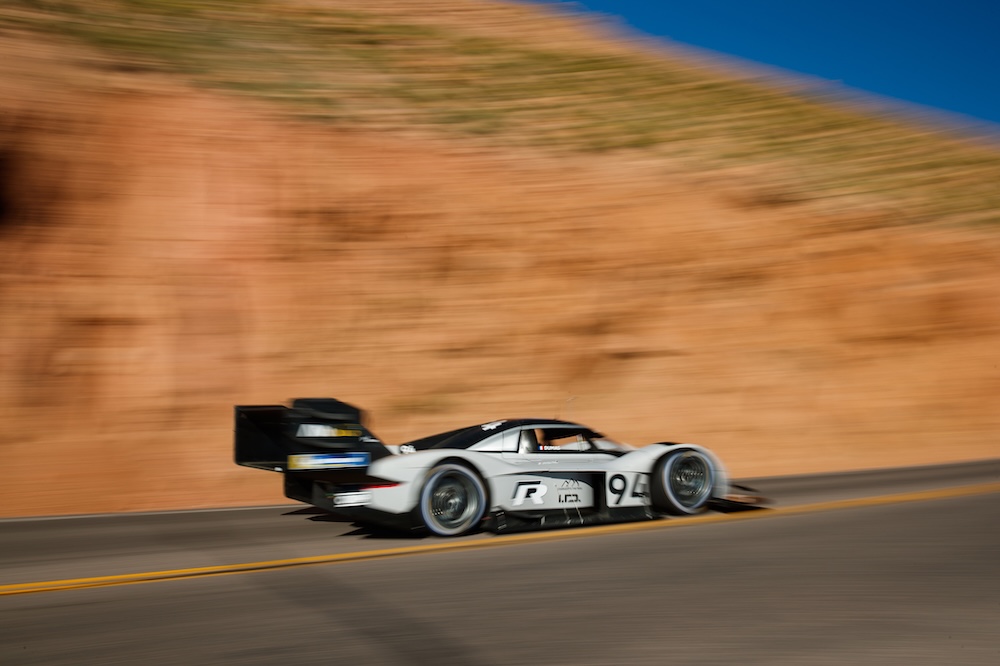
Testing showed the ID.R’s potential, but Romain Dumas knew there was even more to come.
On June 20, Dumas set the quickest qualifying time. Running just a portion of the full course, the ID.R’s 3m16.083 flyer was a full 11 seconds quicker than its nearest rival, Simone Faggioli’s ICE-powered Norma M20. But the VW driver still wasn’t getting ahead of himself.
“From a driver perspective, it’s difficult, because you can’t afford to make even the tiniest mistake,” said Dumas of his race day prospects. “And you only get one shot. If anything goes wrong, it’s all over. If my tires get damaged, I can’t make a pit stop, change the tires and then go back out onto the track. On Pikes Peak, months of work and the related hopes of victory can go up in smoke within seconds.”
At Pikes Peak, race day is the first time the full course is run, practice and qualifying taking place over sections of the track. Joining the dots is easier said than done, with conditions often changing significantly from the start to the finish of a run, and setup being something of a compromise as a car ascends from the lower meadows, through the twisty middle section, and on to the thin air and high-speed blasts of the run to the finish. Pre-start, the tension builds and the conditions change, and adding to Dumas’s nerves, a 45-minute delay for an earlier car leaving the road saw the clouds building, some light sprinkles of rain in the middle section, and the chance of more showers on his ascent.
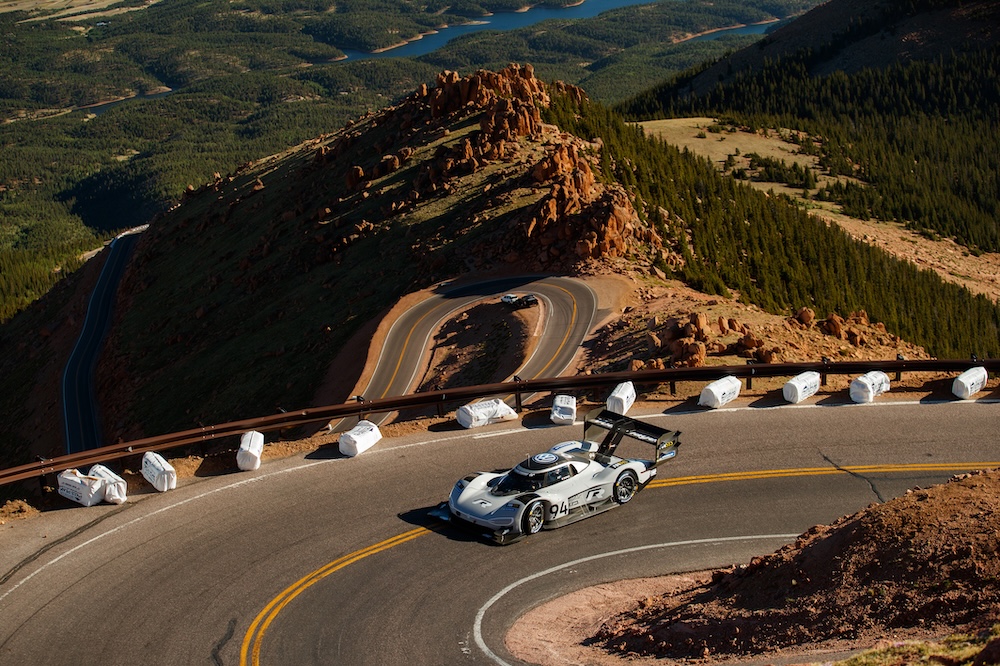
Thankfully, the rain held off, and as Dumas began his run, it was obvious that this was going to be something special. Mile after mile, the undulating whirrs of its motors signaled the ID.R’s relentless progress, until suddenly there it was, a gray shape accelerating to the finish through a gray, drifting mist.
Stop the clocks. A new record time, 7m57.148s. Dumas and the ID.R had not only smashed Loeb’s record by a mighty 16.73s, but had recorded the first sub-eight-minute ascent of the mountain.
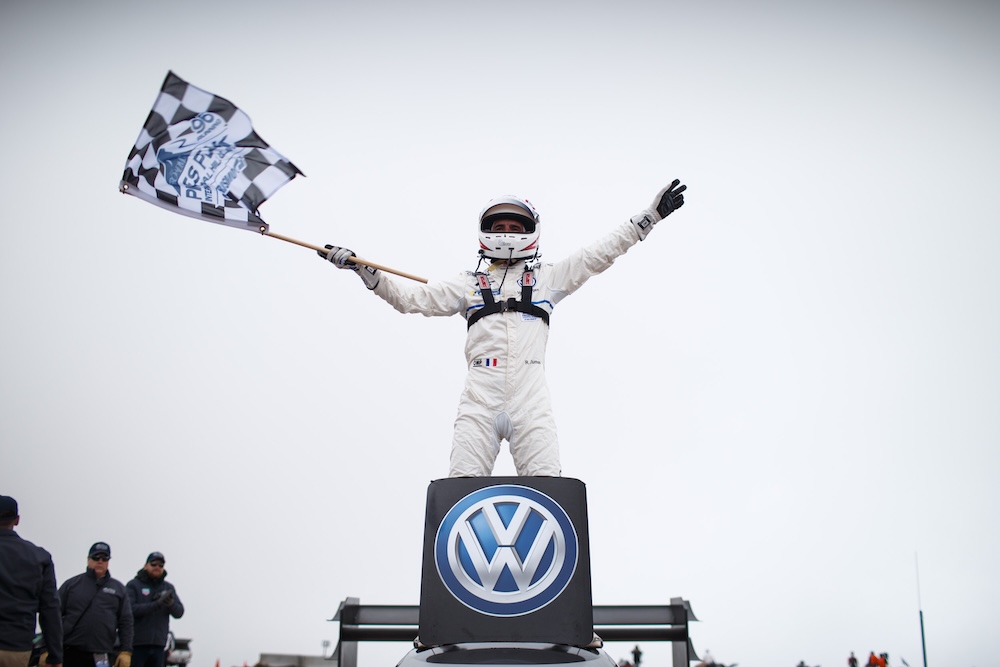
Romain Dumas and the Volkswagen ID.R Pikes Peak shattered the record on the Colorado peak, stopping the clock at 7m57.148s.
Putting Dumas’s dominance into even starker perspective, the second-place finisher – Faggioli’s Norma – was forty seconds slower than the flying Frenchman.
An electric performance by the all-electric Vee-Dub. But as the team celebrated at the start line and Dumas tucked into a cheeseburger at the summit café, he mused on how much quicker he might have been…
“I had some fog and it was quite humid with some damp in the second section,” he said. “I’m happy with this, but we could have gone maybe 10 seconds quicker if that middle sector had been dry.”
As Dumas finished his post-run meat treat, rain and snow began to lash the summit, cutting the event short and dashing the forlorn hopes of the later runners – not that any could have lived with VW’s astonishing EV.
Eight years later, Dumas’s record run remains the Pikes Peak benchmark. At times, it feels like an untouchable mark – but so did Loeb’s previous record, until the ID.R came along.
Can the likes of Robin Shute or defending King of the Mountain Faggioli come close to that magic sub-eight-minute mark this year? That’s one of the fascinating unknowns of Pikes Peak. If the weather gods decree it and conditions are benign to the point of perfection, then who knows? Either way, the 104th Running of the Pikes Peak International Hill Climb will be unmissable viewing.
Who’ll be on top of the world in 2026? RACER Networkwill bring live coverage of the Race to the Clouds to viewers across the world. Pikes Peak Live, presented by Mobil 1, coverage begins at 9:00am ET/7:00 a.m. MT on Sunday, June 21.
Fans worldwide can also stream the race live on RACER+, free with email registration, ensuring motorsports enthusiasts everywhere can experience one of the world’s most challenging and iconic competitions in real time.
Bundle and save to get 6 print issues of RACER Magazine, unlimited digital access to the RACER archive, and 24/7 motorsports streaming on the RACER+ App for just $129.99 for one year. CLICK HERE and subscribe now for the ultimate motorsports fan experience.

RACER Staff
Read RACER Staff's articles
Latest News

Comments
Comments are disabled until you accept Social Networking Cookies. Update cookie preferences
If the dialog doesn't appear, ad-blockers are often the cause; try disabling yours or see our Social Features Support.