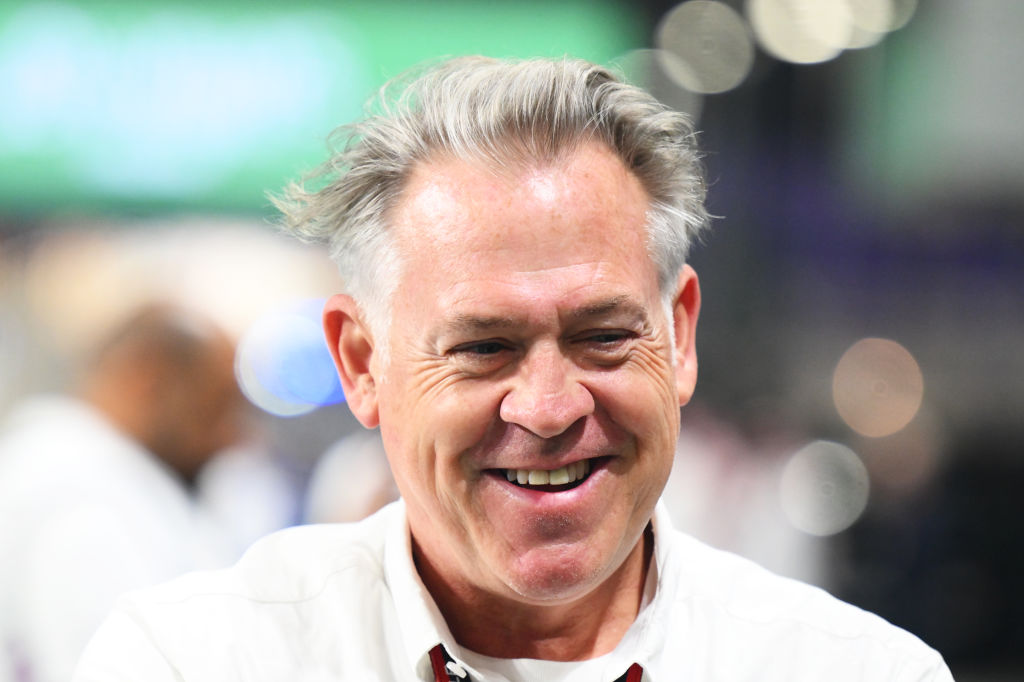
Simon Galloway/Getty Images
Elkins on choosing IndyCar as his closing chapter
Scot Elkins, the new Managing Director of Officiating (MDO) for IndyCar Officiating Incorporated (IOI), hopes his new position will be the perfect closing chapter to a long career as a well-traveled racing official.
The Indiana native has worked for most of the known racing organizations in the U.S. and on the international stage – often for abbreviated periods – which made the call from the Independent Officiating Board (IOB) to be their person in charge of the IOI a perfect fit for his station in life.
“I'm looking at it as kind of my last big project, to be honest,” the Indiana native said during a briefing on Saturday at the Indianapolis Motor Speedway. “I'm not that old, even though I look it, but I'm looking at it as something that [is] coming full circle in a lot of ways. When I worked in open-wheel the last time, it was, it was a long time ago, but coming back and being a part of it is, I won't say it's a dream, but it's something that I've always wanted to be a part of. And so, yeah, I do kind of see it as maybe my final big project.”
Elkins was part of Champ Car in the 2000s and has had stops at IMSA, NASCAR, the SRO, many tiers of the FIA in open-wheel and sports cars, and junior open-wheel in capacities as a race steward, senior official, or with technical oversight.
He wasn’t onsite for last weekend’s Sonsio Grand Prix on the Indianapolis road course where the IOI struggled to cover itself in glory; Elkins was in Sebring with SRO, but he did start on Monday and has fully assumed his position as the day-to-day leader of the IOI’s race control department commanded by Race Director Kyle Novak and its technical inspection team run by Kevin "Rocket" Blanch.
Next Sunday’s Indianapolis 500 will mark Elkins’ first event as the chief executive responsible for all aspects of race administration and technical compliance, which he welcomes.
“The good news is that Kyle and I and Rocket and I kind of all know each other,” he said. “I was in this paddock tertiary about 20 years ago, and so a lot of the people are the same as we all know. And so I think it's going to work really well. I mean, again, as the (IOB) said many times, and everybody said many times, things aren't broken. We just need to make some adjustments into how we operate, how we communicate, and how transparent we are, and I think that's the biggest targets we have as the IOI.
“As a native Hoosier, I've always loved this. This is the first place I ever came when I was a child. I sat in Turn 1, and I was 12 years old. And I've always loved IndyCar racing. I've always kind of wanted to be a part of it. I feel like there's some kind of unfinished business when Champ Car and IndyCar split a little bit, and so I felt like I wanted to come back and be a part of it. I like the approach that the board's taking. I like the way that the independent organization is operating, and I just felt like I wanted to be a part of that.”
Under the IOB’s original envisioning for itself, the MDO, and the IOI, the three-person board would have a limited role at the races while the MDO was meant to be their delegate – their eyes, ears and director – behind the scenes.
But with the extended search for an MDO that pushed into the second month of the IndyCar season, IOB members Raj Nair and Ray Evernham have been a familiar presence at the events along with the occasional appearance of its the third member, the FIA’s Ronan Morgan, to fulfill the duties meant for the MDO. Elkins’ recent hiring should allow the IOB to step back a bit, but Nair, who serves as its chair, doesn’t expect the IOB members to disappear.
“Scot's in charge,” he said. “It’s a board versus CEO relationship, so Scott's in charge. You know, we're partially here because we enjoy it, I guess, but we are here to observe the way we framed it is in our experience so far, at the beginning of season, one of the things that we really want to identify is where we think we were going strategically, and some strategic initiatives that we had in mind, and we've put that in place.
“We discussed with Scot as he was coming on board, now that he is on board, that strategy. We sat down with Scot and Kyle and Rocket and have gone through that together and aligned on that, and now it's our responsibility to really leave that to Scot and the team to go execute that, and then us monitor that the progression of that strategy, but it's always been the case that Scot's the CEO and he's running the organization and we're overseeing, and to an extent, from this point on, he'll be the one proposing where the strategy is going, and the board will be the one commenting on it and approving it.”
Elkins will also spend the rest of the Indy 500 getting a feel for how he can complement Novak and Blanch in their roles.
“It's actually not that much different than what I did at IMSA, because I wasn't directly involved in race control or technical inspection in those areas, I'm just kind of just kind of overseeing it. The big part for me is being here, since it's Saturday and I started Monday. The big part for me is actually just trying to get an understanding of how all the systems and all the groups operate, and get a feel for what's happening.
“For me, I think it's going to be important that during the race I'll be in race control as a resource in case anything comes up or if Kyle – not that Kyle would need it, but if you wanted to bounce something off of somebody, or have a have a secondary opinion, I'll be there available for that. The same with Rocket in technical inspection, when that process happens, like when we get to go qualifying, I plan on being on the ground and being a part of the qualifying process and trying to get a real understanding of it.
“It's pretty unique here relative to how it all works, and so that's the biggest part, is just being where I think I'm needed, not necessarily being where I might be used to for the last 10 years.”
Marshall Pruett
The 2026 season marks Marshall Pruett's 40th year working in the sport. In his role today for RACER, Pruett covers open-wheel and sports car racing as a writer, reporter, photographer, and filmmaker. In his previous career, he served as a mechanic, engineer, and team manager in a variety of series, including IndyCar, IMSA, and World Challenge.
Read Marshall Pruett's articles
Latest News
Comments
Comments are disabled until you accept Social Networking Cookies. Update cookie preferences
If the dialog doesn't appear, ad-blockers are often the cause; try disabling yours or see our Social Features Support.