Marshall Pruett
If you think today's IndyCars are fast at Phoenix...
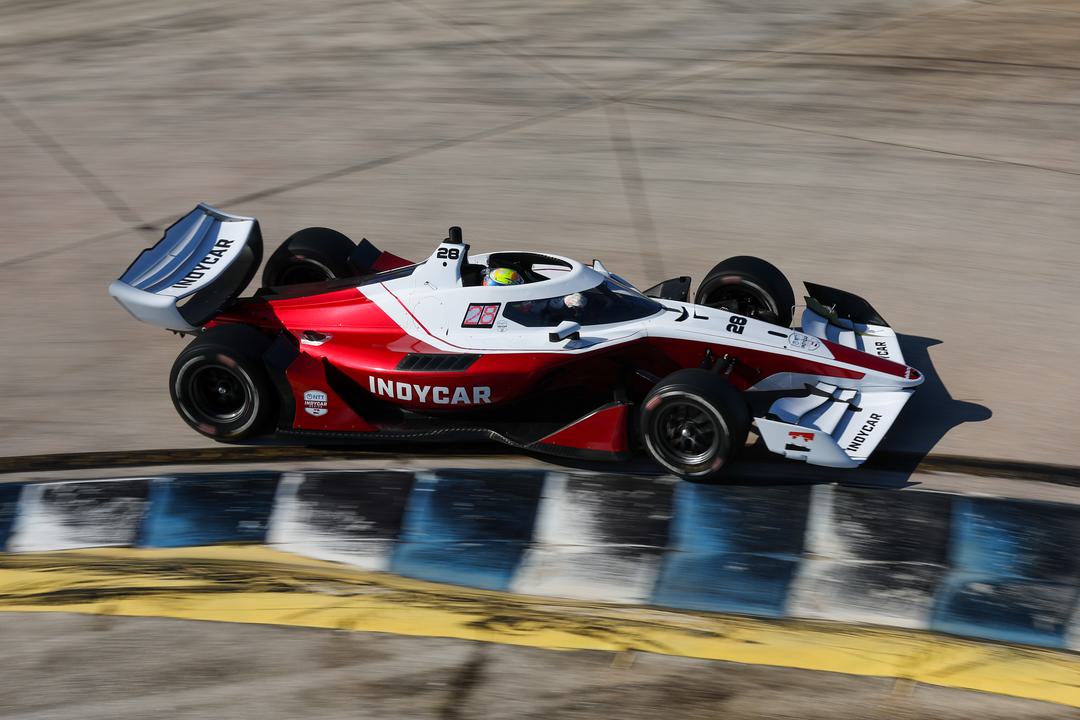
There’s plenty to marvel at around one-mile Phoenix Raceway oval as NASCAR fans get their first look at the grand differences in speed between their favorite Chevrolet, Ford, and Toyota Cup cars and the Chevy- and Honda-powered Dallara DW12 IndyCars that have a feature race on Saturday.
Team Penske’s David Malukas set pole position for the Good Ranchers 250 in the No. 12 Chevy with a two-lap average of 175.3mph, with a quickest lap of 20.4s during the run. Cup drivers will have to wait until Saturday morning to qualify for their Sunday race, so for the sake of comparison, the pole from the November championship-deciding race had Denny Hamlin on pole at an average speed of 133.7mph, with a best lap time of 26.9s.
To newer fans of IndyCar, the 41.6mph separation in average speed and the extra 6.5 seconds it took Hamlin to finish his best lap might be staggering, but a look back to IndyCar’s last visit to Phoenix from 2016-18 reveals the otherworldly realm of performance the was once delivered by the DW12.
During the series’ all-time high-downforce manufacturer aero kit era, and with the Phoenix track having undergone a recent repave, Team Penske’s Helio Castroneves set pole in his No. 3 Chevy at a staggering 194.9mph, up 19.6mph over Penske’s Malukas, and 61.2mph above Hamlin’s average in his Joe Gibbs Racing Toyota Camry from November.
Castroneves also turned that 194.9mph lap in just 18.7s, 2.6s better than Malukas and 8.2s faster than Hamlin.
On a one-mile oval.
The technical specifications for the 2016-17 manufacturer aero kit era, and in 2018 for the last Phoenix race where expensive custom bodywork made by Chevy and Honda was replaced with today’s spec Universal Aero Kit 18 panels, was considerably different than what is found in today’s rules.
More than 100 pounds of weight has been added with the aeroscreen cockpit safety device (2020) and the adoption of hybridization with an energy recovery system (2024), which has pushed the DW12’s minimum weight to an all-time high since rear-engine design became the standard in the 1960s.
In making its first run at Phoenix in hybrid specification, the DW12 has received a range of changes by the IndyCar Series with the goal of tire safety and preservation – at the highest speeds, the high weight tends to punish the right-side tires – so engine power has been reduced by dialing down turbocharger boost, and downforce has also been modified to make it harder to fly through the corners without lifting off the throttle.
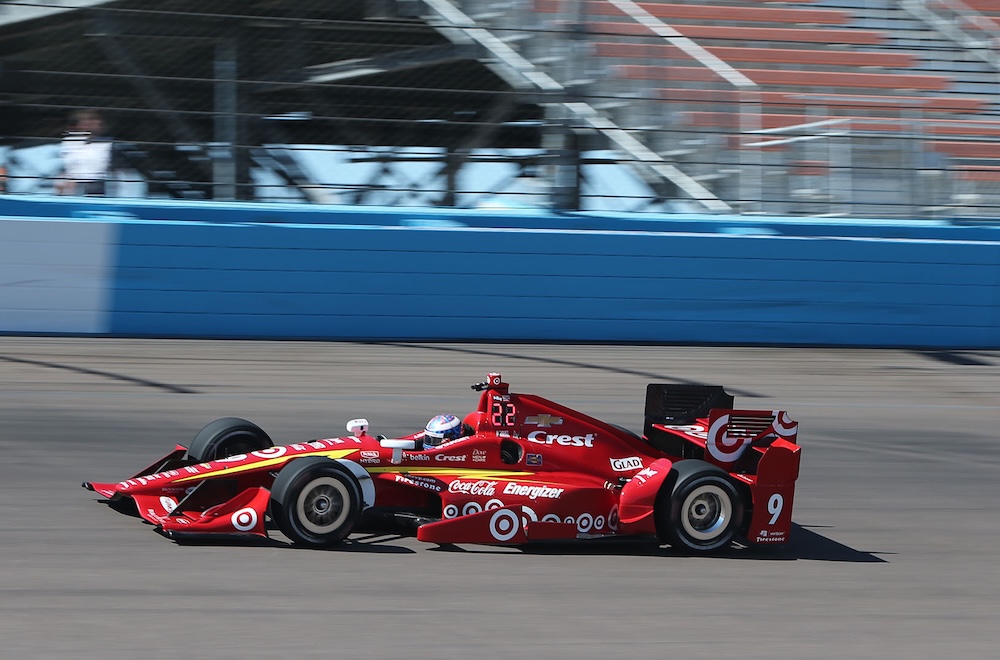
It’s a significantly different driving experience for the likes of Chip Ganassi Racing’s Scott Dixon, winner of the 2016 race (pictured, top), who was one of many drivers from the aero kit era who’d climb from the cars with right legs that were exhausted after mashing the throttle against the pedal stop throughout the race thanks to the insane downforce that glued their cars to the corners.
“The track was newly resurfaced, so that's more grip there, but we had what, 2500 pounds more downforce?” Dixon told RACER. “It's a really significant number. And probably the same amount of drag as now, or less, so it's definitely a different car. The weight itself, from the hybrid to the high CG (center of gravity) with the aeroscreen, it just feels like a bigger, heavier car, without the grip
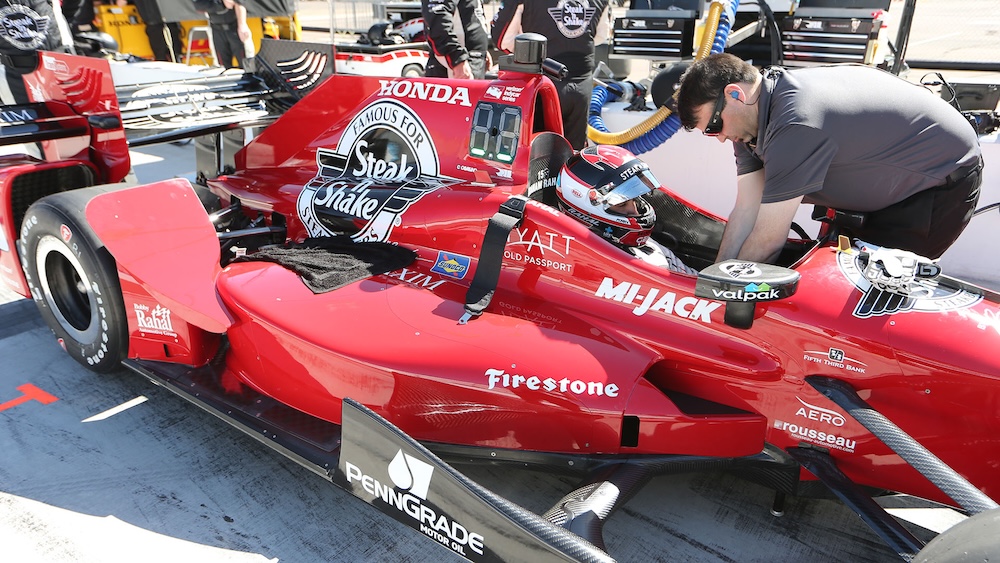
All that 2016-spec bodywork created a ton more downforce, which meant way higher cornering speeds than we see today. Rahal was not a fan. Marshall Pruett photo
“And the tires have changed through that period of time as well. But ultimately, what you're trying to do is create a tire on the car that's going to degrade a bit quicker, so that you hopefully have better racing. That's the whole point of it. That's just part of the formula, but ultimately, hopefully it creates more degradation in the race, it creates some separation between good cars bad cars with the whole big picture in mind of making better racing.”
Graham Rahal recorded a top finish of fifth during IndyCar’s last race at Phoenix – during the 2016 race Dixon won – and doesn’t miss lapping at nearly 200mph in the pre-aeroscreen days.
“I ******* hated those days,” Rahal said. “The risk was so high. I'm fine with taking risks, but sometimes, you’re like, ‘Dude…’ Guys like (Will) Power and Felix (Rosenqvist) can crash today and yeah, it hurts, but you're OK, you’re going to be all right for tomorrow. In those days, man, when you're cornering that fast? I remember (Alexander) Rossi crashing here in testing and it took a way longer time to recover because your cornering speeds were that much higher, so the impacts were insane.”
Both veterans says they enjoy the demands of today’s hybrid cars, which are obviously slower by a wide margin over the DW12s that last raced at Phoenix, but ask more of its drivers to extract performance throughout the lap.
“I actually like it a lot,” Rahal said. “I'm not saying it's as fast, but to me, I think it's better. I don't think fans really care about the speed difference from then to now. If you're watching in Turn 3 and 4, it looks fast. It’s not Helio’s 194mph lap, but tomorrow, for Cup qualifying, they’re going to see 26s lap times and what we have is just totally different. And that's not ****ing on Cup, because if the racing is good, the racing is good. I'm not sure anybody really cares about the speed numbers if I’m honest.”
Phoenix Raceway has fundamentally altered the facility that houses the one-mile oval, but the track itself hasn’t changed. It’s another aspect of why Dixon is enjoying the challenge of mastering the 2026-spec DW12 as the same facility where he won in an immensely different DW12 back in 2016.
“There's definitely much more going on with today’s laps,” he said. “The track itself hasn’t changed, and it’s surprising how good the track surface is for being something like 10 years old. In this car now., you've got different transitions through each corner and it's not an easy flat and kind of point and shoot, which he had before. With the current car, there's much more that you need to take care of, whether it's the drivability to tire degradation, to setting up the car. It's way more difficult with all the new things on the car, and then with the lack of downforce. But it’s a cool puzzle to try and solve.”
There’s no telling how the race will go throughout the 250 laps; if IndyCar and Firestone have nailed their chassis and tire formulas, passing should be a regular part of the contest. But if the race lacks excitement, Rahal hopes the series will get another chance to strike the right balance between performance and entertainment.
“Everybody need to understand that when we do a one-off race and then we leave, and we do one race and we leave, it’s beyond hard to get the package right,” he said. “Look at the first years of Gateway (WWTR) and how bad that racing was. And now it's one of our best races, arguably the best short oval of the year.
“And that’s because there's been time to go back and keep going back and to work on getting the package right. It takes time. I hope we get to get back here and get that chance to make whatever stuff that might be off in the race…we can get it right if we’re given the time.”
Marshall Pruett
The 2026 season marks Marshall Pruett's 40th year working in the sport. In his role today for RACER, Pruett covers open-wheel and sports car racing as a writer, reporter, photographer, and filmmaker. In his previous career, he served as a mechanic, engineer, and team manager in a variety of series, including IndyCar, IMSA, and World Challenge.
Read Marshall Pruett's articles
Latest News
Comments
Comments are disabled until you accept Social Networking Cookies. Update cookie preferences
If the dialog doesn't appear, ad-blockers are often the cause; try disabling yours or see our Social Features Support.