Alastair Staley/Getty Images
Aston Martin likely to run limited laps in Australian GP out of concern for driver welfare
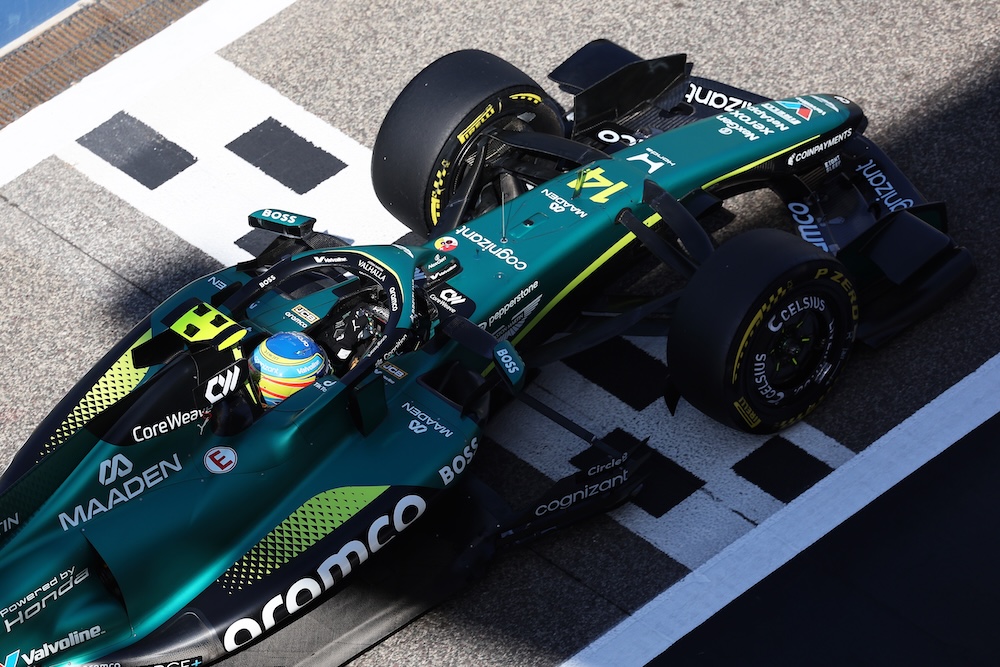
Aston Martin says it is likely to limit the number of laps it runs in the Australian Grand Prix due to vibrations creating a risk of permanent nerve damage for its drivers.
An issue with the Honda power unit causes significant vibrations that had been impacting the reliability of its battery, but improvements have been made to the battery since the end of pre-season testing. However, a further effect is the vibration it generates through the steering wheel, and both Fernando Alonso and Lance Stroll have said there’s no way to complete the 58-lap distance in Melbourne without risking permanent damage.
“I think the important thing to understand is that the battery is the thing that we have been focusing on, because that’s the critical item,” team principal Adrian Newey explained. “So without giving away any technical details, what we have achieved for this weekend, it tested on the dyno over the course of the weekend and got to the solution – which we will be using here at Melbourne – on Monday or Tuesday. That has successfully significantly reduced the vibration going into the battery.
“But what is important to remember is that effectively the power unit – i.e., the combination of the ICE and possibly the MGU as well – is the source of the vibration. It is the amplifier. The chassis is, in that scenario, the receiver. A carbon chassis is a naturally stiff structure with very little damping.
“The transmission of that vibration into the chassis, we have not made any progress on. That is something that we know. So that vibration into the chassis is causing a few reliability problems – mirrors falling off, tail lights falling off, that sort of thing, which we are having to address – but the much more significant problem with that is that that vibration is transmitted ultimately into the driver's fingers.
“So, Fernando is of the feeling that he cannot do more than 25 laps consecutively before he will risk permanent nerve damage to his hands. Lance is of the opinion that he cannot do more than 15 laps before that threshold.
“I think there is no point in [not] being open and honest in this meeting. On our expectations, it is something that unfortunately Koji [Watanabe, Honda Racing Corporation president] and I haven't had a chance to discuss properly prior to this meeting, but we are going to have to be very heavily restricted on how many laps we do in the race until we get on top of the source of the vibration and improve the vibration at source.”
Watanabe was sitting alongside Newey and confirmed Honda will also be running the power unit under certain restrictions as countermeasures to the vibrations from a reliability point of view. With the power unit yet to run at its full capacity, Newey says the team remains uncertain about how far down on power it might be.
“So, divide it up into chassis... I could be horribly wrong, but my assessment will be that we are, from a chassis performance view, kind of in that middle group,” Newey added. “So, definitely behind the leaders. What's that gap? I don't know. I'm guessing somewhere around three quarters of a second, maybe a second.
“We have an aggressive development plan in place. Already with where we've got to in the factory with that development plan, had we had time to bring it here to Melbourne, we would be significantly ahead of where we will be over the weekend.
“Hopefully at the moment, that's all quite a good trajectory. So, given a bit of time, I see no inherent reason within the architecture of the car why we can't become – on the chassis side – close to, if not fully competitive.
“I think on the PU side, if we simply talk about kilowatts, pure raw power, then there's no point in speculating, because once we have GPS and sound analysis from the Formula 1 TV coming in over the weekend, then that's very easy for FOM, for the teams, etc., to measure to quite a high degree of accuracy what power each PU is producing.
“And from that, of course, you can then start to work out the lap time deficit. And one of the problems of these regulations is that the shorter you are on ICE power, the more you have to make up for using electrical energy to cover for that lack of ICE power, which means that by the time you really want that electrical energy on the straights, your battery's gone flat. So, it becomes a self-fulfilling downward spiral.
“So, a straightforward sort of calculation of what ICE power means on lap time is compounded by the effect of lack of electrical energy. As I say, there's no point in speculating, because we'll find out – particularly on Saturday when everybody has their engines at full beans.
“Do I believe in our partner’s – in Honda's – ability to bring that power up and to be competitive? Absolutely. They have a proven track record, and we have total faith.”
Presented by:


Chris Medland
While studying Sports Journalism at the University of Central Lancashire, Chris managed to talk his way into working at the British Grand Prix in 2008 and was retained for three years before joining ESPN F1 as Assistant Editor. After three further years at ESPN, a spell as F1 Editor at Crash Media Group was followed by the major task of launching F1i.com’s English-language website and running it as Editor. Present at every race since the start of 2014, he has continued building his freelance portfolio, working with international titles. As well as writing for RACER, his broadcast work includes television appearances on F1 TV and as a presenter and reporter on North America's live radio coverage on SiriusXM.
Read Chris Medland's articles
Latest News
Comments
Comments are disabled until you accept Social Networking Cookies. Update cookie preferences
If the dialog doesn't appear, ad-blockers are often the cause; try disabling yours or see our Social Features Support.