Joe SkibinskiPenske Entertainment
Is Palou cheating? No, he's the cheat code
If, as the old saying goes, "Imitation is the sincerest form of flattery," where would accusations of cheating fall into the realm of adulation?
After their latest rollicking win, some folks are indeed struggling to accept what they’re seeing from Alex Palou and his Chip Ganassi Racing team. Especially when the No. 10 Honda squad pulled another upset after starting fourth at St. Petersburg and amassing leads that exceeded 10 seconds on two separate occasions. The trigger point is how the winning takes place.
“When Palou took the lead in St. Pete and built a 10-second lead in 10 laps, everyone, including me, started to wonder how that’s possible in a spec series without any tampering or fishiness to their car,” one such fan said in an outreach. “Add to that Ganassi’s lack of onboard cameras and I could see a recipe for some major conspiracies. Thoughts?”
It’s easier, it appears, to question the legality of what they’re witnessing – safer to point to exploiting of loopholes or allege skullduggery – than to accept the fantastical performances being produced by the No. 10 Honda team as honest or earned. Similar accusatory responses were elicited last year when Palou won five out of the first six races, eight total out of 17, and ran away with his fourth championship in five years.
Painting the achievements of a generational talent driving for the best team of the decade – so far, at least – as a byproduct of cheating takes no effort or evidence, which is unfortunate. But it speaks to the difficulty some have in processing Palou’s achievements.
So is he cheating, or is Palou the ultimate cheat code?
When it comes to the spec Dallara DW12 and all of its hybrid heft, Palou has mastered the art of finding the limit of adhesion and living a few decimal points below its razor-sharp edge.
His driving is often described in boring terms like "tidy," "clean" and "efficient." They’re a perfect fit for this car. And as the records show with 20 wins from 99 starts, "devastating" is another word that belongs among his descriptors.
Today’s DW12 is known as a killer of tires when drivers push beyond their limit and reach the point of sliding the fronts too often with bouts of understeer or locked brakes, or murdering the rears by repeatedly feeding in opposite lock to correct oversteer.
And we aren’t talking about huge, demonstrative drifts with IndyCar drivers visibly sawing at their steering wheels. The tire-ending moments are subtle, small, and lightning fast; a swift accumulation of little corrections that accelerate rises in tire temperatures and rapid losses of grip.
Run the video back from St. Petersburg, or pretty much any of Palou’s races, and you won’t find him slewing sideways, or smoking tires through errant applications of the brake or the throttle pedal. Palou’s super power is control, precision, and consistency with that control and precision.
If the tires start to surrender when driven at 100 percent, Palou hits 99.8 percent and lives at that self-induced threshold. If they can withstand less, he dials his metronomic limit down. And if, by chance, the tires can take more punishment than usual, he adjusts his limit accordingly and performs at that elevated level without tipping over the tire-killing line. Tidy. Clean. Efficient.
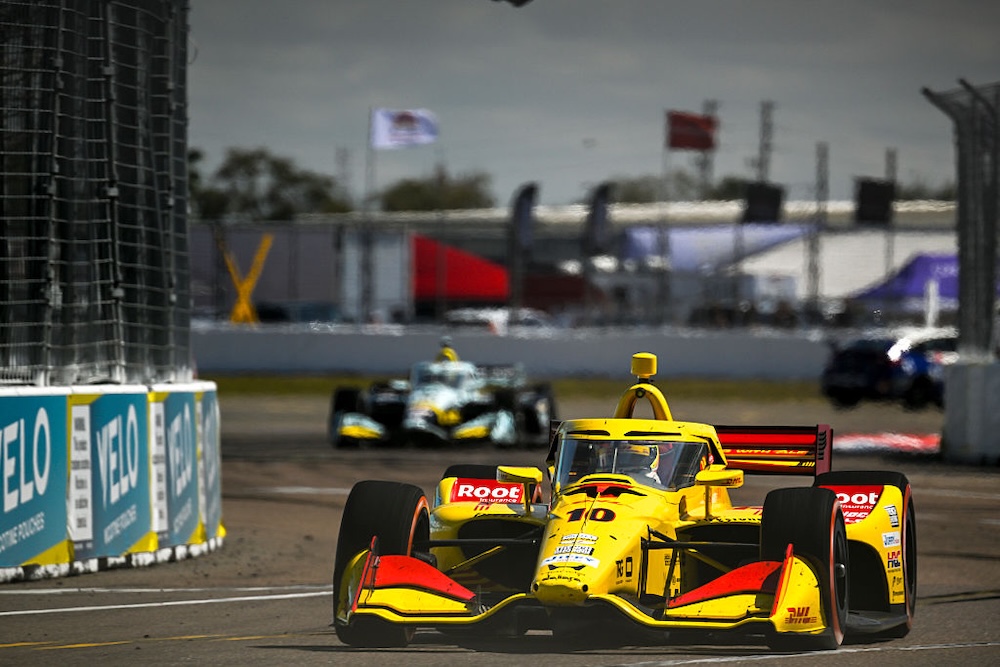
One of Palou's superpowers is knowing exactly how much punishment his tires can take, and then pushing them right up to – but never over – that precise point. Gavin Baker/Getty Images
“He's just so consistent,” Chris Simmons, Ganassi’s director of performance, said of Palou after the race. “He doesn't make any mistakes, and he's super easy on the tires. So on lap one and two, that looks good, but that compounds over the run. So by lap 10, it looks superhuman. And by the end of the run, it looks like he's Iron Man.”
Understanding Palou’s ability to overcut polesitter Scott McLaughlin and front row starter Marcus Ericsson on Sunday begins with the tire choices he made for the race.
As Palou’s race strategist Barry Wanser often shares, his driver leads the tire-choice decisions, and in this case, Palou opted to start on new Firestone alternates, which were a major question mark leading into the race.
Teams knew the new street course alternates were more durable than last year’s short-life specials, but hadn’t run enough laps in the heat of the day on the 2026 alternates to know how long they’d last before degradation set in and a heavy reduction in grip would take place. The longest runs anyone got on the alternates came in the pre-race warmup, which was cool and overcast. By the afternoon, the skies were blue and conditions were warm, which led to a lack of confidence in the alternate’s durability.
Palou ultimately chose a two-stop race, which involved rolling the dice on whether he could make the new alternates last long enough to stick to the two-stop plan. If he couldn’t run until at least the one-third point in the 100-lap race, Palou would need to abandon the two-stopper and shift to three stops, which would have ruined his shot at victory. The risk was real in that regard – the best driver on a three-stop strategy placed ninth at St. Petersburg.
In the end, the gamble paid off. Palou was one of only four drivers among the 25 starters to make the two-stop plan work while starting on new alternates; Romain Grosjean who finished eighth, Ganassi affiliate Meyer Shank Racing with Marcus Armstrong in 11th, and Ganassi teammate Kyffin Simpson in 15th were the others.
From there, Palou made a pass to take third from rookie Dennis Hauger on the opening lap and stayed there until the first round of pit stops approached. McLaughlin opened from pole on new Firestone primaries, which everyone knew were long lasting, and led until he pitted for used alternates on lap 35. Behind him, Andretti Global’s Marcus Ericsson also started on new primaries and inherited the lead for a lap before matching McLaughlin’s strategy by stopping on lap 36 and bolting on used alternates for the middle section of the race.
Their strategy was clear: Start on the safer but slower primes, run just past the one-third point in the race, then split the last two stints on the faster alternates. They’d run the second stint on their best used alternates and save the new alternates for last, giving themselves the highest quality rubber with the most life to consume in the run to the finish line. It was a case of going good-better-best with their tire compound sequencing.
Palou went in the opposite direction with best-better-good.
His strategy centered on trying to make up ground and possibly build an advantage on the fastest tires in the first two stints before closing on the slower primes with the hope of having enough of a buffer to where those finishing on new alternates would cut into the lead, but not to the point of getting past him.
The first strike by Palou came with the timing of his first pit stop, which was on lap 38. He managed to go three laps longer than McLaughlin and two more than Ericsson on their new primes… while using the new alternates with the unknown durability.
It’s a small thing in terms of laps; Palou only went a bit longer than McLaughlin and Ericsson in front of him on primes, but he was able to make immense speed on those new alternates, and for 38 laps. It was a monumental achievement.
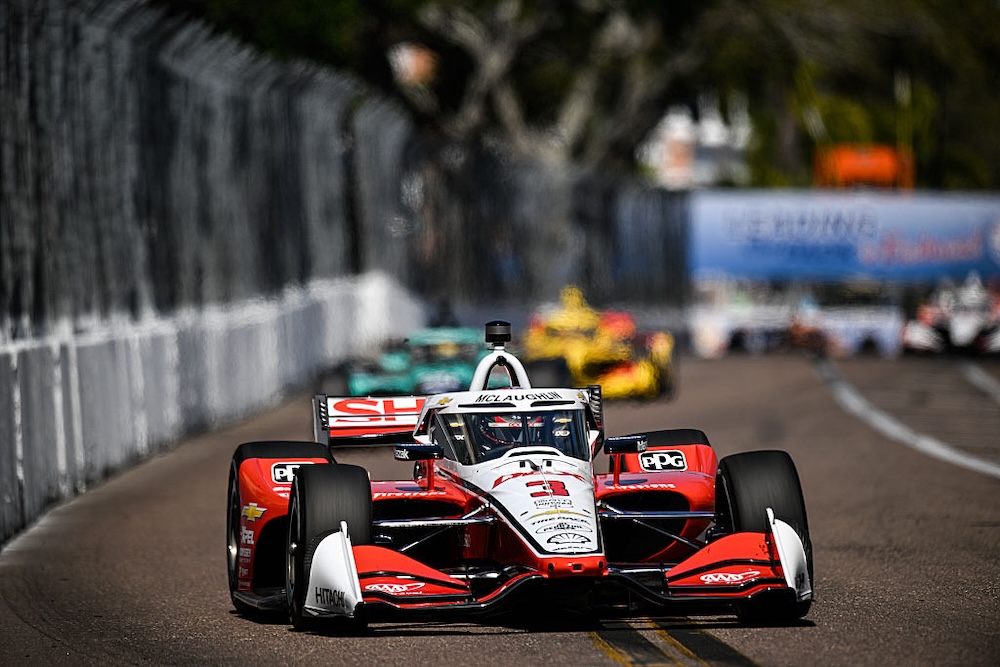
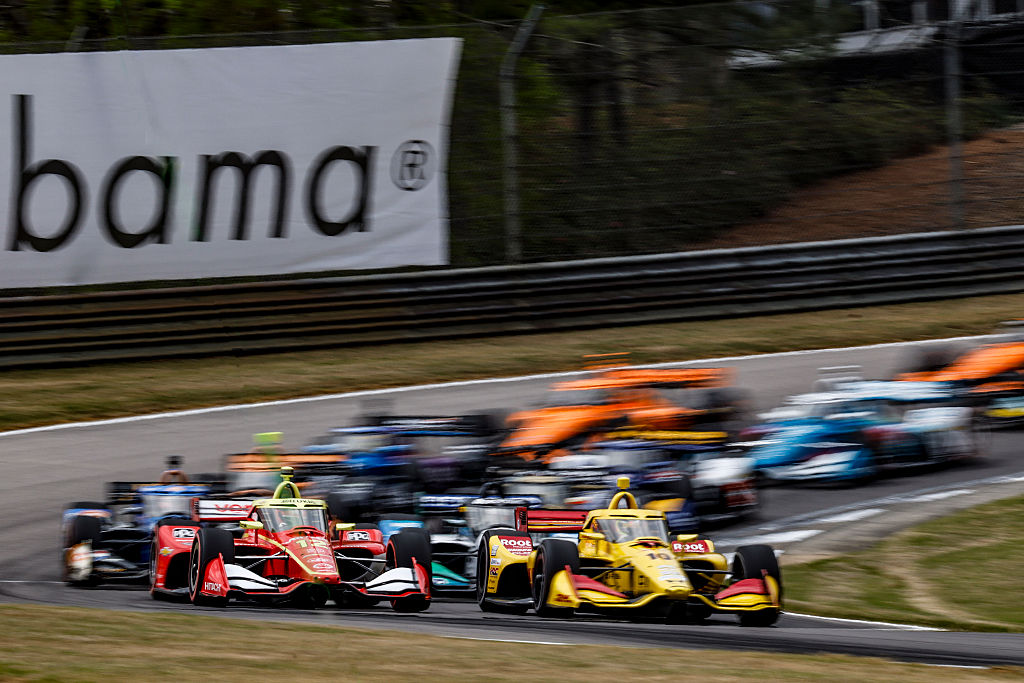
McLaughlin had an early advantage on the harder prime Firestones, but Palou – here lurking in the background – was able to stretch his unproven alternates even further. Brandon Badraoui/Getty Images
He also took great care of those tires, which allowed him to set his fastest lap of the race on lap 37 – his in-lap – with a 1m02.8281s. McLaughlin’s in lap was 0.7306s slower with a 1m03.5587s.
Look to their first two out laps on cold tires, and keep in mind that Palou and McLaughlin took used alternates, which meant they were on the same compound for the first time, and Palou was 0.2842s faster to start.
Next, as McLaughlin and Ericsson fought each other – along with MSR’s Armstrong, who made it a three-way party – while trying to get their tires up to temperature, Palou was 1.2955s quicker on his second flying lap on used alternates.
Prior to the first round of pit stops, Palou kept things close, sat just over a second back from McLaughlin, was able to go a few more laps than McLaughlin before pitting, and was markedly faster on those extra laps. Then, on the first few laps after emerging from the pits, Palou was faster still as his closest pursuers slowed themselves while their battles for second and third raged on.
The running order on lap 50 was Palou, Ericsson, and McLaughlin. On that lap, while all three were on used alternates, it remained tight as Palou turned a 1m03.6s while the other two clocked 1m03.8s. And then the effects of Palou’s tidy-clean-efficient driving started to stand out as the trio put more miles on their used alternates.
On lap 54, for example, Palou was flying with a 1m03.0s tour; Ericsson could only muster a 1m03.8s and McLaughlin was at a 1m04.0s even, losing between 0.8s and 1.0s on that lap alone.
Palou’s consistently unmatchable pace in this stanza is where the race was won. His laps 58 and 59 were nearly identical at 1m03.1937s and 1m03.1926s. Ericsson, in second place, turned a 1m03.7361s and a 1m04.0041s for a combined loss of 1.3539s to Palou in just two laps.
Back on lap 50, when the Palou and his closest pursuers ran almost the same lap time on relatively fresh used alternates, his lead over Ericsson was 1.6s and McLaughlin was down by 3.8s. But as their tires reached and went past the mid-point of the stint – as their usability was about to meet an abrupt end – Palou struck with control and precision and consistency.
What was a 1.6s lead on lap 50 became 7.0s on pure speed by lap 60, and making that extra speed without abusing his tires. Palou kept going until lap 67, and by that point, McLaughlin had overtaken Ericsson, who was struggling to keep his used alternates alive, and it cost everyone chasing Palou – including McLaughlin – a ton of time as they got bottled up behind the Andretti driver.
By the time McLaughlin got by Ericsson, Palou had disappeared – thanks to his pace and the slowing effect Ericsson had on the field – to the tune of 13.8 second on lap 66. Credit Palou for the advantage he amassed, but don’t discount Ericsson’s effect on amplifying that lead by holding and fading in second place while keeping faster cars in third and fourth place at bay for so long.
With their final pit stops beckoning, Palou took used primes on lap 67 and McLaughlin went in for his candy – the new alternates – to start the fightback on lap 68.
Every other driver who finished inside the top eight at St. Pete had two new sets of tires, at a minimum, and some had three sets of new tires – optimum rubber from start to finish.
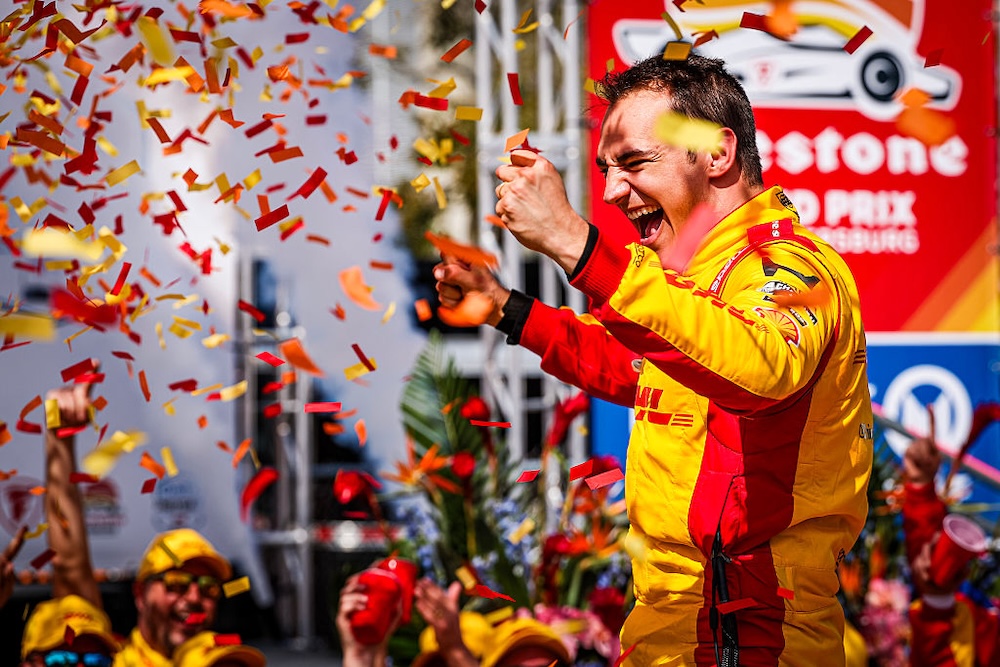
One race into the season, and it already feels like Palou's rivals are on the clock to reel him in. David Jensen/Getty Images
Andretti’s Kyle Kirkwood, on a two-stop strategy as well – but aided by having two sets of new alternates after starting 15th– charged his way to second by lap 77.
Kirkwood did as expected by using his new alternates to slice into Palou’s lead on old primes, and by lap 80, the once-gaudy lead of 13.8s on lap 66 was carved down to 5.5s. With the respective difference of tire grip in mind, and the per-lap time loss he was suffering, Palou wasn’t going to match Kirkwood’s pace. Finally, he was at risk of being overtaken for the lead.
Lap 70 was a perfect indicator of their performance disparity, as the checkered flag awaited everyone on lap 100. Both were just starting their final stints, and with those new alternates giving him an edge, Kirkwood’s lap 70 was 0.8102s quicker than Palou's. Holding the upper hand, Kirkwood did as expected and put his compound and tire age advantage to good use while attacking Palou’s lead. But it didn’t last.
Palou started equaling or beating Kirkwood’s times between laps 80-90 as the Andretti driver’s car lost its balance and started to burn through its alternates. By lap 90, Palou stopped the losses with more of the control, precision, and consistency, and expanded the lead to 6.9s over Kirkwood and 7.9s over McLaughlin, who was preparing to pounce and take second place.
But before that happened, Kirkwood continued to slow. He lost nearly a second per lap to Palou from laps 90-93, which also meant McLaughlin’s distance to Palou was growing as well, and by the time he got around Kirkwood, Palou was gone. It happened to McLaughlin earlier in the race with Ericsson, and again to finish the race with Ericsson’s Andretti teammate, which made it easier for Palou to punch out to double-digit leads.
McLaughlin’s hard-charging efforts to get by Kirkwood also came at a cost to the capabilities of his once-new alternates.
From lap 94 when McLaughlin took second, he was 1.5s slower than Palou on the same lap, 0.4s slower on lap 95, 0.6s slower on lap 96, 0.2s down on lap 97, and 0.6s slower on lap 98. Despite being saddled with used primes, Palou took great care of his tires and had speed left to burn in the waning moments of the race. Over the last two laps – with a monster lead – Palou eased off, running laps at 1m05s while McLaughlin kept hammering away with 1m04s.
At the checkered flag, Palou’s margin of victory over the Team Penske ace was 12.5 seconds.
Palou’s magic was only made fully apparent during the post-race analysis. His opening stint on new alternates lasted 38 laps and his quickest lap of the day was on lap 37, which spoke to how well he cared for the delicate compound.
McLaughlin’s closing stint on new alternates was only 32 laps long, and with Kirkwood out of the way, his last batch of laps on those tires ranged from 1m03.8s to 1m04.4s. Palou, at the end of his beginning stint new alternates, was faster from laps 32-37, reeling off low 1m03s and that 1m02.8s best.
Kirkwood actually posted the fastest lap of the race on his new alternates with a 1m02.2s tour, which was 0.6s better than Palou's, and suggests Palou knew he had more speed in his new alternates, but elected to dial back just a tad to preserve their per-lap capabilities as he stretched that first stint out to lap 38.
And with his formidable lead shrinking fast in the final stint, Palou embraced the same control-precision-consistency mantra and didn’t overact by trying to nullify Kirkwood’s tire and speed advantage from the moment they left the pits.
He and his team knew they’d lose the early battle between old primes and new alternates, and weren’t rattled when a 13.8s lead dwindled to 5.5s. As those new alternates lost their peak on the cars of Kirkwood and McLaughlin, Palou had enough speed held in reserve to regain most of what was temporarily lost and captured the 20th victory of his career while McLaughlin was nowhere to be found at the finish line, 12.5s arrears.
Is that cheating, or is Palou the cheat code?
Marshall Pruett
The 2026 season marks Marshall Pruett's 40th year working in the sport. In his role today for RACER, Pruett covers open-wheel and sports car racing as a writer, reporter, photographer, and filmmaker. In his previous career, he served as a mechanic, engineer, and team manager in a variety of series, including IndyCar, IMSA, and World Challenge.
Read Marshall Pruett's articles
Latest News
Comments
Comments are disabled until you accept Social Networking Cookies. Update cookie preferences
If the dialog doesn't appear, ad-blockers are often the cause; try disabling yours or see our Social Features Support.