
The RACER Mailbag, February 4
Welcome to the RACER Mailbag. Questions for any of RACER’s writers can be sent to mailbag@racer.com. We love hearing your comments and opinions, but letters that include a question are more likely to be published. Questions received after 3pm ET each Monday will be saved for the following week.
Q: Alex Palou reneged on his contract, plain and simple. But what was the value of his contract to begin with? Was it $12 million? I highly doubt that figure, given how cheap IndyCar owners are. When Mr. Brown said he needed to sue "to protect the McLaren brand," my skin curdled. Let me drop a couple of names – Oliver Askew and Theo Pourchaire. Dropped like hot potatoes, but I guess that doesn't hurt the brand.
Jonathan Morris, Ventura, CA
MARSHALL PRUETT: I believe the $12 million is the McLaren-fed number on total projected losses for the duration of Palou’s multi-year contract.
Oliver and Theo… I wish those two were still in IndyCar, and I don’t disagree, but treatment by employers, clients, family, and significant others is a reflection of how much they do or don’t value you, right? Getting dumped for a hotter, newer, faster, or wealthier model sucks, but it’s nothing new in life or sports.
Q: I’m writing in the aftermath of something that’s been bothering me, and I’m curious to know how you see it.
In the week following the killings of two protesters in Minneapolis by government agents, IndyCar leadership met with the President to promote a Washington, D.C. race called the ‘Freedom 250.’ This meeting took place just two days after a previously scheduled session between the President and the commissioners of the NFL, Major League Baseball, the NHL, and the NBA was canceled.
The contrast is hard to ignore.
It feels like the A-list of American sports chose to walk in one direction, while IndyCar deliberately walked the other. Whether intentional or not, the optics suggest a series that is out of step with its peers at a moment when public alignment and silence both carry meaning.
I’m writing to ask how you interpret this decision in the broader context of IndyCar’s leadership, relevance, and long-term positioning. Do you see this as tone-deaf, pragmatic, opportunistic — or something else entirely?
I’d genuinely value your take.
Doug Garrison
MP: On this, I’m a pragmatist.
IndyCar is dwarfed by the NFLs and NBAs in the sports-entertainment landscape, and even in its own sector by NASCAR. That’s never going to change by going to the Barbers and Laguna Secas and Mid-Ohios and Nashvilles on the calendar. As much as we love those places, they just don’t move the needle with bringing in waves of new fans.
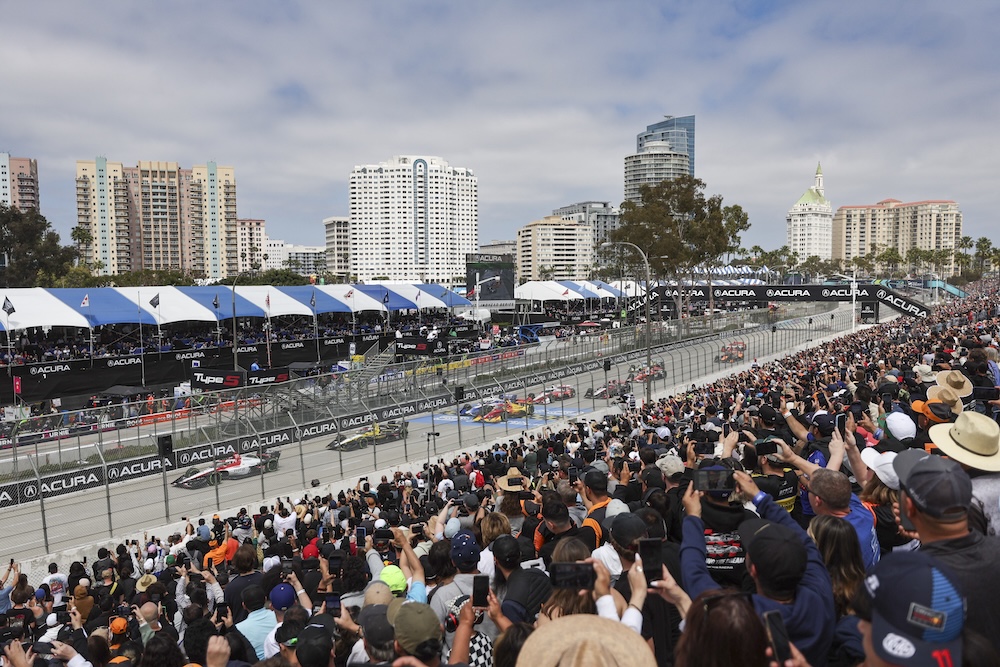
Street races like Long Beach show the value of taking the racing to the people. Chris Owens/Penske Entertainment
And yes, the Cleveland Grand Prix was amazing, and so was the Michigan 500. I miss them. But going back to an old-timey places that fell off the schedule 20-plus years ago isn’t the answer.
Attention is oxygen, and IndyCar has been taking shallow breaths for decades. An invitation to be the headliner in a Washington D.C. Grand Prix during the 250th is an automatic yes for any series, and especially for one that struggles to poke its head above NASCAR and all the stick-and-ball sports on the national radar.
Going to new places like Arlington, and now Washington D.C., with urban street races, is where a series in need of attention gives itself the best chances of attracting a large volume of new followers. But there’s a scary risk involved with this particular play, and it’s with inserting IndyCar into the non-stop shouting match that is modern politics.
Prior to Friday, many thought of IndyCar as an apolitical entity, and one that didn’t pick sides. (It would take genuine or willful ignorance to be oblivious to the political leanings of Penske and Fox, but I digress.)
That notion obviously changed when the race was signed into existence by President Trump, which triggered polarized responses along the most predictable lines where one side is canceling and the other is cheering.
Speaking generally, the side that loves everything about President Trump cannot fathom how anyone would complain, criticize, or boycott the race, much less IndyCar as a whole. IndyCar fans who are strong opponents of President Trump feel let down, disappointed, or betrayed by IndyCar. Plenty have said they’re done with the series. And some don’t care about the politics and are just happy to have another race.
But this divide wasn’t happening last Thursday, and that’s the scary part. It’s hard to know how many fans who say they’ve cancelled IndyCar are truly gone for good, but if it’s a solid number, they embody the downside of this maneuver.
And it doesn’t matter that the Grand Prix of D.C. is a one-time affair. For some, the fact that IndyCar has joined forces with President Trump for a one-and-done event is a deal breaker, and if they hold firm to their threats, the series will have a smaller fanbase. At least for now.
Then there’s the potential upside of the gamble, which is the public embrace of and by President Trump. This could backfill those losses and potentially grow the series’ fanbase as a result of aligning with the voters for the party that won the popular vote. Maybe kicking IndyCar’s brand out of neutral and shifting it to the right will bring a windfall of fans and financial prosperity. It’s entirely possible. It could also fail. That’s the unsettling nature of a gamble.
So, yes, this might be the move that breaks IndyCar out of its painfully slow growth. It could also have a neutral outcome, or shrink its audience. We won’t know until the race is over, the attendance figures and TV ratings are in, and then need to check back in 2027 once the new season gets under way to deliver insights on whether the Freedom 250 delivers a sustained lift at St. Petersburg and beyond.
It’s hard to imagine a single race will radically transform IndyCar’s future – if you’ve been around the series for a while, you’ll have heard a lot of hyperbole about new events being game-changing affairs, and they rarely live up to the billing – but I’m told Penske and Fox are going all-in on D.C. like it’s a second Indy 500. If that holds true, maybe the Freedom 250 is remembered as the start of something transformational for the series.
Having been here during IndyCar’s best days and its worst, my optimism is always focused on its improved health and finding its way out of the deep shadow cast by NASCAR and now F1 and all of the major league sports. This is a pragmatic decision where no American racing series would deny the president’s request, but there’s no guarantee it will or won’t work to the series’ benefit.
I wish politics were a thousand miles away from IndyCar, but those days are over.
Presented by:
Marshall Pruett
The 2026 season marks Marshall Pruett's 40th year working in the sport. In his role today for RACER, Pruett covers open-wheel and sports car racing as a writer, reporter, photographer, and filmmaker. In his previous career, he served as a mechanic, engineer, and team manager in a variety of series, including IndyCar, IMSA, and World Challenge.
Read Marshall Pruett's articles
Latest News
Comments
Comments are disabled until you accept Social Networking Cookies. Update cookie preferences
If the dialog doesn't appear, ad-blockers are often the cause; try disabling yours or see our Social Features Support.