The RACER Mailbag, January 21
Welcome to the RACER Mailbag. Questions for any of RACER’s writers can be sent to mailbag@racer.com. We love hearing your comments and opinions, but letters that include a question are more likely to be published. Questions received after 3pm ET each Monday will be saved for the following week.
Q: I realize the tobacco-money fueled CART days are never coming back and that more or less spec cars are the name of the game. But I'm still interested in advantages teams can develop with their cars. I'll never understand the black magic that goes into dampers, so let's focus on something I do understand – weight! Other than buying a newer tub with all the latest safety equipment integrated and/or running a driver who doesn't outweigh the ballast threshold, what can teams do to reduce an IndyCar's weight so that they can put as much ballast lower/where they want it?
Corey, Fishers, IN
MARSHALL PRUETT: Teams aren’t allowed to make any changes to reduce weight. But you are onto something with the ballast. The lower the weight, the better, which is why you see larger drivers like Scott McLaughlin and Graham Rahal working so hard to shed any excess pounds.
If they can take three pounds off, that’s three pounds less weight sitting in the cockpit and three more pounds the team can place below the cockpit in the keel where ballast is placed.
There’s a minimum weight standard that every car must achieve, but for those with smaller/lighter drivers, there is a benefit to having less mass sitting upright in the car and placing a larger amount of ballast down low. That being said, the ballast/driver equivalency process works well since the six-foot-plus McLaughlins, Rahals and Newgardens aren’t at a competitive disadvantage to the O’Wards and Ferruccis and others who aren’t tall or bulky.
Q: This is in response to last week’s Mailbag talking about the size of current IndyCar engines compared to the Judd V8s.
Did IndyCar make a mistake by not designed the new car to be able to fit a larger engine? A new engine manufacturer could join IndyCar more by easily modifying their existing engine from another series vs having to make something bespoke.
Will, Indy
MP: Yes and no. In the grander scheme, yes. Hindsight is a great thing. Plan for all possibilities and don’t paint yourself into a corner.
But there was a full expectation for everything to be good and rosy at whatever point the new chassis and engine formula went live, and from the CART IndyCar Series to the Indy Racing League to the Champ Car World Series, every single Indy car formula this century has used a highly specific engine formula with displacement and cylinder count defined.
Coming back to hindsight, yes, it would have been wise to design the IR28 with a more universally-minded engine bay, but the approach IndyCar has taken is exactly how it’s been done for decades.
Q: Will the February IndyCar test be open to the public?
Scott Thompson
MP: I don’t have specifics, but I’m told fans are part of the plans being crafted by the track and series for the spring training test.
Q: I was watching qualifying from Michigan in 2000 during my lunch break. One of the items they were talking about through the coverage was the SST turbo setup. I said to myself, "Hey, this sounds like a good thing to ask the Mailbag to learn more about."
What was the idea behind this, the advantages, and how in particular does this work compared to the typical twin-turbo setup or a conventional single turbo setup?
Alan Bandi, Sarver, PA
MP: It was a setup developed by Toyota that was briefly used in oval qualifying by its teams – Ganassi was the main outfit, I recall – where a custom exhaust package was created to free horsepower that was being lost.
Compared to a naturally aspirated engine that sends all of its exhaust straight out of the headers with no restrictions, the 2.65-liter turbo V8s used in CART (and every other turbocharged car) has an accepted restriction in the exhaust flow path. The exhaust comes out of the headers, in this example, and joins to hit and spin the hot side of the turbine wheel. Think of the turbo housing and all of the twists and turns needed with piping to contort the exhaust into the housing like kinks in a garden hose that limit the full flow of water out of the spout.
For qualifying, Toyota came up with a single-side-turbo exhaust arrangement that used one exhaust bank to hit the spin the turbine – testing showed that four cylinders of exhaust energy was enough to make maximum boost – which allowed the other four cylinders to flow their exhaust without the turbo restriction, and that, in turn, gave them more power.
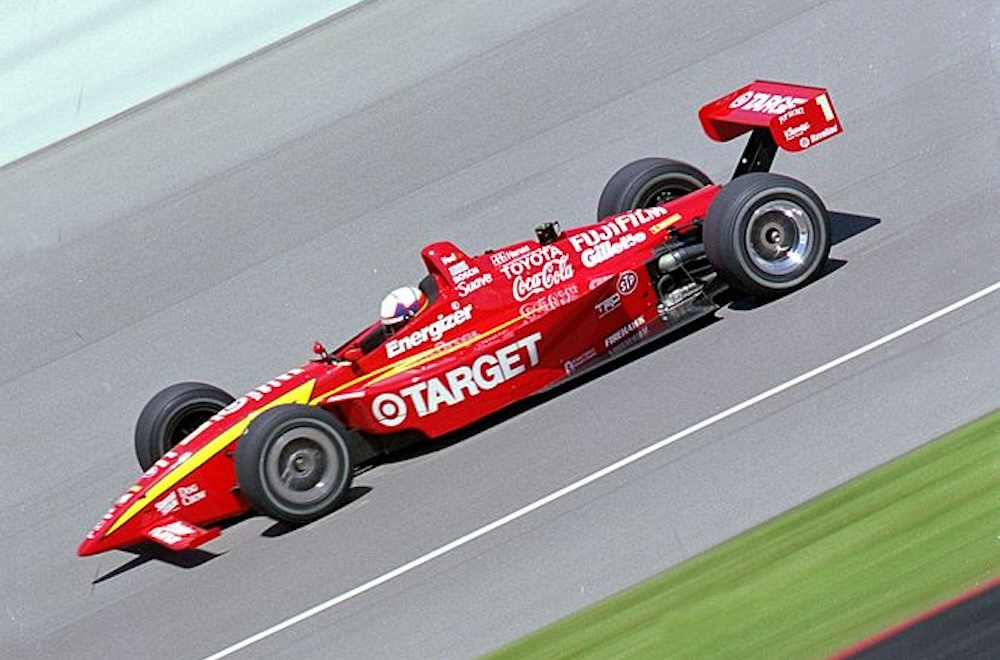
Toyota tried some new tricks for oval qualifying in 2000. Robert Laberge/Getty Images
Q: Andy Evans is a name I hear brought up when reading about IndyCar and sports cars in the late '90s, and not in a positive light when he owned IMSA. I think it was Butch Leitzinger who shared a couple of stories on a particular podcast, which included Andy having two radio channels: One for his team in the pits and the other to race control. As a driver and series owner, Andy was in the position to change the rules mid-race and get penalties or full course cautions called to benefit his team, and sounded like he did that often.
With a new IMSA season approaching, I think IMSA is in a better place now compared to the turbulent times of the late '90s. I’m curious to know what Andy Evans is up to, and if you have any of your own stories about him?
Brandon Karsten
MP: I interviewed him a few years ago for RACER Magazine’s feature on the Ferrari 333 SP IMSA WSC car, but that’s about it; his time and place in the sport – first in IMSA, then into CART IndyCar and the Indy Racing League – rarely coincided with where I was working. If he was in IMSA GTP Lights or WSC, I was in Indy Lights, and so on, but there were a few years where we were in the same circles.
I’m not sure what he’s doing today. It took a while to arrange our one call and it didn’t venture beyond the topic. Privacy and secrecy has always been part of the routine.
Q: It's the slow season. I'm thinking of starting an IndyCar off-season bingo card. Definite spots would include "Dale Coyne has an open seat on January 15," and, "Driver's seat at risk at McLaren." Any other major items to include?
IMSA: I have two questions here. First, AO Racing's Spike car. The pictures of it in gold for Daytona looked great. How good does it look in person? Second, how awesome does the Aston Martin Valkyrie sound in person?
John Balestrieri, Wisconsin
MP: You can add, "Will St. Pete feature 25 or 27 cars on the grid?" to that card.
I don’t care for the new Spike livery. It looks great up close, but doesn’t stand out to me when it’s on track. But it isn’t for me, it’s for kids. So if they like it, that’s all that matters.
The Valkyrie is phenomenal. If it had another 2000 rpm, it would be perfect.
Q: I really liked your response to William Mazeo last week about chassis manufacturers, and I'd also like to add to your Lola point (as I live next to where it used to be based).
The old Lola site is now MPA Composites Ltd T/A ACE Technology, Multimatic Special Vehicle Operations and Parkers "The Parts People" (Huntingdon). Though I'm so glad that area was redone when the PVC windows firm went bust. Another point is that Lola Cars, the old wind tunnel, was also up for sale in 2024. As much as I'd love for them to come back (I got into U.S. racing in the Lola-based Champ Car days), it would take some effort.
Anyway, now to my question. As we approach the Daytona 24, I noticed that Dean MacDonald's flag on the chassis is the Scottish flag, not the British flag. I know Dario Franchitti, back in the day, had a Scottish flag, while Dan Wheldon and Justin Wilson had English flags. Just curious as to why U.S. racing does this, given that it is a UK and Northern Ireland license?
Dan Mayhew
MP: We have had Lola back in Formula E with its Yamaha relationship; it was bought by businessman-racer Till Bechtolsheimer.
On flags in this instance, there’s no such thing as "U.S. racing." It’s a single team deciding how it wants to apply flags to its car. I’d assume RLL spoke with Dean and confirmed his preferred flag. If not, I’m sure Dean will/would say so since these are the kinds of things that make people mad.
Marshall Pruett
The 2026 season marks Marshall Pruett's 40th year working in the sport. In his role today for RACER, Pruett covers open-wheel and sports car racing as a writer, reporter, photographer, and filmmaker. In his previous career, he served as a mechanic, engineer, and team manager in a variety of series, including IndyCar, IMSA, and World Challenge.
Read Marshall Pruett's articles
Latest News
Comments
Comments are disabled until you accept Social Networking Cookies. Update cookie preferences
If the dialog doesn't appear, ad-blockers are often the cause; try disabling yours or see our Social Features Support.