Inman exulted to bring speedway bike racing back to SoCal for World Speedway Invitational 3
The last significant speedway motorcycle race held in Southern California took place in 2013, but world-class speedway returns to SoCal next week as the third edition of World Speedway Invitational will take place inside the Thunderdome at Industry Hills Expo Center in City of Industry. Set to run on Saturday, Oct.25, the World Speedway Invitational will bring together the fastest and most high-profile speedway racers in the world and see them go to war on a frantic 1/8-mile bullring of a track.
Just like the former iterations of the event, this one will be promoted by speedway organizer and former racer Kelly Inman. Among the most prolific and established names in speedway racing the world over, Inman is both enthused and thrilled to bring world class speedway competition back to one of the sport’s worldwide bastions of popularity. Over the weekend, we tracked down and caught up with Kelly Inman to get a read on this Saturday’s world class event.
Q: Kelly, you’ve been involved in the sport since you were a kid in Costa Mesa, California. Can you provide us with a little bit of background on your journey through the sport of speedway?
KELLY INMAN: I’m the owner and promoter of Industry Hills Speedway. I’ve been in this sport my entire life at all levels from racing myself to being a mechanic. I’m Greg Hancock’s best friend. (Hancock is a four-time speedway world champion). I worked for him for several years. He’s actually kind of a silent partner in this with me and pushing all this. Any of the European guys that I couldn’t get a hold of and stuff, Greg has reached out to them. He’s really wound things up for me, you know? My background goes from racing to bike owner, to sponsor and then I started promoting speedway events about 25 years ago. I’m in a very fortunate spot with the city. It’s a city that loves racing.
Q: The last time the World Speedway Invitational ran was back in 2013. Can you speak about that?
KI: The first one was in 2012 and the second one was in 2013. Those were two very successful events. It’s a huge expense to do this thing. With a couple of changes overseas, we kind of had to put the event on hold. I was really focused on growing the sport here in America and keeping the industry afloat. It’s taken a number of years to land on our feet with big events such as this. We have a whole restructure of American speedway going right now and this is part of it. Bringing this event back to the level of the 2012 and 2013 events where we literally had eight European guys racing is what we want to achieve. We’ll have six European Grand Prix riders competing this Saturday, which we are super happy about. The 2012 and 2103 events were both sold out. 6,000 people each night.
Q: Why is the World Speedway Invitational coming back after over a decade?
KI: I’ve always wanted it to come back. Honestly, I promote this event and I’m a one-man band. Just taking it on itself has been a challenge. I want it back because I want to expose the American riders to the level of the European Grand Prix stars. It’s a whole other level. We’re fortunate to have Artem Laguta coming. He’s the 2021 world speedway champion. It’s his first time in the United States. He’s really eager to give it a shot.
Q: To your point, what will the rider roster and event program look like?
KI: It will pretty much be the old style Grand Prix format. It’s 20 heats, two semi races and a main event. The riders are Artem Laguta from Poland. Maciej Janowski from Poland. Andzejs Lebedevs from Latvia, who just got sixth in the world final. Tom Brennan, who is a Gold Medalist from Great Britain, will be there. Wiil Cairns, he’s the young phenom over there, will race here. From America we will have Broc Nicol, the current AMA national speedway champion. Max Rumi, the U.S. speedway champion, will compete. Slater Lightcap and Billy Janniro, an 11-time AMA national speedway champion, will race. Wilbur Hancock, Alex Martin, Austin Navratil and Aaron Fox will also race. I just added Aaron Fox, a two-time national champion, to the roster.
Q: What will the racing format be?
KI: It’s 20 heats and they race for points. Basically three, two, one and zero finishing order. The top eight riders in points at the end of the 20 heats go into two Semi races. Out of the two Semi races, the top two finishers are into the Finals, which is four racers. The winner of the Final is the overall World Speedway Invitational 3 champion. There will be 16 racers competing and I’ve got some reserve riders.
Q: Will the World Speedway Invitational be along the lines of an FIM Speedway world championship event over in Europe?
KI: I guess you could say it’s kind of an America vs the world event. I wouldn’t say it’s at a world championship level yet. That’s our goal for next year. We want to have all the Grand Prix stars here. This is an invitational and I invite the best riders that are available from all over the world. It gives me a chance to also put in a couple of our young and upcoming stars where they get to ride with world champions. They never get to do that. I’ll have some Junior Speedway exhibition races with 250s and 150s. The overall program is super-standard. It’s pretty much a two-hour show, really. Yeah, we’re looking forward to it.
Q: You’ve stated that you want to make the World Speedway Invitational a “global celebration of the sport of speedway and I want to make sure that I’m compiling the best group of riders to put on an exciting and competitive show for the U.S. fans.”
KI: Absolutely. You know with speedway in the United States, the heyday was the 1970s, '80s and early '90s. There would be 10,000 people on a Friday night at Costa Mesa (Calif.). Speedway has become such a small sport because it is very difficult to get into. We don’t have the practice tracks. I’ll go out on weekends and do shows and people will say, “Oh, I used to go back in the 1980s when Bruce Penhall was racing!” I’ll go, “Bruce is one of my greatest friends and a sponsor and a partner and he still comes around. We still run speedway. It’s never gone away.” It’s difficult for racers because tracks are few and far between, especially in California with real estate costs. We want to expose speedway to the general public and get it back out there again. It’s here and it’s coming back BIG.
Q: Let’s say a teen-aged motocross kid was reading through this interview. Why should they come out to the World Speedway Invitational?
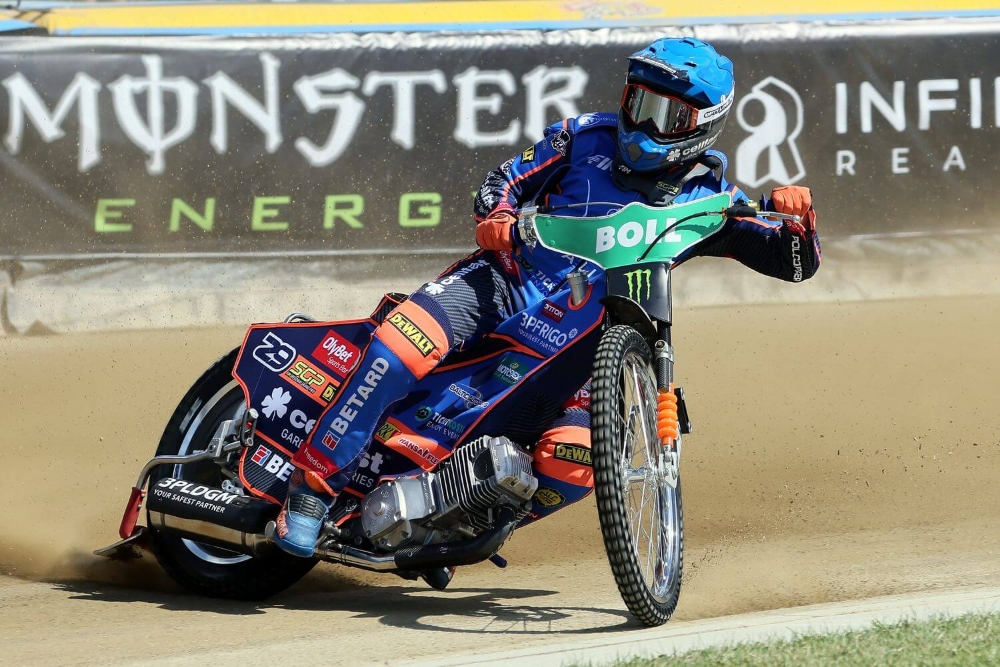
KI: It’s four laps, so it’s real quick and heats are done in about two minutes. They all start from a standstill. The bikes have no brakes and no gears. They’re running on methanol and they’ve got to be able to slide the bike through the corners. They’re trying to get around an oval as fast as they possibly can. It’s a very acquired form of racing where I typically tell established motocrossers, “Forget everything you know about racing. This is SO different.” It takes quite a while to pick up on.
It’s a small community of great people. It’s the very first form of motorcycle racing which started in the early 1900s. We want to expose speedway to the public again. We’re still here. We’ve never gone away. This is 23 races of action right in front of your face.
It’s super-fast paced. Each race is about two minutes. There are 23 different races. It’s a quick four laps of super-exciting alcohol burning and no brakes speedway bikes that are closer and faster together than you’ve ever seen before. The bikes have to be 170 lbs. They’re specific built for speedway and to go left. It’s a laydown motor. 99 percent of all the motors are GMs, which are made in Italy. It’s a dry clutch and single speed with no brakes. There is no telemetry. It’s a very raw from of racing and it’s a bike that can only be used going left on a speedway track. Nothing else. We’re going to have riders at the event that are world champions and gold medalists. Most American fans only see these riders on TV. The only other way to see them would be to go over to Europe and be part of the crowds that are 50,000 deep.
Eric Johnson
Born and raised in the rust belt to a dad who liked to race cars and build race engines, Eric Johnson grew up going to the races. After making it out of college, Johnson went into the Los Angeles advertising agency world before helping start the motocross magazine Racer X Illustrated in 1998. Some 20 years ago, Johnson met Paul Pfanner and, well, Paul put him to work on IndyCar, NASCAR, F1, NHRA, IMSA – all sorts of gasoline-burning things. He’s still here. We can’t get rid of him.
Read Eric Johnson's articles
Latest News
Comments
Comments are disabled until you accept Social Networking Cookies. Update cookie preferences
If the dialog doesn't appear, ad-blockers are often the cause; try disabling yours or see our Social Features Support.
.jpg?environment=live)