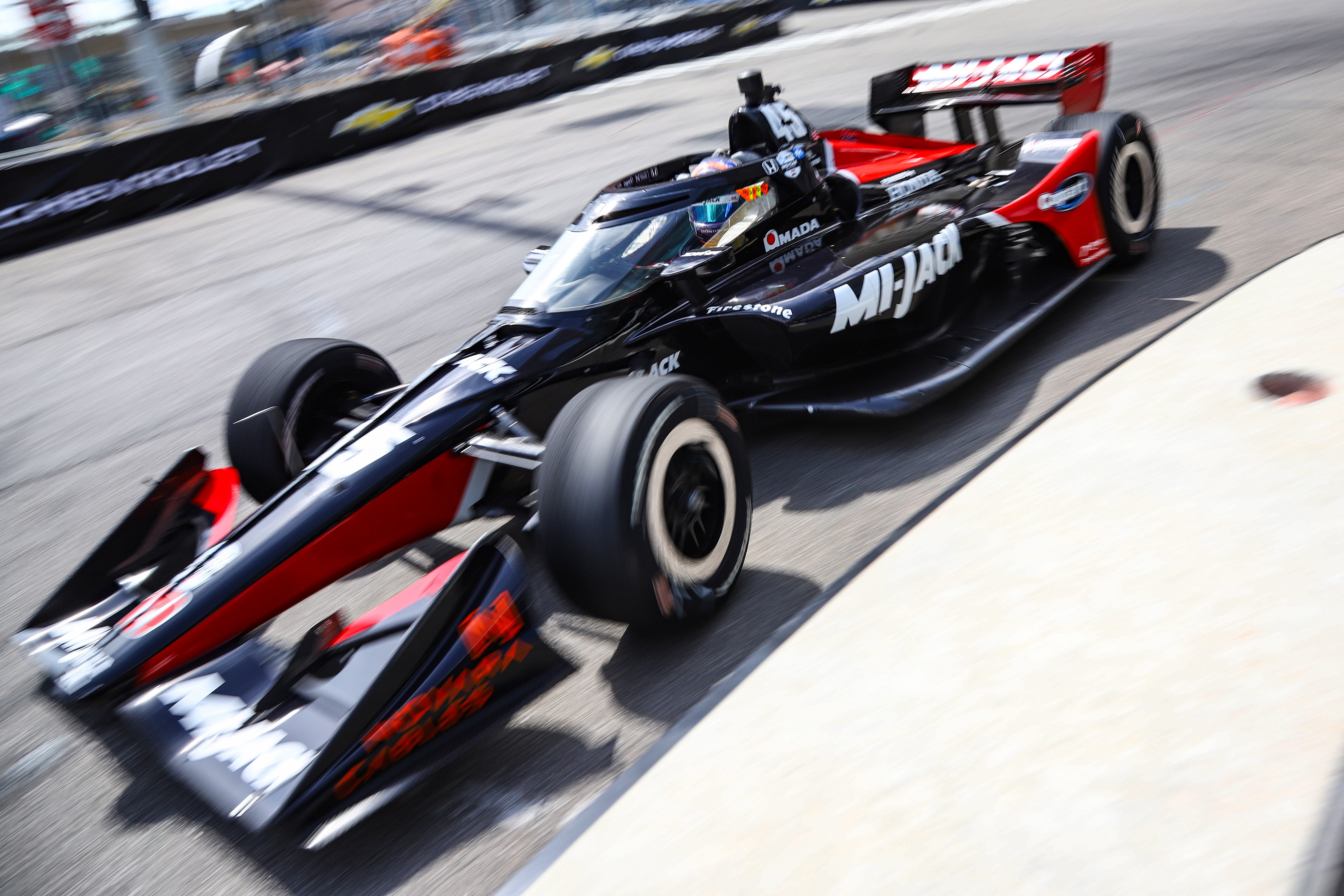
Aaron Skillman/IMS Photo
Dallara issues technical bulletin after Foster's suspension failure
Dallara, makers of the spec DW12 chassis used by every IndyCar Series team, has issued a technical bulletin in the wake of Louis Foster’s crash on Sunday at the Chevrolet Detroit Grand Prix. The communication urges every team to conduct an inspection of the mounting bracket that failed on the No. 45 Rahal Letterman Lanigan Racing Honda.
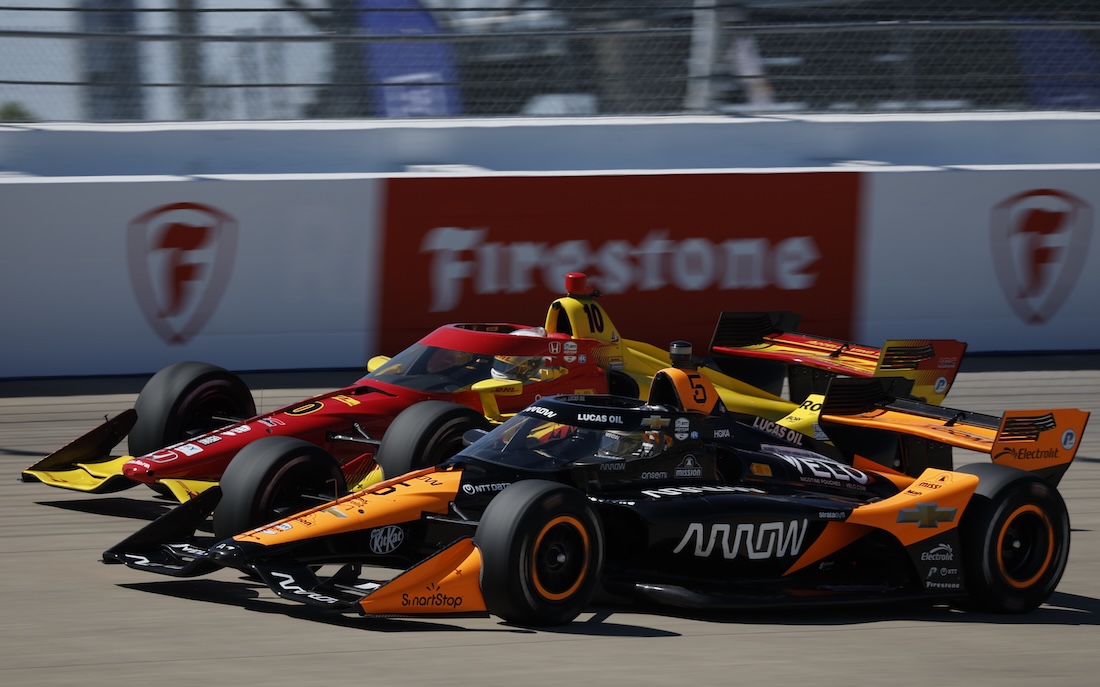
Foster was at the fastest part of the 1.6-mile track where speeds reaching 180mph are achieved when a portion of the rookie’s right-front suspension broke away from the chassis and collapsed inward, which caused the Briton to hit and glance off the right-side wall and spear into the No. 60 Meyer Shank Racing Honda driven by Felix Rosenqvist at nearly unabated speed. Foster continued into the runoff area and hit the tire barriers nose-first before coming to a stop.
Foster was uninjured in the scary incident while Rosenqvist hurt his knee and was taken for medical inspection before being released and cleared to drive. Foster’s No. 45 chassis was destroyed in the crash, making it the second RLL tub that has been lost since April when Takuma Sato wrote off the No. 75 Honda at the Indy Open Test. MSR reports Rosenqvist’s No. 60 tub survived the crash and will return to action, but the repair bill could exceed a quarter-million dollars.
The brackets in question mount to the inside of the DW12 tub and have captured K nuts welded to the brackets. Mechanics installing the upper and lower A-arms insert two bolts through the brackets attached to the ends of the A-arms and tighten them into the inner bracket, creating a sandwich consisting of the outer bracket, the tub the bolts pass through, and the inner bracket.
With Foster’s car, the lower right-front leg of the bottom A-arm’s inner bracket is what is said to have failed, with the K nut breaking free from the bracket, which then led to the outer bracket being ripped away from the broken inner bracket, and the suspension collapsing that ensued.
More IndyCar


The captured nut on the inner brackets is a major time-saving convenience. Teams are allowed to forego the brackets with the secured K nuts, but geometry changes would take an exceedingly long time since inner paneling would need to be removed within the tub and a second mechanic would need to try and contort themselves to place washers and nuts on each bolt, which isn’t something teams have time to do during a session. Thanks to the captured K nuts on the inner brackets, a single mechanic can complete the geometry changes at the front of the car.
At the back of the DW12, the process is switched as the suspension brackets slide onto studs inserted in the sides of the gearbox and bellhousings, and to make geometry changes, mechanics remove the nuts and washers that hold the brackets onto the studs, move the brackets up or down onto a different set of studs, and re-install the washers and nuts to clamp the suspension in place.
In a call to four IndyCar crew chiefs or team principals, some told RACER they have gone straight to replacing the inner brackets with brand-new brackets, while others said they will inspect the brackets, re-use any that pass the crack-checking process, and change any that fail the inspection.

Marshall Pruett
The 2026 season marks Marshall Pruett's 40th year working in the sport. In his role today for RACER, Pruett covers open-wheel and sports car racing as a writer, reporter, photographer, and filmmaker. In his previous career, he served as a mechanic, engineer, and team manager in a variety of series, including IndyCar, IMSA, and World Challenge.
Read Marshall Pruett's articles
Latest News
Comments
Comments are disabled until you accept Social Networking Cookies. Update cookie preferences
If the dialog doesn't appear, ad-blockers are often the cause; try disabling yours or see our Social Features Support.