Walt Kuhn/IMS Photo
Boles speaks on Andretti penalty and race tech
It took five days following the penalty announcement for Andretti Global to get some answers from the IndyCar Series on what took place with the Nos. 27 and 28 Hondas to lose their finishing positions at the Indianapolis 500, get moved to the bottom of the results, receive fines, and have personnel suspended for the Chevrolet Detroit Grand Prix.
Following the Monday afternoon notice from the series that detailed Andretti’s illegal modification of the energy management system (EMS) covers on the cars of second-place Marcus Ericsson and sixth-place Kyle Kirkwood, and illegal modifications to the suspension A-Arm mounting points for the carbon fiber EMS covers that enshroud the A-arms, three outreaches apiece from Tuesday through Friday were made to IndyCar and to the Andretti team by RACER.
The Andretti team was consistent in declining requests to speak on the matter and explain what it did to modify its EMS covers, which the penalty notice said, “provided the capability of enhanced aerodynamic efficiency to both cars.”
The heart of the illegalities stemmed from Rule 14.12.1.1, which states “EMS must be used as supplied by Dallara and approved by INDYCAR.”
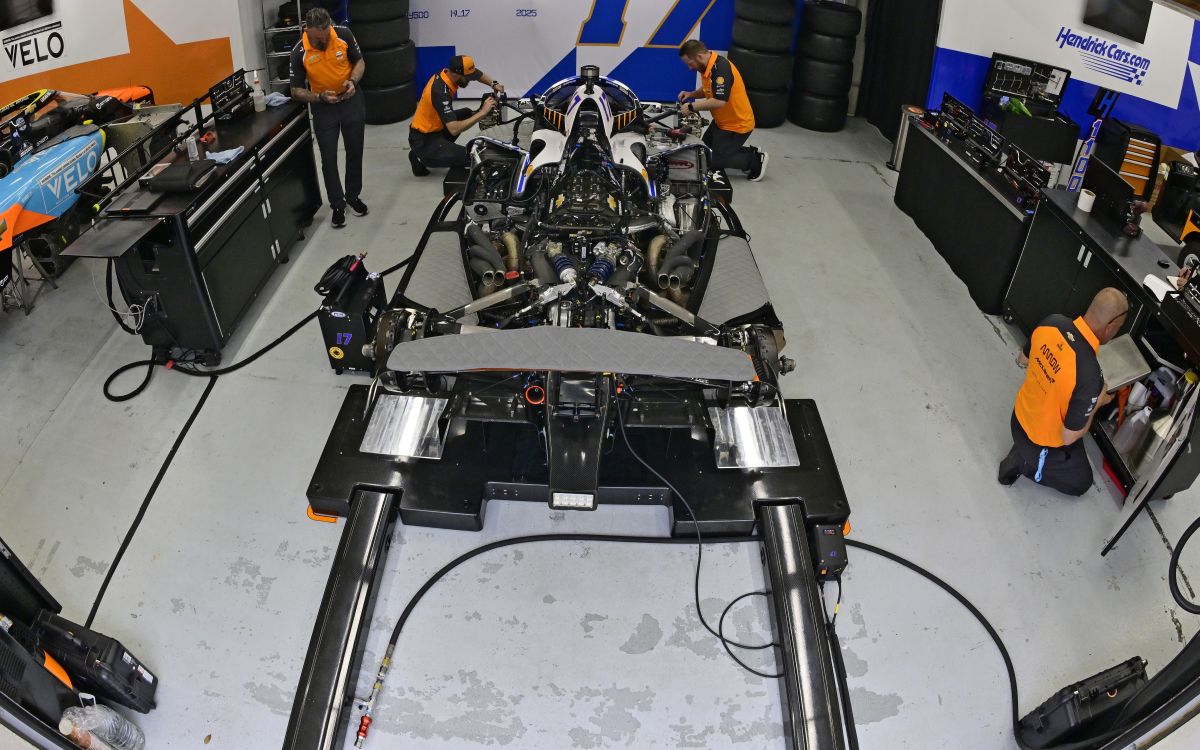
Other than mentioning the EMS covers and mounting points were modified and made use of illegal spacers, no information was provided on where the illegal covers were found on the cars, whether the parts were original or reproduced by the team, which was a subject of speculation, how the covers were positioned on the cars to potentially provide aerodynamic gains, etc.
Simply put, the penalty announcement explained the "what" while omitting the "how" or the "why," which was vigorously pursued throughout the week. Speaking with IndyCar President Doug Boles on Tuesday, the possibility of answering seven questions on the matter was presented and a response was received that it would be best held for Thursday. Attempts to do so on Thursday was unsuccessful.
Another attempt was made on Friday, along with multiple conversations held with other members of his staff on getting the questions answered, and a call on Saturday was presented. On Saturday afternoon, the conversation with Boles was successfully completed where some of the questions were answered and others were not.
RACER: Were the EMS covers manufactured by Dallara?
Doug Boles: Yes, they were. I want to end any speculation that they weren’t. This was a part to be used as supplied, and it's failed that test, but they were manufactured by Dallara.
RACER: Were the EMS covers of the same aerodynamic profile as the other legal EMS covers used in the race by other teams?
Boles: Let me just walk through the process. [Technical Inspection] pulled in the top 12 and took off the right-side EMS covers on the front, in the back, and in the process, that does two things. It allows us to look at the EMS covers, but also just to ensure that the wishbones (suspension A-arms) that are used on the car are the proper wishbones that are the Dallara wishbones. So in removing the parts, you don't know once the parts are removed what the aerodynamic profile is of the part, we just know that it failed the "as supplied" rule.
RACER: Is Dallara involved in reviewing components, as the maker of the parts? Or is that something where IndyCar technical inspectors alone, with no Dallara assistance or involvement, reviews the legality?
Boles: The tech team does it. Honestly, it's a part that is pretty clear. You could take a layman off the street, and put the one part by another part, and you can tell if they've been modified or not. So Dallara is not involved, but this is not something where you need Dallara to look and understand.
RACER: Were modified EMS covers found only on the front suspensions of the 27 and 28, rear suspension only, or all four corners?
Boles: We didn't do the left side of the cars. We just did the right side of the cars and they were found on the front suspension of both cars.
RACER: Were the other Andretti cars pulled in afterwards?
Boles: They weren't. They were not checked. Maybe there's a day that you can post-tech 33 cars. But right now, when we post-tech for the 500, we do between 10 and 12 cars. This year we did post-tech of 12 cars. Obviously the Marco (Andretti) car had an incident, and Colton (Herta who was 14th) was outside the top 12. So they did not go through the post-race tech.
RACER: Is that something you might reconsider with future rule evolutions if x-number of cars are found to have an irregularity in a team, to extend the search, at minimum, to those parts on other cars from the team?
Boles: It's a good question, and one that I think is something we can talk about in the future, but we really haven't talked about right now, especially in a three-hour race where one car (Andretti) goes out 20 minutes into the race. Unless we're going to impound people's cars and say you can't leave. That would be a change in the long-standing process, and we haven't talked about that.
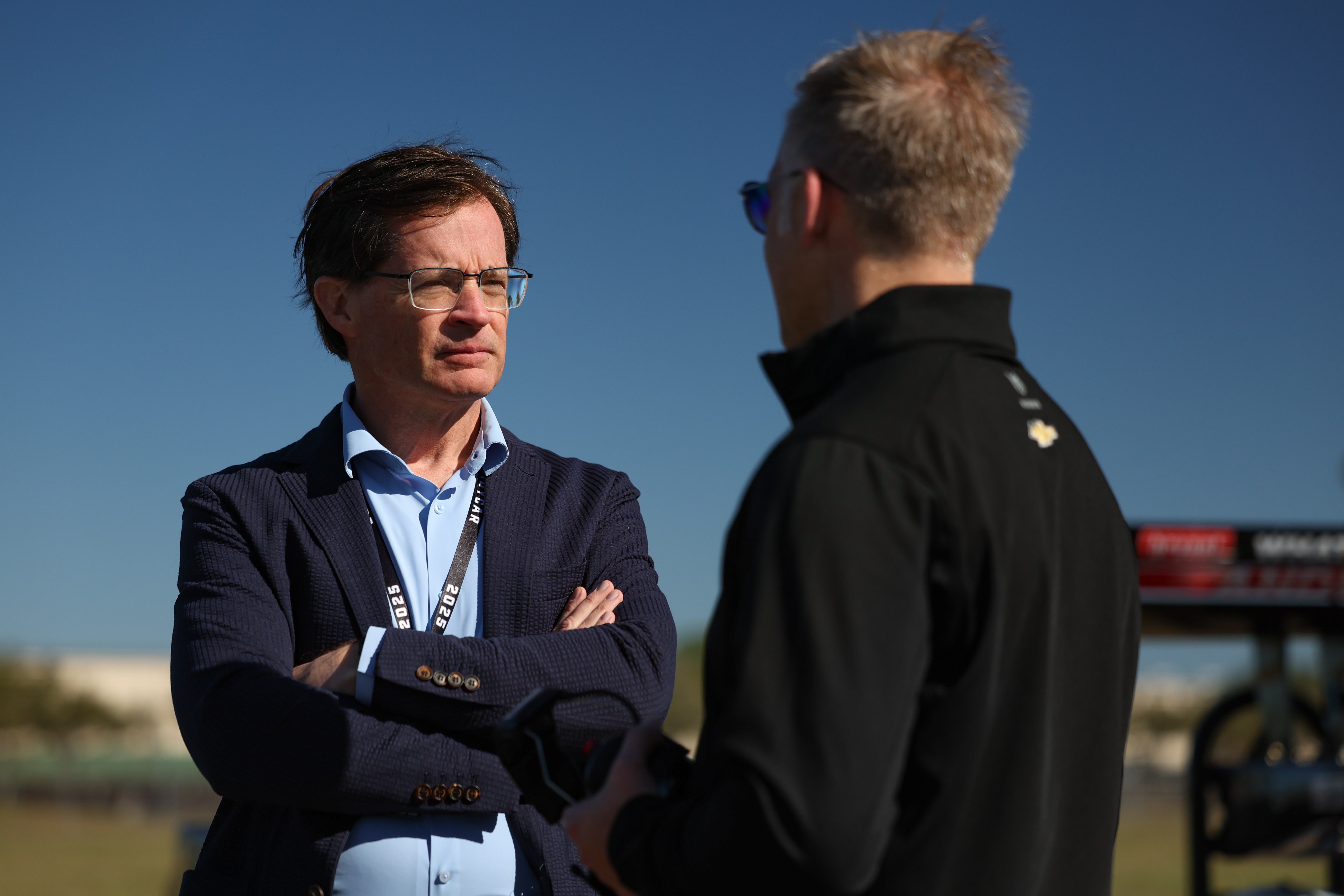
IndyCar President Doug Boles (left) talks with Ed Carpenter. Joe Skibinski/IMS Photo
Boles: Where we are is when they came apart, they didn't fit in the "supplied as" rule and at that point in time, we didn't put them back together to figure out why. The purpose of the "supplied as" rule is so we don't have to talk about intent, and we don't have to talk about advantage or not. It just is an area where we say, ‘Look, you can't change them that way.’ And we don't get in this question of, is it intent, or is it done for a specific advantage? So we stopped at the point that it violated the supplied-as rule, and that's where we ended it. There's not levels of failure. Otherwise we’ve got to go put stuff in wind tunnels. We were focused on the ‘as supplied’ rule the same as where we were with the Penske one with the attenuators.
RACER: Understood. There may be shades of gray here if the EMS covers for whatever reason didn't fit appropriately, and so a mechanic used a Dremel to trim whatever he or she felt was appropriate to have them fit onto the suspension correctly. That's a fitment thing.
Boles: So the rule allows for sanding and fitment. This was "not used as supplied."
RACER: Was searching for the EMS modifications part of pre-race technical inspection, or is this traditionally a post-race inspection?
Boles: This is a post-race inspection level because they literally have to take the parts off of the car, and my understanding, and I wasn't there when it happened, but my understanding is it took anywhere from five to 20 minutes, depending on the team that was taking it off. So to do that on the front end (of the race)…there's always going to be post-race inspection, because you're going to need it, because teams have the opportunity in a pit stop or sitting on pit lane to make adjustments to their cars.
RACER: Interesting to see with both the Penske penalty and the Andretti and PREMA penalties what I believe is a new wrinkle for 2025 in adding personnel suspensions to go along with the other penalties. Normally it’s just fines and points and positions. Seems like a powerful new message to send.
Boles: The rules allow for it. For me, it's about the integrity of the events. And at some point, is a financial penalty right? There's people that might say, "I don't care about the money, I just want to be on the pole. I want to win the 500." There's a grid penalty, which I still think is appropriate. But I also think that it's a reminder that there are people responsible for the cars that need to be responsible for the cars, and it just felt like it was the appropriate place. Especially in these situations where it's clear these parts have to be used as supplied. And that means as supplied, it doesn't mean ‘I'm going to fill a seam or I'm going to modify the part’ for whatever reason.
RACER: Would you characterize the technical inspection team, in light of the three teams, and five cars penalized in a one-week span, effectively, as taking a more stringent approach to inspection with the violations that they have been finding coming from Pole Day forward? Or is this just simply businesses as usual, and there's just been a high frequency of violations that have been found? Have the proverbial screws been tightened?
Boles: The supplied-as rule is pretty black and white. It should be the easiest one for all teams to follow. And I think to the extent that we find things not used as supplied…that’s going to cause challenges. So it's not that we are doing anything differently. I think teams need to pay close attention to the rule and realize that supplied-as is supplied-as, regardless of intent. That's the reason for the rule. We don't care why or anything other than it's just got to be that way. It's better for all of us.
And for me, I hope that going forward…we haven't really had this problem at other events. It's the Indianapolis 500 and everybody's doing everything they can to be as fast as they can. I think some of these supplied-as rule (violations), hopefully we don't see these at other events. We've gotten through all the other events up to now, with the exception of we had an intrusion plate safety supplied-as issue for Colton (Herta at The Thermal Club), and we took away points and penalized the team because that was a safety issue. And same with PREMA (on Robert Shwartzman’s car at Thermal), with their fire-pull issue.
RACER: Most other racing series don’t do this, but would you consider building out some form of online resource for violations, public showing of the violations, whatever it might be, something like they do in NASCAR, to be as transparent as possible?
Boles: I've had a couple of conversations in the last few days with some team owners about that. So right now, when IndyCar puts up a penalty notice, they obviously know what it is, because we've talked to them about it, but they get a notice that says you violated rule x, y and z. Here's the penalty for that, and then they get that. It gets posted on (the private IndyCar Information Service site) so all the teams see the penalties that are there. So I've asked what about in the future, attached to that note, is a photo of what the items were, what they look like, so the whole paddock understands.
But you're right, it would eliminate some of the rumor and speculation. It would be clear what the violation was. So it's definitely something to be considered.
Marshall Pruett
The 2026 season marks Marshall Pruett's 40th year working in the sport. In his role today for RACER, Pruett covers open-wheel and sports car racing as a writer, reporter, photographer, and filmmaker. In his previous career, he served as a mechanic, engineer, and team manager in a variety of series, including IndyCar, IMSA, and World Challenge.
Read Marshall Pruett's articles
Latest News
Comments
Comments are disabled until you accept Social Networking Cookies. Update cookie preferences
If the dialog doesn't appear, ad-blockers are often the cause; try disabling yours or see our Social Features Support.