Joe Skibinski/IMS Photo
How hybrids dial up Indy 500 Fast Friday pucker factor
Qualifying for the Indianapolis 500 is one of the most harrowing experiences for drivers every year. The big horsepower, coupled with the stripping of downforce and drag to barely adequate levels to produce average speeds above 230mph, has the best IndyCar aces flirting with disaster during those four laps.
And that was before the IndyCar Series made the move to hybridization.
As the most talented and courageous drivers entered in the great race tell the story, going hybrid and the handling changes at the 2.5-mile Speedway brought on by packing 100 pounds of an energy recovery system into the rear of the cars, could lead to three straight days of “wild” and “knife edge” moments in the cockpit as accelerated tire wear becomes the enemy during the 10-mile blasts.
“I'd have to say that was the biggest step change – decrease in grip – I've had in an IndyCar,” said 2014 Indy winner Ryan Hunter-Reay, whose IndyCar career dates back to 2003.
Throw in the forecast of high winds – increased instability with gusts over 30mph predicted on Saturday – and bravery will be a vital component in holding onto the grip-limited machines during Fast Friday and two days of time trials.
Minus the wind in April, two drivers performing qualifying simulation runs during the Indy Open Test hammered the Turn 1 wall as Takuma Sato and Kyle Larson spun while fighting to control their unwieldy machines.
“I think whoever qualifies on pole may need a vodka shot just to settle everything down…a cigar or something, just to bring the levels down,” said 2024 Indy pole winner Scott McLaughlin.
Three days of crash-free running have been completed prior to Fast Friday, where turbocharger boost is raised to give teams and drivers the ability to perform qualifying simulation runs with the same power level they’ll have when it counts over the weekend as the field of 33 is set.
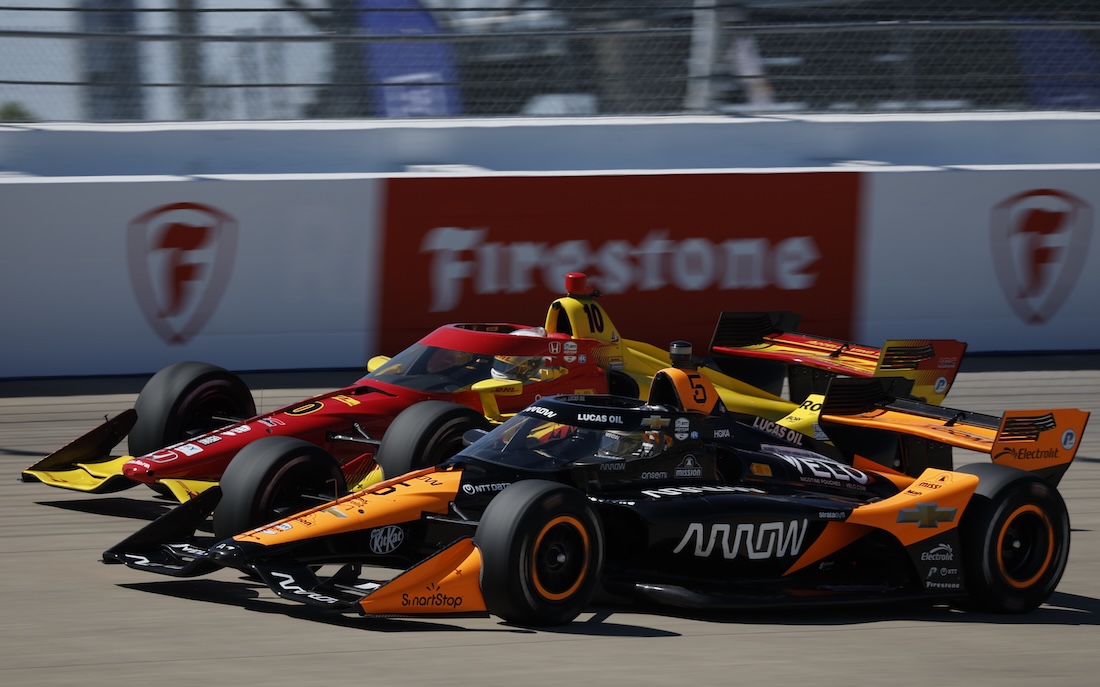
Arrow McLaren’s Pato O’Ward, who rates at the top of IndyCar’s most daring drivers, isn’t sure the clean running will hold.
“I think I think people should watch out for Turn 1,” said the 2024 Indy 500 runner-up. “You're gonna see race cars a lot more on the edge than what you have been in the past. And that means that there really is no space for a wiggle. Your bum has to be extra sensitive in feeling what's going on, because if you don't stay ahead of the balance, you're gonna pay for it. Can't wait. I love this event. It's just so sick. You never feel like you have such a big set of balls than when you finish qualifying here.”
Will Power, the 2018 Indy 500 winner, is on high alert within his No. 12 Chevy.
“It’s more of a knife edge like to catch, as you saw, like two guys crashed at the test because it’s so unpredictable,” he said.
“It’s going to be wild,” added O’Ward’s Arrow McLaren teammate Christian Lundgaard. “We definitely have a very strong feeling of it’s just going to be tough mentally. You gotta hang in there, and it's gonna be tricky.”
Two-time Indy 500 winner Sato offered the most illustrative example of how the extra 100 pounds has fundamentally altered handling and tire life while in qualifying trim.
“It's definitely more challenging in the cockpit,” Sato told RACER. “Without the hybrid, for the four laps, usually lap one is OK. Second lap, definitely the front tires start to degrade and have more understeer. By the third lap, the car gets quite neutral. By the fourth lap you just play, you hold on, right? Those things (have) speeded up with the weight.
“So now, everything is at least one lap sooner. Fourth lap was the full ‘playing’ lap; it's now become lap three. So I don't know what it's gonna be like on lap four. We might have to make some sacrifice on lap one.”
Championship leader Alex Palou attempted a few qualifying simulations with high boost at the test and will embark on his first simulations since the test during Fast Friday. The emerging theme of no longer knowing what to expect on the last lap or two of the unbridled blasts.
“I couldn't do more than two laps before I had to bail out, so I don't even know what the third is gonna feel like,” Palou said. “So I'm not looking forward to it. But I think it's actually good. I like it. I like that it's challenging.”
AJ Foyt Racing’s David Malukas added more insights to the rapid decline of grip encountered in qualifying simulations.
“Man, those four laps felt like a full tire stint,” he said. “The first two laps I believe are OK – I think it's pretty comparable to previous years – but the last two laps, man, it really takes a toll on the tire. And we really need a lot of maneuverability on the (handling adjustment) tools. I've never had it that drastic from where the starting point of where I was with the tools, to where I finished the four laps, and the pace drop. It was astonishing how massive it was.”
“There's only so much you can do with this weight. It's just where it's located. The rear just has these big snaps very late into a corner, too. It's on edge. I’ve already had a few moments, just in race running with race downforce levels. Even if you make it through the four laps, it just understeers a whole bunch, and then you're just going to ‘deg the front-right tire; then by the fourth lap, the rears are gonna be gone. You're gonna be loose, so it's gonna be a tough one.”
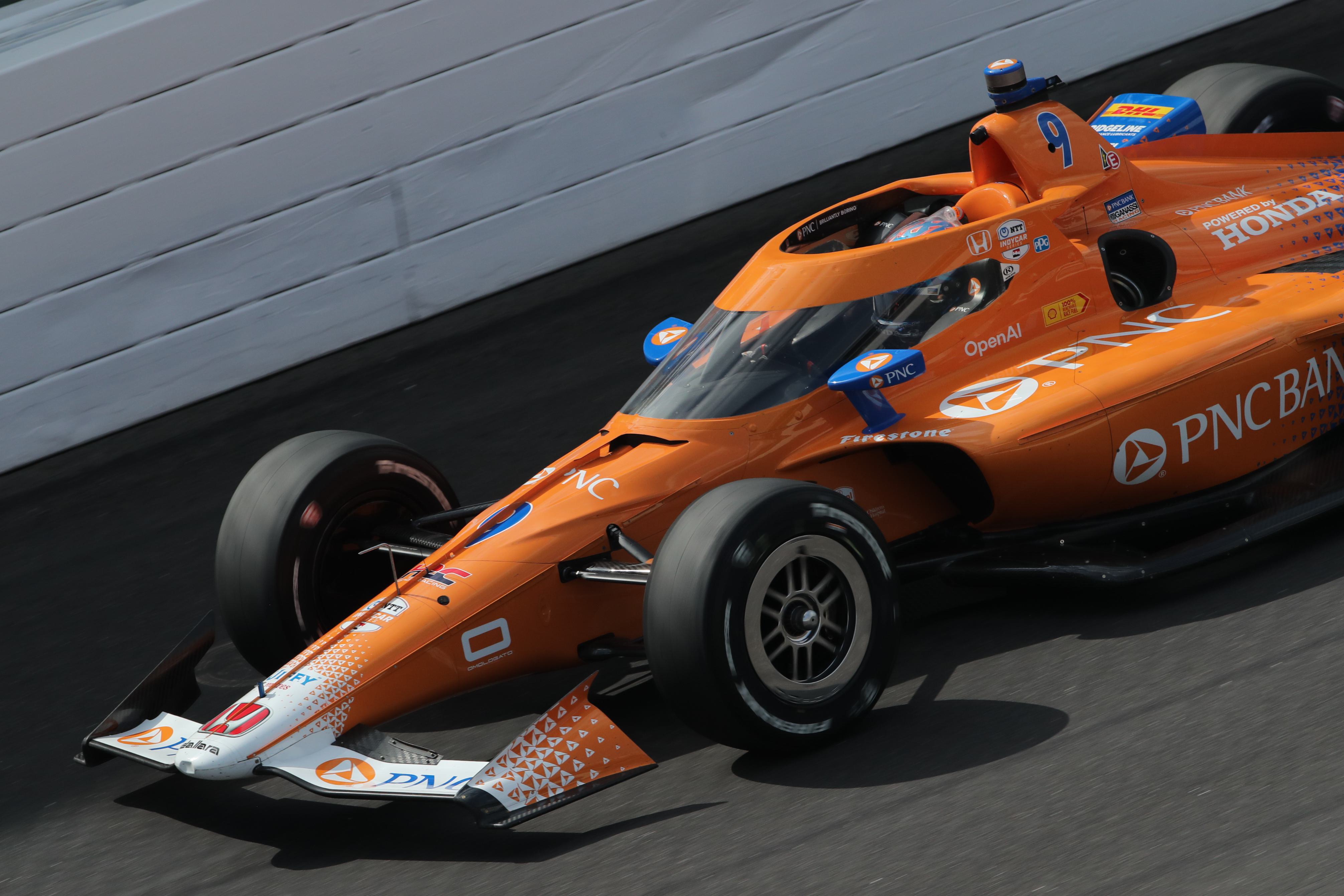
Scott Dixon says to watch out for a lot of improvisation – and mistakes – as drivers grapple with the elements and the various tools in play. Matt Fraver/IMS Photo
Scott Dixon, the 2008 Indy 500 winner and five-time Indy polesitter, expects fans to see a lot of improvisation during qualifying as conditions change, mistakes are made on how the hybrid power is harvested and deployed, and drivers who are accustomed to being flat on the throttle for four laps have to lift to protect themselves and their cars.
“I think it's going to be easy to mess up,” Dixon said. “It's very easy to go in with a mindset of, ‘Hey, this is what we're going to do for deploys.' But when you roll out, the conditions can change pretty quickly so I think you have to be ready for change. That’s the biggest thing. Looking at the four-lap averages, there are a lot of people struggling. So there are some bigger speeds, obviously, but speeds in general, I think they're going to be way down.
“You might be pretty miserable if it’s as hot as it could be and with the winds, you’ve got to be prepared to dial back if that’s what it takes to complete the run. And you're gonna have to pick your time pretty carefully based on conditions, which means you're probably going to be jamming and taking your first run because it's going to be slightly cooler. I think a lot of people will be pulling times, going again, because they got something wrong or the weather was a problem. I think the madness at the end is going to be a bit crazy.”
Marshall Pruett
The 2026 season marks Marshall Pruett's 40th year working in the sport. In his role today for RACER, Pruett covers open-wheel and sports car racing as a writer, reporter, photographer, and filmmaker. In his previous career, he served as a mechanic, engineer, and team manager in a variety of series, including IndyCar, IMSA, and World Challenge.
Read Marshall Pruett's articles
Latest News

Comments
Comments are disabled until you accept Social Networking Cookies. Update cookie preferences
If the dialog doesn't appear, ad-blockers are often the cause; try disabling yours or see our Social Features Support.