Lumen Images
How one phone call changed Pagenaud's recovery – and GM's engineering muscle
Simon Pagenaud put on his racing suit and helmet, just as he’d done a thousand times before. But this time was different. The 2016 IndyCar Series champion and 2019 Indianapolis 500 winner was in an uncomfortable intersection where nervousness and excitement and anxiety came together and clashed.
The battle for dominance among powerful emotions was new as he crouched down, settled into a kart, and stared out at the open road ahead for the first time since his nasty barrel-rolling crash through Mid-Ohio’s Turn 4 in the summer of 2023.
Vibrating with nerves and anticipation, Pagenaud pulled away and was quickly overcome by his body’s reaction to the little machine’s unforgiving nature. With no suspension to dampen undulations in the road or soften the strikes while powering over curbs, the track beneath the kart shook Pagenaud with what felt like a rolling earthquake. The seismic sensations fired into the seat, up through his spine, and into his brain. It felt like July 1 all over again, but far worse.
The violent Mid-Ohio IndyCar incident — result of a brake component failure at the end of a 175mph straight – whipped his head in every direction within the cockpit of his No. 60 Meyer Shank Racing Honda.
His HANS device limited his head's forward movement, and IndyCar’s foam head-surround cushioned some of the other travel, but within the helmet, Pagenaud’s brain was repeatedly slammed against the walls of his cranium.
The pummeling of Pagenaud’s brain – akin to having boxers punching from all sides at the same time – left the married father of two with a worrisome concussion and other damage he’s not ready to discuss.
Eager to test his readiness, the tiny vehicle represented baby steps back to the sport he loved. But his brain wasn’t prepared for the harsh and unrelenting jolts delivered by the kart; a wicked migraine was the first symptom. This, Pagenaud knew, was something he could handle. The next symptom — extreme nausea — was the show-stopper.
With the migraine raging inside his skull, and the queasy taste of fluid starting to build on the back of his tongue as his stomach began to convulse, Pagenaud pulled into the pits and stepped away from the kart.
Despite an aching desire to be fully healed, it wasn’t time. More emotions arrived as sadness made its presence felt. And worry. Having turned 39 in May of 2023, Pagenaud was in the twilight of his full-time IndyCar career.
Being paid as a professional racecar driver — the physical act of strapping in and competing for teams in exchange for healthy compensation – is how he supported his family, and how he’d planned to earn a living for many years to come, either in IndyCar or IMSA’s sports car championship. The kart provided an answer Pagenaud didn’t want to hear or accept. His profession, his life’s passion, was out of reach.
Every sensation the kart transmitted and induced was evidence of a need for a softer, more gradual approach to the healing process. Being slowly reintroduced to absorbing and processing the incessant physical pounding that comes with being an elite racecar driver was the clear and obvious need for Pagenaud’s brain.
And then Rob Buckner, who at the time was Chevrolet’s IndyCar program manager, placed a random call to the North Carolina-based Frenchman.
“We missed Simon in the Chevy camp,” Buckner tells RACER. “It all starts from when Simon went to Meyer Shank, and we missed that voice, the way he approaches a simulator, and the way he looks at manufacturer support and the tools and professionalism he brings.”
Pagenaud raced for Honda-powered teams through 2014, then joined Chevy-aligned Team Penske, where his greatest successes were earned, and returned to Honda with Meyer Shank in 2022.
“If you know him as a person, it transcends manufacturer relationships,” Buckner continues. “I’d still wish him well and talk to him at the track. And our partnership with Simon – championship, Indy 500 win… it was incredible. So we were looking for a development driver and getting everything online at the GM Charlotte Technical Center. And it's very difficult because it's based in Charlotte.
“So Ryan Baldi, who's led a lot of simulation items and simulator development at GM for many years, had the idea of, ‘Man, we should check and see if Simon would be up to trying to help in the simulator. Is this something he's healthy enough to do? Is it something he'd be interested in doing?' Because he lives locally, and he's also available on days where we're traveling and maybe Fridays when we're practicing. Would he be interested in helping our simulation group? And Simon was immediately thrilled at the idea of it.”
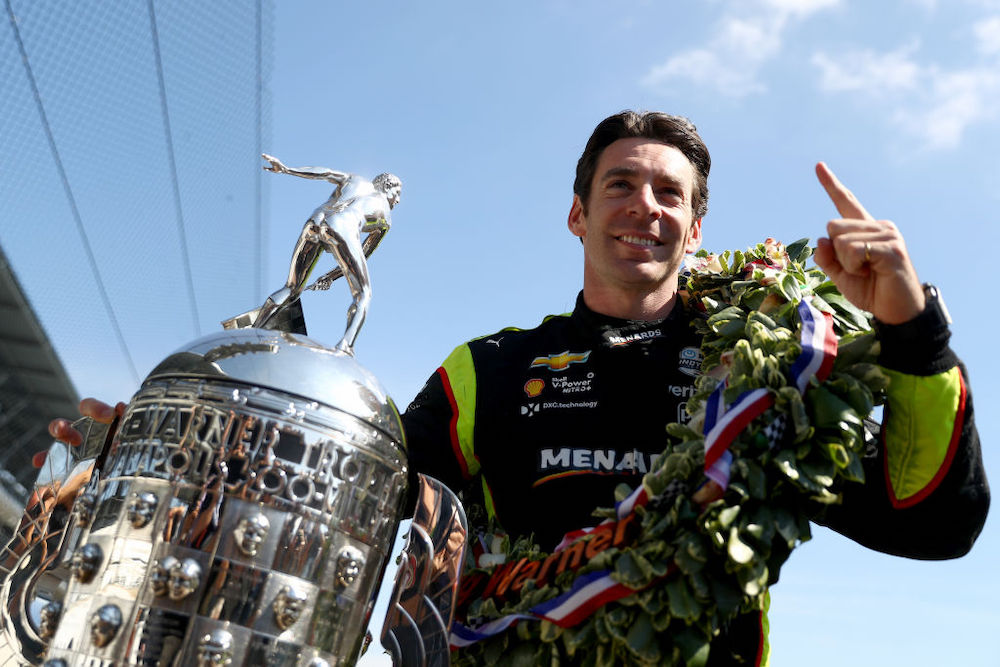
Pagenaud has had close associations with both of IndyCar's manufacturers at different points in his career, but his greatest successes - including his 2019 Indy 500 win - came while he was wearing a Bowtie with Team Penske. Clive Rose/Getty Images
Full-size driver-in-the-loop simulators have become standard equipment for auto manufacturers and the wealthiest teams to use in replicating the tracks where they compete. In digital form, chassis, aerodynamic, and engine tuning is tested and refined prior to each event, which produces a strong baseline to start the weekend.
Active drivers in Formula 1, IndyCar, NASCAR, and IMSA spend plenty of time in those multi-axis simulators, which replicate some of the forces experienced in the cockpit, but their availability is limited. And with most IndyCar drivers living in Indiana or Florida, locality was an issue at the North Carolina campus.
The idea of having an on-demand IndyCar champ and Indy 500 winner, sitting ready just minutes away from the Tech Center to assist Chevy in its IndyCar preparations for 2025, as their secret weapon was a stroke of genius.“It’s very humbling and very touching,” Pagenaud tells RACER. “Obviously, life changes after a dramatic event like I had. The cell phone doesn't ring as much. But one day it rang, and it was Rob. And from the very beginning, he was very supportive of my recovery, even before we started talking about getting on the simulator. He was very present in sending me messages, calling me, and we always had a great relationship. We've won a lot of races together, so it creates a bond.
“And there's also another person, Ryan Baldi, who's in charge of the simulator, and he needs credit for it as well. He’s somebody that I've always enjoyed working with on the simulator. But when the phone rang, Rob and I were talking a lot about my recovery, and asked did I want to test myself on the simulator to see where I was? That was the question Rob had for me.”
Unbeknownst to Buckner and Baldi, the opportunity was exactly what Pagenaud needed as a long-awaited next step in his recovery: A racing-like environment, with a moderate amount of shaking on every virtual lap to retrain his brain to accept the movement and frequencies, but minus the harshness and abrupt shocks that brought on the migraine and vomiting.
Just what the doctor ordered.
“I think he was a bit cautious,” Buckner says. “He had to work with his doctors and understand if this is a good next step. And as we were putting all the details together, he said, ‘Actually, this is something my doctors would like for me to do, and it's something I would like to do!’ It was complementing to all parties.”
Buckner’s first motivation was to apply Pagenaud’s vast arsenal of circuit knowledge and renown technical feedback to help improve Chevy’s competitive fortunes. The thought that being on the simulator would also help Pagenaud to expedite his healing hadn’t occurred to GM’s IndyCar boss, but it has turned into an immensely and mutually beneficial working arrangement.
“At that time, I had no idea if I was going to be of use, but I was very attracted by the idea and my doctors were very enthused by the chance to test myself on a moving simulator,” Pagenaud says. “And there were a lot of questions from me, about myself; was I going to feel things same way it used to? Was I going to be able to even manage a couple hours? I had no idea. So later in 2024 I had my first goal on the simulator. I said, ‘Listen, if I can give you feedback for that day, let's see if you can even use it.’ Because I just want to see if I can even do it for myself. So this is just going to be one try.
“It went well; my feedback was helpful for GM on the IndyCar side. I'm not going to lie, it was a big challenge personally, but it was awesome to have a reference, a new reference, of where I was at and how much I was struggling for different things. And we decided that we would do this a bit more frequently. So Rob and Ryan put a plan together, and we started slowly and increased a bit in terms of number of days.
“And I felt it was very useful for my recovery. It's probably been the most useful therapy I've had, and when I'm talking about therapies, physical therapy, eye coordination, reconnecting the bridges in the brain, things that were not as seamless as they used to be.
“In this process, it's improved massively. So that was really awesome to have a chance to practice all these abilities that honestly, you can't practice any other way, unless you put yourself on the racetrack in danger. So starting in the simulator was, technically speaking, from body healing and brain healing, the best situation I could expect, and I’m extremely grateful that we could do it with GM and continue those great relationships.”
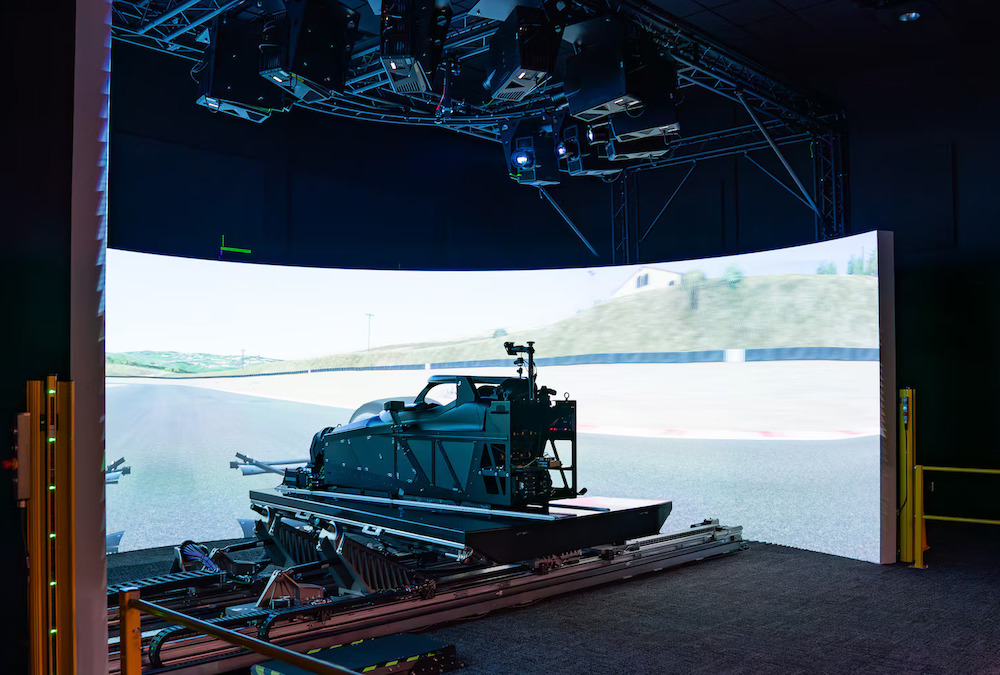
Chevy's simulator has become Pagenaud's home away from home – and a valuable tool in his recovery. From Chevy's side, the benefits are helping a friend, and gaining reams of information from one of the most technically-minded IndyCar drivers of the modern era. Image via GM
Buckner, who just welcomed his first child and will spend the rest of May at home with his wife and daughter before taking a new managerial role within GM’s racing division, marvels at the work ethic of his friend-turned-sim driver.
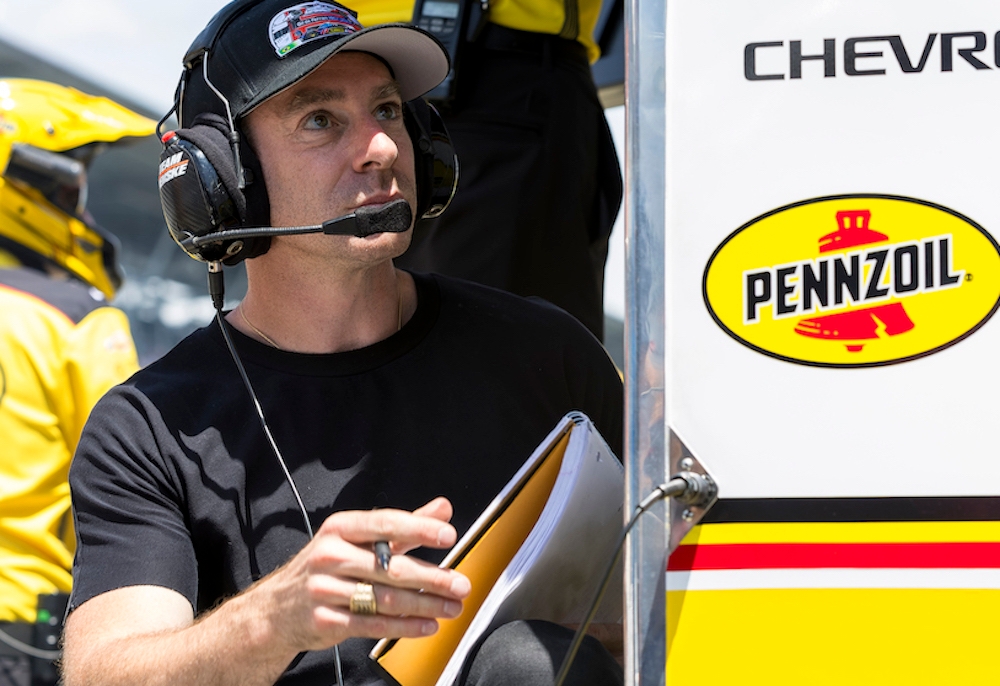
“Nothing had changed with Simon – the way he approaches the simulator, his professionalism, the way he can fit and work with a group of eight to 10 engineers for 12 hours,” he says with a laugh. “If I'm at the Charlotte Tech Center and I stop by there in the evening and they're having a development day, Simon's still in there, driving at 6pm, 6:30pm, and he's debriefing when he gets out of the cockpit. And he still has that absolute fire of competition.
“It's amazing that it complements his health and recovery. I joke that we're going to give him an Employee of the Month award, because he's there all the time. He's at the Charlotte Tech Center more than I am. He's still the only driver that will send us a multi-page report days later of here's how this felt, here's what I think we need to try next. And it's just amazing. Our engineers like working with him.
“And he's team-agnostic, really; he can drive our different teams’ setups and look at the tires and different track feelings and sensations. His feedback is critical. And then just knowing that it's good for him, it's great for all of our Chevrolet staff to work with him and being part of his recovery. It really is a great story. And it's great to have Simon back in the Chevy camp, maybe not in the public eye. It's not like he's driving a Chevy at the racetrack, but he's Employee of the Month at the Charlotte Technical Center. Pretty cool to have him involved again.”Years ago when Pagenaud was racing for Team Penske and GM was preparing to build and outfit the Charlotte location with engine dynos and DIL simulators and other racing development tools, he was recruited to assist in the search for the best simulator vendor. After a global tour to sample the offerings from various manufacturers was complete, Pagenaud gave his recommendation and GM bought multiple DILs to use across its stock car, sports car, and open-wheel programs at the facility which has become like a second home.
“When Simon was with us, because his feedback was that good, we wanted to make sure he was the one laying out the pros and cons and what we went with for a full dynamic driver-in-the-loop simulator,” Buckner said. “So we've got three full-motion rigs, and it takes essentially the IndyCar tub where we have a cockpit built, and the steering motor can go all the way to full effort. And Simon, traditionally, he wears his firesuit, turns the steering gain up to 100 percent, and sweats in there like a gym session.
“It actually used to be a joke – no one would want to go after Simon or sit in the seat, because it's a race for him, and that's the way he's always approached it. We have every track we’re able to replicate there, and with Simon, we say, ‘Hey, try this option. Run five-10, laps. We want to collect data.’ And then we'll go through options, A, B, C, D, and he'll run through all of them, sometimes aware of the changes we're making, sometimes not. Provide his feedback. And it's as close to running a racecar as it can be without consuming tires and engines. But we have all the tire, aero, and engine models.
“It's an incredible tool, and it's always been one of Simon's strong suits from how he approached that when he was driving full-time. And it does seem like he really enjoys the work, because his attention to detail in the way he approaches racecraft is unbelievable. You spend any time with the guy and you think, ‘Man, I probably need to be doing more. I probably need to be working harder,’ because that's just how he approaches life. It's refreshing to have him plug back into the program, helping our engineers, and he truly has made our simulation program better and that raises the performance of all 14 of our full-time drivers.”
It’s been nearly two years since Pagenaud's life-altering crash, and ongoing work in the simulator continues to have positive results on his health. But there’s no timeline established between the 40-year-old – he celebrates his 41st birthday on Sunday – and his doctors for when a return to racing could become possible.
Despite his constant efforts to undo the hidden damage, Pagenaud puts in the time at the GM Charlotte Tech Center with the knowledge that his days as an elite driver might not return. It was something he feared in the beginning, a dread that was fueled by the unknown. But the surprise call from Buckner has revealed things to Pagenaud that weren’t fully realized before July 1, 2023.
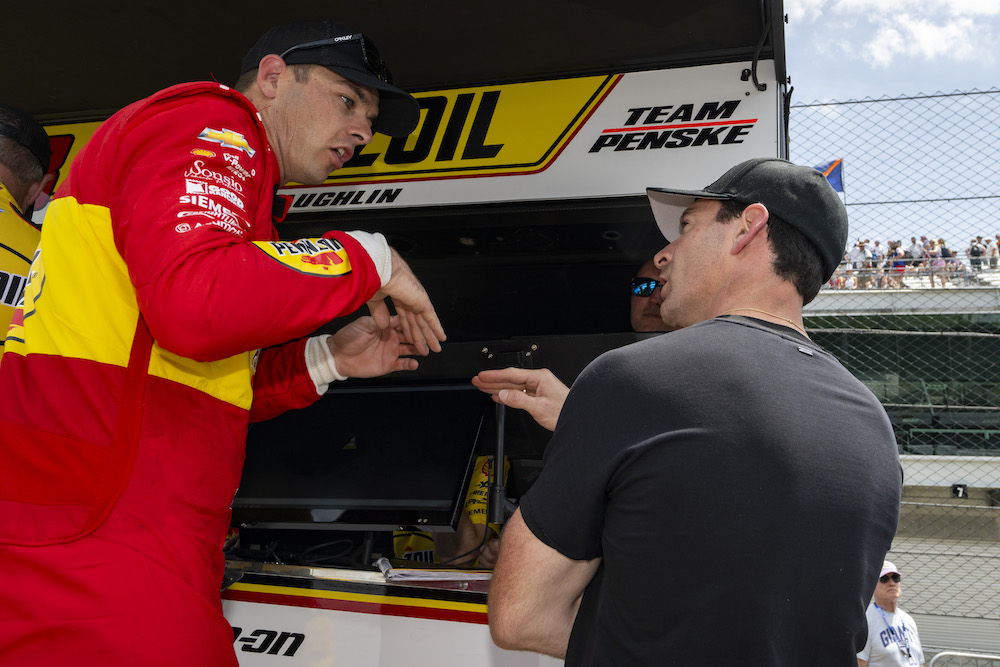
McLaughlin brought Pagenaud into the fold as an advisor for last year's Indy 500, and the pair will continue the partnership for this year's edition of the race. Lumen Images
Driving isn’t the only value he offers to the racing community. Penske’s Scott McLaughlin, the 2024 Indy 500 polesitter, hired Pagenaud as his personal coach and Speedway mentor last May, and he’s back again this year to help guide the New Zealander as the Kiwi chases his first win at IndyCar’s crown jewel.
The work with McLaughlin has unlocked a greater interest in downloading his knowledge to more of IndyCar’s next-generation drivers, just as his late mentor Gil de Ferran did when Pagenaud was trying to reach new levels in the sport.
At some point over the last two years, between his sought-after simulator driving skills, imparting wisdom to drivers who dream of attaining half of what he accomplished, and other professional interests he holds, Simon Pagenaud — the guy who had to race to live —has evolved into to a new and newly coveted version of himself.
Former rival Tony Kanaan, the 2004 IndyCar champion and 2013 Indy 500 winner, has thrived as Arrow McLaren’s new team principal, and other IndyCar contemporaries from Dario Franchitti to Ryan Briscoe have established themselves as team-wide driver mentors. It’s not hard to picture Pagenaud in a similar team-based role.
He still wants to race. That’s only natural. But Pagenaud understands that if it doesn’t happen, there’s no need to fear the unknown. It’s a byproduct of the calls that continue to come in and new non-driving opportunities he’s excited to explore.
Even at his title-winning peak, Pagenaud was a multi-faceted character. Today, the other facets are where he’s securing his future.
“It's very emotional,” Pagenaud acknowledges. “Just thinking about the journey, how far I was and where I'm at today, it's a major improvement. It's, unfortunately, still not enough to be at a competitive level, especially the level of IndyCar. But it is what it is. I'm able to still do some of what I love, even though it's in a virtual world, and it's being fulfilled by the technical side, which is something I've always loved, and honestly, something we're losing in real life because there's almost no track testing or anything of that matter.
“So for me, focusing on the technical side, in a dark room, with engineers, it's actually a good thing. I'm obviously looking at the positive, even though it's not where I would like it to be, but it has been a massive improvement due to the simulator. I could have done a lot of work with the doctors in person, which I already do, but I don't think we could replicate what my eyes are seeing when I’m in the simulator, what my reflexes are doing driving a car, even in virtual world.
“What makes a race car driver special is quick mental processing, powerful reflexes, vision and stability of the vision through your neck, and all these things for me have been an issue from the crash. So any little improvement is a better day. That's really where I'm at, and that's really what this situation, this relationship with Rob, with GM, has done for me. I’m so very, very thankful, very grateful. Because it took one phone call from one person, and the idea from Ryan, to get to do this. They’ve given me a way to unleash some of my knowledge that I probably would have never had a chance to use otherwise.”
A racing program, energized in dark rooms by the virtual contributions of a modern great. A modern great, pulled out of darkness by a racing program that rebuilt his sense of worth, opened new avenues of employment and security. It’s old friends and colleagues, caring for each other in ways that extend well beyond the race track.
“He's looking after his health, he's definitely helping us,” Buckner says. “And it's just like a dream little program we've put together.”
Marshall Pruett
The 2026 season marks Marshall Pruett's 40th year working in the sport. In his role today for RACER, Pruett covers open-wheel and sports car racing as a writer, reporter, photographer, and filmmaker. In his previous career, he served as a mechanic, engineer, and team manager in a variety of series, including IndyCar, IMSA, and World Challenge.
Read Marshall Pruett's articles
Latest News
Comments
Comments are disabled until you accept Social Networking Cookies. Update cookie preferences
If the dialog doesn't appear, ad-blockers are often the cause; try disabling yours or see our Social Features Support.