Getty Images
From the pages of Vintage Motorsport: Joest Another Day
For the 2024 edition of the 24 Hours of Le Mans, a trio of privately-run Porsche 963s prepare to take on their factory brethren and the rest of the Hypercar field, and it’s not for the first time. From the pages of the June/July issue of Vintage Motorsport, Gary Watkins looks back at the emergence of Joest Racing in the mid ’80s when the privateer took on the works Porsche team at Le Mans and prevailed.
Joest Racing had upheld Porsche honor with a from-the-rear victory in the 1984 24 Hours of Le Mans. That was the year that Stuttgart had withdrawn its factory entries, courtesy of a spat over the future direction of the rules for the World Sportscar Championship. But for 1985 the factory cars were back at La Sarthe and ready to resume a winning streak that had stretched beyond the introduction of the Group C 956 in ’82. Reinhold Joest had other ideas.
A privateer beating the factory teams in the WSC was possible. In fact, Joest had famously done it at Monza in 1983, the first season the 956 had been released to customers. But twice around the clock at Le Mans was surely a different story.
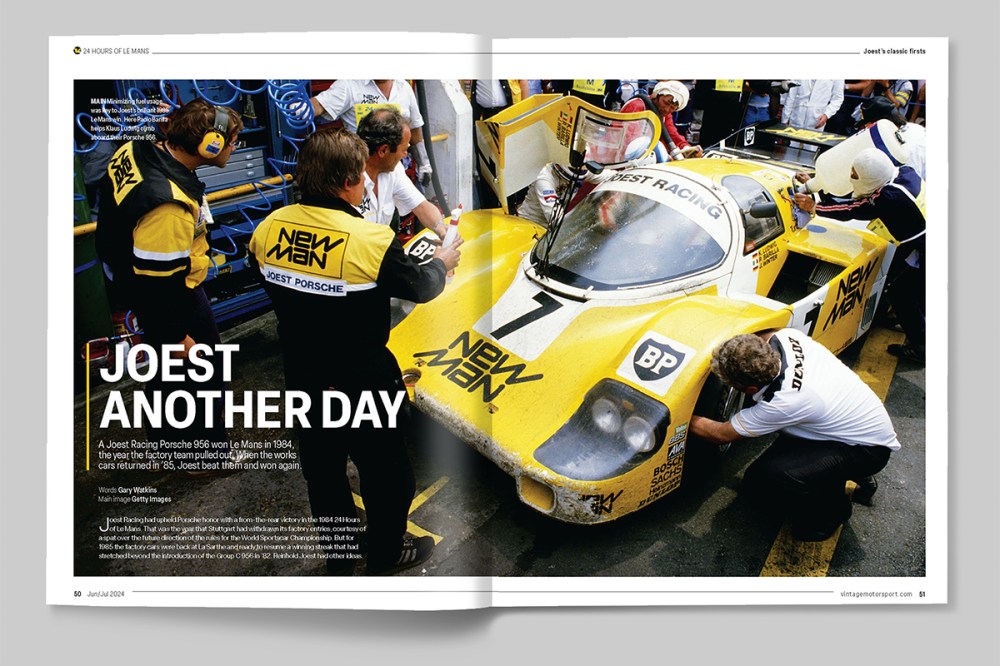
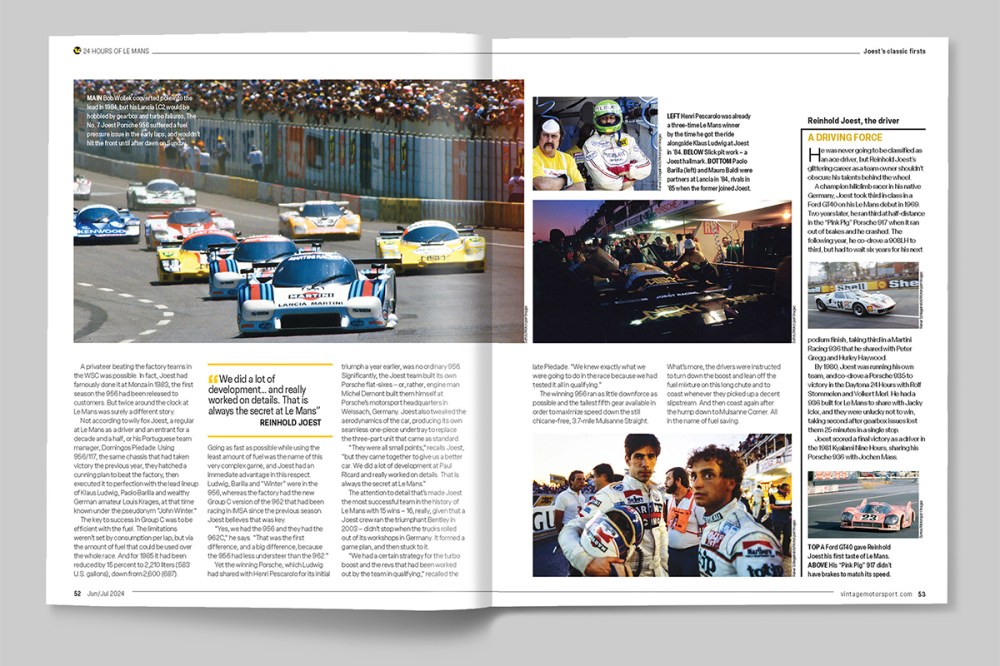
Not according to wily fox Joest, a regular at Le Mans as a driver and an entrant for a decade and a half, or his Portuguese team manager, Domingos Piedade. Using 956/117, the same chassis that had taken victory the previous year, they hatched a cunning plan to beat the factory, then executed it to perfection with the lead lineup of Klaus Ludwig, Paolo Barilla and wealthy German amateur Louis Krages, at that time known under the pseudonym "John Winter."
The key to success in Group C was to be efficient with the fuel. The limitations weren’t set by consumption per lap, but via the amount of fuel that could be used over the whole race. And for 1985 it had been reduced by 15 percent to 2,210 liters (583 U.S. gallons), down from 2,600 (687). Going as fast as possible while using the least amount of fuel was the name of this very complex game, and Joest had an immediate advantage in this respect. Ludwig, Barilla and "Winter" were in the 956, whereas the factory had the new Group C version of the 962 that had been racing in IMSA since the previous season. Joest believes that was key.
"We did a lot of development… and really worked on details. That is always the secret at Le Mans"REINHOLD JOEST
"Yes, we had the 956 and they had the 962C," he says. "That was the first difference, and a big difference, because the 956 had less understeer than the 962."
Yet the winning Porsche, which Ludwig had shared with Henri Pescarolo for its initial triumph a year earlier, was no ordinary 956. Significantly, the Joest team built its own Porsche flat-sixes – or, rather, engine man Michel Demont built them himself at Porsche’s motorsport headquarters in Weissach, Germany. Joest also tweaked the aerodynamics of the car, producing its own seamless one-piece undertray to replace the three-part unit that came as standard.
"They were all small points," recalls Joest, "but they came together to give us a better car. We did a lot of development at Paul Ricard and really worked on details. That is always the secret at Le Mans."
The attention to detail that’s made Joest the most successful team in the history of Le Mans with 15 wins – 16, really, given that a Joest crew ran the triumphant Bentley in 2003 – didn’t stop when the trucks rolled out of its workshops in Germany. It formed a game plan, and then stuck to it.
"We had a certain strategy for the turbo boost and the revs that had been worked out by the team in qualifying," recalled the late Piedade. "We knew exactly what we were going to do in the race because we had tested it all in qualifying."
The winning 956 ran as little downforce as possible and the tallest fifth gear available in order to maximize speed down the still chicane-free, 3.7-mile Mulsanne Straight.
What’s more, the drivers were instructed to turn down the boost and lean off the fuel mixture on this long chute and to coast whenever they picked up a decent slipstream. And then coast again after the hump down to Mulsanne Corner. All in the name of fuel saving.
"We knew how much we could gain by using less revs, and how much by coasting," said Piedade. "If you coast for 1,000 or 1,200 meters a lap, for every 10 laps you’re able to do one lap more than the rest."
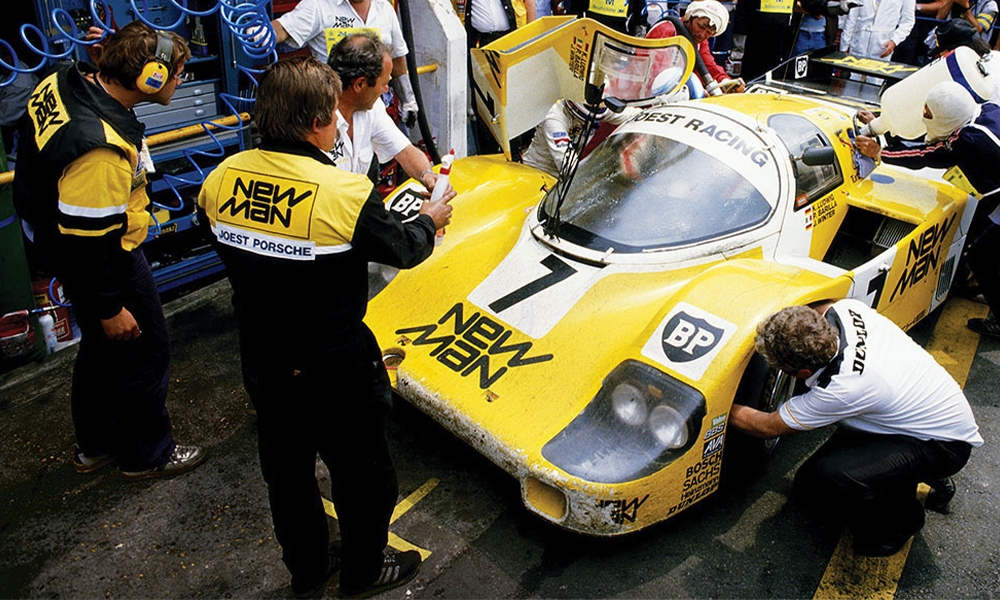
Slick pit work – a Joest hallmark. Sutton/Motorsport Images
Joest also confirms the story that the winning crew were instructed not to use first gear. "This is perfectly true," he says. "This was also one of our secrets."
It was Piedade’s job as team manager to make sure that the Joest drivers stuck to the carefully-crafted plan.
"The most difficult thing is to tell racecar drivers that they aren’t there to race," Piedade explained. "I had to tell them that they were there to drive in a certain way to win the race. Maybe the works drivers were not listening to Peter Falk and Norbert Singer [respectively, team manager and senior engineer at the factory team], because they were pure racing animals. Our animals were different.
"Klaus was a master at Le Mans, and that year Paolo listened to everything he said. They were such a good pairing. Paolo was a very, very underrated guy and he was definitely on top form that year."
"Klaus [Ludwig] was a master at Le Mans, and that year Paolo [Barilla] listened to everything he said"DOMINGOS PIEDADE
Ludwig also pays tribute to Barilla, who would briefly make it to Formula 1 with Minardi in 1989 and into ’90.
"Paolo really was a fantastic co-driver," he says. "We were very close on lap time, but if you look at the factory cars, there was one shooter and one controller in each one. They weren’t as evenly matched as us."
The late Krages would only drive for approximately 70 minutes over one stint on Saturday evening, and much of that was spent behind the safety car.
"Louis was always on standby in case there was a safety car," recalls Piedade. "He was happy to accept his role. To be in a car with such good drivers was a big thing for him. He wasn’t upset with us at all."
The Joest car’s ability to go further on its fuel than its rivals, the factory included, inevitably resulted in the finger of suspicion. Piedade had an answer for them.
"I pointed a finger back," he said, "but it was the middle one…"
Piedade also wanted a "little cartoon of the middle finger" on the sheet of paper that the team taped over the meter on the refueling tower. Instead, it settled for a less inflammatory question mark.
"Jurgen Barth [Porsche’s boss of customer sport] kept coming down to look at our fuel reading," said Piedade. "He was always surprised by the number that he saw. We weren’t. We knew we were going to be that good on fuel in the race."
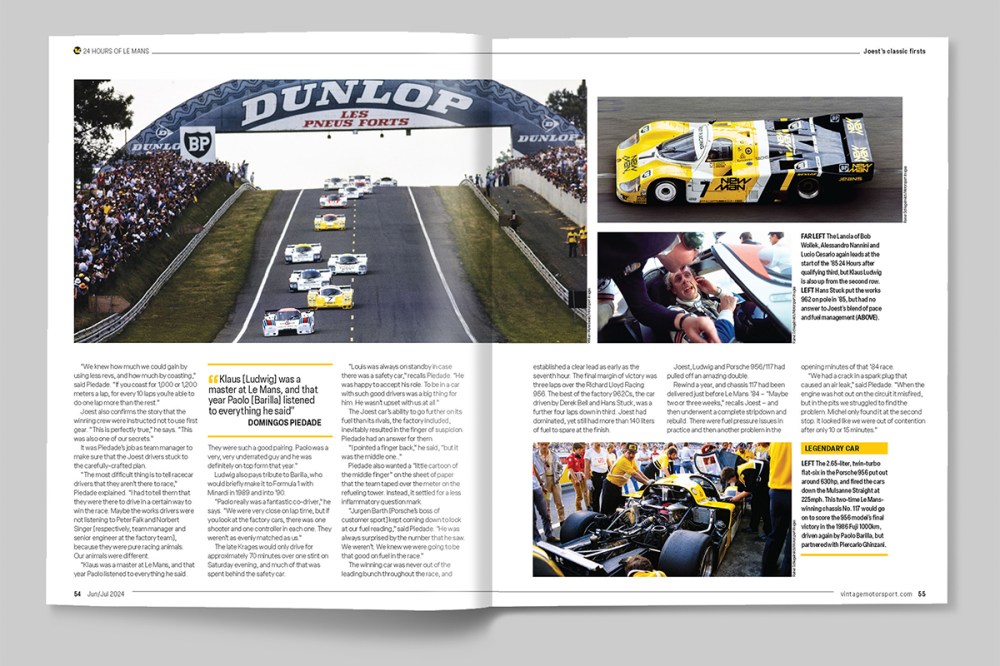
The winning car was never out of the leading bunch throughout the race, and established a clear lead as early as the seventh hour. The final margin of victory was three laps over the Richard Lloyd Racing 956. The best of the factory 962Cs, the car driven by Derek Bell and Hans Stuck, was a further four laps down in third. Joest had dominated, yet still had more than 140 liters of fuel to spare at the finish.
Joest, Ludwig and Porsche 956/117 had pulled off an amazing double.
Rewind a year, and chassis 117 had been delivered just before Le Mans ’84 – "Maybe two or three weeks," recalls Joest – and then underwent a complete stripdown and rebuild. There were fuel pressure issues in practice and then another problem in the opening minutes of that ’84 race.
"We had a crack in a spark plug that caused an air leak," said Piedade. "When the engine was hot out on the circuit it misfired, but in the pits we struggled to find the problem. Michel only found it at the second stop. It looked like we were out of contention after only 10 or 15 minutes."
Ludwig and Pescarolo, who would return to the Le Mans winners’ circle 10 years after completing three wins with Matra, eased their way up the leaderboard, making it to the front during the 17th hour. It would be the final time that a car entered with just two drivers took overall victory at La Sarthe.
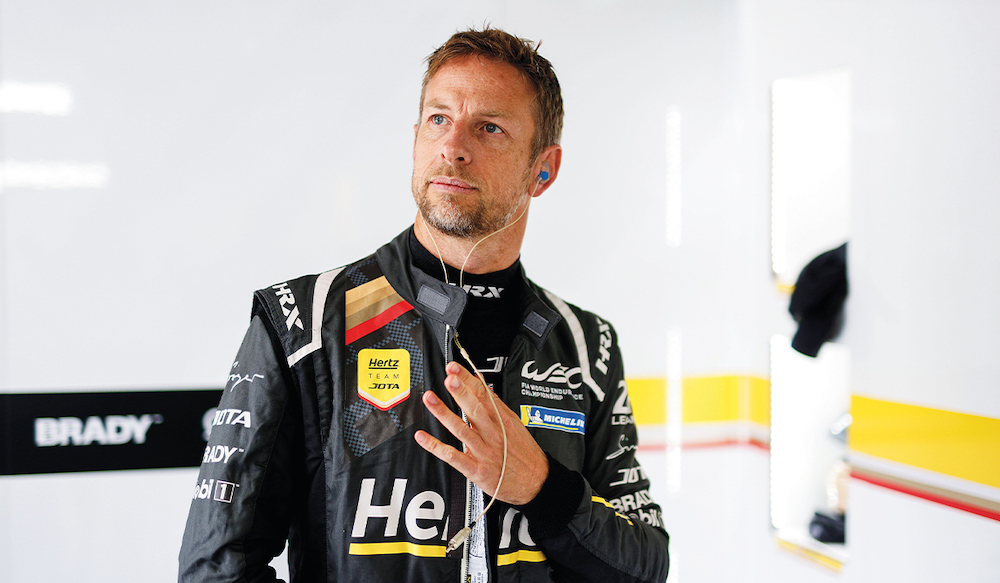
Reinhold Joest is held aloft by his ’85 winners (left to right) Louis Krages (aka "John Winter"), Paolo Barilla and Klaus Ludwig. This combo was leading in ’86, too, until thwarted by engine failure. Sutton/Motorsport Images
Incredibly, 956/117 might have made it three wins in a row. The same vehicle, again shared by Ludwig, Barilla and Krages, was leading in 1986 when the safety car was deployed during the night as a result of Jo Gartner’s fatal accident. The course vehicle was on track for two-and-a-half hours, the Joest Porsche ran too lean for an engine way short of its operating temperature, and the unit eventually expired.
So Joest Racing didn’t quite pull off the three-peat, but a double for a privateer was still a phenomenal achievement. Someone at the time no doubt even called it unrepeatable, yet Joest Racing would do it again in 1996 and ’97 – the first year with some factory assistance, the second with overt opposition from Weissach.
And not long after that, Audi came knocking on Joest’s door and the rest, as they say, is history. Or, rather, more history.

VM Staff
Read VM Staff's articles
Latest News
Comments
Comments are disabled until you accept Social Networking Cookies. Update cookie preferences
If the dialog doesn't appear, ad-blockers are often the cause; try disabling yours or see our Social Features Support.