JEP/Motorsport Images
How FIA WEC tire makers are chasing sustainable performance
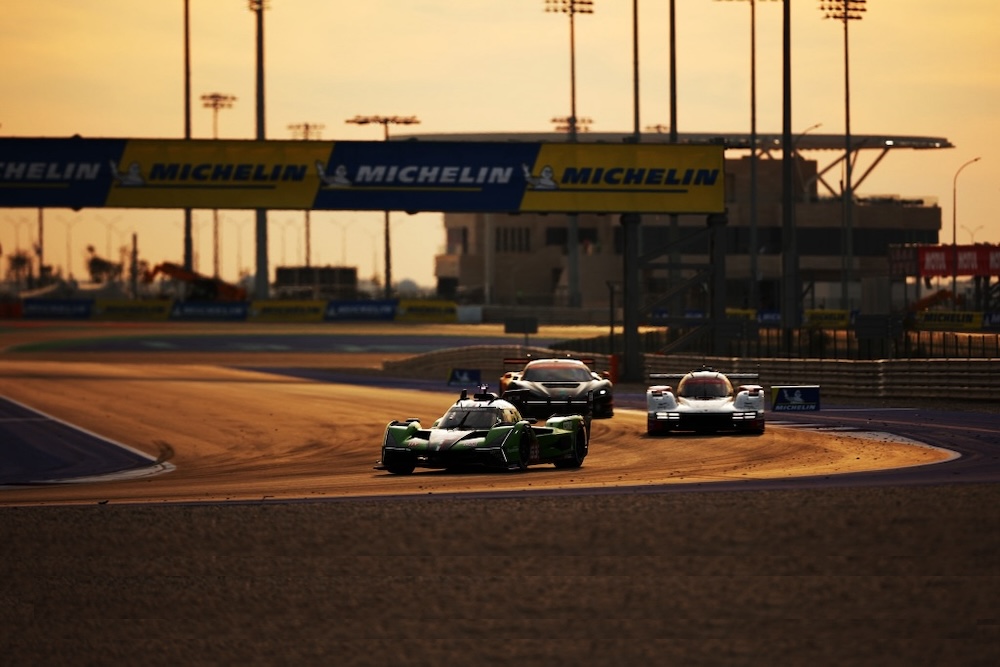
The 2024 FIA World Endurance Championship may already be underway, with tire specs frozen and allocations for each race set, but development work behind the scenes for Hypercar supplier Michelin and LMGT3 supplier Goodyear is very much ongoing.
In the WEC, as in most championships, tire wars between multiple manufacturers are a thing of the past. Yet both Michelin and Goodyear would argue that it is just as challenging as a sole supplier to develop race tires for these new categories -- which feature a wide variety of car concepts -- and reach ambitious sustainability targets at the same time.
In the top class for this season, Michelin has returned with its 2023 range for the Hypercar teams in the WEC (and GTP teams in IMSA). But in the background, it is hard at work developing a brand-new range for 2025.
The new tires are currently "in the third phase of development" after completing three track tests. The first was with a new rain tire late last year in Le Castellet, with subsequent testing in Bahrain. Then at the end of last month, Hypercar teams were invited to take a car to Portimao for further slick tire testing.
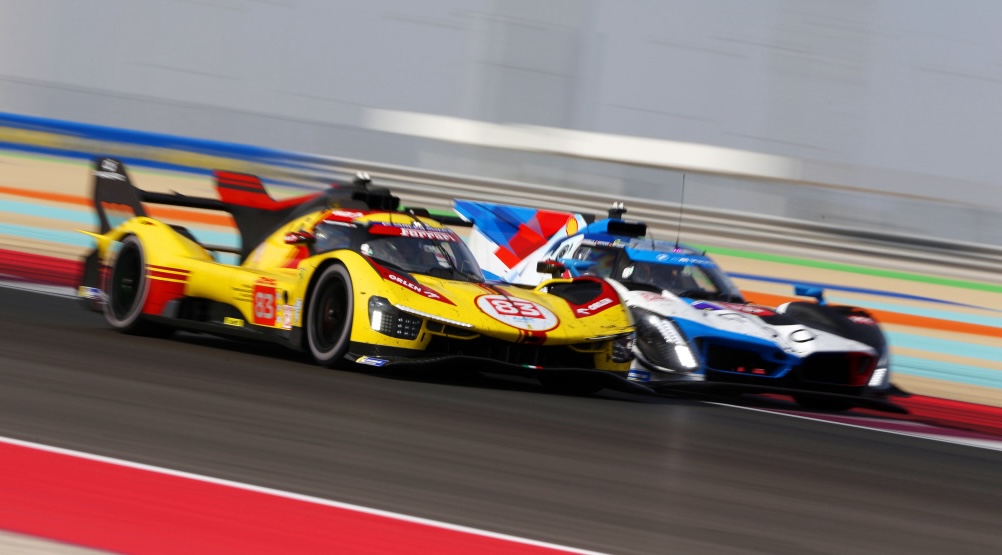
Michelin’s Hypercar tires have to suit a variety of cars and technical approaches, while maintaining the teams’ strategic options. JEP/Motorsport Images
Developing tires that are suitable for the wide variety of LMH and LMDh cars competing in this new converged era has been a colossal task since the Hypercar formula made its debut in 2021, yet Michelin continues to push forward. For the next generation of tires, it is focusing on warm-up and sustainability.
Michelin, along with every major manufacturer around the world, is pushing to reduce its carbon footprint as a matter of priority. With that in mind, it should come as no surprise that its goals in motorsport stretch beyond making changes to its development and production processes. For next season it aims to produce race tires for the WEC and IMSA that feature a significant increase in sustainable materials.
"What we achieved for 2023 was developing a new wet tire with 45 percent sustainable materials; it was a big step for us to produce sustainable materials for worldwide championships," Michelin's sports car operations manager Pierre Alves told RACER. "And in the slicks, we have more than 30 percent.
For next year the main target for our developers is to go higher, with no compromise in performance. We need to improve the percentage but not degrade the performance we have today.
"Next year we will bring tires with more sustainable materials in wet and slicks and we are going to work on the warm-up. We have targets to go over 50 percent sustainable on the slick and higher on the wets. Though at this point we don't know if we will be able to reach it, because we can't compromise on performance.
"We are making efforts on the casing, with recycled metal parts. We are also using old rubber, using companies that can extract carbon black and have new ideas with rice peel and orange peel to make some resins and oils. We need to find a balance, because if we can go over 50 percent but the performance isn't as good, we will have to evaluate it."
Ultimately Michelin's goal is to produce tires made entirely from sustainable materials, but this is a task that's far from simple. There are gray areas in defining what constitutes a sustainable material and developing new solutions to replace traditional rubber and traditional manufacturing techniques is both costly and complex.
"We could produce a tire with 100-percent sustainable materials -- we know how to do it, and we know our competitors can too," Alves explained.
"The big problem is producing these in industrial quantities. We can make one tire fully sustainable, that's easy, but we need to make six to seven thousand for the WEC."
One area that Michelin says will not change going forward is in-race strategy, even as its range of race tires for the WEC and IMSA become more environmentally friendly.
Currently, Michelin produces soft, medium and hard slick compounds -- each with a specific temperature window -- and nominates two for teams to use at each race bar the Le Mans 24 Hours, where all three are on offer.
In future seasons Michelin says it will not reduce its range and restrict teams to using a single tire compound in races. This is because it believes that tire choice is a key feature of prototype racing at the highest level.
"For us the strategy aspect is important," Alves reiterated. "We want to bring strategy in tire choice. If you only have one choice you limit strategy. The issues last year with teams struggling on our tires (and the debate surrounding the tire warmer ban ahead of Le Mans) was always a team not choosing the right tire at the right moment.”
Next page: Inside Goodyear's LMGT3 tire development plans.
Meanwhile, in LMGT3, Goodyear’s strategy and roadmap differ significantly and largely mirror its LMP2 program.
For the new GT class, it produces two slick compounds of its Eagle F1 Super Sport (a “medium” and what it describes as a “medium plus”) and a single wet tire. It then nominates a single slick spec for the teams to use at each race. This is because the manufacturer believes that offering up just one option to teams for each weekend is hugely beneficial as part of its drive to improve sustainability. It allows teams to plan which tires to ship to events long in advance, reduces the costs to teams who no longer feel the need to spend money testing back-to-back at circuits with different tires and reduces waste at the end of the season.
All the while, Goodyear feels the racing remains exciting and that strategy continues to play a key part in the outcome of each race. For example, in this weekend’s race, which is being held on the low-energy Imola circuit, Goodyear expects that teams may begin experimenting with triple stinting tires ahead of the Le Mans 24 Hours, where triple and even quad stints to save time in the pits should be possible in the right conditions.
If the race at Le Mans runs dry and pretty clean, Goodyear told RACER, teams may complete at least three triple stints when the circuit cools down overnight, as the wear rate at the Circuit de la Sarthe is so low and the operating window of its medium spec (yellow-labeled) tire is so wide.
However, like Michelin, Goodyear also continues to increase the amount of sustainable material used in its tires. Happily, it is meeting its targets in this area. Beyond its commitment to using sea freight where possible, the materials used in its wet tires are more sustainable than its previous GT3 wets.
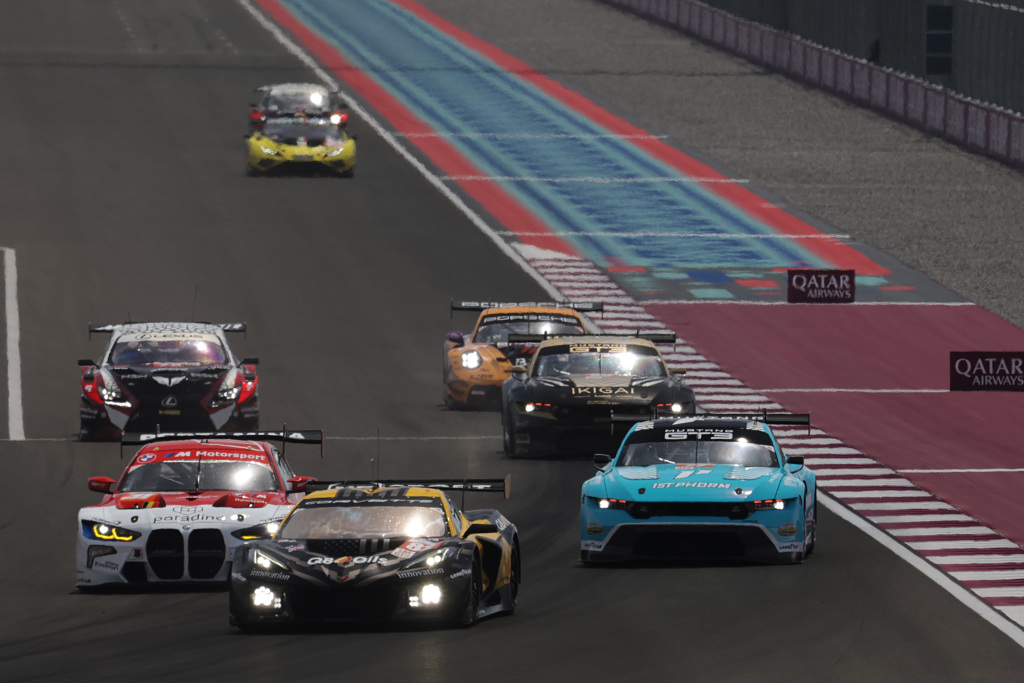
Goodyear’s approach worked well in bone-dry Qatar, but could face more challenges in the European races with their typically more mixed conditions. JEP/Motorsport Images
"We have increased the material within the compound that is sustainable," Goodyear's endurance program manager Mike McGregor told RACER. “For instance, our new wet tire hits the 33 percent target. That's with big steps forward with the compound itself, but still maintaining a good level of grip and consistency and performance in varied conditions. The new wet has to cover wet surfaces and a drying track -- it is a very versatile product.”
With the bone-dry week in Qatar (where its yellow-labeled compound made its global debut) in the rear-view mirror and the European leg of the season now upon us, Goodyear is ready to showcase this new concept.
While the two slick specs were developed over a number of significant tests over the past 18 months, in partnership with a number of GT3 manufacturers, Goodyear's approach to developing its 2024 LMGT3 wet was radically different. Unlike the slicks, the wet is based on its products developed for Goodyear's Nürburgring GT3 program in the NLS and for the 24 Hours, rather than a pure evolution of its previous LMGTE tires used in the European Le Mans Series until the end of 2023.
"What we have tried to do is take a lot of learnings from the Nürburgring program," McGregor explained, "as opposed to the slicks where we said our Nürburgring effort wasn't a relevant platform for us. I think the Nürburgring is the most competitive wet tire arena out there, so we used that as the basis for our tire.
"For our slicks, we've gone to a new mould profile, and we have had to reflect that into the wet development. So based on sim work and in-house development we produced new mould profiles to match the slick profile. We also took the construction concept of what we developed over the slick, with some tweaking and the inclusion of lessons learned at the 'Ring."
To test its new concepts and the advances in compound technology, Goodyear primarily utilized its private test facilities in Mireval, France and Wittlich, Germany. These tests were used to evaluate their levels of grip and consistency in varied conditions.
"Wet testing for us is done a lot differently," McGregor noted. "We do a lot of lab testing on the compound, then we do internal evaluation testing at our private facilities -- we can water them to different levels. That's much more accurate than doing large-scale Grand Prix (circuits) testing, but we'd done that for the Nürburgring wets before we started this development, so that information has been fed into them."
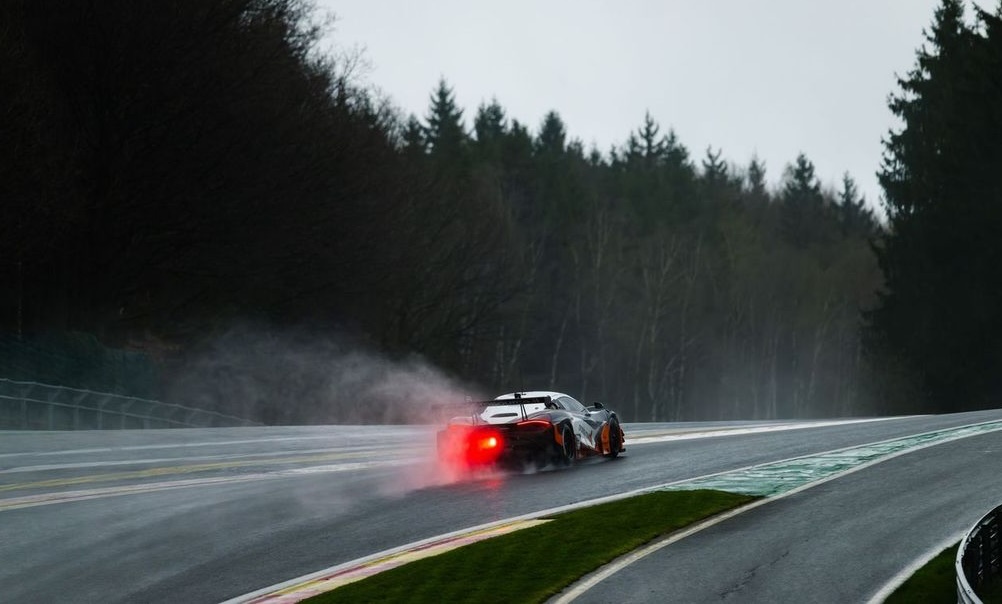
Four Goodyear customer teams got to try their new wets in testing at Spa, and liked what they found. Paragraph 5 photo
The 2024 wets were finalized at the end of 2023 in early December, though until this month during a test at Spa, none of Goodyear's LMGT3 customer teams had used them, as the WEC Prologue and race weekend in Qatar and most private testing proved to be dry too.
The test at Spa included LMGT3 teams Manthey, Team WRT, Vista AF Corse and United Autosports get their first taste of the wets, and the early feedback has been positive.
"We've seen improvements in grip over our previous reference -- more consistency and the overall pattern performance," McGregor said.
Goodyear obviously cannot accurately predict when it will need to use the wet tires for the first time, though history tells us that it should expect to call upon them at some point before the end of the season.
"We have to be prepared for all eventualities,” McGregor said, “but we know from historical data where we need to take the biggest allocations of wets. Spa you expect mixed conditions, same with Le Mans. Sao Paulo is at a time of year where it is more their winter season, with a greater chance there; then Fuji is another one where it can spring a surprise. So we expect you'll see wet running this season in the WEC."
The other tire compound that Goodyear will debut later this year in LMGT3 competition is the red-labeled "medium plus." The expectation is that the yellow “medium” will be the "go-to" for the early portion of the FIA WEC, but following the test in Barcelona in the past month, where the medium plus” proved to be more versatile than expected, Goodyear has decided to hold off on making firm decisions for the second half of the season.
In Qatar, the “medium” was used after Goodyear conducted a pre-evaluation of the circuit -- which was new to the WEC -- before the Prologue. This involved sending staff to scan its surface last year, completing simulator work and taking advice from staff working on its motorcycle racing program who had visited the Lusail International Circuit in the past.
"The big thing for us is optimizing the right tires for the right track," McGregor said. "I can't say whether it's going to be just Bahrain, Bahrain, COTA and Sao Paulo, where we see the second spec. It will cover the slightly more aggressive tracks or tracks with higher sliding energy. Bahrain is the most aggressive on the calendar, so I am sure we will, at the very least, see it used there.”
It goes without saying that it’s still very early days for Goodyear’s new LMGT3 offering so it’s too soon to predict when its next generation of LMGT3 tires will debut. What we do know is that the current product range will return in 2025 along with an increase in the use of sustainable materials and the potential to shift to a single slick tire spec for every race. However, there is no concrete timeline for future developments as Goodyear remains fully immersed in year 1 of this new venture.

Stephen Kilbey
UK-based Stephen Kilbey is RACER.com's FIA World Endurance Championship correspondent, and is also Deputy Editor of Dailysportscar.com He has a first-class honours degree in Sports Journalism and is a previous winner of the UK Guild of Motoring Writers Sir William Lyons Award.
Read Stephen Kilbey's articles
Latest News
Comments
Comments are disabled until you accept Social Networking Cookies. Update cookie preferences
If the dialog doesn't appear, ad-blockers are often the cause; try disabling yours or see our Social Features Support.