The RACER Mailbag, February 14
Welcome to the RACER Mailbag. Questions for any of RACER’s writers can be sent to mailbag@racer.com. We can’t guarantee that every letter will be published, but we’ll answer as many as we can. Published questions may be edited for length and clarity. Questions received after 3pm ET each Monday will appear the following week.
Q: Not this again! The powers that be are talking about... guaranteed starting spots in the Indy 500? Two quick questions:
1. They're kidding me, right?
2. Where has RACER been on this in the several days since this broke?
BK, Indy
MARSHALL PRUETT: Roger Penske isn’t kidding. He’s been serious about having guaranteed starting spots at every IndyCar race, including the Indy 500, for many years, and has spoken about it in print to myself and others for years, both before and after he purchased the series.
I realize "guaranteed Indy 500 starting spots" recently surfaced as an item of interest, and if you weren’t aware of it beforehand, it could have been mistaken as something new. But it wasn’t.
On the subject of "where has RACER been?", here’s a link from August, which was the last time we wrote about the topic, which spelled out the same exact thing you’re referencing, but six months ago:
“IndyCar introduced nothing that was remotely formal or final in the meeting, but some interesting ideas were shared – and commented on by team owners – that could form the framework of a future system that is heavily modeled on the Leaders Circle program … the same number of 22 Leaders Circle contracts was mentioned, but with a twist where those 22 entries could be guaranteed to start at every race, including the Indianapolis 500.”
Also, if you’re a reader of RACER Magazine in addition to RACER.com, here’s what Roger Penske told us in May:
“To me, if you are going to commit to a full season competing in our series, you should reap the benefits and ensure that you have positions secured on the grid. That security will be a benefit to our teams and their sponsors, as well as those team’s ability to attract drivers.”
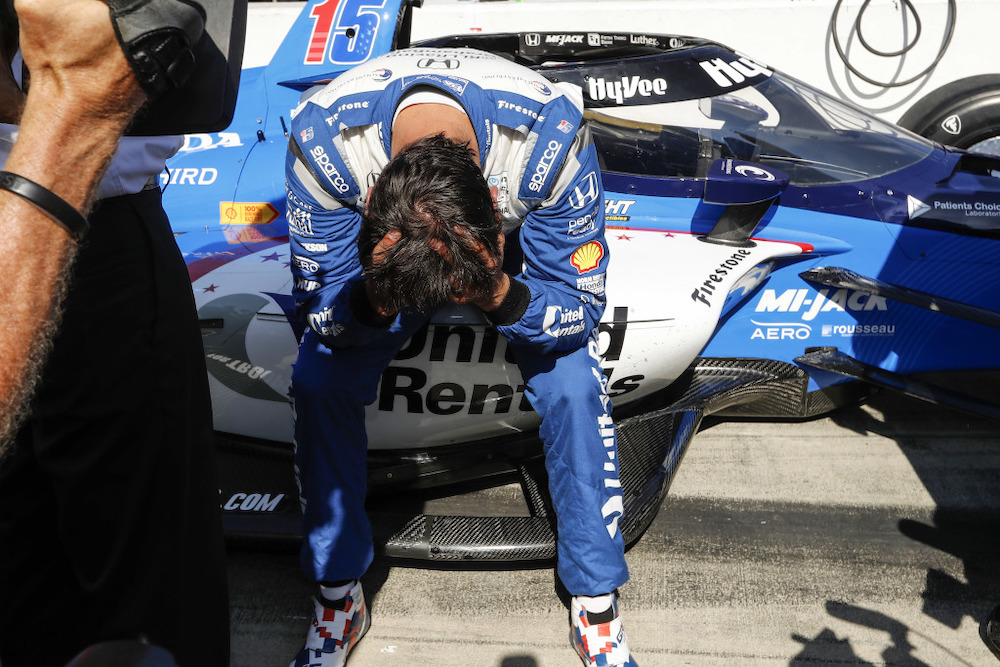
Guaranteed spots would mean more security for the regulars, but at the expense of some Bump Day drama when one of the big names strikes trouble. Phillip Abbott/Motorsport Images
Q: I just finished reading an article about the IndyCar hybrid. While I kind of understood the overall concept and I am sure you have talked about it in previous write-ups, I now better understand the technical challenge IndyCar and Honda/GM have been dealing with. That is, implementing hybrid power on an oval.
Many if not all of your readers know that drivers basically do not lift during a lap at the 500, for example. So when would the hybrid be able to regen? Obviously a major technical challenge. The decision to keep the package as light as possible is yet another technical challenge that eventually precluded lithium batteries and pushed the direction to supercapacitors. And as you mentioned in previous articles, vendor and supply issues slowed down the whole process.
Based on my further understanding, I can understand the delays and say well done to Honda and GM for taking charge of the project. As you reported, the last test was relatively trouble-free, so that is a positive. While I look forward to its implementation, my only concern is, when should it go online? Honestly, I am not sure it makes sense in the middle of the season just to tick a box. I will stay tuned.
Glenn, Renton, WA
MP: Think of drivers running in the draft at Indy where, as you point out, they’re hard into the throttle and don’t brake. Under normal hybrid racing circumstances, there would be no way to charge the energy recover system (ERS) while flying around Indy, and only while braking for pit lane would charging be possible.
To address this, IndyCar and its ERS partners created an option for drivers to use a "fiddle paddle" as it’s often called, which is a small paddle mounted to the back of the steering wheels. Some road-going hybrids have the same exact paddle (not the same paddle itself, but the same technology) where drivers can lightly squeeze the paddle and engage the motor generator unit (MGU) to spin at relatively low RPM and harvest electricity that gets sent to the supercapacitor. If you’re cruising in your hybrid on the freeway and traffic is speeding up and slowing down as it often does, cars with that regen paddle give the driver the chance to use the paddle to manage their speed, get some charging done, and avoid using the brake -- and triggering the brake lights -- which can be annoying.
So, rather than having to drag the brake to trigger the MGU to wake up and spin and harvest on your IndyCar, a paddle on the steering wheel is gently engaged by drivers with their fingertips. Where this is really smart, in the context of an oval race, is for every driver in the draft, they’re almost never at 100-percent throttle. They’re having to lift to avoid running into the car they’re drafting off of, so with the ERS and paddle, drivers in a draft can use that extra throttle to counteract the MGU.
Simply put, if a driver is sitting at 90-percent throttle in the draft at Indy, and they want to harvest some electronic horsepower to recharge their supercapacitor, and they drag the paddle and the MGU want to slow the car by the equivalent of seven-percent throttle, a driver can go from 90- to 97-percent throttle and use the internal combustion engine to match and neutralize the slowing/charging effect of the MGU.
Also, if a driver wants to let another driver go past them, a harder pull on the paddle and bigger recharging moment would give them more of a MGU boost to use whenever they wanted to repass them. That’s a new strategy to look out for in 2025 when hybrids debut at IMS. And the paddle can be used anywhere; it isn’t just for the ovals. But it is particularly handy on the ovals.
At the other ovals, all small by comparison to Indy, we could see big lifts into Turn 1 at WWTR get somewhat or mostly traded by staying harder in the throttle while using a bigger pull on the harvesting paddle to slow their speeds. Lots of strategy to consider when IndyCar goes hybrid.
Q: I apologize if I missed this previously, but what will the IndyCar teams be doing with the weight difference between the first race and Indy? Will they add extra weight to the cars to match hauling a battery around, run with the new components and risk damaging them in a wreck, or will they be running without them and face a different balance setup after Indy?
ET
MP: Nothing to apologize for -- the cars will run at the lighter weight until the series goes hybrid. Here’s a story we did on the topic a few weeks ago.
Q: I'm going to ask again why IndyCar can't adopt the IMSA power unit? Yes it will be bulkier, heavier, etc. So what? It also solves a lot of problems with engine suppliers, etc. Throughout the history auto racing, (until spec car racing) racers have adopted parts from other series, trucks, aircraft, or whatever worked.
Joe, Twinsburg, OH
MP: Yep, before spec cars took over the landscape in IndyCar, you had a lot of options to chuck a V6, V8, or inline-4 in the back of an IndyCar. But as you know, IndyCar has been a spec series (or really close, with only two chassis options for the last 20 years, and only one since 2012), so that’s your answer. The DW12 chassis is tailored like a tight-fitting suit to the exact dimensions of the 2.2-liter turbo V6 formula that launched in 2012, and the rest of the car is snug and packaged to work -- and only work -- with that little 2.2L motor.
It’s not just a case of the car being bulkier or heavier being the issue. It’s in having to change everything around the big IMSA motors to make it fit and run -- longer, wider, taller -- and that’s going to cost a fortune. And once that’s done, you’ve taken a car that handles well and performs at a high level and turned it into a turd because every aspect of its performance will be damaged due to high center of gravity and the chassis balance being destroyed.
Think of taking an Olympic hurdler, duct taping a bowling ball to their stomach, and how much it would throw off their ability to sprint and leap and land and maintain their balance with a heavy bowling ball attached to their midriff. If you like chaos, it would be hilarious to watch, but would also be a competitive failure. We’re talking about the same here in IndyCar.
So, it’s a romantic idea -- to just stuff a GTP engine in an IndyCar -- and I wish it could work, but it won’t. The days of have easily-modifiable IndyCars where everything from jet engines to bus motors could be used with relative ease left us 40-50 years ago.
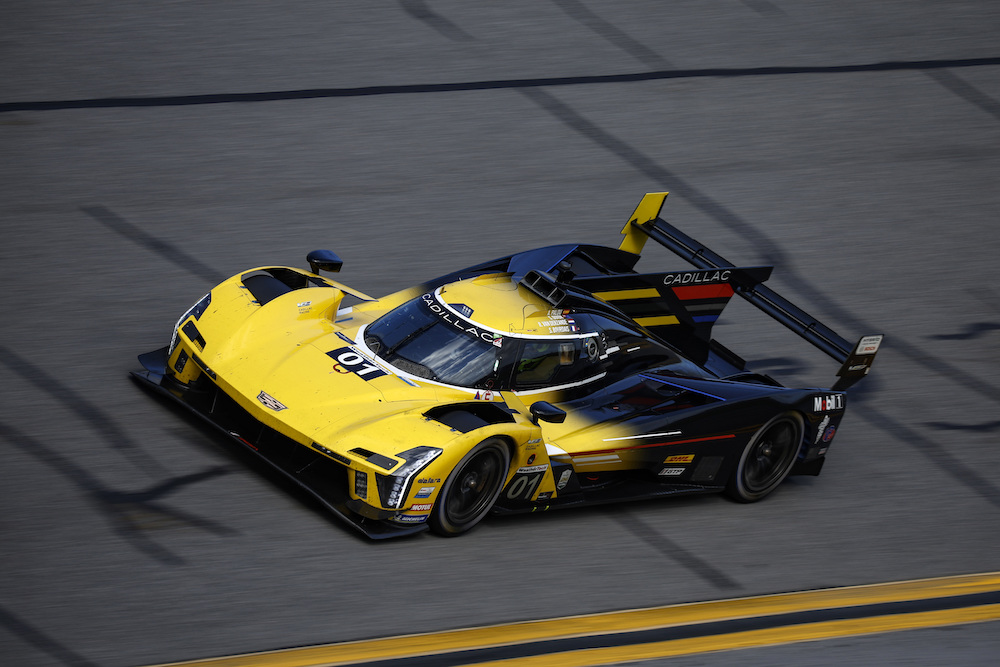
The idea of taking the engine out of this and dropping it into an IndyCar scores lots of points for coolness, but zero for practicality. Michael Levitt/Motorsport Images
Q: Just read your article on "100 Days To Indy." Let’s see if I got this right:
IndyCar fires its head marketer.
It reduces the shares of the Leaders Circle to improve marketing.
It creates a marketing job description but doesn’t fill it.
It decides to increase the Leaders Circle shares again by an unspecified amount.
It’s response to "Drive To Survive" only includes the first third of the season?
Would anyone have paid attention to F1 if DTS had stopped at Monaco?
It’s no surprise that IndyCar ignores just about everyone’s opinion outside of George Street that it should broaden the scope of "100 Days" to include the entire season.
Are you kidding me? One third of the entire season? They need to get their heads out of their a**es.
I realize there are costs involved, but if they really want to make a series that focuses on the 500, how about a second set of episodes tor the remaining races in the season like 2600 Miles To Nashville {total length of the remining races rounded) to get to the championship, which seems far more compelling to me than just a single race (regardless of the fame and history)?
I have always been a big fan of R.P., but this is beginning to feel a little like The Emperor’s New Clothes.
John, Madison
MP: If I worked for IndyCar, I’d be sending you a bunch of merchandise right now in exchange for using the 2600 Miles To Nashville idea, John. That’s brilliant. The Emperor’s mention is as well.
Q: Have you heard any more on the possibility of McLaren starting up an LMDh program? I had read at one time they were looking into it, but I haven’t read anything else on it since then.
Cory, PA
MP: A subject I need to get an update on, Cory, but overall, no, I’ve heard nothing to suggest a McLaren GTP project is imminent.
Q: I've got a bunch of questions on my mind after reading your latest story on the upcoming IndyCar ERS.
First, why is IndyCar using only 60hp, out of the 150 potentially available? What is preventing it from using all the power? Is it all about reliability and making sure the system works as intended, before feeling confident in its ability to be cranked up? And are we eventually going to see the full potential? If so, when? And what would be the difference, design-wise, between a 60hp ERS and a 150 one?
Second, is the late addition of the old turbocharger push-to-pass a temporary solution, or is IndyCar planning on keeping it, even once the ERS reaches its full potential?
Third, you wrote: “IndyCar drivers will accelerate harder and reach top speeds faster with the ERS unit activated […]”. And Kyle Kirkwood said: “It’s not like the hybrid system can hold enough juice to run an entire straight flat out; that would just require too big of a battery.” So, is the extra horsepower only going to provide a boost in acceleration? Which means, top speeds will basically remain the same, right?
If so, I’m finding this a little disappointing to get all this extra horsepower but have top speeds still stuck at 180mph, which is what they typically reach at Long Beach or Mid-Ohio. If IndyCar belongs to the pinnacle of motorsport, shouldn't these cars have brutal top speeds? Wouldn’t you love to see these hit the 200mph mark also on road and street courses? If F1 cars and Hypercars do, why should IndyCar be content with only 180?
Finally, could you provide a more specific definition of a "short burst" (wink)? Seriously though, how long would this be? Two seconds? Five? Also, and following up on Kirkwood’s statement, isn’t it a little misleading to say that these cars will have 800+ hp when it will only be for a period of time that isn’t much longer than a cough? And is there any chance we get bigger batteries/capacitors, in order to get longer burst?
Xavier
MP: Great questions. On the first, yes, not wanting to go nuts with power output in Year 1 is the motivation behind running at a lower level while ironing out the kinks.
On the second, turbo P2P is here to stay until, most likely, but not for certain sure, the ERS units are cranking out enough power to no longer need the added turbo boost to make up the speed and performance deficit. When the ERS can do over 100hp on its own, I’d look for turbo P2P to be retired.
Yep, I’d love to see Indy cars perform like they once did, but with the sizable jump in vehicle weight, and the heavy downforce levels that are used at most races, giant top speeds outside of the Indy 500 are not realistic. The beloved CART Indy cars weighed less, made more power, and had less downforce, so they were indeed missiles at most of the tracks they visited.
And no, it’s not misleading to say a fact is a fact, and in the story, I wrote multiple times, including the opening paragraph, that it was for short burst, to make sure nobody thought otherwise. There was no exact period of deployment time to share when the article was written, but afterwards, 4.5 seconds was shared as the anticipated period of maximum energy burn.
As this is something that could happen multiple times per lap at some tracks, it should account for some badass acceleration that fans at different corners can see firsthand each lap. If this is something to complain about, I’m not sure what to say.
Q: So the big news has finally broken: IndyCar trading cards! Is there anyone under 60 in the marketing department?
Vincent Martinez, South Pasadena, CA
MP: I think it’s a fun development that takes what the series learned at no cost while observing how big the reaction was the Ganassi reigniting the trading card trend last year. And as I’m told by "the yoots," cards have been a much bigger deal to those who are much younger than grandpa and grandma for a little while now, so until it proves otherwise, it looks like a smart move.
Here’s something the older generations of fans might like: I keep hearing to look out for IndyCar and the Speedway to take a page (like the trading cards, the folks at Penske Entertainment are really good at copying things) from the NFL Hall of Fame and The Masters by hosting a ceremony in May at Indy to bestow Indy 500 winners with the series’ version of a HoF/Masters jacket.
Now, if we get trading cards of Indy 500 winners in their new jackets…BOOM. Crossover jackpot.
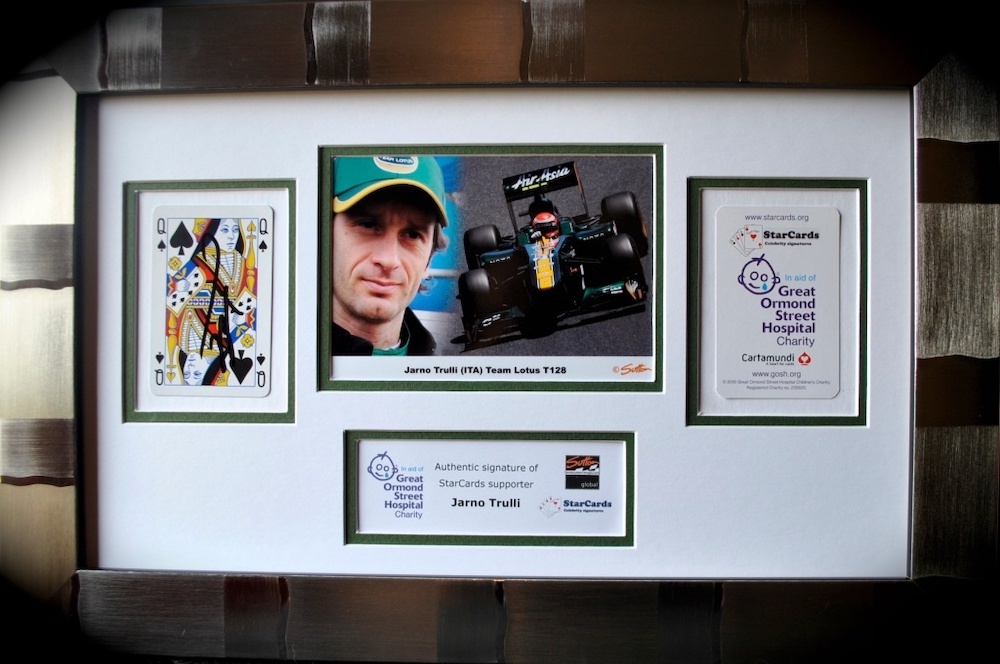
Technically it's not a trading card, but we're still bummed to learn that we're 13 years too late to bid on this playing card signed by Mailbag icon Jarno Trulli. Motorsport Images
Q: Why isn't the Indianapolis 500 entry list as big as it used to be in the 1960s and ’70s when there would be from 60 to 80 cars entered in the great race?
Kurt Perleberg
MP: Because the Indy 500 wasn’t restricted to entries using official engine leases from a small pool of engine manufacturers. Calling Drake (not the Canadian rapper) and ordering a turbocharged Offy, or ringing Cosworth or Ilmor or Judd to get a solid turbo V8, or dialing up Honda and getting a spec naturally-aspirated V8, or walking into Speedway Engines and buying three ready-to-go Oldsmobile V8s from Rick Long, are not an option.
When you could buy and run motors you owned, or readily lease an engine that could contend for wins, the entry lists were huge. Once that changed, and after the dreadful Lotus engine supply experiment died after one season, we’ve asked Chevy and Honda to supply 16-18 entries apiece at Indy, and for both, it stretches their finances and their personnel to the limit. Get a third manufacturer in the series, and that changes. Add a fourth, and we could see 40-plus entries at the 500.
Q: I was very happy to see that Cusick Motorsports and Dreyer & Reinbold Racing are teaming up again for the Indy 500, but I was upset that one of my favorite drivers, Stefan Wilson, won't be driving for them. Such an absolute shame that he won't race in the 500 after what happened to him at IMS last year.
I'm sure that was a tough decision for Don Cusick, since I believe it was Stefan who helped get Don into IndyCar racing. However, having Conor Daly and Ryan Hunter-Reay as drivers is pretty solid!
A couple questions. With Cusick and DRR together again, do you know if they plan to run any more races this year? Also, both Don Cusick and Dennis Reinbold have talked in the past about hopefully going full-time in IndyCar. With them teaming up, do you think there is a chance that Cusick/DRR goes full-time next year? Dennis has the crew, the cars, the experience, and I'm sure some good financial backing, and Don is a passionate team owner who also appears to have solid sponsors and money. I would love to see this team full-time next year with at least one car!
Scott Freeman, Bloomington, IN
MP: I haven’t heard of the team doing more races after Indy. For a part-time team, facing the move to hybridization soon after Indy, they’ve known that the full-time teams will take priority by all the vendors involved. If Don and Dennis can spool up the sponsors to underwrite a full-time campaign in 2025, I’d bet they’d love to do it, but it’s a far cry from rounding up an Indy 500 budget to banking $7 million or more to put one car on track at every race.
Q: Do you know if Anders Krohn is still going to be a part of the Dreyer & Reinbold/Cusick Motorsports program for the Indy 500? If so, any idea who else will be working with him? The Cusick team seemed to have a good, unique program going on in May of last year. I enjoyed Anders when he was on the IndyCar radio and television broadcasts – he was very insightful – and I always thought that he would be a great addition to a team. Hopefully he stays involved!
Dan Michaelian, Destin, FL
MP: Sadly, that terrible waste of humanity will still be involved with Don. (Kidding…but only a little bit. OK, actually, I love Anders, but if I said something nice about him, he’d think I was ill).
Krohn runs the day-to-day of Cusick Motorsports, so he’s in there negotiating, planning, and serving as a team manager would. His loss from the airwaves is definitely felt.
Q: Why doesn’t Penske leverage some of its other brands for low-cost marketing efforts? Penske Truck Rental as the official rental truck of IndyCar and the Indianapolis 500? Every Penske rental truck is an opportunity for a rolling billboard across the United States.
Scott, Nashville
MP: Great question, Scott. (Is there a shrugging emoji that also says "It makes a lot of sense to me"?)
Q: Free marketing idea. Too late for the Super Bowl, but how about this: Penske Entertainment, for the Daytona 500 ad buy? I’ll storyboard it. 30-second TV ad. The scenes go back and forth between F1 and IndyCar races.
Them: Show an F1 race finish with a 30-second margin of victory with "Ticket price- $2500" at the bottom of the screen.
Us: Show an Indy 500 win with a margin of victory of less than a car length.
Ticket price: $50’ at bottom of the screen.
Repeat this comparison once or twice as the ad time slot permits.
In the last five seconds, a solid screen with the series and IMS logo and it reads: "IndyCar. The greatest racing, the greatest spectacle, AND the greatest value. Come watch us in person."
I offer what I consider this brilliant and effective concept in good faith to Penske Entertainment with the only compensation being four suite tickets in either the Pagoda or Turn 2 suite for the 500 this year as my retirement present.
Mike DeQuardo, Elkhart Lake, WI
MP: Be on the lookout for a big package of IndyCar merch like the one I’m (not) sending to John from Madison.
Q: My question is about the Andretti rejection. I think it’s a little short-sighted that they were not granted entry to F1; I think over the long-term Andretti can actually help F1’s growth in the USA. But I believe it’s what has been stated before -- that the teams are worth way more than when the Concorde Agreement was signed, and they want that $600 million.
I personally would keep the money and develop my other teams and even branch out into F3 and F2, and maybe MotoGP (ie Trackhouse). But I do remember Michael wanting a franchise system in IndyCar because he felt it was too easy to enter the series, and teams like his have made lots of investments in dampers for example and wasn’t happy that someone could just buy a car and enter the Indy 500.
Maybe a little hypocrisy?
Frank, Toronto
MP: Not sure I saw a question in there, but thanks for sharing your thoughts, Frank.
Q: Don't know if you can or want to use this map, but it does show a bunch of North American acreage with no IndyCar race nearby. Don't know how many millions of people are affected here, as the weatherman would say. Filling in the bare spots might help get some new fans onboard. Let's start with some old favorites and possibilities.
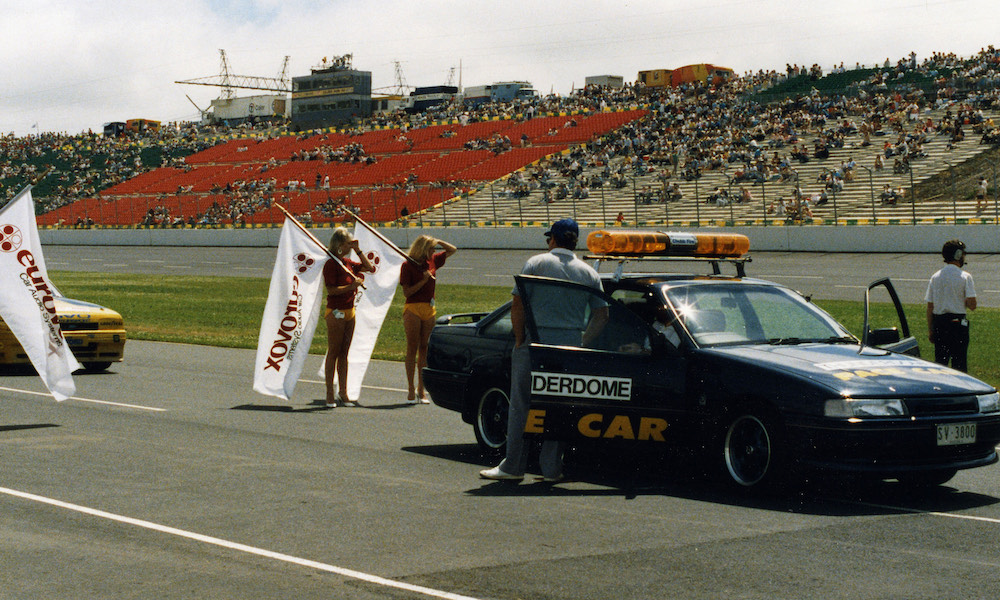
1. Get Watkins Glen back. New Yorkers, New Englanders and Canadians benefit.
2. Fill the great plains to the Rockies with Texas, Phoenix and take a new look at Denver where 120,000 attended on average over three days and Paul Tracy and Sebastien Bourdais had a confrontation. What's not to like?
3. Getting Vancouver back is a no-brainer and revisit Edmonton with a 175,000 average over three days.
4. Take a trip into Mexico and go no further as then you start loading cargo planes and adding to the expense.
You have the potential for 24 races here and exposure to many more fans.
Let's get the Captain on it. Might take some serious negotiation but that's what he does. Got to save IndyCar somehow, and bringing it to the masses is a start.
Jeff, Colorado
MP: Thanks, Jeff -- very informational for those who don’t know. I do know the series, though, is aware of where it does and doesn’t race! Agreed on bringing it to the masses.
Q: Hi! I’m 14 and I fell madly in love with IndyCar and racing in general at the 2023 Indy 500. I understand the journey to becoming an IndyCar driver is extremely challenging, especially since I don’t have a recently deceased ka-billionaire great uncle, I’m not about four years old, and I’m not all that great at karting (yet). However, I really, really, really want to actually be one. Could you provide some insights into the typical development ladder, from karting to junior series to eventually competing in the NTT IndyCar series?
I have done some research, so I know the basics and order. but I’d like to know from someone more involved in the scene about key steps, challenges, opportunities, and so on. Also, what drivers would you say have had the most unconventional path to IndyCar? Thank you so much!
Sincerely,
A girl who likes IndyCar :)
MP: Great to hear on all fronts! You’re on the right path with karting, and from there, the most popular routes to car racing of late has been in either the Skip Barber Racing School and its entry-level open-wheel cars, or the newish USF Juniors series created by Andersen Promotions, which also runs USF2000 and Indy Pro 2000.
I asked 2019 Indy NXT champion, former Arrow McLaren IndyCar driver, and karting phenom Oliver Askew to provide some insights on your shared world of karting.
"Hello. Great question, and there is no right answer, unfortunately. But, it sounds like you have the right attitude, which is passion, drive, and the willingness to do whatever it takes to make your dreams a reality, hold on to that no matter where this sport takes you.
"The most important piece of advice that I can give anyone who is trying to make the step into professional car racing is, network until you’re annoying, and then keep networking. Take advantage of every opportunity that you create. I also think that as racing gets more popular, the harder it will be to break away from the crowd. Create a unique brand and market yourself in a positive light.
"The steps that today’s drivers take to make their way up the ladder is well documented, and you’ll find that there are many options to make your start. Unfortunately for many passionate racers, the amount of money it takes to make that start is discouraging, and it only gets more expensive. But like I said earlier, if there is a will, there is a way, and lucky for us, IndyCar has the greatest ladder system that offers opportunity other series do not.
"I was in a similar situation to you trying to make the step from karts to cars, I did not have any money, just some talent and a good book of contacts. I left myself no other option but to make that step happen.
"Focus on that North Star and use this community to create opportunities for yourself. Good luck."
The wildest example I can think of is SoCal karting phenom George Mack who went from karts straight to IndyCar -- the Indy Racing League as it was known, which only raced on ovals -- in 2002. Mack was slightly older, which was a benefit, so he had the racing experience and maturity to handle the crazy leap and learn an entirely new kind of racing in big and brutally fast cars, and on ovals, which were the opposite of the road racing he’d done since he was a kid.
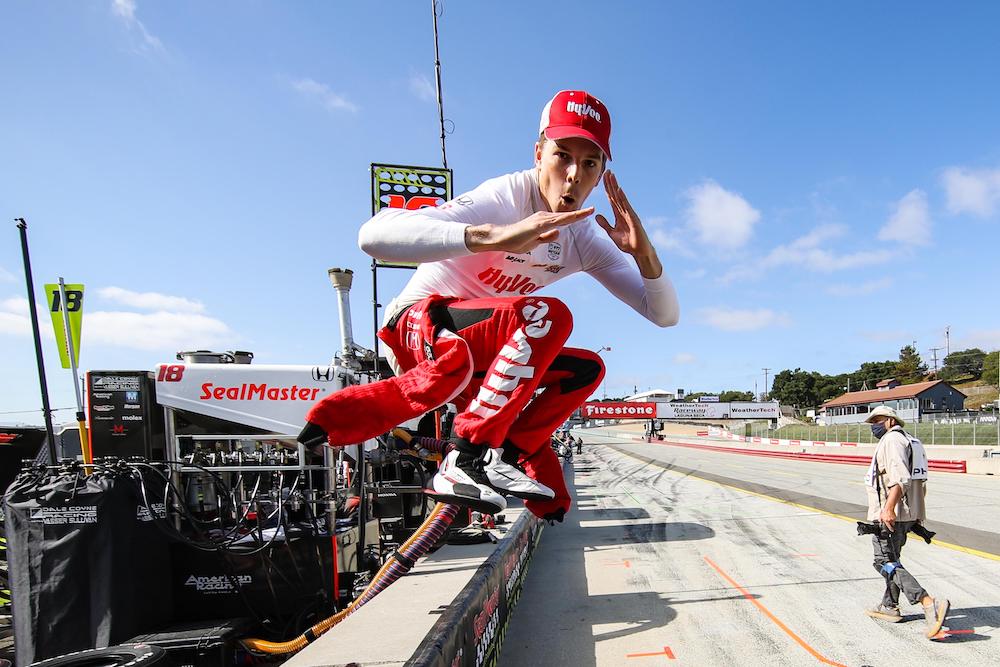
Lots of good advice from Oliver Askew for our IndyCar star in the making. The only thing we'd add is not to try moves like this if the car in the next box is coming in to pit. Image by Penske Entertainment
Q: I am going to try to provide something other than rage or negativity for you this week. The double helping of Mailbag last week was a pretty good summary of the public mood. I wonder what the Andretti/GM mood is? Michael has offered his response, but GM has been silent.
Given how much fun the Rolex was, and with Andretti and GM both entered into IMSA and WEC, I was wondering if it might not be a good idea to add a healthy bit of revenge to proceedings. Any chance of GM taking some of the proposed F1 money and instead cooking up a couple of extra Caddies for WEC/IMSA, perhaps with "Toto hates fun" on the fin and a TV campaign with the slogan "Banned in F1, available on racetracks and in showrooms near you"?
I realize this isn’t like the 1960s and modern GM is not going to respond to FOM like Ford did to Ferrari’s snub, but it would be great if it did take things personally and used that to give a bit more of a media nudge to the programs it is doing. Especially since a little bit more media attention to a pair of series that are booming with these new, great-looking cars that put on races F1 simply could never deliver could make quite a difference.
If the main thing that has given F1 this boom is horseshoe up an orifice levels of luck with a media product (DTS) then some serious effort with money and marketing talent could do wonders if GM took this rejection as the motivation to fight fire with a flamethrower.
Anyway, looking forward to all the non-F1 racing IMSA and WEC will give us this year. All we need is Ferrari to give Risi a 499P to put the cherry on top.
Duncan, Ottawa
MP: Thanks for believing the Mailbag doesn’t always need to be used like a free weekly therapy session to vent, Duncan.
I know Cadillac remains committed to Andretti, which is both admirable and phenomenal. FOM is acting like a social media influencer who believes the big spotlight they currently have will never change, and therefore feels comfortable treating people like Michael and Dan Towriss and Cadillac like s**t. I don’t know when it will happen, but there will come a time when FOM will see F1 on a decline and need an Andretti Global, and when that time comes, I’ll laugh.
Q: Isn't it a bit strange to be only five weeks out on the IndyCar season opener at St. Pete and the time is still listed as TBD? I know TV controls all that, but it seems like this is usually settled much earlier before the year than this.
Forrester
MP: I figure we’re on the clock to have it revealed by the time you read this. And if not, I’m not sure what’s going on.
Q: Even though we met however many years ago at a Red Bull Global Rallycross event, Michael Andretti has no idea who I am, nor should he care what I think. But, if he were to ask, I'd hate to see him be all John Cusack in "16 Candles" with FOM. I'd tell him to take that money and make a kick-ass, six-car IndyCar team, a NASCAR team and MotoGP-shoutout Trackhouse, get you an open wheel outfit, too. Then have enough left over to buy all his employees a big-ass ham for Christmas.
Shawn, MD
MP: We’re on the same page here, Shawn. Michael and Towriss have asked F1 to marry them many times and in many different ways, and keep getting rejected. F1’s a BIG moneymaker at the moment, so it makes total sense for them to try this hard to get in, but continuing to ask for F1’s hand in marriage would be sad to watch.
Q: I can't for the life of me understand why IndyCar wants the potential last race of the year in Argentina to be non-points. Yes, it's out of the U.S. market for pretty much all the sponsors, but I honestly think the eyeballs on the race might be greater if the race was in Argentina.
IndyCar's ratings fall off every year around the last couple of races because it overlaps with the start of the NFL season. With NFL games starting at 1pm, it would be impossible for the series to run a final race stateside that doesn't conflict with a bunch of football games.
Argentina is two hours ahead of Eastern Time -- you could start a championship race at 10 or 11am EST (it would already be early afternoon in Argentina) and finish in time to not have to compete with the NFL.
I genuinely believe that part of F1's growth in the U.S. is that the races are on first thing in the morning on a Sunday. There are no other sports on, and most people haven't started their planned activities for the day yet.
I'm sure die-hard fans watch the last race now, but the casual fan is probably more inclined to skip out on the race because they have middle-of-the-day plans (likely watching football). The sport needs new eyeballs, and nobody who isn't already a fan is going out of their way to watch IndyCar while the most popular live TV programming in America is on.
Have the finale in Argentina, market the heck out of it so people know it's happening, and start it before football. Viewership would increase.
Jacob
MP: Depending on where you live in the U.S., like the East Coast, yes, F1 races are on first thing in the morning. If you’re on the West Coast, those races often start at ungodly hours, so it’s not a convenient-starting-time thing. It’s a F1-is-just-super-popular thing.
If you consider how F1 and NASCAR, which are much bigger than IndyCar and can survive going head-to-head with football without suffering damage to their TV ratings, are also racing into October and November, and IMSA goes to the middle of October with its Petit Le Mans finale, I’m not sure there are a lot of weekends that jump out as super free and uncluttered for IndyCar to make a big impression.
It’s not just the specter of going up against the NFL; it’s all the other big-time racing series, which are in the home stretch of their championships, that I’d expect to command a lot more attention than a non-points, counts-for-nothing exhibition race being held anywhere on the planet. (OK, IndyCar at Bathurst would be epic).
But overall, sure, you could run the race early and hope to catch some viewers, but if we’re talking about something that really makes a large TV impression, I’m struggling to see how Argentina or wherever else the post-season non-points race might be located, would be a ratings winner. I’d love for it to happen, but don’t know how it would.
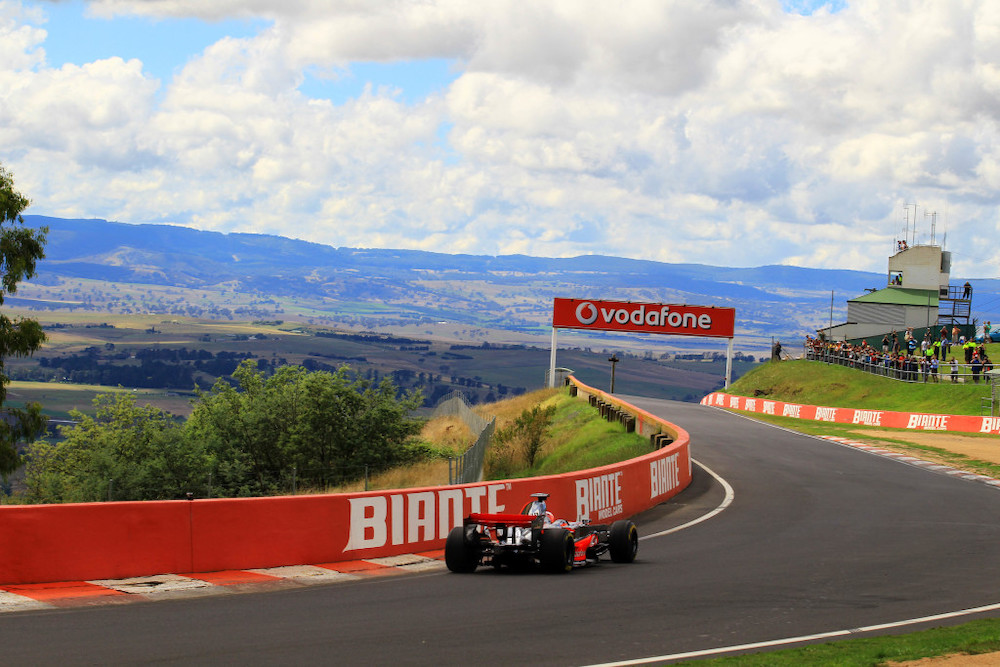
You can get one big open-wheeler around Bathurst. But if you tried to have an IndyCar race there, you'd probably lose half the field in a pile-up at The Dipper on the first lap. It'd still be epic, though. Motorsport Images
Q: F1 is now hosting five races in North America, and if that one in Chicago goes ahead it'll be six. Do you think this is enough for it to plan its F2 NA series? Something not aimed at rookies like F2; more like an IndyCar competitor. They'd have way more exposure with those five or six weekends than IndyCar gets with the 500.
If that were to happen, how many teams you think would switch from IndyCar to that F1-managed series?
Also, is it possible for a manufacturer like McLaren to buy engines from Chevy and make a McLaren-Chevy GTP, as it happens with their F1 and IndyCar program, or do IMSA/WEC rules require them to make a deal with a manufacturer that is not in the grid yet?
William Mazeo
MP: At the insane prices F1 charges, I can’t see how North American fans could support all five at the same high level without a COTA or Miami or Las Vegas suffering (Canada and Mexico will be fine), so adding Chicago would certainly dilute one or more of the other venues. If that happens, would F1 and its teams have to pay the negatively affected circuit an anti-dilution fee? (Sorry, too soon?)
CHRIS MEDLAND: I’m not sure about this one, William, because if it’s not the headline race on a schedule it doesn’t get anywhere near the amount of exposure that the main grand prix gets.
I do think it would be cool to have a North American F2 championship -- but run to FIA F2 rules with the same car -- that would allow strong Super License points and provide opportunities to more drivers from this region. Not that I see a Chicago race being added anytime soon, but even with the three U.S. races and Montreal and Mexico, there’s scope for 10 races if you follow F2’s current format.
Aside from the cost though, the biggest hurdle might be getting Las Vegas to allow support races, as those would mean shutting the streets down for even longer than they already do.
Q: I have attended the British GP twice at Brands Hatch in the mid 1980s and other races at Silverstone. Why did Brands Hatch lose its rotation for the GP? Brands Hatch is such a nicer track, with vertical development and great viewing areas, whereas Silverstone is a bit boring, made from a flat old airfield. I would love to see the GP come back to this historical track!
During a layover at Charles de Gaulle airport in Paris, I rented a car to drive out and see an old dinosaur, Reims. What an amazing trip back into time, about an hour from the Paris airport! It is commendable that the French have allowed this historical track to stand. I think you need to go and report on this old track. Perhaps you have already done so and I missed it?
Tim, Germantown, TN
CM: I wasn’t totally sure about why Brands lost out but a bit of research tells me it was two-fold -- one was that FISA at the time wanted to commit to longer-term deals and so signed with Silverstone for seven years to stop the alternation. And it appears the reason it was Silverstone that got that deal over Brands Hatch was the vast development space for run-offs, etc., for safety reasons at Silverstone, while Brands was also going through a change in ownership.
And Reims is amazing isn’t it! Admittedly my report on it was when I was working at ESPN -- I drove to a number of old French circuits in 2013 on the way down to the Spanish Grand Prix, including Reims but also Circuit Charade at Clermont-Ferrand, Magny Cours and Paul Ricard. You can drive a lot of the old layout of the full Charade circuit too, which was incredible around the edge of the mountain.
What I will admit is that in the feature I looked at the chances of a return for the French GP, and said it would only really happen at Magny Cours given the work done there. Access to Paul Ricard ruled that out in my eyes, but just over three years later came the announcement that the race was heading back to the latter!
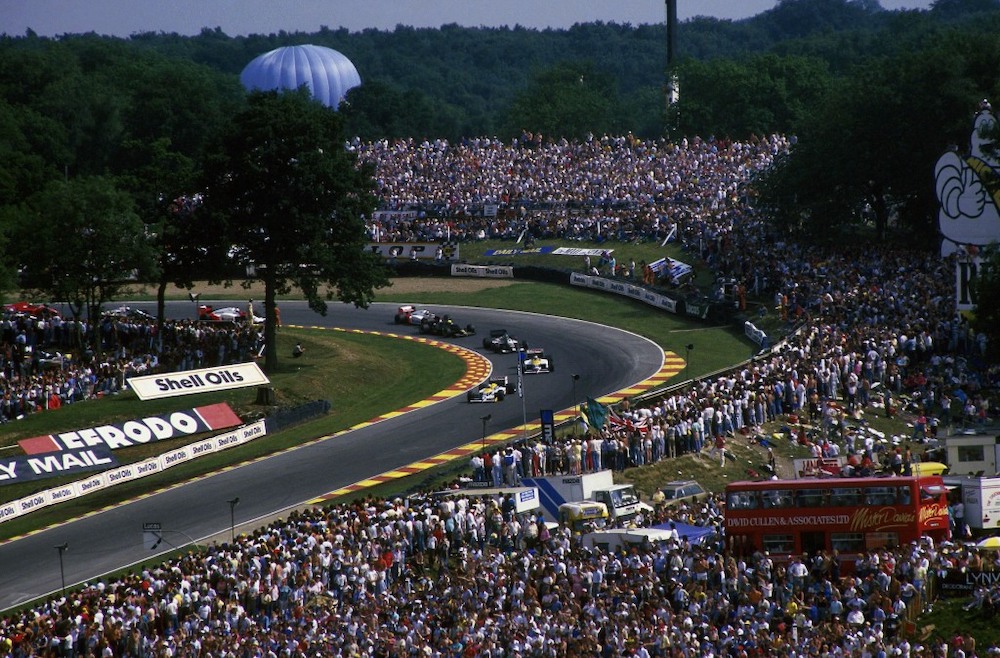
Lots to love about F1 at Brands Hatch (shown above, with eventual winner Nigel Mansell leading during the track's last GP in 1986) but it would require a monumental amount of money to bring the venue up to modern Formula 1 standards. You'd also need to have a chat with some of the neighbors, who are already antsy about the noise during race weekends... Motorsport Images
Q: Has there been any discussion of the EC antitrust authority stepping into the Andretti/F1 situation. Its aggressiveness is well-known.
Also, your recent Mailbag discussion mentioned the economics having changed since the €/$200M expansion fee was set, such that the investment is instantly worth much more. Is there talk of increasing the fee to reflect current economics?
Doug Farrow, Plymouth, MN
CM: It’s a topic that’s come up a few times, but mainly from sources offering an explanation as to why F1 would never give a straight "no" but instead offer the scenario that would make an entry possible (hence the 2028 information).
And yes, increasing the fee is one of the central topics when it comes to the next Concorde Agreement, that will need to be agreed at some point over the next two years. That might be 18 months away, though, and there are so many other aspects to the Concorde that it’s not as simple as just agreeing a fee and signing a new one quickly.
Q: Do you think that we will see Lewis Hamilton pilot a Ferrari 499P at Le Mans in the coming years?
TM, FL
CM: I certainly hope so! It opens the door to a top category drive that might have taken tougher planning if he was finishing his F1 career elsewhere, but Hamilton has never really stated a desire to race at Le Mans. A number of years ago he said he wished he wanted to race in IndyCar or at Le Mans but that the motivation isn’t there and that he has other things outside of racing he’d love to do once retires, so it remains to be seen if that view changes at Ferrari.
Q: If Williams is not financially stable, why aren't Dorilton and Andretti talking about a sale/investment? Seems like there is an opportunity for at least a 500% profit over the price Dorilton paid. And isn’t making money Dorilton’s main business? Is there anything going on there?
Ed Joras
CM: I take “not financially stable” with a pinch of salt, given James Vowles wanted to be allowed to invest $100 million in facilities. Dorilton clearly has the money and is willing to invest it, but at this stage that means Williams isn’t profitable. Once it is, that’s when a sale might make sense as a new buyer wouldn’t need to invest so much.
As for Andretti, it’s clear that all the plans now are for a brand-new team setup, so the cost of an existing team would be higher and less cost-effective given it wouldn’t need some of the facilities. And investment doesn’t work for it either as Michael Andretti wants total control of the team’s decisions and future -- that’s a key reason why the Sauber investment a number of years ago fell through.
Q: Follow-up to your response to CJ Leland in the Feb. 7 Mailbag: If FOM wants more anti-dilution money and wants GM as an engine manufacturer/supplier, why didn’t they just stipulate that a 2026 entry is approved contingent on a $600 million dilution fee and GM committing to being an engine manufacturer by 2026-28?
Alternatively, this hasn’t been central to many discussions, but would all the 10 teams be on board with an 11th entry if FOM upped the prize money pool accordingly?
NorCal Rob
CM: So, FOM clearly wants to agree a new figure with the teams, but as pointed out in another answer, that figure is set in the Concorde Agreement that currently runs until the end of the 2025 season. The next figure (if one is agreed) will be in the next Concorde, but that’s such a complex agreement itself that it will likely take a lot of talks and negotiations. That’s why it’s not as simple as just upping the fee, as it will happen alongside multiple other discussions.
I believe the existing teams would be more open to an 11th team in that scenario, yes, but then it comes down to FOM asking why they should be the ones footing the bill for another team to come in if they don’t foresee a big enough return? There are owners and shareholders that need pleasing -- it’s a huge business after all -- and if F1 is so attractive and potentially so lucrative to a new team, that’s why the onus has been on the entering team to pay for a spot. If FOM’s profits go down rather than up because it accepted an 11th team, Stefano Domenicali’s job might be on the line!
Q: The accusations against Christian Horner will be terrible for Formula 1, not just for the Red Bull team. If Horner is fired, how will we ever know what the Red Bull team might have done in the future? If they fail to live up to their past success, rather than feeling that the other teams have overtaken them, we will always think that Red Bull was crippled because of the loss of Christian Horner. And this surely brings Formula 1 into disrepute, especially in the wake of the accusations against Toto and Susie Wolff.
Oh dear, and with that thought, here comes the conspiracy theory: Maybe the Wolffs found out who was behind the rumors of their improper information sharing. And what if this is their revenge? And the following rumor -- that the accusations against Christian Horner are really the playing out of a power struggle within Red Bull -- is just poisoning the well further. I don’t believe it, but once the thought is spoken, it will always be in the back of the mind.
Big Sur Ridgewalker, Big Sur, CA
CM: I’m steering clear of rumors surrounding Horner based on the fact that I’ve yet to speak to anyone with any certainty about what’s happened and the severity of the allegations. Clearly it’s something big enough to trigger an investigation, but there are so many potential reasons for that, that we’re only going to report fact on this topic.
Regardless, as much as Horner has done an excellent job at Red Bull, so too have so many other key personnel. It’s a team with huge strength in depth and multiple senior members who have had a major influence on its success, that -- perhaps Adrian Newey aside -- I don’t think the departure of any one person would be totally decisive for it’s chances of further titles.
Q: Can Max Verstappen enter F1, F2 and F3 in one season and challenge for all three championships? He’s never been F2 or F3 champion before, so he should be eligible for the series?
Willem
CM: Technically yes, I believe he can. Although there’s a minimum age, there’s no maximum age so if he really wanted to do something like that, he could (as could anyone else who hasn’t won either title -- the only result that makes you ineligible).
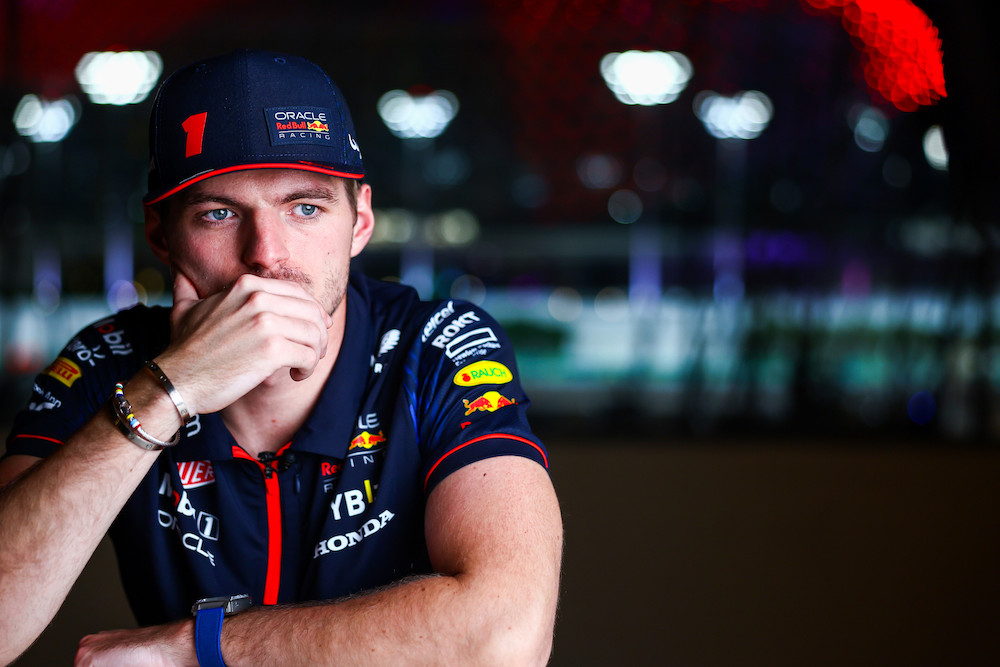
That feeling when you have three world championships but are still haunted by unfinished business in Formula 3. Mark Thompson/Getty Images/Red Bull Content Pool
Q: With all due respect to Kelly Crandall, IMHO the Clash at the Coliseum is "Must-Miss TV." Perhaps I'm not in the target audience. Perhaps I have an attention span longer than the average squirrel, maybe I don't like rap music or anything that is labeled "music" these days. Too much hoopla and assorted other bullstuff for this kid.
I have reduced my NASCAR viewing to maybe three-four races per year, down from all of them in past years. Have switched to IndyCar and F1, although F1 is mostly a parade.
John, Downers Grove
KELLY CRANDALL: It’s not for everyone and that’s fine. But there is nothing wrong with NASCAR trying something new and going all-out with an exhibition event.
Q: I am very disappointed that NASCAR has only two practice sessions for the Daytona 500 and that the first time the Cup Series cars will turn a lap will be in qualifying. Why has NASCAR cut down on practice so much, especially after COVID?
Kurt Perleberg
KC: After COVID the industry realized there were better, more condensed ways of doing race weekends, and with the Daytona 500, it came down to not needing so much practice because teams didn’t want to wreck their cars. As the week went on, more and more drivers stopped participating in practice once the car was as prepared as it could be, and fewer and fewer were participating in drafting sessions. It was a matter of time and money. But now that the schedule doesn’t have anything before qualifying, some have backtracked in a sense and have expressed liking some form of track time to put a car on track and make sure nothing is leaking or dragging.
THE FINAL WORD
From Robin Miller's Mailbag, February 16, 2016
Q: I don’t understand why so many of the younger drivers without full-time rides in IndyCar don’t drop down to Indy Lights instead of sitting on the sidelines. I’m guessing the answer has something to do with money, but can you shed some light on what goes on behind the scenes with these drivers?
Steve, South Carolina
ROBIN MILLER: First and foremost is that Lights aren’t going to help Karam or Spencer Pigot or J.R. Hildebrand make progress -- they already crossed that bridge. And most of the Lights’ owners need sponsorship too, so that’s why so many young foreign drivers get seats. Someone once asked Jimmy Vasser -- the 1996 CART champion -- when he was losing his ride with Ganassi after 2000 if he thought he needed to go back to Lights for a year. To his credit, he laughed like the rest of us. In the 1950s,’60s and ’70s many of the IndyCar regulars still ran midgets and sprints because they didn’t make enough money just driving an IndyCar.
Marshall Pruett
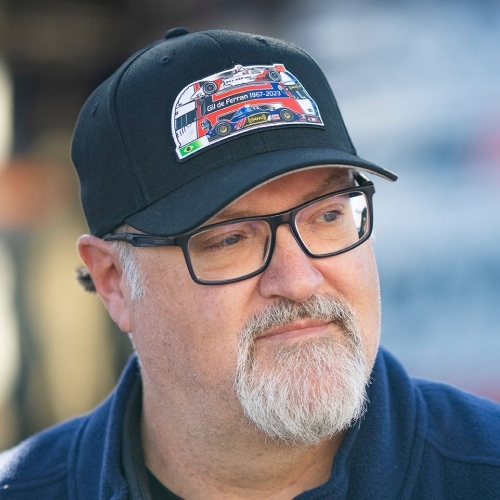
The 2026 season marks Marshall Pruett's 40th year working in the sport. In his role today for RACER, Pruett covers open-wheel and sports car racing as a writer, reporter, photographer, and filmmaker. In his previous career, he served as a mechanic, engineer, and team manager in a variety of series, including IndyCar, IMSA, and World Challenge.
Read Marshall Pruett's articles
Latest News
Comments
Comments are disabled until you accept Social Networking Cookies. Update cookie preferences
If the dialog doesn't appear, ad-blockers are often the cause; try disabling yours or see our Social Features Support.