The RACER Mailbag, January 10
Welcome to the RACER Mailbag. Questions for any of RACER’s writers can be sent to mailbag@racer.com. We can’t guarantee that every letter will be published, but we’ll answer as many as we can. Published questions may be edited for length and clarity. Questions received after 3pm ET each Monday will appear the following week.
Q: I was thinking about Honda and IndyCar, noting that Penske and Chevrolet are apparently silent about the prospect of losing Honda, and there’s all this talk about maybe a spec engine would be better than engine competition; and suddenly I was hit by a terrible conspiracy theory:
The spec engine that’s being discussed would be from Ilmor, which makes the "Chevrolet" engines that are currently in the cars. Who owns Ilmor? Roger Penske, who also owns IndyCar. So he would not only do away with an engine competitor in the racing series, but also, all of the money from engine leases would flow to one of his companies. Obviously simpler and easier, but opposite to the direction taken successfully by IMSA. Mr. Penske is acknowledged as a master manager, leader and organizer, and he loves an unfair advantage, but I have never heard anyone say he was a brilliant marketer.
Big Sur Ridgewalker, Big Sur, CA
MARSHALL PRUETT: This has the feel of an Oliver Stone movie where lots of conspiratorial questions get added up to equate to a likely misdeed. Truth is, American Honda/HRC US are saying that they’d welcome taking a big slice out of their annual racing budget by buying or leasing a spec-ish motor instead of spending zillions to do it themselves.
And since Honda/HRC US has the deepest respect for Ilmor as a rival and collaborator, it makes more sense for Honda/HRC to suggest Ilmor -- the only other expert in the world at making championship-winning 2.2-liter turbocharged V6 IndyCar engines -- is the best fit for the job.
Let’s also be honest here: A proposed spec supply suggestion from Honda/HRC for the company Penske co-founded and co-owns is one where everyone knows full well that it will benefit Penske’s bottom line. The thing being served up as a possible conspiracy is actually the exact thing Chevy/Ilmor’s main rival would welcome, so that probably makes it something other than a dastardly plan Penske devised.
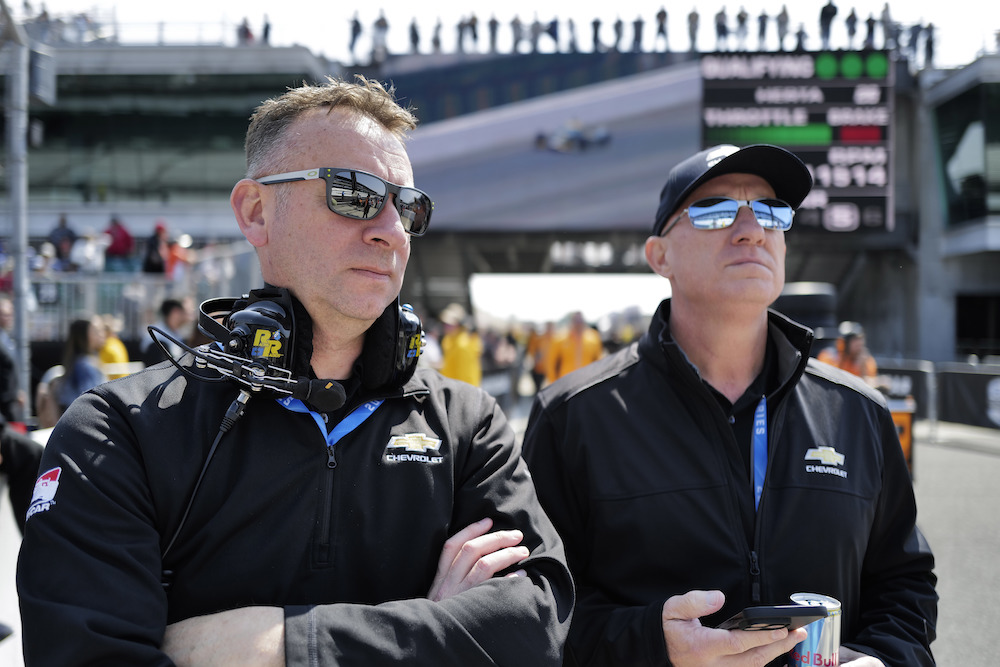
These Ilmor engineers might be giving off some secret government agent vibes with the dark uniforms and mirrored shades, but there is no deep state conspiracy behind the standard engine chatter. Michael Levitt/Motorsport Images
Q: A few months ago, I came across a post you retweeted from Dawn Treader Performance and their restoration of the Penske PC26. Since then, they have had a couple of excellent videos of the car being run on an airport in the UK. What a great sound and look; I was immediately transported back to my childhood in the 1990s seeing this car run in person at Michigan, Cleveland and Nazareth.
What is it like, from a parts availability and cost standpoint, to restore a ’90s-era CART car? Is there much opportunity for an interested person to pursue an endeavor, or do teams tend to hold on to their stock of old cars? And where might these cars be seen running again? It looks like track days shy away from open-wheelers, so perhaps vintage festivals? I can only come across a couple of YouTube clips from a Goodwood Festival where a PC22 was tearing it up.
Chris Reardon, Washington, DC
MP: Plenty of open-wheelers at SCCA and NASA club racing events, and the same is true for vintage series that welcome them (some series are dedicated to sports cars or stock cars, only). There is a sore lack of modern-ish Indy cars at vintage events, which I hope gets resolved sometime soon. The HMSA vintage organization will be running a field of vintage Indy cars during the Long Beach GP in April, so if your calendar and bank account will allow, it’s a perfect excuse to come and watch IndyCar, IMSA, and vintage Indy cars in action in SoCal.
My friend Patrick Morgan, whose Dawn Treader Penske you referenced, was kind enough to help with some insights:
"A difficult question to answer, and everyone in the restoration business has to grapple with them. There are many cars out there in various states of completeness. Parts availability can depend on the specific chassis – for example there were many 1997 Reynards around, less so with Lolas for that year, but by 2002 the field was almost all Lolas so there more to be found around for those cars. Engine-wise, Cosworths are pretty much available with electronics to support them; early Ilmor/Chevy engines are out there and a very few later Ilmor-Mercedes engines. I have yet to see a complete running Honda and only a couple of Toyota-engined cars running.
"Cost-wise, it really depends on what you start with and what your end point is. There is quite a cost difference between simply running a car and having a race-ready car in terms of, for example, a fuel cell being certificated, dampers rebuilt, etc.
"It's all expensive and you've got to want to do it, but it’s achievable and not as painful in the longer term as an F1 car. The duty cycle on the engine for an Indy car is 600 miles at full throttle rather than 350km with varying throttle for an F1. Knock 200rpm of the rev limit and reduce the boost a tad and it's going to last longer than 600 miles. So for the performance, it's much more cost effective. And better looking... just my view, of course!"
Q: As we’ve hit the dog days of the offseason, it’s the perfect time for a movie marathon. What are your go-to racing movies to get us through the cold winter months and, in your opinion, which recent one is the best?
Michael in Central Indiana
MP: This is where I need to admit I’ve been fearful of watching "Gran Turismo" because it looks so generically bad: Shouty team boss guy. Young driver who needs to find his confidence. Cartoonish crash scenes (barring the terrible ’Ring crash Jann experienced). But I do need to watch it.
Other than my passion for hate-watching "Driven," I don’t have much to offer that’s original in terms of cinematic pieces. "Le Mans" and "Grand Prix" are the go-to gems. I did add a few items to my Watchlist on Prime that should range from terrible to amusing. One is "Born2Race," a documentary-style movie about Al and Bobby Unser that, based on the trailer, is horrifically bad, which means I’ll love it.
During the pandemic, I came across something called "Gearheads: Win At All Costs." It’s as if someone watched "Driven," challenged themselves to make something worse than the worst racing movie of all time, and possibly succeeded, with the mess set in the world of short track racing.
I’m a much bigger consumer of racing annual reviews and documentaries. The documentary "Hurley," about Hurley Haywood, is well worth watching. "Super Speedway" is another that’s always awesome.
Q: My 23-year-old son (an avid IndyCar fan that I’ve brainwashed since his toddler years) and I will be attending the Rolex 24 At Daytona for the first time. We live in Indy, and have been to many IndyCar races across the country, and attended the IMSA event at IMS this year.
We’ve never been to Daytona International Speedway, and have never been to a 24-hour race. So we’re looking for tips on what to do, how to plan, what not to do, sleeping/eating strategies, etc. We’ve agreed that it’s going to be awesome, but we’re prepared for a few moments of "what did we get ourselves into?" We rented a small condo about five miles away for shower and sleeping purposes only, but we’re tempted to sleep a bit in the car at the track and maximize the experience.
We’re open to any and all advice! Thanks in advance!
Jeff Keen
MP: First recommendation is to check the track’s website for what you are and aren’t allowed to bring in with food and drink. Based on that, I’d plan on treating the events as a "touring race," which means having a nice rolling setup for you and your son, if possible, that has whatever you can have in a cooler, plus folding chairs, umbrellas, rain gear, and sunscreen.
Although DIS has giant grandstands that are quite comfy, this isn’t an event where you park yourself in a seat all day and all night long. Go up there, for sure -- especially for the start on Saturday -- but plan on using the tunnels to go into the infield and tour from turn to turn and stand and watch where standing is all you can do, and set up your camping chairs and chill and watch at the places where that’s possible. I’ve slept in my rental car every time I’ve been there, except for last year when I was sick and needed to get proper sleep in a bed, so go with how you’re feeling on which option to take.
If you or your son like to take photos, there are a bunch of places to do that as well. Just buy a little stepstool to chuck into your rolling wagon, or bungy it onto your backpack, to help shoot over the fences as many fans do.
Last piece of advice: Challenging yourself to stay up for the entire race is great if you two don’t have to go to work on Monday or Tuesday. But if you do, skip that challenge because it takes a week to 10 days to feel human again.
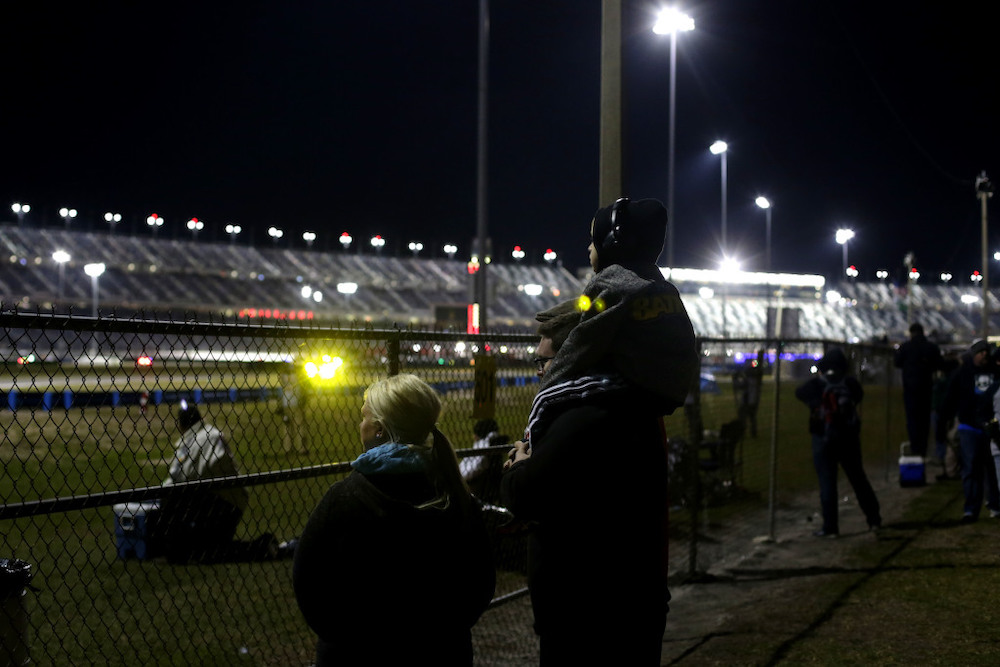
Two laps around the clock means plenty of opportunity to explore the different vantage points at the Rolex 24 At Daytona. Alexander Trienitz/Motorsport Images
Q: In response to Ed, from Westfield in last week's Mailbag, via a short story:
My brother attended the Indy 500 every year from 1975-1997. It was the only auto race of any kind he ever attended. I tried unsuccessfully many times to talk him into Road America (closer to his home) for the CART folks and IMSA. No dice.
Fast-forward to 2022. He's retired, kids are grown and gone and he's bored. I talk him into IndyCar at Road America. We get there early enough Sunday morning to walk through the paddock. I make sure he notices all the driver and team names on the banners fluttering in each paddock. After a while he stops and says, "Now these guys aren't here, right"? Me "what do you mean?” “Well, Castroneves, Herta, Scott Dixon, they're not here today, are they?”
I was flummoxed. I tried to explain that yes indeed, they are here and in fact if we hang around long enough we might bump into them showing up for work.
Instead, we head down to the bleachers in T5 to watch the driver introductions on the giant screen. Me: “See, there's Castroneves, there's Dixie,” etc. I think -- not 100% sure -- I have him convinced.
Now for the Ed from Westfield section: I talk him into IMSA in August again at RA. After a full weekend of exciting multi-class racing, I ask for his thoughts. "Well, the cars are boring. I like IndyCars much more."
Bear in mind this is a very successful, college-educated guy. He'll never be convinced that if it ain’t an IndyCar it's just a car. The good news is he's now a road course fan and went with me again in ’23 and is going again in ’24 -- of course, only for IndyCar.
Keith Conroy
MP: Great story, Keith. Glad he got to see both, even if he likes IMSA less than IndyCar.
Q: As we all know, IndyCar does very little marketing/advertising of the series to the general public other than the occasional TV commercial on NBC. If the argument is that the series is practically focused solely on B2B, why even do that? (I guess that's an NBC thing?)
Perhaps that is precisely why there is little advertising and promotion. There aren't even promotional ads within a former series and current car sponsor Verizon's company, as a friend of mine who works in the Verizon headquarters (and has been a Verizon employee for over 20 years) has continued to tell me he sees nothing internally promoting the car, Will Power ("Is that really his name?" I was asked) or the series and didn't even when they were the series sponsor. You would think Verizon would be proud of being the sponsor to one of the best drivers in IndyCar and tell even their own employees about it, but apparently not. Not even when Power won the 500. Bueller? Bueller?
How about this simple strategy: Some time ago there was a weak marketing effort about the series having the best drivers in the world. Though that is arguable by some or many, let's go with it (again). Hype up the season (and past champion Palou) by saying the series and the championship is to crown the best driver in the world (because of ovals, streets, and road courses on which they compete to determine the title), and beat it into the viewing public with social media ads, a few relevant influencers, and in upcoming race commercials.
At worst it will get online debates aplenty; at best it will get more of the IndyCar-clueless public trying to see "who the hell are these guys and why are they hyped to be the best drivers in the world?" Geez, IndyCar, throw us some kind of bone to help get the word out -- the aging IndyCar diehard fan demographic is dying out and needs some help spreading the word before it's too late. What says you?
Randy Mizelle, Oak Island, NC
MP: Not sure where the Verizon-didn’t-do-commercials angle comes from, but they did, because I saw them when they aired, along with millions of other people. Do we wish that continued in the latter years? Of course!
The "best and most diverse drivers" promotional angle has also been used, plenty of times, in CART, Champ Car, and the modern-day IndyCar Series. I know you and I grew up at a time where a great TV commercial could make a difference, but I just don’t know if that’s a thing that still works like it once did, with the younger demographic IndyCar is chasing.
Q: Last night, as I was watching Team #144 of the Maize & Blue as they ROLLED the TIDE on their way to the championship game, a random thought popped into my head: “I wonder how many people know that Jim Harbaugh was once co-owner of a multi-championship winning IndyCar team?”
So, I Googled it, and very little came up that was recent. It would be smart for IndyCar to embrace this link (and others as they arise) when their star is shining and eyeballs are on them. Put something out there congratulating him (and the team) on the recent wins, along with footage of him jumping over the wall changing tires back in the ’90s! IndyCar should exploit this to their advantage considering U of M has arguably the largest fan base and alumni of any school. IndyCar competes with all other sports for eyeballs. Embracing and engaging your competitors on their turf should not be feared, exposing the sport to potential new fans.
Further thoughts on this subject led me to the sports-media wunderkind whose "Thunderdome" sits kitty-corner to IMS (via I-465)! The one and only Pat McAfee! People either love or hate him, but his numbers don’t lie and he has created a juggernaut based right in Indy and his reach has no bounds. He is an admitted fan, has sponsored Conor Daly in the race, and drove the pace car for one of the Indy GPs, so he’s obviously a fan. Why not exploit that?
There is nobody else in sports media who has a daily three-hour show on constant replay on a major network. He has amassed a huge following, and IndyCar needs to hop on his coattail in any way possible, as even if he only spends five minutes of his three-hour show talking about IndyCar/interviewing drivers, it is guaranteed to bring new eyeballs. If IndyCar is not pursuing it already, then they need to hire me to drive that initiative.
Steven Bushouse
MP Two excellent points, Steven. While I’ve been aware of McAfee since his NFL days, I’m new to him as a sports show host and do, on occasion, enjoy some segments on ESPN. And that part, with ABC/ESPN, might be an issue with IndyCar tied directly to its rival at NBC. Can’t deny that the exact audience McAfee speaks to is of the age that IndyCar needs most to start following its series.
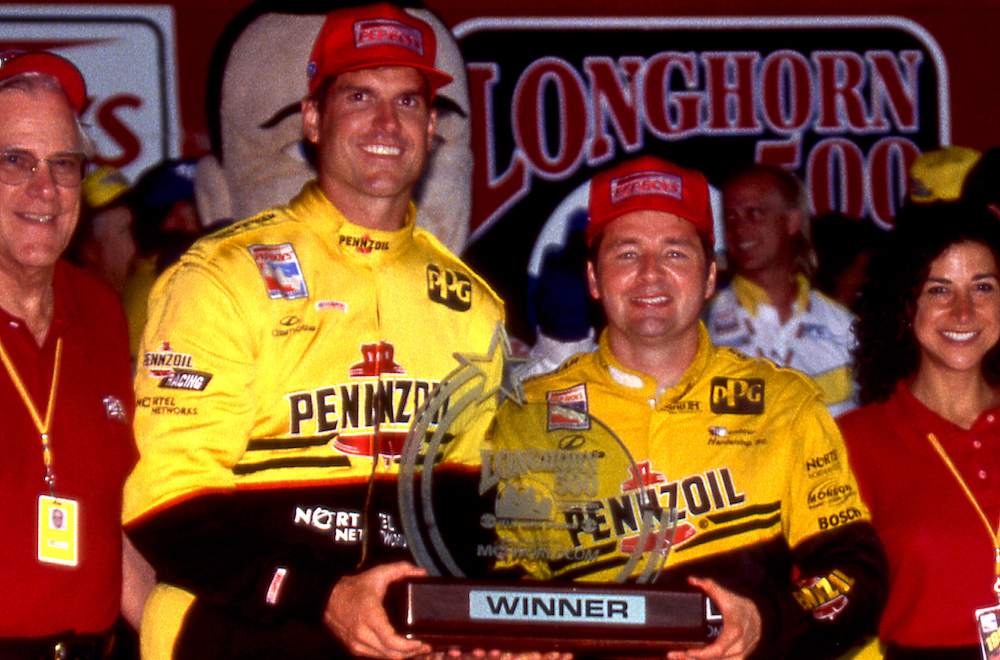
Harbaugh and Scott Goodyear collect the spoils after Panther Racing's win at Texas in 1999. Penske Entertainment
Q: As I digest all of the concerning comments about IndyCar, I am wondering if there is any good mental energy at 16th and Georgetown being spent on some out-of-the-box marketing, or are they all in a defensive mode fending off threats relating to suppliers and broadcasters?
One never sees a good advertisement with IndyCars or their drivers anymore. I recall the Texaco ad with Mario and A.J. where they kind of rib each other, and the Valvoline ad with Little Al ribbing Mark Martin and Joe Amato.
I also am ominously reminded of the Honda/FedEx ad with Gil de Ferran. Those were great. Guys like Mario and A.J. are still with us. Why can't someone create a funny ad with those two? Maybe partner them with a couple of IndyCar drivers like Alex Palou or Josef Newgarden. Make it comical, something that would go viral on YouTube or TikTok.
Look at Palou, a two-time champion that hardly anyone outside of the series itself knows about. Criminal! And Josef, possibly the best oval racing driver since Rick Mears, and again, not even close to a household name.
Look what State Farm has done with Patrick Mahomes and Andy Reid. I know this isn't the NFL but it's something to think about. How about getting Chip and Scott in a funny ad? Look what the NFL did with John Madden.
I'm a fan of all motorsports but I'm still mad that IndyCar let NASCAR beat them to the punch in staging a street race in Chicago. My two cents.
James
MP: Next time I speak to IndyCar, I’ll ask if they have anything in the works, or an ad agency to help create such things.
Q: When the IndyCar hybrid system is finally implemented, will the cars be able to roll off after a stall without having to be restarted? I don't ever hear mention of this capability. From day one, this is all I have really cared about as it could eliminate some of the long cautions that happen on road courses.
Rick Navratil
MP: Hi, Rick, yes, that’s the plan. It’s been written about here in the Mailbag and in other RACER stories.
The only caveat is if the supercapacitor is nearly depleted of energy when the spin or stall happens. Can’t wind up the motor generator unit to start the car if there’s not enough juice in the supercap to wind it up.
Q: For everyone worried that any change to the engine specs/manufacturers/formula will bring with it the horrific and feared term Balance of Performance, a reminder:
IndyCar has already been there. Back in what's widely described as "the good ol' days" you could run an Offy, Cosworth, or Buick but your boost was limited to balance the performance of each. The Buick, being a pushrod engine, got a fat turbo allowance (to its eternal detriment in durability) yet always put up big numbers on pole day. That pushrod loophole in the rule book was big enough to drive a Mercedes through, though...
Maybe we old-guy IndyCar fans born in the ’60s or ’70s shouldn't fear the idea of a new BoP. If it comes to that. I plan on watching IndyCar for life. F1 just isn't racing, to me. Nothing much is, anymore, sadly.
Bill Bailey
MP: Thanks Bill, but BoP was never used back then. Engine type, displacement, boost, and weight was a common pick-’em solution in open-wheel, sports cars, and so on, but actual balancing of performance, where the sanctioning body actively dialed boost/weight/revs/etc up or down to make a Cosworth DFX equal to a Buick or a Judd or a Chevy, and so on, wasn’t done. If they had, the racing would have been much closer, but each era of IndyCar has its dominant engine from back in the day, and that wouldn’t have been possible if true BoP was employed. There were adjustments made, of course, but the old practice was more like a distant uncle to BoP than the grandfather of the process.
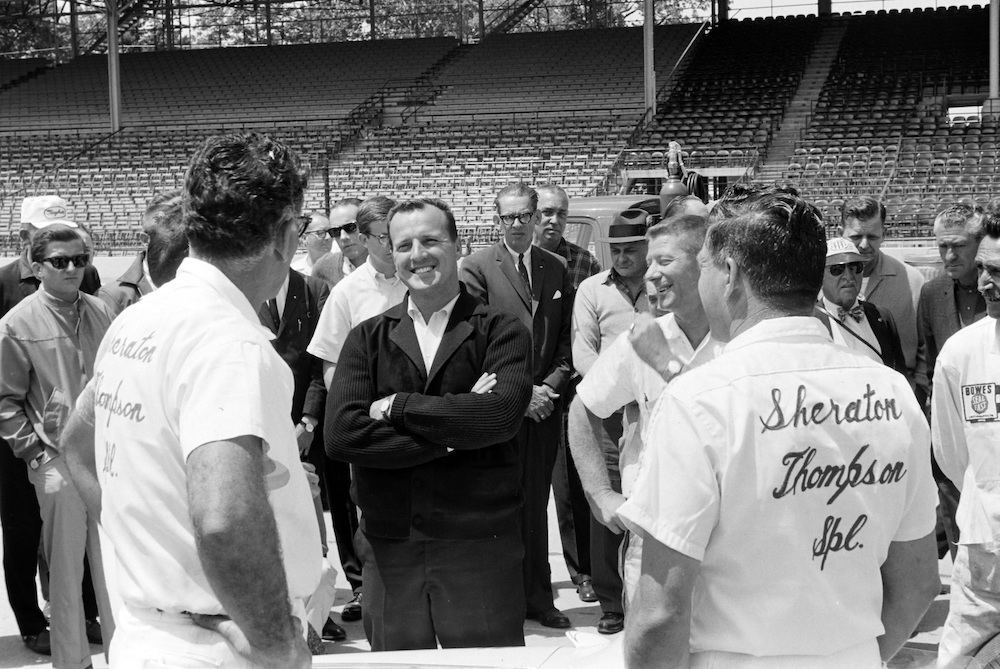
Not sure A.J. would have looked so cheery if his Watson-Offy had been slapped with a BoP adjustment at Indy in 1964. The quotes would have been good, though. David Phipps/Motorsport Images
Q: What do you think about the Chili Bowl? 370 racers on an indoor dirt track. Racing all week long. Makes a lot of events seem tiny.
Pete Pfankuch, Wisconsin
MP: I’ve always wanted to go but haven’t made it happen yet. My friends who attend say it’s all kinds of awesome.
Q: Tell us what your crystal ball is for the next five-seven years of IndyCar.
In the near-term, would it simply make sense to start in 2025 and 2026 testing and adjusting the cars to the IMSA engine formula for 2027? Just start the process of what is needed to fit/accommodate these engines now? You can test the adjusted chassis/engine while still running the Honda and Chevy in the near-term for the next two seasons.
IndyCar would need to use a few chassis at different tracks for the engine testing. If this change was made there might need to be some sort of handicapping for power, but if all things were equal, it would be a matter of space, weight and aerodynamic profile. I would think some of that could be worked out over time. The weight might go up, but do IndyCar fans really care about the actual weight? No. They just want to see cars racing. I am sure balancing this all would require some testing for many variables, but if we are to keep the existing chassis and will need new engines, what really is the choice?
I think people are tired of the old chassis, but I also feel some aesthetics could be incrementally changed over time. The tub and aeroscreen are ugly, but it appears the same basic car will be in place for a while. Can Dallara not change small things over time? Maybe change the front and rear wing (loved the early 2000 IndyCar with the angled front wings, love the angled rear wings in Formula E) and maybe only changes to parts of the car one year at a time. The bodywork for the new engines could be a one-year change. If you keep the same car, make some incremental changes each year to change the look.
Finally, all NBC advertising should involve either high-speed slipping and sliding, some sort of elbow checking, loud, loud noise and some incidents. Get a huge social media presence that involves the drivers, personalities, the science of racing, feuds, etc... If IndyCar wants to garner new fans, get them smelling the bait in small bites. My kid knows all the MLB all-stars but does not watch games. He knows them in many small social media highlights. I’ve got to believe advertisers like eyeballs, no matter how they get these videos viewed.
Tim, Chicago
MP: All interesting thoughts, Tim, but there’s no "adjusting" of the DW12 to fit GTP motors without it costing a fortune. That’s why, as I’ve written ad nauseum, a new chassis would be needed if IndyCar went to an all-shapes-and-sizes engine formula.
Other than going hybrid, I have no idea where IndyCar is headed by the end of the decade because they don’t know and haven’t mapped out where they want to go.
Q: I must say the Corvette Z06 that is going to compete in IMSA is still pretty similar to the Corvette C8.R it is replacing. What are the technical and mechanical differences between the Z06 and C8.R? With the Z06 racing in GTD Pro along with GTD, what has been the feedback from drivers in testing, and is GM expecting the car to make the Corvette name become competitive again?
Brandon Karsten
MP: Great questions, which are better served in a feature-length story, not a quick-hitting Mailbag reply. The previous chassis was built to the now-retired GTE regulations, which made for faster cars than the GT3 formula, but lacked some of the driver aids like anti-lock braking. Corvette was planning to build a proper GT3 version of the C8, but didn’t have one ready in time to go with IMSA’s move to all-GT3 regulations in 2022, so the series allowed Corvette to modify the C8.R, retrofit it with things like ABS, and then used Balance of Performance to make it work among the purebred GT3 models.
Corvette won the 24 Hours of Le Mans in its class and the GTE-Am title in the FIA World Endurance Championship in 2023, so I’d say the name hasn’t lost its competitiveness. With its move to a proper GT3 car, there’s every reason to believe Corvette’s grand success in IMSA will continue as well.
Q: It seems that for the relationship between CART/IndyCar and NASCAR has been a zero-sum, parasitic relationship where neither series has positioned itself to mutually grow together. I personally believe this does not need to be the case, however I understand that the “I run this town” attitude of the France family the past 75 years has shaped this narrative.
However, I also believe that if there was anybody who can help change this narrative and mend the relationship, it is Roger Penske. NASCAR would have to come to the table also, but do you see this the same way I do -- that the relationship between IndyCar and NASCAR needs to change for the long-term betterment of both series? Is there a reality where NASCAR and IndyCar can truly work together in a substantial way and cross-promote?
Additionally, I believe IndyCar has been long out of touch with grassroots racing. As a dirt racing fanatic I would love to see some sort of connection between the "big leagues" and "old school grassroots." The BC39 is an awesome event, but that’s really the only gesture that Roger Penske has made acknowledging grassroots racing. [ED: The BC39 event predates Penske's purchase of IMS by a year]. [Indianapolis Motor Speedway president] Doug Boles is a rock star at that event every year (personally greeting every driver and tilling the track in the tractor himself) – why can’t we have more of that?
Eric
MP: Both series would undoubtedly benefit from working together, but that’s just not how competing businesses in a free economy tend to behave, right? I’m sure if Coke and Pepsi worked together, they’d sell more soda, and an alignment between McDonald’s and Burger King would sell more of their food, but these are warring businesses in the same space who are trying to beat the other. IndyCar and NASCAR are the same and always have been, as I’ve seen it.
Like the soda and fast food companies, IndyCar and NASCAR have similar products to sell, but they’re just different enough to attract different audiences, so it’s not like the glaring need for Champ Car and the IndyCar Series to join forces for their mutual betterment.
Former IndyCar CEO Randy Bernard tried to rebuild the roots to short-track racing in the early 2010s and while it was cool to see, it didn’t seem to do much for the series. He was fired before it could be developed into a bigger program. Maybe Kyle Larson’s upcoming Indy 500 debut will bridge the worlds of IndyCar and short-track racing in meaningful ways.
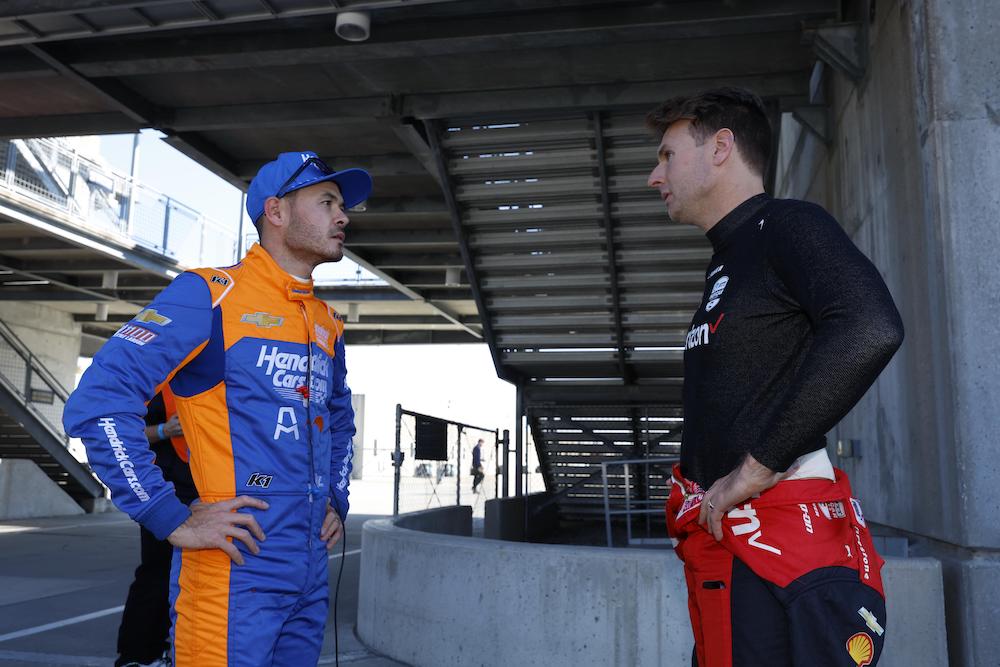
There's plenty of respect between NASCAR and IndyCar drivers, but the chances of sustained, high-level cooperation between the two series seem slim. Chris Jones/Penske Entertainment
Q: Do GT3 manufacturers turn a profit by selling their race cars? It’s always been interesting to me that some sell many, many cars (Porsche, Ferrari), while others seem content to limit things to a "factory team" feel (Corvette). Is the value purely in the marketing, or is there money to be made as well?
Brad
MP: Sure, some do. Ferrari charges a fortune and sells every GT3 car they make. Porsche doesn’t go silly with pricing, and they definitely operate as a business with their customer racing, rather than as a marketing arm and expense as some of the smaller brands do. All depends on the size of the brand and what they’re trying to achieve with the GT3-based programs.
Q: You have said that you know management at IndyCar read the Mailbag, but I really wonder if they care, because there is no such forum on the IndyCar website. Their website is all feel-good stories about the series. Do you have any sense that they are taking in all the feedback from the Mailbag and formulating a plan that they will announce in the near future that addresses Honda's and the fans’ concerns? Their silence is deafening.
Dave
MP: One of the things that you can find among a group of like-minded people who’ve been ultra successful in their other businesses is an inward approach to whatever they do with decisions and planning. In other words, if you’ve made billions elsewhere, looking to comments sections and forums on how to run your new business just doesn’t fit the mindset of most business leaders. Titans of industry tend to look in the mirror and see everything they need.
Prior to IndyCar’s sale, when it was run by people who never believed they were the smartest people in the room, it was common for them to look to those comments and forums to get the real pulse of the fans. Now, we get the series talking down to its fans, telling them that negativity is "out." Because, well, who wants to hear the frustrations of IndyCar’s most invested and passionate fans? Just smile and blindly accept whatever you’re told to do, people...
Q: Regarding all the Honda stuff, I assume this goes much deeper than at a dollars and cents level, correct? If it was just about money, with an overabundance of teams, entries, and sponsors (in some cases), couldn’t Honda simply request the engine subsidy they absorb be reduced or eliminated in future years to make the budget align? That seems to be a simple answer. Or is asking each team to pay $500k or a $1 million more in 2025 or 2026 unreasonable? If the simple answer isn’t be pursued, there must be something much deeper going on, right? What am I missing?
Mark Schneider
MP: The financial balance in the paddock is one where some teams could easily absorb a doubling of the annual engine lease price, but approximately half could not. It’s a rarity for teams who rely on paying drivers to come across one who has an extra $1.25 million to give; in most instances, it’s a fight just to get the amount those teams need to properly operate.
What Honda was saying in simple terms is that for what it costs them to compete in IndyCar, there’s just nothing close to a reasonable return in brand promotions or car sales. If IndyCar was delivering a TV audience that was double or triple the size of what it was in 2023, and the series was playing in front of packed houses at every stop on the tour, you’d hear no concerns about costs.
If IndyCar can find a way to add tons more value, that would be amazing and I’d guess Honda would be fine with paying a premium price if it felt it was getting a premium product that warranted the big outlay in return. But until that happens, bringing the price down is the smart call to keep them coming back.
Q: Rush cover question. Have you heard Geoffrey Keezer's piano cover of Limelight? If not, give it a listen. Best version is a live one on YouTube, but the Amazon version is perfectly fine (although actually quite different). Stick with it, he does the "verse" twice before he unleashes the good stuff.
Luke
MP: The Mailbag is the gift that keeps on giving. I’ll give it a listen. I’ve probably listened to Natural Science (off the same record as Limelight) from Rush’s 1998 Different Stages concert a dozen times over the last week. One of the great deep cuts from the trio from "Tronno."
Q: Have you heard any updates on Alex Zanardi’s condition?
Mark Shunk
MP: I have not, and it’s just because I haven’t asked. I don’t believe his wife Daniela would remain quiet if there was a big change in his condition, so I respect her approach to the topic.
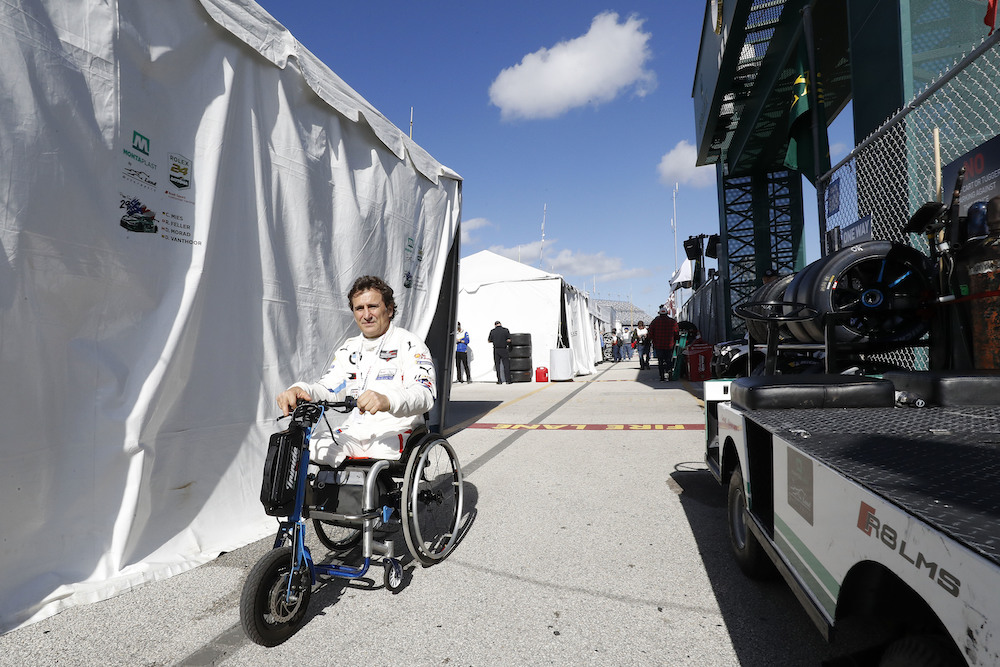
For now, no news probably means no news. Michael Levitt/Motorsport Images
Q: I read the Mailbag every Wednesday at my desk during my lunch break, but may have to stop after seeing the suggestion from Ed in Westfield regarding WEC (or other styles of cars) on the grid at Indy. I had to spit out my sandwich.
As you suggested, my response to changing the grid to WEC cars or any other design other than open wheel would be ‘&^%$ no!’ and to immediately dump my season tickets to the 500.
No offense to Ed, but I can't imagine anyone attending an IndyCar race would have any other response. I became been a fan of IndyCar exclusively because the cars looked so cool to me as a kid, and while an update would be nice, I still love the open-wheel IndyCar look. I would assume that a very large majority of fans would feel similar. WEC, IMSA, sports cars, etc all offer a great racing product and I'm fans of all. But for me, the IndyCar is king.
You asked for responses from fans who are happy with the series -- well, here I am. Yes, things can always be improved, and we should not settle for the status quo, but I am not going to submit to the gloom and doom.
I remain a huge fan, and that will not change until they stop racing or I'm gone. We have outstanding drivers, iconic tracks, and the most competitive racing series around.
F1 racing has become nearly unwatchable, while IndyCar continues to surprise every week. The memories I have made this year alone: taking my teenage daughter to her first 500, my son and I's first (not last) visit to Road America, are worth more than a 100 new chassis.
On a separate note, Doug Boles is such a dynamic personality, and his passion and enthusiasm for the Indy 500 are infectious. Is there a way IndyCar could use him to promote the whole of IndyCar in addition to the 500? His energy could be a huge boon to the series. Mr. Penske, please find a way to utilize him more!
Here's to green flags in a few months.
Josh, Lousiville, KY
MP: Thanks, Josh -- great stuff, and yes, Doug’s one of the greatest assets within the organization.
Q: Over the holidays my wife started watching a series called "Sullivan's Crossing" on the CW app. I, with nothing better to do, was in the room, playing with my phone. I was shocked when every other commercial break featured an advertisement for the 2023 edition of "100 Days To Indy." The show being watched was definitely a series targeted at women. Is IndyCar trying to get more women interested? I will say that the ad did feature some of the best-looking drivers.
Bruce
MP: Bless your heart, Bruce. IndyCar’s seen one of the greatest increases in women racers working in the series and its metrics for female fans is rather strong. How’s this: I can’t say if there’s a specific initiative in place by the series, and the series doesn’t control which commercials The CW airs within its shows, but it’s the one half of the world’s population that deserves all of the outreach and appreciation IndyCar and every other series can offer.
Q: Gasoline engine, electric motor -- no?
Gary Allen, Brooklin, ON
MP: Gasoline motor, electric engine -- yes?
Q: Seeing that it is January and everyone is starved of racing action, this is always the time of year when I find myself sifting through my collection of IndyCar memorabilia. My dad recently brought over his collection of the Autocourse annual books -- he has all 14 publications of them from 1993-2006. As I am looking through these books, I couldn't help but think to myself, "What a shame they don't make these anymore for IndyCar." These books were awesome. Marshall, you and the RACER crew need to write and publish an annual book like these.
Paul Cray
MP: I started collecting Autocourse F1 annuals in the mid-1980s and added a lot of the older editions from the ’60s and ’70s, most of which sit in storage. Same with the Autocourse IndyCar annuals. Both are must-haves for open-wheel fans, along with the Hungness Indy 500 annuals.
I co-wrote the 2008 and 2009 American Le Mans Series annuals, which was a rewarding experience while I was early in my switch from being a crew member to a member of the media. You’re right; RACER would be the perfect choice to produce a new IndyCar annual. If IndyCar wanted to pay RACER to create one, I’m sure it would be considered.
Q: In a previous email I said that I didn’t think the car/engine for IndyCar was holding the series back from growing.
However, it seems like there is serious angst among older IndyCar fans about the aging chassis/engine combination (I’m relatively new Mailbag reader). How hard would it be to take the current F2 or Super Formula chassis, replace the roll hoop with the aeroscreen, work on the suspension to keep the Firestone tires, and drop in the hybrid engine? Granted, it appears that the current IndyCar, F2, and Super Formula Dallara chassis are all very similar anyway, but it seems like it could be a cheap and quick solution to the ‘problem’.
Speaking of F2, my perception is that IndyCars are about the same or slightly slower in comparison. I think making IndyCars clearly faster than F2 cars would help with finding additional engine manufacturers.
Will Coffey
MP: Good line of thinking, Will, but each of the cars you’ve described has been designed to very specific rules and dimensions, just like the DW12, so there’s no cheap of easy retooling of one to make it work in another series. It’s like assembling a Honda Accord, Toyota Corolla, and Chevy Malibu and trying to make the Toyota into the Chevy and the Chevy into the Honda. They’re all of similar sized and layouts, but they’re still so different that it would be smarter to simply build a new car from scratch.
Q: You guys stumbled onto a great idea. The answer to all of IndyCar's problems is… "Driven 2: Electric Boogaloo."
Keith, Orlando, FL
MP: It’s the sequel I’ve been calling for… for at least a decade.
Q: Cale Yarborough passed away Dec. 31. His history in NASCAR is well-documented. Do you know of any stories of Yarborough when he raced Indy cars, or have any photos from when he raced open-wheel?
Jeffrey Smith, Cabot, AR
MP: I was one year old when he made his last Indy 500 start and never met him as an adult, so I’m of no use for stories, but here's a photo from our friends at IMS.
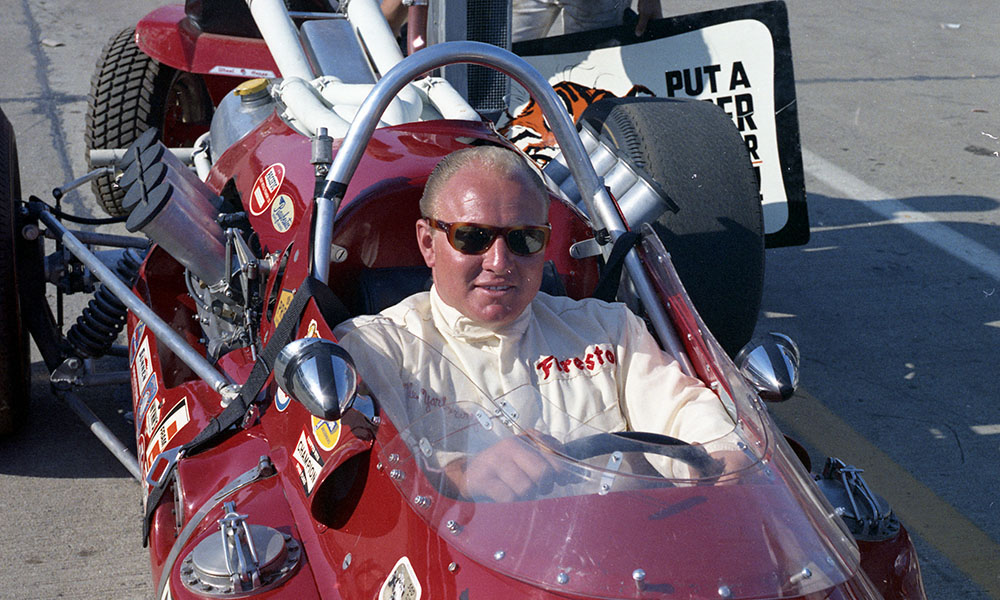
Yarborough's open-wheel journey started at Indy in 1966. He made four Indy starts between 1966 and 1972, achieving a best result of 10th in his final appearance. He also ran the entire 1971 season, picking up fifth places at Trenton and Michigan. Photo via IMS
Q: People think that IndyCar was slow to jump on a program to showcase the drivers and events on the schedule, but it’s not true. Back in 2013, "IndyCar 36" was on the NBC Sports network and is still available on YouTube. Drivers were followed for 36 hours on a race weekend throughout the season. I remember an episode where Josef Newgarden was followed during the Indianapolis 500 weekend when he drove for Sarah Fisher. He and some friends went to a coffee shop and met up with a bridal party in Broad Ripple, I believe. Simona de Silvestro was followed at the Brazil race in that time period.
Mike
MP: Watched all of them and they were well done. But I wouldn’t rush to hail IndyCar as a leader in this type of content; the concept of doing special features to promote a series has been around for decades.
Q: OK, so we have the Grand Prix of Toronto. Rush is from Toronto and is in the Rock and Roll Hall of Fame. We don't have a Grand Prix of Winnipeg and the Guess Who, nor BTO are in the Rock and Roll Hall of Fame despite their significant contribution to the genre. The Guess Who sold more records than the Beatles in 1970. Rush clearly deserved their induction, but I don't understand why the Guess Who nor Randy Bachman's next band, BTO, have not been added to the HOF. Do we need a Grand Prix of Winnipeg to get this oversight resolved?
John
MP: We most definitely need a IndyCar GP of Winnipeg. We also need back-to-back events in Ontario so the Toronto GP is followed by the next-door Mississauga GP to honor the oft-forgotten Canadian band Triumph.
Q: Can you offer an opinion as to why Beth Paretta has been unable to get her IndyCar program off the ground? I thought Roger Penske and Bud Denker were enthusiastic about helping. At the 2021 500 that team generated more publicity than probably anyone besides Helio. And the fans love Simona.
I also don’t understand why the most recent rumors about Paretta Autosport included the rather slow Tatiana Calderon. What happened to Simona? Nothing against Tatiana, but Sim is a proven IndyCar driver with several top-five finishes, mostly with sub-par teams. Someone asked you this a few months ago and you said Simona hasn’t been here trying to promote herself, but I don’t see any reason why she would need to. She and Beth have phones, and I’m sure Simona would travel here if it was necessary. She is currently training to race bobsleds, but that is just her winter activity.
Patrick, Brownsburg, IN
MP: The willingness to help from Team Penske by fielding/supplying a large portion of the team in 2021 was not offered after 2021. After that, the quality vs cost to partner with other teams, from what I’ve heard, didn’t make sense. I know a lot of companies have a strong affinity for Beth, and she’s great at finding sponsors. But Beth isn’t the "doing it just to do it" type. If she doesn’t see a quality Indy 500 finish in the realm of possibilities, she’s not going to give a program the green lights.
Are we actually judging Tatiana, an IndyCar rookie, on barely a half season spent with one of the worst teams in the series who joined so late that she didn’t get to do proper pre-season testing? C’mon, man.
Sure, everybody I know has a phone. But if Tatiana is actively trying to create IndyCar opportunities for herself and Simona is not, team owners don’t take notice? The last time Simona was here on a regular basis was 2015, which is a lifetime ago. A handful of mostly unremarkable results with ECR in 2022 did nothing to create interest. And while some of those less than memorable ECR runs had nothing to do with her, it doesn’t change the fact that a former full-time driver returned and did not stand out.
I’ve been one of her biggest fans since her Atlantic Championship days and would love to have her back, but I’m not going to crap on Calderon because she’s putting in the effort to create new opportunities for herself.
Q: It always amazes me why both IndyCar and F1 won’t take ideas from each to make their own series better.
Let's take a look at why F1 won’t use the alternative start/finish line for qualifying. It’s stupid on so many levels. No. 1, it will save tires – now you’re only running two laps vs three on a quali run, and you can use those tires for a second quali. No. 2, it changes how qualifying is staged -- they can make three runs instead of two in the allotted time, which makes it better racing for the mid pack teams and it will save tires over the course of the entire weekend, something F1 has been pushing for.
Having said that, why won’t IndyCar adopt the DRS and get rid of the Push to Pass on the street and road courses? DRS makes for more exciting racing and can keep the pack closer together. If you can get close enough to the guy in front of you, bingo, and increased passing is something we all want to see. And, it keeps those dreaded words out of racing: "fuel mileage race."
Joe, California
MP: I’ve hated DRS from the moment it was introduced. Once thing I’ve never seen is DRS helping to keep F1 cars packed closely together, so I’m not sure why it would do that in IndyCar. Push-to-Pass, as it’s been used, has avoided the cartoonish passing DRS usually creates, and doesn’t necessarily equate to an automatic pass. I’ll take that over DRS.
F1 has had some of the worst racing I can recall in recent years, so I’d hope IndyCar would adopt nothing from F1’s on-track rules and jeopardize diminishing its mostly great racing. If IndyCar is looking to steal ideas from F1, it should borrow from its marketing and digital strategies, its presentation of its drivers with standardized victory lanes with video boards and the like (barring the Indy 500, of course) and make a much bigger effort to make its drivers, teams, and itself look important.
CHRIS MEDLAND: We’ve had this one a few times and I’ll admit you make a compelling argument, Joe, and I don’t have a firm answer as to why it’s not adopted in F1 other than the fact that it would take resource to invest in changes to timing beams and circuit configurations to make sure you had a reliable alternate line. I don’t believe it would be hugely costly, but it’s also far from F1’s biggest issue -- the way drivers act on out-laps is the major headache, and that doesn’t get resolved by a switch to a different start/finish line.
It does make a lot of sense, but I think it’s best if it’s implemented on all tracks for ease of following for fans, and that’s why it would need a bit of lead time. I couldn’t get a rapid response out of the FIA this week given the sporting director changes going on, but I will try and confirm that it’s something that’s been looked at and find out if there’s any specific reason against that I’m not thinking of.
Q: Should we be taking recent comments from Zak Brown and Gunther Steiner disparaging the common ownership of Red Bull and the team formerly known as Toro Rosso and Alpha Tauri at face value? That they don’t like the combination from a competitive standpoint? Or are there tea leaves we should be taking a closer look at?
Namely, in beating up on Red Bull and its junior team in the press, are these team principals trying to build a compromise that would see Red Bull divest the team to someone like Andretti Global and thereby putting the 11th team issue to sleep, at least for a while?
Or would they be just as happy if Red Bull sold the junior team to anyone else? Perhaps Honda?
KC Moose
CM: No, I think there’s just a bit of posturing going on ahead of the new Concorde Agreement on two fronts -- one from McLaren is partly trying to ensure Red Bull can’t get an advantage from owning two teams, and then from Haas the same but at a different rival team in the form AlphaTauri.
From what I hear, it’s a topic that actually has been quietened over the winter because of the number of partnerships within F1 that already exist (given the two teams involved, think McLaren and Mercedes or Haas and Ferrari) and Red Bull could ask similar questions, but they’re comments from rivals that are to help themselves competitively rather than aiming for any sort of Andretti compromise. You’re right that any sale wouldn’t be a bad byproduct for them either, as keeping it at 10 teams will increase their value, but I don’t believe it’s targeted at any specific outcome.
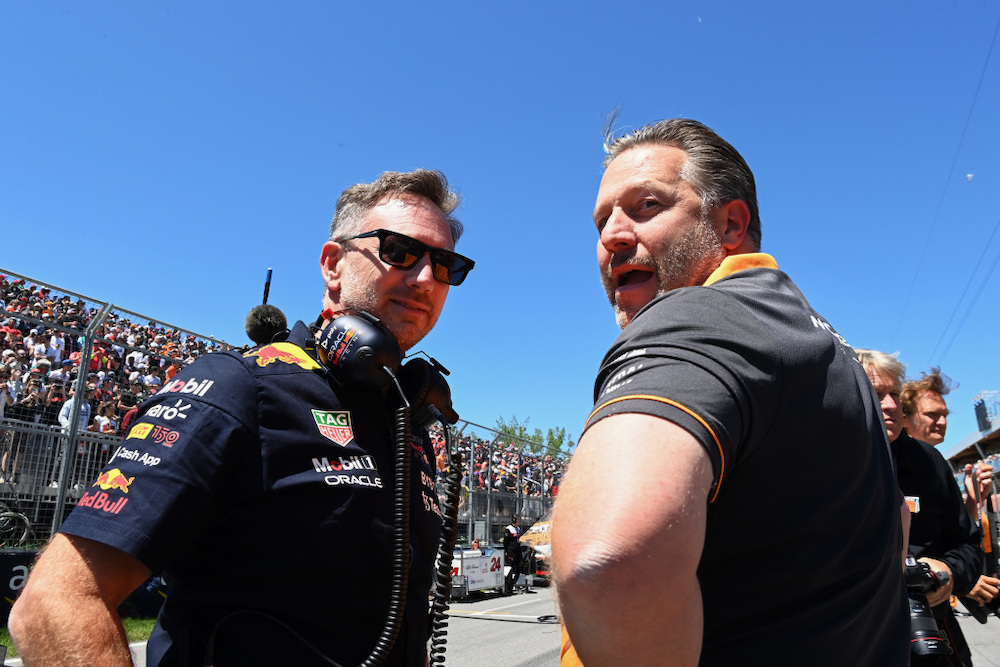
Posturing? In F1? How dare you? Mark Sutton/Motorsport Images
Q: I submitted an email previously suggesting American companies currently sponsoring F1 teams offer scholarships to promising American drivers in the Road to Indy series to go to Europe to race. The goal would be to develop the next American F1 driver. Marshall didn’t think much of the idea and questioned why a Road to Indy driver would want to go to Europe. If they wanted to race in F1 they should just go to Europe.
The problem, as I see it, is twofold. The U.S. feeder system just doesn’t offer enough Super License points to qualify, so drivers must go to Europe to race; and the lack of financial support for Americans to go to Europe. There appears to be little interest in having Americans in the F1 feeder series (Regional F3, F3, F2, etc.)
Let me ask the question a different way,
Does F1 want American drivers? Do the American sponsors want American drivers? If they do, what can they do to make this happen? Right now, the Red Bull junior driver program is the only path I’m aware of for a promising American driver to get to F1. For what Oracle is supposedly paying the Red Bull F1 race team they could pay for the entire F3 grid at Silverstone.
I also must believe that there are a lot of Americans that would jump at an opportunity to go to Europe to race.
I was hoping Chris could respond to my question.
Scott, Miami
CM: Yes they do, but not at any cost. In a perfect world, F1 wants high-quality drivers that hit as many of the biggest markets as possible, and we’ve heard many times how American sponsors and fans want to get behind winning drivers. The F4/F3/F2 ladder has been designed to prepare drivers for F1, so I agree that it wouldn’t be ideal to prep a driver on the Road to Indy ladder and then move them across.
In an ideal scenario, the Road to Indy program and F4/F3/F2 in Europe need to be a bit more similar. We see plenty of F2 drivers making encouraging switches to IndyCar, but not the other direction because it doesn’t prepare them for F1. I don’t believe it’s solely money that’s the issue, though (as expensive as F3 and F2 are), as there are far more avenues than just the Red Bull pathway -- look at Williams bringing Logan Sargeant through, while Mercedes, Ferrari, McLaren, Aston Martin, Alpine and Sauber all have driver development programs too.
The issue there is they tend to pick up talent out of karting or in the initial junior categories, so an American would either already have had to make the switch to Europe to have shone in single-seaters, or be so good in karts as well as having a family that is willing to let them move at such a young age.
And the Super License system is a regular roadblock as you mention, too. Far more points are on offer in Europe, making drivers racing in those categories realistic targets for F1 driver development programs. Even highly talented drivers in IndyCar struggle to score the points needed given the weighting, which all limits their chances of reaching F1 if they haven’t started in Europe in the first place. So that would be the most simple change that would open doors in my opinion.
Q: Should teams have the option to retire racing numbers based on a driver’s achievements? (So, for example, Hendrick could retire No. 24 in honor of Jeff Gordon, while other teams would still be allowed to use that number.) I acknowledge the differences in car number systems between IndyCar, NASCAR and F1, which might make this harder to implement. But it seems odd to see cars like the 24 and 48 without Jeff Gordon and Jimmie Johnson. Retiring numbers could better reflect a driver’s impact on the sport, vs a Hall of Fame induction which, as a fan, I’m indifferent to.
Andrew
MP: In theory, there’s nothing stopping teams in any series from holding their own number "retirement ceremonies" with the driver that number is associated with. And as you point out, a new Cup fan might only know Alex Bowman is the driver of the No. 48 and have no connection to Jimmie representing that number.
For me, the number part has limited significance. It’s the driver and their achievements that gets remembered first, which is why Halls of Fame is where they belong. Two of my all-time favorite drivers were Gilles Villeneuve, who used the No. 27 and died in 1982, and Ayrton Senna, who also used the No. 27 and died in 1994.
Those weren’t the only numbers they had in F1, but those are the ones I most heavily associate with them. Senna’s first championship was with the No. 12, which is another number that’s attached to him. His final title was earned with the No. 1 on his car. Do we retire all three? I have no clue, which is why I prefer the HoF route, because the car number played no role in what they achieved or how they achieved it.
CM: As you hint at, in F1 it has only really become an issue in recent seasons since we introduced specific driver numbers -- prior to 2014 your number was allocated to you each year based on the team’s performance in the previous season, so you rarely had continuity to build up an affinity with a number.
No driver can use the same number as another for two consecutive seasons after the original driver’s final race, so there’s a natural pause in its usage anyway, and as it stands I don’t think many drivers would take an iconic number to use as their own as there are still plenty of options available. Moving forward, though, I think your idea is a good one -- either to retire certain numbers for good, ideally due to performances and legacy but also depending on circumstances (as happened with Jules Bianchi’s No. 17 after his death).
I’m not sure teams themselves can realistically do it in F1 as they don’t decide what a driver picks, but they could always suggest they wouldn’t run a certain number on their car again to try and dissuade anyone from choosing to pick it up when they join the grid.
KELLY CRANDALL: Whenever the topic of retiring car numbers in NASCAR comes up, the first thing to realize is that once that happens the sport is going to quickly run out of numbers. You mentioned two with the No. 24 and the No. 48. But there are going to be those who want the No. 43 retired, and the No. 3. What about the No. 21 for the Wood Brothers? It goes on and on. The idea of retiring them within the team is certainly an option, but what would be the point if someone else can still drive it? As you said, it’s weird to see the number without the driver that is connected to it behind the wheel, so does that really solve anything or make it seem important as you’re hoping? Personally, I can’t think of an ideal way to do it.
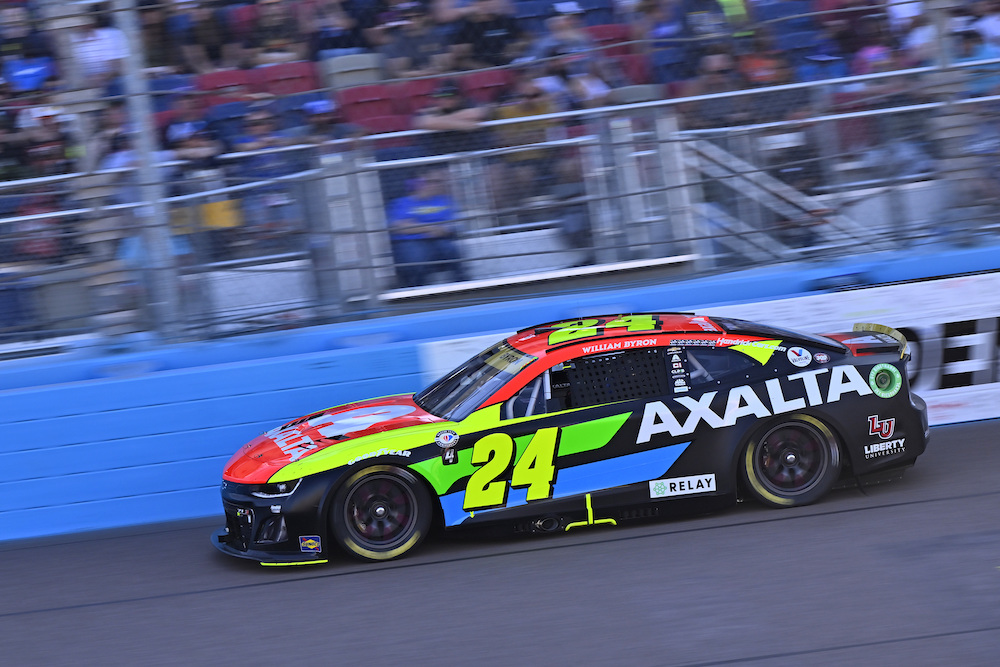
There are issues of practicality when it comes to the question of retiring car numbers, but the current policy of keeping them active allows those numbers with storied histories to add to their legacies with future generations of drivers. Rusty Jarrett/Motorsport Images
Q: Is whoever puts the photos on the Mailbag page OK? I suppose it's still Mark but I think "drivers battling monks" has to have been a subtle plea for help from whoever it was.
All the best for 2024 to all and all readers
Dave, Jersey (the original one near France, not NJ)
MARK GLENDENNING: Ha, thanks for your concern. I’m fine, although there was certainly an element of self-preservation to the photos over the last few weeks when the alternative was a month of 10-plus page Mailbags filled with photos of Jay Frye and Mark Miles looking serious. I don’t think we even have enough photos that would fit that category. Then there’s the problem of coming up with that many different captions about the same thing. So that leaves us with Plan B, which is throwing random keywords into the search box, seeing what comes up and then going to town.
With regard to the drivers fighting monks though, when you consider that was actually a thing that a PR person once made happen (during a European Le Mans Series visit to Nottingham Castle in 2001), maybe it was a cry for help from them?
THE FINAL WORD
From Robin Miller's Mailbag, January 16, 2016
Q: My fan friends and I are always looking for something to chat about during the off-season, either current news or old memories. Some great memories came up the other day surrounding Carl Haas and his great racing accomplishments (I bought my first FF Lola T202 from his sales guy, Pete Ledwith in 1971, but that’s another story). So now that Newman/Haas is just a fond memory, how is Carl doing? Any updates on his health or what he’s been doing? [ED's note: Haas died six months after this letter was first published]
How ’bout some of your memories and stories about him? I really miss watching him on the grid, touching each part of his cars. It was truly a spiritual and almost religious ritual at every event, and we could use more guys like him today. The Captain is close but no cigar, if you know what I mean.
Mike McFarland, Elkhart Lake, WI
ROBIN MILLER: All I’ve heard is that Carl is a prisoner of Alzheimer’s and seldom leaves his house, but still enjoys good food. He was a racer to the core and made such an eclectic team with Paul, but they treated their team and drivers with first-class care and brought a lot to IndyCar racing for three decades so it always bothered me they never won the Indy 500.
I guess my favorite story is when I bought my first race car from Andy Granatelli. It was a McNamara Formula Ford with no spares, so after I crashed it at Watkins Glen, I had to replace the Koni shocks and was told to call Carl Haas. Well hell, as mechanically challenged as I was, I had no idea Haas owned an automotive parts clearing house so I just figured it was good ’ol Carl himself. So I called him in his office, introduced myself and asked how much for two Koni shocks? He screamed: “How the hell should I know? Call the parts department.”

Marshall Pruett
The 2026 season marks Marshall Pruett's 40th year working in the sport. In his role today for RACER, Pruett covers open-wheel and sports car racing as a writer, reporter, photographer, and filmmaker. In his previous career, he served as a mechanic, engineer, and team manager in a variety of series, including IndyCar, IMSA, and World Challenge.
Read Marshall Pruett's articles
Latest News
Comments
Comments are disabled until you accept Social Networking Cookies. Update cookie preferences
If the dialog doesn't appear, ad-blockers are often the cause; try disabling yours or see our Social Features Support.