
The RACER Mailbag, December 20
Welcome to the RACER Mailbag. Questions for any of RACER’s writers can be sent to mailbag@racer.com. We can’t guarantee that every letter will be published, but we’ll answer as many as we can. Published questions may be edited for length and clarity.
ED's NOTE: This week's Mailbag was long. Like, reeeeeally long. So out of respect for the need for our readers to actually have time to spend with their families as we head into the holiday season, we've split the Mailbag in two, and will run the second part on the usual day next week. Questions that were sent after this week's Mailbag closed will not appear next week, but will instead run in the January 3 edition.
Q: I am a long-time fan of IndyCar and believe it offers some of the best racing in-person or on TV of any on the planet. I wish the series would get some good headlines for once.
When I saw the article about Honda threatening to pull out after 2026, I recall the TV commercial they produced the summer before last that featured a driver view of a Honda in nearly every motor racing series imaginable except IndyCar, and this came on the heels of Ericsson winning the Indy 500 in a Honda-powered car.
I would think with the new hybrid engine coming on, that would be right up an OEM like Honda's alley from an R&D standpoint. (My wife loves her Honda CR-V Hybrid, by the way.)
Between the race sim fiasco, the non-points club race, no Texas race, a six-month off-season, and now Honda, IndyCar could use a really strong headline for a change. Brad Pitt is doing that F1 movie and I look forward to that Ferrari film that's coming out. Both will generate some robust public interest in the sport.
IndyCar could use a lift like that to perhaps boost Honda's spirits. Your thoughts?
Dennis Jones
MARSHALL PRUETT: I agree wholeheartedly, Dennis. I’m a glass-half-full guy. I wake up every day wanting to write positive things about IndyCar, and IMSA, and hope that both series become America’s favorite racing series. But that doesn’t mean I shirk my responsibilities when there are problems to chronicle.
One of the great gifts of my life is having been born at a time when IndyCar was the clear No. 1 racing series and also, as IMSA rose to prominence in the 1980s with GTP, to see IMSA rival IndyCar for that top spot.
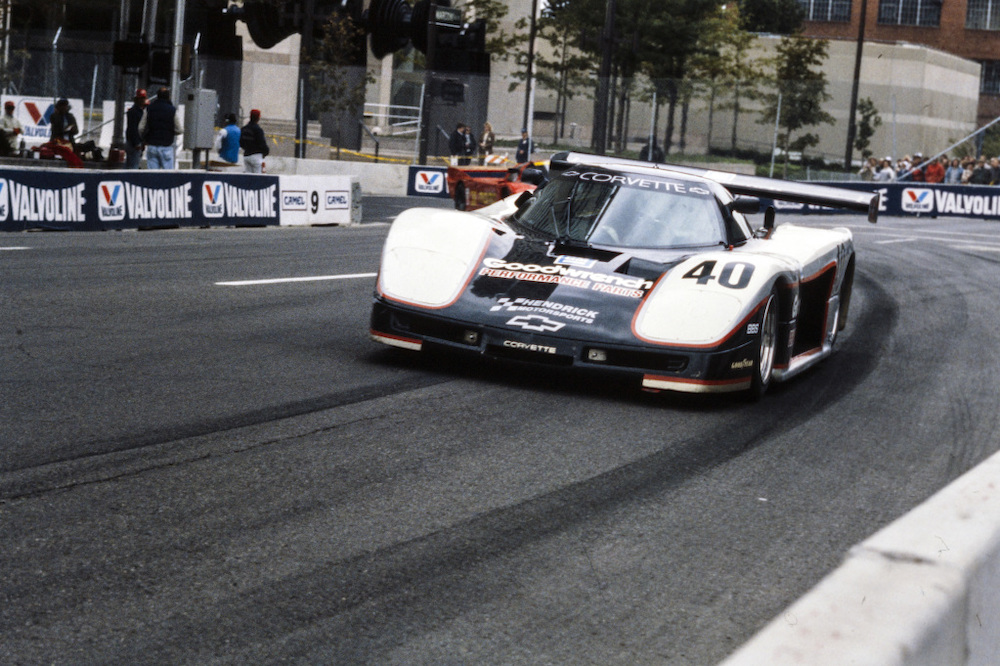
IMSA claimed a big chunk of the American motorsports spotlight with its original GTP era in the 1980s, and is riding a wave with the modern version too. William Murenbeeld/Motorsport Images
So with that context in mind, it’s easy for those of us who were around back then -- and I was fortunate to work on IndyCar and IMSA teams during their peaks -- to know what we had then, compare it to what we have now, and want both series to rediscover some of their former glory.
It would be silly for me to think that both will ascend to the same peaks they once stood upon. But it’s not impossible for IndyCar, since that’s the main series you’re commenting on, to become so much more than it is today in its home country.
And for the sake of clarity, and as much as I would genuinely love to have the old CART 2.65L turbo V8 formula back in action, I don’t want IndyCar to become a tribute act and mimic what it once did as CART or Champ Car. I want it to succeed as what it is today, with safer cars and with newer technology and all of the advancements that time and ingenuity have brought us through the excellent folks at Dallara, Team Chevy/Ilmor, Honda/HPD, Firestone, and the operations team led by Jay Frye.
So yes, IndyCar has taken a lot of Ls (that’s losses) in the last 12 months with the myriad items you’ve mentioned and others that weren’t. Being a late adopter of hybridization was always going to limit its impact in the racing world; F1’s been there for more than a decade and IMSA went hybrid last season, so while it was needed to keep Chevy and Honda on the island, there’s no reasonable expectation for IndyCar to undergo a large swing in popularity because its cars will be hybridized at some point in 2024. If anyone believes IndyCar is going to get bumps in attendance and ratings because energy recovery systems are installed, please seek therapy. But the rest of what it has to offer is solid. Old, but solid.
We’re blessed with great racing and drivers and teams who are mostly phenomenal. That’s a huge and ongoing W (that’s a win). And yet, in the market where it competes, it takes constant Ls against NASCAR and F1. And IMSA’s gaining ground.
That’s obviously not something I want or anyone is the least bit happy about. Finding ways to kill IndyCar’s status as America’s best-kept sporting secret is the thing we’re patiently waiting for Penske Entertainment to address. And maybe it has grand ideas on how to achieve that and the executive leadership team just hasn’t told us. And maybe they haven’t, and that’s why they avoid the topic like the plague.
From my end, I know of nothing that’s on the horizon that classifies as a game-changer, but as I said at the beginning, I do genuinely wake up each day with hope for the people who own the series to conceive and implement ideas that move the proverbial needle. And not by a little bit, but by a lot.
Q: How much of the value proposition that Honda refers to is the need to supply half the IndyCar field vs the overall viewership of the series? I see IMSA as more viable, because an OEM can step in and support two-three cars, whereas the IndyCar ask would be to start with 10-12. Am I missing something, or is the need really to get to 4+ OEMs so the ask is to support six-eight entries?
Alternatively, what cost savings would come from a spec engine and OEM differentiation coming from ECUs?
Dan, Brownsburg, IN
MP: The IMSA dollars are high as well, but this all comes back to perceived return on investment. For what Acura/Honda spends in IMSA, there’s a strong feeling of great ROI being delivered. At the price point to be in IndyCar -- whatever that number is -- there’s a feeling that the return is far too small.
I tend to think of ROI in terms of inflation. According to Honda, IndyCar’s inflation is off the charts while IMSA’s is manageable.
So as you said, if Honda had fewer cars to support in IndyCar -- say, a third or a quarter of the grid -- the ROI would be perfect.
Going to a spec motor means there’s a significant one-time development cost, just like the energy recovery systems, but after the product has been locked down on technology and mass-produced, the annual costs are limited to rebuilds and support technicians. As it is, each engine supplier spends gobs of money every year to improve their respective engines, and if that annual cost almost entirely went away, they’d have the yearly leases to pay for and, in theory, have a ton of extra money -- still well below what they spent today -- to put into marketing and promoting IndyCar.
Due to today’s high costs to compete, those marketing and promotion budgets have been slashed to the smallest number I’ve seen since the Indy Racing League was a thing. IndyCar’s greatest problem is that not enough people know it exists. More fans and better TV ratings solves a lot, and it’s hard to make serious inroads on this age-old problem if there’s almost no money left over for the manufacturers to help present IndyCar to a wider audience.
There were many reasons for CART’s huge popularity at its zenith in the 1990s, and among the larger contributing factors was the massive marketing investments made each year by its three, four, or five auto manufacturers who supplied engines and spent crazily to promote their involvement in the series through TV and print advertising campaigns, purchasing large volumes of tickets to give away, etc. Many of the Fortune 100 companies who were in the series as team sponsors did the same exact thing, which was a huge help.
But we can’t ignore the enormous financial might that auto makers could bring to bear in bringing IndyCar’s product to the masses through their marketing and promotional budgets if: We had three or more manufacturers in the series and, most of all, those manufacturers have proper marketing/promotions budgets to deploy. But that won’t happen as long as the costs to supply engines are so stiflingly high when two brands are left to support the entire field.
Want to make IndyCar great again? Do things that free up the dollars so car companies can make a huge difference in pointing the national spotlight on the series through TV, streaming, print, and digital campaigns.
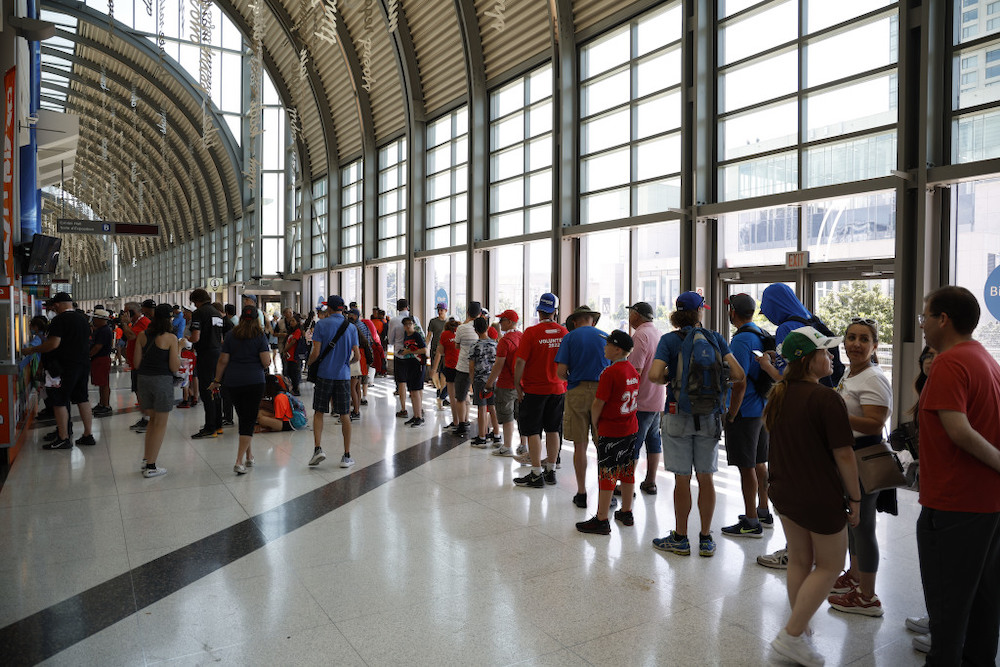
You know what's not a good ROI? Standing in line for 30 minutes to spend $20 on a cold sandwich. Which, according to the photographer who took this shot, is what's going on here. Michael Levitt/Motorsport Images
Q: Interesting to read that Honda might leave IndyCar but says it has the money to expand in F1 and possibly into NASCAR. This news follows the delay of the hybrid system (again). Obviously the lack of a third engine supplier makes the economics difficult for Honda. We all know Honda are racers -- they are in IMSA with Acura, and in MotoGP. How likely is it that they are serious?
Craig, Leland, NC
MP: Is 1,000,000,000-percent a strong enough answer?
Couple of points here: Honda’s F1 involvement is funded/built/run by the main corporation in Japan; IndyCar is funded through American Honda’s budget. Now, with a new alignment that starts this month, California’s Honda Performance Development -- the property that designs/builds Honda’s IndyCar motors, builds its IMSA GTP motors, and so on -- has been renamed Honda Racing Corporation U.S., which directly affiliates it with Honda Japan’s parent racing division, HRC.
We expect some of the HRC F1 work to, for the first time that I know of, have HRC U.S. getting involved, and that’s where the comments about possibly using HPD/HRC U.S’s future IndyCar budget for F1, or NASCAR, or wherever, has relevance.
If Honda didn’t want to stay in IndyCar, it would have said nothing, waited until whatever point it felt was appropriate, and informed the series it was leaving. But that’s not what it did. It wants to stay, but not without changes to meet its ROI needs. That’s what partners who care about the health of a series do before it’s too late. Let’s hope IndyCar calms down and acts in the smartest way possible.
Q: Mailbag letters have become a predictable tsunami of complaints about Penske Entertainment's handling of the series, lack of marketing innovation and delays in green-lighting a new chassis or attracting a third engine manufacturer.
I'm a long-time fan. I don't much care about those complaints: the cars look good, the racing is close, and the engines are loud.
What does greatly annoy me is the hugely crappy TV deal the series is stuck with. I used to watch every race avidly. Now, in Canada, I can't. Some races are shown on a major network, some on a specialty sports channel, but in recent years, I haven’t been able to see some races at all. They are carried on a provider few people get -- or have even heard of!
I don't own or run a multi-billion dollar racing and entertainment organization, but I know a dumb deal when I see it. Why did Penske sign/allow it?
A. Jenkins, Ontario, Canada
MP: Let me thank you for a non-Honda/hybrid/car question! To the best of my knowledge, it’s the strongest offer IndyCar received. I’d also keep in mind that as a U.S.-based series, IndyCar’s focus has been on signing the best U.S. broadcast deal, and yes, I know the series races in Canada, and since ABC/ESPN was dropped, the "international" TV package has been less awesome than it was under the former TV deal.
As the last TV/streaming negotiations were underway, IndyCar CEO Mark Miles told me more than once that the series was chasing hard to find a streamer to really grow IndyCar’s digital footprint. That obviously did not happen; it’s the one major expectation that fell short of what I was told they were seeking. Streaming is also the one I’m most curious to see where things end up when the new deal is done ahead of 2025.
Q: I might be just a bit biased, but I can’t help but wonder how T.E. McHale would feel about Honda considering leaving Indy Car after the 2026 season, and how much of an influence he might have been convincing them to stay?
Honda leaving would almost certainly lead to the demise of Mid-Ohio on the Indy Car schedule as well, but not sure how long the current contract is for?
Tom Maiyer Jr
MP: I had this exact conversation with a friend last week; we both loved T.E. His ways were different than Chuck Schifsky’s, but I’m sure their efforts would have been driven by the same care for their brand and for IndyCar. At the risk of overstating things, Chuck’s message -- which is Honda’s message -- comes from a place of love for the series. Tough love. Those kinds of public statements only get made when there’s a feeling that whatever was said in private has either been ignored or given a lower priority than they deserve.
Honda sponsors Mid-Ohio, Toronto, and all manner of things in the paddock. Other sponsors could be found, no doubt. But it’s a different deal when one of your five engine partners leaves, and when it’s one of two.
Q: So that article about Chevy being tight-lipped about Honda's concerns sure reads like a message from Roger himself. I've seen more than one comment from fans about Roger and Ilmor, and it seems like they aren't realizing what a serious blow to the series it would be if they lost Honda. Or am I just reading too much into it?
Ryan, West Michigan
MP: It didn’t take long to realize during the Zoom call that we were being spoken to by Penske Entertainment’s executive leaders in the pre-formulated answers crafted during the seven days from when the interview request was made to when the interview itself was conducted.
The repeated reference of being willing to speak about cost reductions and other related matters "in the proper forum" was a public message from on high at IndyCar for Honda to pipe down, but without saying so directly.
Reminded me of the old coaching trick used by Phil Jackson with the Chicago Bulls where he’d rip into Scottie Pippin, who sat next to Michael Jordan, instead of Jordan himself, when he had criticisms to offer the GOAT. The shouty words were aimed at Jordan’s No. 2, but everyone knew it was Jackson barking at his No. 1, minus the public visuals of dressing down everyone’s hero.
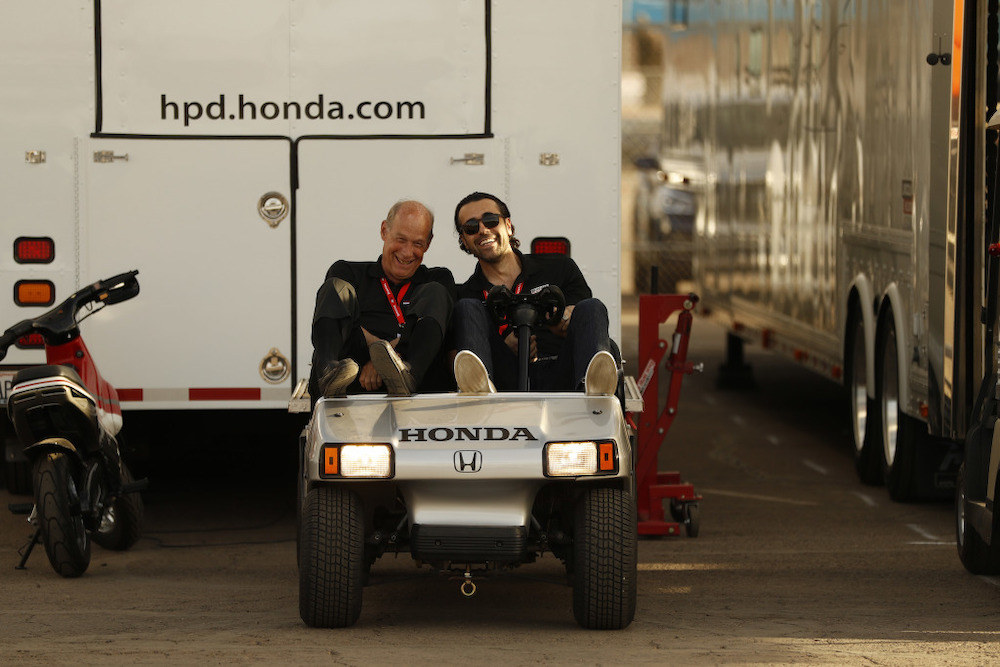
There's not a person in the paddock who doesn't miss the late T.E. McHale, who was HPD's longtime head of motorsport communications. But his job was to act in Honda's interests, and that's what he'd be doing were he here now. Well, that, and forbidding anyone from eating dessert in the Honda hospitality unit until they'd had at least one brussels sprout. Michael Levitt/Motorsport Images
Q: In light of all of the fooferaw regarding the "classic" chassis model, huge costs for engine manufacturers, and yet another delay on the hybrid, may I gently suggest that the folks at IndyCar take a look at the series they hosted so beautifully this year: IMSA!
How hard would it be for Dallara to tweak the chassis for a GTP hybrid engine? The R&D has already been done, and we know the dang thing (through multiple manufacturers) works.
So what say ye?
Whitney W, gettin' out the popcorn for the comment section
MP: Not much to tweak since the final product would be the same Dallara GTP design used by BMW and Cadillac. The IMSA ERS unit is comparatively huge and super heavy to what IndyCar came up with, and it takes up the entirety of the passenger side of the GTP tub. There’s no place to stick the big battery and related components in an open-wheel car, so it’s a non-starter unless IndyCar decides to adopt GTP regulations!
Q: Do you know who sets the pricing for IndyCar's engine lease programs and if the pricing is the same for each manufacturer? While we've covered the gamut of cost vs. value over the last week, the part I've never been able to wrap my head around is how these suppliers seem to indicate that more business for them equals more financial loss.
I totally understand sunk development costs, but when it comes to income from each individual lease it blows my mind that these crucial series partners are expected to operate at a loss. This feels very un-Penske-like from a business perspective, and seems like a crucially important detail when it comes to not only Honda's feelings about return on investment, but also the ability to deliver on increased demand for its product (Indy 500 entries... ahem...)
Lyle
MP: The manufacturers set the number; an increase was approved for 2024, I’m told. The leasing-at-a-loss was part of the new engine formula each manufacturer accepted in 2012, so the practice pre-dates Penske’s 2020 purchase of the series by a long while.
Q: First Honda is considering leaving IndyCar, now its idea to prevent that from happening is interesting: Spec engines, all built by Ilmor. For fans clamoring for a third manufacturer, would that idea be acceptable to them, or would they leave forever? If several manufacturers saw value in this, and the cost was very low, and they agreed to a certain expenditure in advertising, I think this just might work. Your thoughts?
Mike Talarico, Charlotte, NC
MP: Great question, Mike. As I see it, we have two things to ponder: Do fans -- new, old, and future -- care more about the actual engines being designed/manufactured/developed by Chevy, Honda, Toyota, Ford and Hyundai, if we were to have that dream scenario, which conform to an extremely tight and rigid formula where all the engines perform at nearly identical levels?
Or would fans -- new, old, and future -- simply love to have Chevy, Honda, Toyota, Ford and Hyundai competing against each other in IndyCar with spec engines, but with the ability to express their individual talents and technological skills in other, less costly areas?
If we were having this discussion 10 years ago, I’d say it was the first option, because the spirit of manufacturers fighting each other for our entertainment -- and their promotional benefit -- was still very much a thing in IndyCar. But I just don’t see that it matters to the same degree as it once did. I’m fortunate to interact with a lot of young and newer IndyCar fans -- most of whom are in their 20s -- and seemingly, 99 percent of what they want to talk about is the drivers and the dramas.
Which engine has better fuel economy? And how might that influence the outcome of the Indy 500? Those are conversations started by old school fans, and I’m thankful some folks still care about the engines and tech side of IndyCar. But it’s not a point of interest I see much of -- and I’m not saying there’s no interest among new fans, but it’s sparse -- as the DW12 era has gone on.
So, I’d say the latter, with having multiple brands who are in the series at a more affordable level, who have techy things they can do that matter to them, while putting big dollars into promoting the series and their participation in it, is the best idea I’ve heard in a while. I don’t love the sound of going to a spec engine, but if that’s the change that brings in manufacturers and showers the country with tune-in messaging for IndyCar, I’m in.
Q: What can be done to control costs in a car designed to house a very expensive engine?
If we assume that Honda plays hardball to bring costs down or to leave the series if it can't get what it wants, and if Chevrolet doesn't want to supply the whole field without the teams paying a lot more for its engines, what can be done to put a less expensive engine in the current chassis?
I love the sound of the current engines, but not as much as I like the competitive balance of the series. If newer, less expensive cars and engines are what it takes to keep the series going, then I am in favor of that change.
What are your thoughts?
Doug Mayer, Revelstoke, BC, Canada
MP: The series has been proactive in trimming costs wherever possible, including through the restrictive amount of on-track testing we have today. But that ignores the inevitable response by teams which, in the absence of abundant on-track running, have poured tons of dollars into off-track testing technology and hiring the high-dollar brains needed to lead simulation and R&D programs.
As teams always do, when something is taken away, they look for workarounds, and that’s been what’s happened with off-track testing. That’s the last big area IndyCar has left to try and regulate, and savings there by capping things, would save the engine manufacturers and teams a lot of money.
The other area is the one Honda suggested, which is to shed the wild annual cash burns on making their own motors. After 12 years of using and developing the same 2.2-liter V6s, there’s almost nothing left to find that hasn’t already been found and put to use as a performance, reliability, or fuel economy gain. In the offseason of 2012, there were vast gains to find since the motors were only a year old. Heading into 2024, it’s spending crazily to find the proverbial needle in a haystack.
And since the new 2.4-liter V6s were abandoned, the chance for that development quest to start anew is gone. So, do Chevy and Honda keep shoveling tens of millions of dollars each year into the 2.2-liter V6 development furnace, or does IndyCar look at ending that financial waste and go with a spec formula that keeps manufacturers in and adds new ones who can afford to play?
I never imagined I’d be in favor of the latter, but if it helps the series to grow, let’s do it.
Q: Would a common engine formula between Japan’s Super Formula series and IndyCar make sense for the OEMs and each series? Toyota and Honda are already involved in Super Formula, and the engines obviously fit in a single-seater, unlike IMSA’s GTP formula.
Joe
MP: If that’s what Chevy or Honda wanted, I’m sure they could. Historically, IndyCar has been responsive to the wants and needs of its manufacturers when it comes to engine formulas, so it’s not impossible if all involved agree on the change.
Q: I’m guessing this has already been bounced around in regard to cutting costs, but what about an approach taken by some of the European car makers, where they share the cost of a common short block?
I believe it was Peugeot, Renault, Volvo and someone else that shared the costs and development of a V6 short block, to which each manufacturer then applied its own cylinder heads and accessories.
Maybe IndyCar could do something similar, where then Honda, Chevy/Ilmor, and whomever could then just focus on cylinder heads (and maybe pistons -- as there would be an interface there.)
Hopefully that would help with costs while still giving participating manufacturers some individualism, something fans to cheer for, and keep the series from becoming a total spec series…
This, of course would still mate to the common hybrid system. Just brainstorming and always respect your thoughts, so what do you think?
Bill V., WI
MP: Fixing those PRV V6s probably covered half of the Pruett family’s income while I was growing up; my father loathed those things, but they were great for business since the heads always leaked and other maladies meant our garage had PRV-powered cars strewn throughout the parking lot in need of repair.
Maintaining individuality is usually the argument against going spec, but this idea of allowing engine suppliers to do their own cylinder heads, or maybe another area that piques their collective interest, could be a winner.
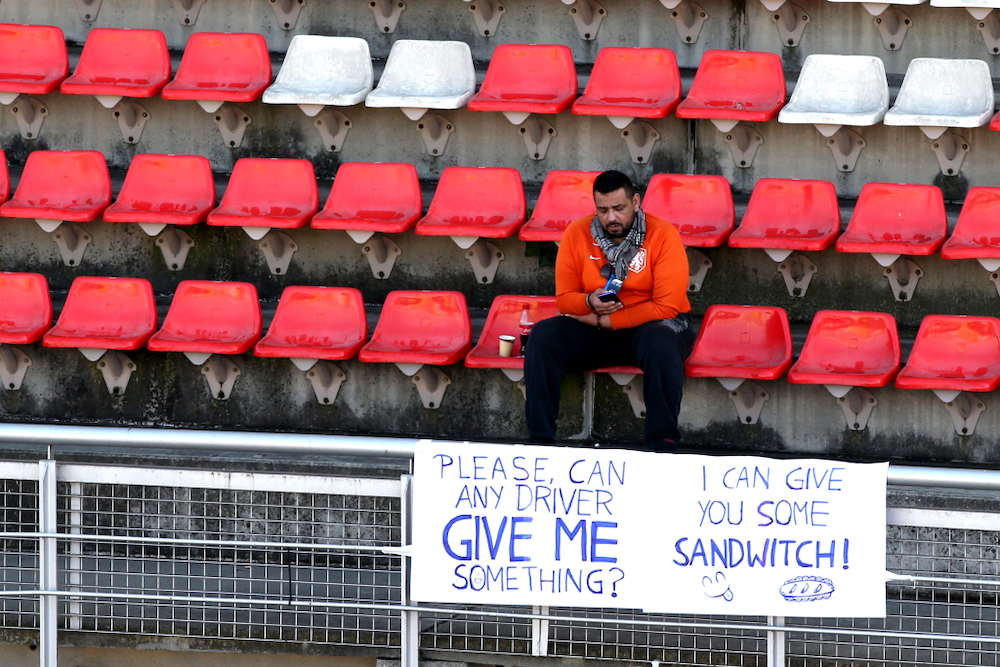
This could potentially be quite good ROI if anyone takes him up on it. Possibly not for the driver, though. Depends what's in the sandwich. Charles Coates/Motorsport Images
Q: When Roger Penske bought the IndyCar Series in 2019, I had high hopes that the series would finally go back to the late 1980s and early ’90s that made IndyCar popular. It’s 2023 and it’s just as bad when Paul Gentilozzi, the late Kevin Kalkhoven and Gerry Fosythe ran Champ Car into the ground from 2004-07. In fact, Forsythe, who’s retired and owns Cosworth engines somewhere in Michigan, must be chuckling the way Mark Miles and Jay Frye are running IndyCar Series like a sideshow.
This has been another terrible offseason for IndyCar with cancellation of the video game, the delay of the hybrid and the possibility of Honda pulling out of the series, for which I don’t blame it. At this point Penske should sell the series and the Indianapolis Motor Speedway to Liberty Media because he’s staring at 90 years old which very old to keep the series going with little progress since he took over the series.
Alistair, Springfield, MO
MP: Another RACER Mailbag Public Service Announcement: Penske Entertainment makes all major decisions and runs IndyCar, not Frye or Miles, who were the people who ran it with autonomy before it was purchased. If it’s a big decision since January 1, 2020, it’s been done by their bosses. Seriously. I’m not making this up.
We return you to your regularly schedule programming.
Q: The past few weeks have seemed like an endless stream of bad news from IndyCar. Long before all the bad news became public, I realized the health of the series was questionable the moment I watched Colton Herta and his dad run those demo laps at Laguna Seca. There, for all to see, was a 25-year-old Champ Car that was way cooler than the Frankenstein that the DW12 has become. It was embarrassing.
How did IMSA get hybridization so right and IndyCar so wrong?
Jonathan and Cleide Morris, Ventura, CA
MP: It’s an oversimplification for me to say that IMSA’s hybrid solution is a 100-percent off-the-shelf package, but it’s not too far from being accurate. Also, the GTP cars have no concerns with space limitations to house all of the Bosch and Williams ERS technology. And we can’t escape the fact that the GTP cars were designed, from scratch, to be outfitted with batteries and motor generator units and whatnot.
The opposite was true with IndyCar’s adoption of hybridization, where it chose to use its existing non-hybrid chassis instead of building it from scratch. And with no passenger area to stuff all of the components, IndyCar and its ERS partners had to find a way to package everything in the one empty space it had, which is inside the bellhousing. It’s a good thing IndyCar outlawed the use of a single turbo soon after the 2.2-liter V6 formula began, because if that was still in place, it’s home would continue being where it was from 2012-13, and that’s where the ERS units are meant to live.
Thanks to eliminating Honda’s single-turbo selection from the dawn of the current motor formula, the series has that unused space to fit the MGU and supercapacitor. If it didn’t, I don’t know how it would go hybrid.
So, by comparison, IMSA’s adoption of hybridization for 2023 in GTP was much easier than IndyCar’s aborted attempts to join them by having to fashion an all-new solution in a pre-existing car.
Q: I've been following Alexander Rossi since he arrived in IndyCar and he's now one of my favorite drivers. I understand he gets a bit of a bad reputation because of his personality (in a previous RACER story, Paul Tracy went as far as to call him “not very friendly” and seeming quite distant, to which you replied that he's simply an introvert, which makes me like him even more, being one myself. But let's focus on his driving skills, here.
The guy became the lead Andretti driver in only his second year in the business before being a title contender in the two following seasons. After that, he kind of fell down the order. Going to McLaren seems to have improved his situation a little bit, but not that much. So, what do you think has been preventing him from fighting for the title again against the likes of Palou, Dixon, Power and Newgarden? What is plaguing him since 2020? (The answer "cartoon anvils" ain't gonna cut it!) What are his weaknesses?
You once wrote that it is his consistency. But other than Iowa, Alex showed that he’s definitely still got the chops to score at least a top 10 if not a top five at pretty much all of the other tracks. Even on the ovals (other than Iowa), which some tend to point out as a potential weakness: he practically always shines at Indy, finished fourth Gateway this year and was in the lead group at Texas before the incident with Kirkwood.
I heard he's having a harder time adapting to the heavy aeroscreen (along with other drivers like Conor Daly, it seems). Could next year’s lighter one make things a bit easier for him?
I also read a few people writing that IndyCar has simply gotten much more competitive over the last couple of years. And with the arrival of folks like Herta, O’Ward, Palou, Ericsson, McLaughlin and probably Lundgaard too, Rossi simply hasn't been able to keep up the pace. I don't know how to feel about that one. For sure the overall quality of the field has improved, however one doesn’t end up in the title fight two years in a row with just dumb luck. That one doesn’t seem fair to me, don't you think?
From my standpoint, I think he's one of the very best in terms of pure speed and extracting the most out of the car he's got in his hands. Same goes for this race pace and overtaking abilities, since he always seems able to make some positions even when starting further back.
I’m thinking of two areas that could be his current weaknesses.
First, setting up the car (at least the current one). This makes sense to me because of the aeroscreen thing and because you previously mentioned in a podcast that the McLaren cars aren't the easiest thing to drive. I guess this would also be part of the reason why they got zero wins this year despite claiming two poles. So, if it is, indeed, a setup thing, it seems that not all the responsibility falls on Alex’s shoulders.
And second, fuel-saving. That one might seem ironic since this is what got him his first win at the 2016 Indy 500. However, I've seen him doing a lot of lift and coast this year, through his car's onboard camera, which had him lose several positions at Road America and Mid-Ohio -- to the point that he had to park his car right after the checkered flag because he ran out of gas.
Does this make any sense to you? Or am I completely off?
Xavier
MP: The fact that you wrote a 608-word question about Alex is incredible, Xavier. I won’t match you with a 608-word response, but will say that we’ve seen Rossi at his best during a time when he was the new kid on the block. He was a rocket with Andretti and took control of the team from Ryan Hunter-Reay, for example, at least in terms of results after placing second in 2018 and third in 2019. And it’s not like Rossi suddenly became old in 2020, but there’s a line drawn in his results after Colton Herta joined the big Andretti team that year, took control of it, and took third in the championship. He finished fifth in 2021; Rossi went ninth and 10th respectively.
Pato O’Ward also arrived with Arrow McLaren in 2020 and took fourth. In 2020, Alex Palou arrived with Coyne, and by 2021, he was a champion with Ganassi. At Ganassi in 2021 as well, Marcus Ericsson leapt forward to sixth in the championship. At Penske in 2021, Scott McLaughlin landed and by 2022, he was on fire, winning three times and jumping to fourth in the championship. There’s a lot of nuanced reasons as to why Rossi went from a top three guy to the outskirts of the top 10, but the part that he can’t control is how a new wave of talent in Herta/O’Ward/Palou/Ericsson/McLaughlin and, as of 2022/2023 with Christian Lundgaard, have displaced him in the standings.
I think he did a great job of getting comfy at Arrow McLaren last season, and had Craig Hampson as his race engineer, but that only translated into one podium and ninth in the championship. O’Ward, as the team’s undisputed leader, also went winless, but he was a point-scoring machine, capturing seven podiums and fourth in the standings, splitting McLaughlin and Indy 500 winner Josef Newgarden. And now Hampson has left the team, so I don’t know what next season will hold for him.
His replacement at Andretti, Kyle Kirkwood, was far less consistent than Rossi and finished 11th among drivers. He also won twice and is challenging Herta as the team’s top dog.
I know Arrow McLaren loves Rossi and raves about all he brings to the team with his technical feedback and professionalism and steady demeanor. It also wants to see him in victory lane before the free agent market heats up, because his two-year contract is done after 2024 and his seat is one where the team wants to have wins at the ready if O’Ward is unable to deliver at any given race. I can’t think of a driver who needs to have a big season more than Rossi for the sake of securing his future in a top-flight team.
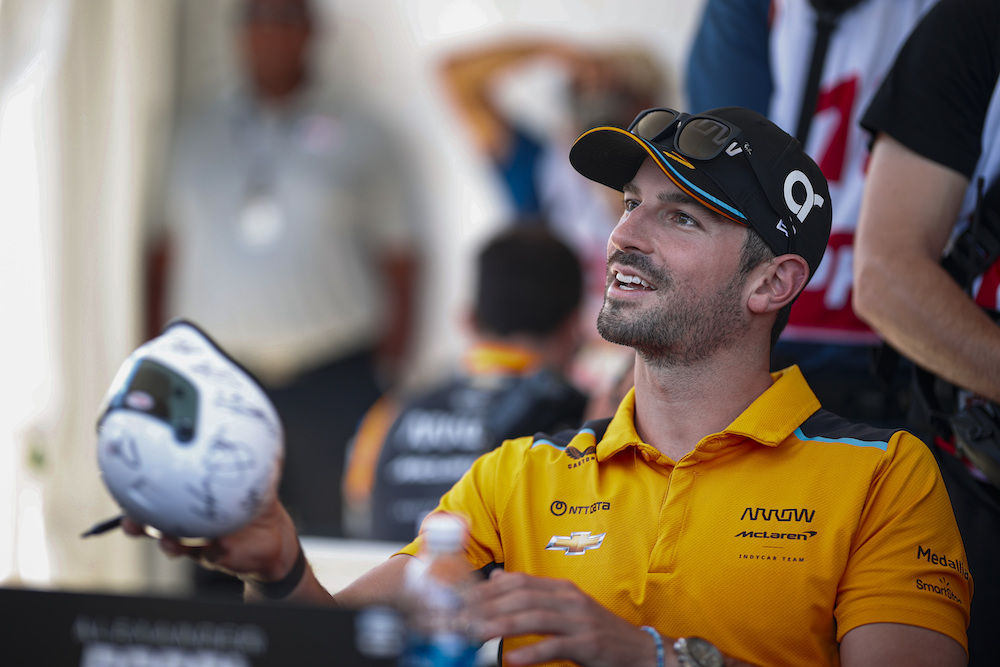
Not sure what's left to say about Rossi after all that, but here he is. Jake Galstad/Motorsport Images
Q: With Honda’s opening shot that it may end its IndyCar engine involvement and Chevy’s verbal gymnastics, it is becoming clearer that as least as Honda is concerned, the effort it is putting into IndyCar is not returning enough on investment to continue. And I don’t believe Chevy will want to stay as the only OEM. Where does that leave IndyCar, the series, and its fans?
This fan, who is well north of 60, can survive on other forms of racing – read IMSA, as IndyCar as a one-chassis and potentially a single-engine series is unappealing. In this scenario the only difference would be the drivers, and the current lot is not going to get the needed number of butts in the seats and eyeballs in front of the TVs.
I’ve followed American open-wheel racing since the 1960s -- Jim Clark, Mario and the Big Eagle were the ones that drew me in, and sadly they don’t drive anymore, and even more sad is that some of them are no longer with us. What made the racing compelling was the combination of the chassis, engine, driver and team diversity. Those combinations of elements does not exist in IndyCar today.
From where I sit, IndyCar lacks any vision and a clear path forward to survival. It has relied on its current technological base far too long, with the car owners being the major impediment that has prevented the needed changes. I always hear that the car owners do not want to spend any money to change. Change is needed, and immediately
Rules are an area I think need changing to attract additional OEMs to the series. Put these changes out there:
Chassis: Layout requirements, i.e., minimum/maximum weights, construction materials allowed, crash tolerances, wheelbase. There would be no series-only chassis supplier designated in the rules. Chassis suppliers, after a first year in the series with exclusive team agreements, would have to supply any team willing to pay for their chassis.
Engine: No specific required number of cylinders; must have some kind of hybrid or electric augmentation. Maximum displacement of three liters. Turbocharged with boast level determined by the engine supplier/teams to a maximum allowed value. Engines with less than 2.2-liter displacement would be permitted additional turbo boost.
Dampers: Sourced and distributed by the series. Teams would not be permitted to modify them or use dampeners not supplied by the series.
Tires: No series-only approved tire. Any tire can be used that meets rule sizing. If there’s more than one tire manufacturers, each must be able to supply half the fielded entries.
Schedule: Needs revamping as there are too many periods with no races. Temporary courses need to be changed with an eye towards the width of the layout. Several of the current temporary venues on the schedule are too narrow at many corners that limit or prevent overtaking which make for less-than-ideal racing.
Warbird Willie
MP: Thanks for putting all of that together, Willie.
Q: IndyCar seems all doom and gloom recently. That said, everything and everyone at IndyCar is putting on the face of "everything is fine."
Is Roger Penske blind and deaf to the reactions of fans and the media? Or does he just believe he is right, his direction is great, and it’s all going swimmingly? As Mr. Penske ages, he seems like an aging Vince McMahon, from the WWE. He’s the only one who sees the vision, he is correct, forget what the audience says, things and wants, and runs off everyone except the true die-hards. Even those die-hards feel like they get gut-punched. Both Roger and Vince seem to have hung on to too much power for too long, with only yes-men in their ear. Is Roger really a dictator who is too stubborn to see the forest from the trees? And see that the forest is on fire?
We have a chassis that’s all but a teenager and hasn’t changed bodywork since 2018, except for the safety enhancement of the aeroscreen. Our engines are stagnant; seemingly because a partially-Penske owned operation, Ilmor, can’t get the hybridization to work without the help of its rival Honda.
I’ve been a life-long IndyCar fan. Born just south of Indy in the late ’70s, IndyCar and the 500 have been lifelong passions and are really in my blood. I attended qualifications through elementary school and high school, and started going to the race itself during college in the late ’90s IRL days, and have been a ticketholder at Indy since 2001. I was elated when Penske purchase IMS and the series. But he seems to be running the series like a participant -- worried about spending money -- and not like a leader of the series that he should be. The series survived under him through COVID, I’ll give him credit for that, but nothing has changed for the positive since. Penske is a multi-billionaire. If he is the steward of the Indy 500; act like it. Make it thrive. But that requires capital expenditure, and that seems like something he’s not willing to put forth.
The state of the series had me depressed enough that I’m considering not renewing my tickets after 2024, not attending any other IndyCar races (I attend two-three every year), and just quit watching American motorsport and throwing my viewing behind F1, which breaks my heart. Should I have any reason at all for optimism of positive change? Yes, the racing is very good. But, when NASCAR changes generation of cars more often than you do, that should be telling and damning!
Jason, Batesville, IN
MP: If future F1 races are anything like they were in 2023, you’ll be back watching and attending IndyCar races in an instant!

Couldn't find any good shots of IndyCar doom and gloom. But I did find one of Guy Smith and Mario Dominguez dressed as Spice Girls in 1999. You're welcome. Michael Levitt/Motorsport Images
Q: Addressing Craig B.’s request on page 6 from last week’s Mailbag to crank up the qualifying speeds at Indy by turning up the boost, back in the 1960s they did something similar by spiking the methanol with nitromethane.
However, this brings up the issue that IndyCar can’t really get around: They need to hold down the speeds to around 230 mph, or else they cannot get liability insurance because cars start to fly in unexpected ways into grandstands. I was a bit surprised to see the Indy qualifying speeds creep up past that point in the last several years.
In addition, as we saw at the April 2001 Texas CART race, past a certain point on that track at around 231–234 mph (depending mostly on the banking but also somewhat the turn radius), the drivers started to "gray out" due to the vertical G-forces, which forced the cancelation of the race while the grandstands were still filling up -- only the second time in history a race was canceled because the cars were going too fast -- and it was because CART mismanaged the situation by not adding a Hanford Device to slow the cars down, because the engine manufacturers wouldn’t/couldn’t agree to a boost reduction.
Dan Schwartz, Atlanta, GA
MP: We’re fortunate to have a supremely skilled open-wheel chassis designer in Tino Belli on IndyCar’s payroll in the engineering offices, and in concert with the aerodynamic experts at Dallara, they came up with some smart updates to keep the cars on the ground during Speedway spins and crashes. So far, since those updates arrived, we haven’t seen anything like you’ve cited from the past.
Q: There is no doubt that recent unwelcome developments require Roger Penske's immediate attention. These developments may not have been a surprise to him -- or the IndyCar Series -- but they were to us (the fans). Will you please speak to us, Mr. Penske?
Rob, Rochester, NY
MP: It’s not lost on me that we’ve yet to have a State of the Series, or an outline of what the future might hold, by the series’ owner. NASCAR does it. IMSA does it. If IndyCar decides to do one, we’ll have you to thank, Rob.
Q: In reference to Pat from VA last week, Yamaha produced Formula 1 engines for quite a few years when they were normally aspirated and built the engine for the Taurus SHO. And don't forget Mercury, the boat engine guys, did the ZR-1 engine for the Corvette. So, getting a non-car company involved in IndyCar might not be out of the question, but I won't be holding my breath.
Tom, Waco
MP: The Polimotor from the early 1980s in IMSA was another example where a plastics company built a four-cylinder GTP Lights engine with some components made from a super hard phenolic material to promote their plastics technology.
Q: It definitely feels like the level of mainstream draw for American prototype racing is something new and special. On Black Friday, my wife and I saw stacks of Cadillac V-Series.R remote control cars displayed prominently in the middle of Target. Came back to the store later that week and they were all sold, except for a couple still on the shelf in the toy aisle. This made me realize how much room for improvement IndyCar has in the merchandise industry. Do you know of any plans for IndyCar to try to get their products in big box stores across the country? Feels like a huge missed opportunity, especially considering NASCAR and F1 are in these stores.
Pat McAssey
MP: I hear, on occasion, from acquaintances who want to do something with IndyCar that involves licensing or merchandising, and the costs to do so have been described as showstoppers. I don’t know if that’s the reason behind this, but it’s the first thing that popped into my head.
Q: I loved the photo of Karl Kempf’s telemetry computer system in the Mailbag last week.
I had the honor of working on a project in the early 1990s for him related to an artificially intelligent short interval factory scheduling when I was a young engineer and were both at Intel. I knew he had worked in F1, but I had no idea the pioneering role he played.
Do you have anything else you can share about his role or point me to other reading material about it?
[Unsigned, via email]
MARK GLENDENNING: It's a cool shot, isn't it? I found that one by accident. Through desperation to avoid running nine pages of photos about Honda and IndyCar, I started messing around with different keywords in our image agency's search box and one of them led to that.
Unfortunately I don't have much additional information about Kempf's motorsport career, other than that he worked for Goodyear before moving to Tyrrell, and also spent time at Ferrari. But I can offer you a shot of him firing up the data system on Ronnie Peterson's Tyrrell P34 during testing at Silverstone in 1977 (below). Don't know about you, but this is definitely the first photo I've ever seen of someone inserting a cassette tape into a Formula 1 car.
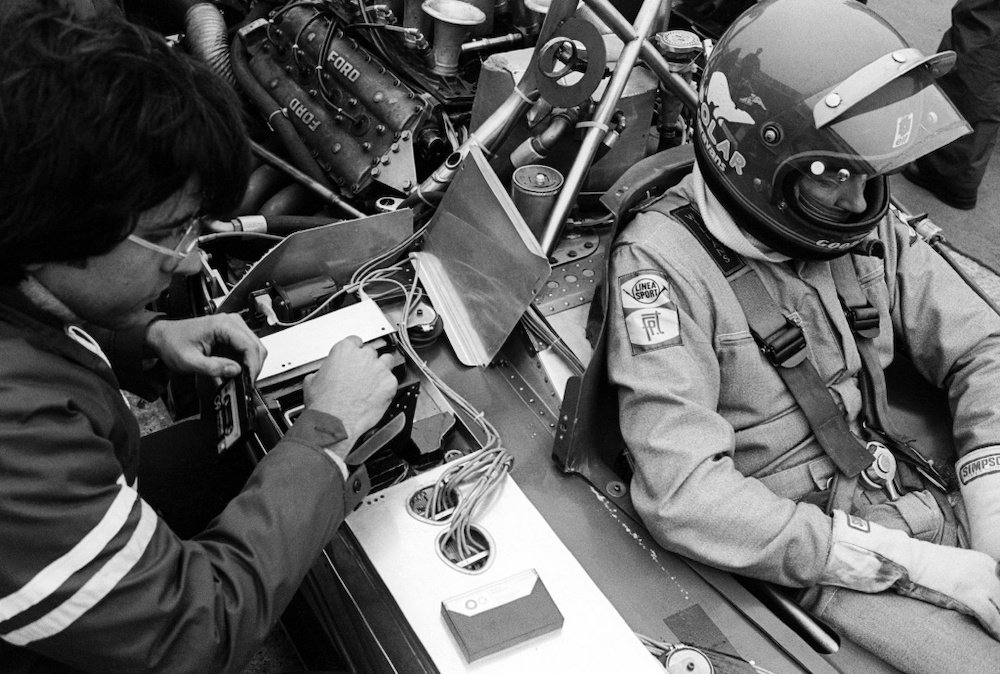
Gone are the days when data logging carried the risk of accidentally wiping your copy of "2112" by Rush. Motorsport Images
Q: I was one of those Thursday ticket holders to Free Practice 1 and 2 at the Grand Prix of Las Vegas. I worked a half-day and drove the five hours or so to my hotel that was less than a mile from the T-Mobile zone by the Sphere. I paid $268 or so after tax and resort fees for my hotel, and about $262 for my $215 ticket and tax and fees. Waited about 10-15 minutes to get into the venue due to fans being searched upon entry.
By the time I made it in, FP1 was already canceled. Not much info was given to the fans, so we were left in the cold not wondering what was going on. Confusion came sometime after 1am when it was announced that all fan areas would be closed at 1am. Some workers said that the food/drink/merchandise vendors would close but we could still watch from our seats. Then police started clearing out the stands. Other rumors were that we would be allowed back on Friday (not sure how that would happen since those seats were for Friday attendees) due to the somewhat ambiguous statement on the big screens, "We look forward to welcoming fans back later today..." The $200 voucher was just a slap in the face to someone like me who wasted all that time and money to attend Thursday.
Reginald Legaspi
CHRIS MEDLAND: I really feel for you, as I felt the situation was really badly handled at the time and said as much on Twitter/X. I’ll admit that I have a bit more understanding of the lack of an apology given the threat of a lawsuit (that came anyway) but it really did feel like there was very little actual care for the fans who had been left without anything to watch.
Even moreso in cases like yours where people stuck it out in the cold and were poorly informed about what was going on. Even in the paddock, I only found out they were closing the grandstands from a tannoy announcement that came a few minutes before the cut-off time.
I get that it was a hugely expensive undertaking to put the race on, but a straight refund to anyone with Thursday tickets should have been the absolute minimum offer, because as you highlight, there’s much more to the outlay than just the ticket. At the very least F1 might have missed out on some potential new fans who had that experience, but it could also have cost it some existing fans, too.
Q: I was watching a video of Pato O’Ward in Abu Dhabi being tested on his ability to jump out of an F1 car under 7.0s and to re-attach his wheel to an F1 car under 5.0s. The first makes sense to me, being able to get out of a car quickly after an accident, but why do drivers need to be tested on how quickly they can re-attach their wheel to the car?
Debbie
CM: The re-attachment is to allow the car to be moved as quickly as possible if needed. Without the wheel, marshals will be fully reliant on a crane or truck to come and lift the car, and they’re not always readily available in the location a car may stop, so the wheel is important. The speed, I believe, is just so that wheels conform to quick release and re-attachment regulations, and the easiest way of doing that was to instill it within the procedure.
Q: Forgive me if this has been asked before. Making a few assumptions here: 1) Andretti Global will be allowed to compete in the 2025 F1 season. 2) Their top pick for a promised American driver, Colton Herta, will not gather enough Super License points in the 2024 IndyCar season to be able to go to F1.
Who do you feel is Andretti’s most likely pick for an American driver?
A) Josef Newgarden -- 29 wins but is considered an oval expert and also would be 34 years old at the start of the 2025 season.
B) Alexander Rossi -- 8 wins, already competed in F1, but again would be 33 by start of season, also has complicated history with Andretti, though all his wins are with them.
C) Pato O’Ward -- he is North American after all :)
D) Someone I’m not thinking of?
Nick, Wendell, MA
CM: Great question, Nick, because I wouldn’t say the answer is obvious. Pato is the best fit of that selection given his more recent testing time, but obviously a deal would need to be done with McLaren. The same goes for Alexander, and obviously Josef would be hard to get from Penske. Plus, Michael Andretti has said he wants an American driver alongside an experienced F1 driver, so I get the impression they might have someone younger than Josef in mind (although he would be a very good candidate).
Now, obviously he’d need a championship-contending season, but I think Kyle Kirkwood also fits the bill for Andretti. I believe the way the Super License points will fall, his Indy Lights championship would give him 15 points but he’d need to finish top two to get to the magic 40 points, and if he did achieve that then he’d certainly put himself in the frame. Big IF, I know.
Q: Chris Medland recently wrote an article about how Logan Sargeant believes support will come from U.S. fans as he continues to develop. I can’t speak for all U.S. fans, but like Rossi before him, I don’t identify with him at all. I would be a bigger fan of Alex Palou or Pato O’Ward in F1 than of Sargeant. I don’t have any attachment to anyone from the Euro ladder series, so having him get to F1… he might as well not be from the U.S.
It might be different if he was on a stronger team. It’s hard to get excited about someone I’d only really ever heard of before he got to F1 because he’s American who isn’t in a position to compete for the podium. I wonder if Liberty understands this at all? If they want to generate patriotism for someone in the series, it’s going to come from Michael Andretti.
On to my question: When do you think we will know if Andretti gets in or not?
Ryan, West Michigan
CM: Sadly I can’t give much of an update on the Andretti front other than that it won’t be before the new year. Sounds dramatic, but obviously there’s only a few weeks left and Stefano Domenicali told me on air on SiriusXM in Abu Dhabi that there was no rush and F1 will take its time looking at all the factors involved.
It very much feels like there won’t be news in early January either, with some in the Andretti camp fearing it will be a drawn-out process until the next Concorde Agreement is in place, and that could take many months.
Q: My question is about teams and what guarantees they have that they can stay on the grid year after year, and whether IndyCar or F1 can remove a team? I'm a life-long Andretti fan and really want to see Andretti/Cadillac in Formula 1. The most frustrating part of this is hearing a team like Haas constantly ask what benefit Andretti would bring. I would ask, what benefit Haas has brought? No wins, no podiums, constant sponsorship drama, and maybe the worst driver pairing in Formula 1 history with Schumacher and Mazepin, meanwhile never once considering an IndyCar driver for their lineup.
Other than a few amusing soundbites from Guenther Steiner, what does Haas bring? If 10 teams are the limit, wouldn't F1 be better off to drop Haas from the grid and replace it with Andretti/Cadillac? Andretti is one of the most famous names in racing history, will excite the American fan base, and also bring one of the biggest car manufacturers in the world as a new engine builder. If I were in charge of Formula 1 and 10 teams was my limit, I would just replace Haas with Andretti.
Steve, Moline, IL
CM: It’s all tied in with the Concorde Agreement. Teams are granted an entry by the FIA and have to pay their entry fee to be able to race -- something that only teams the FIA has approved can do -- but nobody would realistically do that without a commercial agreement with Formula One Management (FOM). As the current agreement runs until the end of 2025, that’s all the current teams tied in until then.
In terms of guarantees, as far as I’m aware there technically are none, but it’s not as simple as not continuing with one team as all of the teams reach an agreement for the Concorde as a collective, rather than individually. Plus, it would be hugely damaging to kick out an existing team, even to replace it with a strong offering. That would then lead to a lack of confidence in FOM from any of the other teams, and would likely see the whole thing fall apart if you can’t trust that your existing entry is not secure (assuming you don’t break any terms).
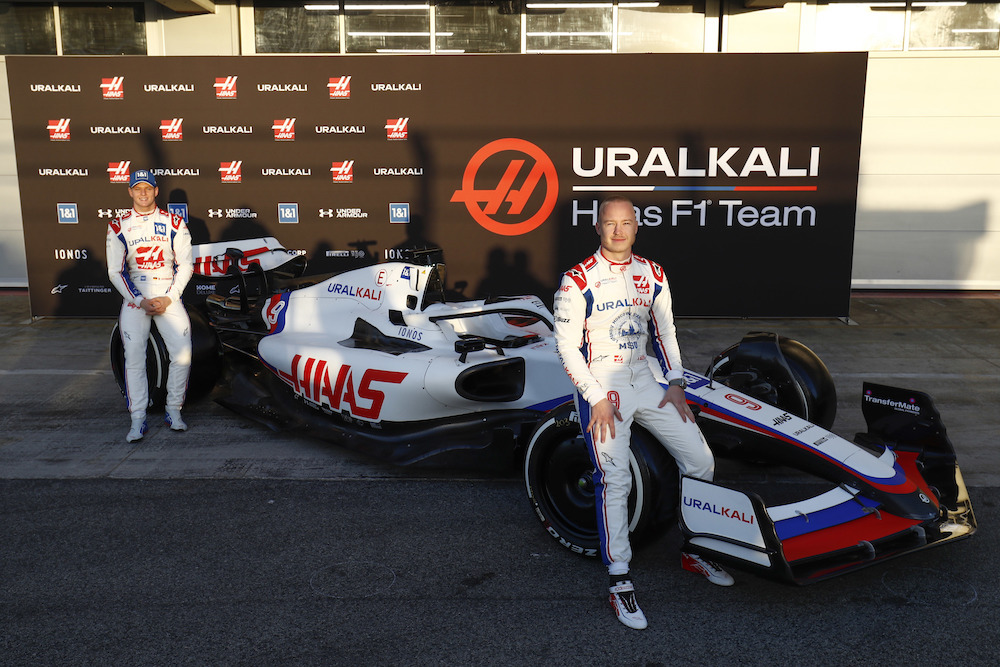
Sure, Schumacher and Mazepin didn't set the world alight, but they wouldn't even crack the top 10 of worst F1 driver pairings ever. Carl Bingham/Motorsport Images
Q: I am tired of people beating down on Logan Sargeant, saying he doesn't deserve a second year with Williams. Just as a reminder, Niki Lauda only scored two points in his first two years in F1, and was beaten 12 points to 0 in his first year at March by Ronnie Peterson, who was only in his second year in F1. Niki was even beaten by Clay Regazzoni in their first year together at Ferrari. Despite a slow start to his time in F1, he went on to win three world championships, so let’s give Sargeant a break. I am not saying he will be a world champion, but let’s see how he progresses in 2024.
Do you think drivers need time to develop or should this "one year, be a star or you are out" continue?
Mark B. Floral City, FL
CM: I’m very much with you, Mark. Not that I think Logan has set the world alight this year or shown too much to suggest he will go on and achieve great things, but as you say there are examples of other drivers who have taken time to deliver big results. And it’s not like there’s loads of testing time available these days, so drivers have to learn extremely quickly during a relentless schedule.
More notably for me, a number of extremely good drivers have struggled as soon as they’ve reached F1, and then haven’t been given the time to find their feet. Think of Stoffel Vandoorne, for example, and how good he looked in junior categories but didn’t get the right F1 environment. And in the case of someone like Sargeant, he was fast-tracked when two years in F2 might have prepared him better to succeed in his rookie F1 season.
If there is an incredible talent smashing down the door to get a chance, then I can understand making a straight choice between that and a rookie who hasn’t made a compelling argument. But without that, I definitely think more time is needed rather than just cutting a driver early.
Q: I saw George Russell's quote that his salary in his first season with Williams was only in the high five figures. That really surprised me given the top driver salaries you hear about. Is Russell's experience typical for first year drivers?
Second, over and over you hear about how much time is spent (and how important) doing simulator work is during the season. Do you know much about the simulator rigs of the various teams? Do the rigs at the factory have shaker plates, etc? Also, are there portable rigs taken to every race?
Ed Kelly, Studio City, CA
CM: I wouldn’t say typical in the sense that five figures did seem particularly low. The only wages I ever had firmly was first-year Red Bull juniors in Toro Rosso/AlphaTauri being on €250,000 per year, so around $275,000. But then I would imagine they’re on a pretty solid rookie’s salary given Red Bull’s investment and the other demands on them.
In terms of simulators, teams don’t take portable ones to races -- they’re extremely expensive bespoke pieces of equipment that are in huge facilities back at their respective headquarters. We’re talking millions of dollars for something that is a cockpit on a rig and huge wraparound screen. Getting the latency as low as possible and the cues are crucial, but so too is the software that allows as many parameter changes as possible and accurately feeds back their impact to the simulator driver.
In terms of some of the hardware, I don’t think shaker plates are used -- at least not in the contemporary sense you and I would see on a rolling road -- because there are no wheels on the simulator. I did ask a team about some details and was told they couldn’t tell me anything officially because of the secrecy around the tech, so I’ll have to admit defeat on any specifics for now!
Q: I’m 28 years old. And in my 25 years of being a NASCAR fan, I’ve only had three drivers: Jeff Gordon, Chase Elliott (by default, when he began his full-time Cup career by taking the reins of the 24 car), and anybody that drives the 24 car as long as it is a HMS number. (Right now that is William Byron).
I’ve never really had a favorite driver down in the lower levels, but that may change for 2024. Shane van Gisbergen may become the driver that I follow closely in Xfinity, as well as being someone I want to see do well in his Cup starts, especially on road courses. I think SVG will definitely be a threat on road/street courses in both Cup and Xfinity, and with him having good equipment from Kaulig, I believe he can post decent oval results once he gets comfortable in the Xfinity car.
Kevin, Arizona
KELLY CRANDALL: SVG is going to be one of the most watched drivers next season because there is so much intrigue in this transition. There is no reason to believe he would not continue to be competitive on the road/street courses in both series, and potentially compete for a win or two. In the Xfinity Series, it’s going to be a lot of fun seeing him go toe to toe with teammate AJ Allmendinger and some other really good drivers on the road courses. On the ovals, he will certainly get a little more leeway as he gets comfortable and adapts, but given how long a NASCAR season is and how talented he is, there should be some good progress as the year goes on.
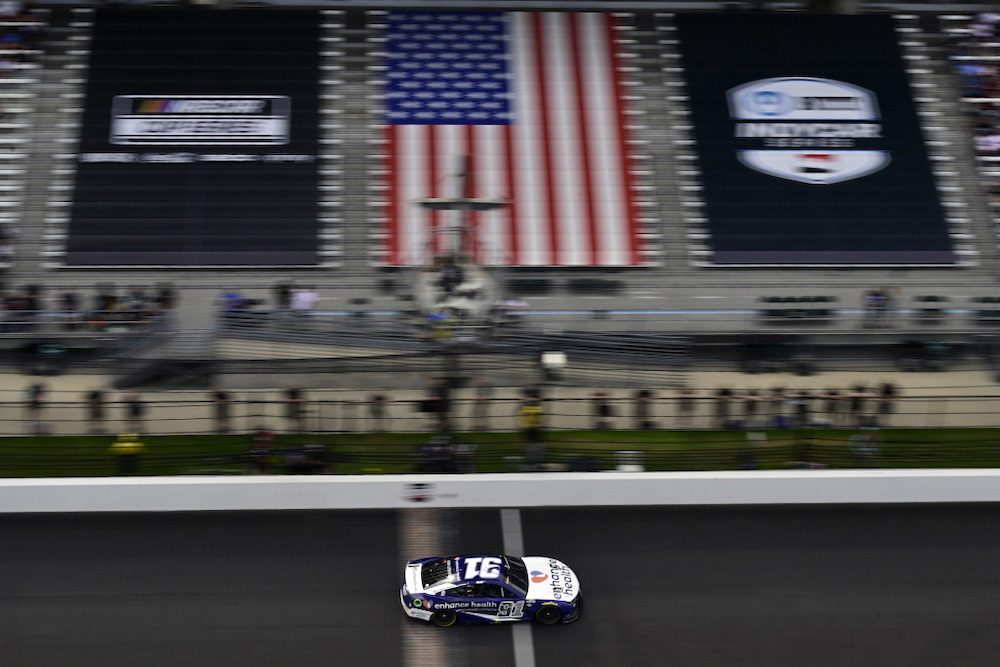
Guess it's too early to start making noise about how van Gisbergen should do the Indy/Charlotte double. Nigel Kinrade/Motorsport Images
THE FINAL WORD
From Robin Miller's Mailbag, December 23, 2015
Q: This may be a long shot, but I figured you might know. Ever have one of those questions that just stick in your craw and wonder why you can’t get the answer?
As a kid, my dad and I watched A.J. Foyt win the ’64 Indy 500, and as you know, that was the last race won in a front-engined car. In the month lead-up to the race, I remember A.J. practicing in a Joe Huffaker-designed, Offy-powered car, the 1963 Watson driven the previous year by Ebb Rose, and possibly his 1961 Floyd Trevis chassis roadster. So the question is, among the three, what made him decide to use the 1963 Watson? I guess the answer could be as simple as the Watson offered them the best combination of speed and reliability, but I have been curious. What made that car different from the 1961-winning car, assuming it was available?
Peter Lohmar, Lawrenceville, GA
ROBIN MILLER: A.J. tested the Huffaker in March at IMS and practiced in it during the first week in May of 1964 before opting for the Watson roadster. Bob Veith got in the car after A.J. stepped out and qualified 23rd. A.J. also jumped in a Ted Hallibrand rear-engine model called the Shrike and turned some practice laps later in the month. But he and Parnelli both felt more comfortable in their roadsters, which were undoubtedly lighter than the ’61 cars and also running the new low-profile tires.
That was the season Super Tex won the first seven races, tried the Lotus at Milwaukee in Race 9 only to have the gearbox fail, then captured DuQuoin and Indianapolis in his Meskowski dirt car before a DNF at Trenton in his roadster. He won Sacramento for his 10th victory and ended the year in a Hallibrand rear-engine Shrike at Phoenix. Parnelli was on the pole in his Lotus with A.J. alongside but his fabulous season ended with a DNF.
“Anne (Fornoro, his publicist) tells me I spun out at Phoenix but I don’t remember spinning one time that season,” said Foyt to RACER with a chuckle. “And, if I did spin, I’m sure it was because something broke.”
Presented by:
Marshall Pruett
The 2026 season marks Marshall Pruett's 40th year working in the sport. In his role today for RACER, Pruett covers open-wheel and sports car racing as a writer, reporter, photographer, and filmmaker. In his previous career, he served as a mechanic, engineer, and team manager in a variety of series, including IndyCar, IMSA, and World Challenge.
Read Marshall Pruett's articles
Latest News
Comments
Comments are disabled until you accept Social Networking Cookies. Update cookie preferences
If the dialog doesn't appear, ad-blockers are often the cause; try disabling yours or see our Social Features Support.