The RACER Mailbag, February 22
Welcome to the RACER Mailbag. Questions for any of RACER’s writers can be sent to mailbag@racer.com. Due to the high volume of questions received, we can’t guarantee that every letter will be published, but we’ll answer as many as we can. Published questions may be edited for length and clarity. Questions received after 3pm ET each Monday will appear the following week.
Q: What modifications, if any, did HPD and Chevy have to make to accommodate the new 100% renewable fuel from Shell for 2023?
Alan K., Raleigh, NC
MARSHALL PRUETT: Our friend Rob Buckner, an engine guru who doubles as Chevy’s IndyCar program manager, was kind enough to help:
“First off, I think it is critical to reinforce the support that both Chevrolet and our competitors have for the 100% renewable Shell fuel to power every IndyCar engine in 2023. It is the right product at the right time and builds upon the formula of E85 that was chosen at the start of the 2.2L era.
"Like most things in engineering the new fuel is ‘same as but different’ in that it is a direct replacement for the previous E85 but slightly different in composition, so it requires some attention to detail to make sure nothing is overlooked. For 2023 the manufacturers cannot adjust fuel injectors, but we are always able to change pistons and spark plugs which opens up some variability in the combustion hardware set. In addition we are always running engines on dynos for calibration refinement.”
Q: IndyCar provides great racing and little to no self-promotion. NASCAR provides very little if any compelling racing, yet excels at self-promotion. One series enjoys success within its arena while one languishes in relative obscurity. Just an observation.
John, Seville, Ohio
MP: Been sick and in bed for most of the time since I got home from Spring Training, and with a foggy head as well, so I had time to watch a lot of what took place in Daytona. I usually watch the last 30 minutes of the Daytona 500 and nothing else, so taking in all the pre-race festivities, the features they rolled out one after the other and so on, left me massively impressed.
My main takeaway was similar to yours: Wow, NASCAR really loves itself, and it shows in everything they do. Everything is so deeply infused with NASCAR history that old fans have tons to embrace while there was lots of new-era stuff presented for NASCAR’s most recent fans. And it was fun. Just love and fun and big energy. My close to the takeaway was: I wish IndyCar was more like that with how it presents itself to the world.
I know IndyCar is deathly afraid of looking old and it wants nothing more than to get younger -- it has the oldest fanbase among racing series -- so maybe all that NASCAR put out during Daytona could serve as a blueprint on how to love yourself and love your history without alienating newer fans. It felt like the perfect balance was struck. All IndyCar wants is youth, and you can feel it in everything they do. Which is sad, considering the incomparable amount of history we have to celebrate.
And then the race… Lord, I actually tried to watch the whole thing but fell asleep either due to nothing happening or the long cleanups. “These ************* just love running into each other” was a statement made more than once on Sunday.
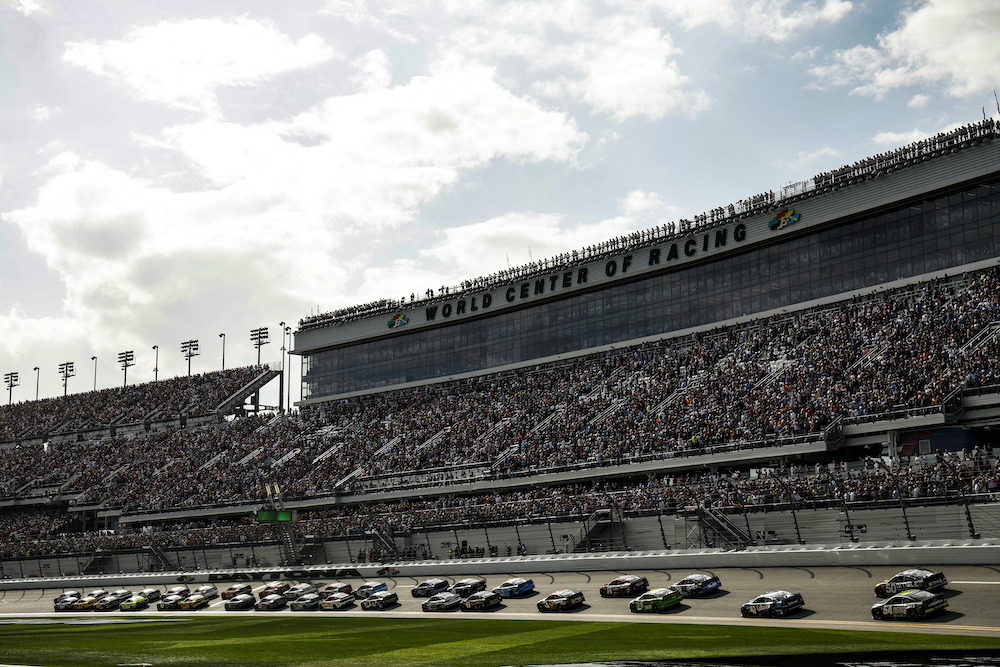
Say what you will about the racing, but our friends in Daytona have some stuff figured out. Michael Levitt/Motorsport Images
Q: I’m writing in response/addendum to the question from Rod in Fresno, CA on leaders circle payout and marketing.
On the "Off Track with Hinch and Rossi" episode from February 2, Alex mentioned that one thing he was excited to do at Media day was a “national ad campaign” for Long Beach. I guess I see it as a possibility that the money they pulled from the Leaders Circle payout could be going to a larger ad campaign. That sounds good to me. So many of us constantly complain about the lack of ads. Do you have any insights as to if the ads they were filming are similar to previous years ads, or if this will be a more widespread campaign?
As a comment, I totally get the frustration teams have with the Leaders Circle payout going down. I don't think a single one of us would be happy to hear that the company we work for is suddenly going to decrease the profit sharing that we get at the end of the year. But that's exactly what this is. Profit sharing. Should the teams have been kept more in the loop? 100%. Should there have been more clear communication on what that money will be used for? 100%. But when I also look at the overall picture and see that the car count is going up again and multiple teams are building new facilities as well as expanding to other racing series, I don't see this as some doom and gloom "IndyCar is dying" scenario.
From a business perspective, if the teams are really healthy (as most seem to be), pulling a little cash from each payout and applying it to something that should help the series grow long term looks like a great idea. Unless my math is wrong, a decrease of $150k for an estimated $6m budget to run a car for an entire season is 2.5% decrease. That doesn't seem like a huge change.
Tyler, Milwaukee, WI
MP: IndyCar is using its drivers for national TV ads on NBC to air ahead of each race as promos for those events, and from what I’m told, they’ve made a nice call to have the drivers do the full voiceovers instead of using a generic voice to handle most of the words. We, collectively, along with the drivers, continue to ask for more national promotion of our finest talents, and it sounds like Penske Entertainment and NBC Sports are making it happen.
I wouldn’t pretend to know all of the financial intricacies behind IMS and IndyCar, but as I’ve understood things -- and I think most fans know -- the Speedway is the big annual cash generator, taking in waves of money for the Indy 500 and Brickyard 400, and other events to a lesser degree.
And from those Speedway-generated profits, budgets for IndyCar get set for operations, marketing, staff, travel, safety, medical, and all the other departments within a business that tours the country and puts on live sporting events. You can also factor in the money IMS and IndyCar take in from sponsors and official partners, and whatever else comes in from television, event promotions, rights fees, licensing, and so on. And from the Speedway’s income, they’ve also set annual prize funds, spanning most recently back to the good old Indy Racing League to today’s NTT IndyCar Series.
If I’m an IndyCar team owner who didn’t take kindly to learning your 2023 Leaders Circle contract(s) are short $150,000 apiece, I’d be asking why, within the expanse of income to work with, the increase spend in marketing wasn’t simply that -- an increase in budget -- instead of being something that Penske Entertainment was unwilling to commit on its own and felt the need to take from what it gives to its LC entries. It’s the taking from 22 entries that has rankled those who are rankled. By the numbers, yes, it’s a tiny amount lost from an annual budget. This is also the only business link between the series and its teams.
It’s not like these are franchise owners who are obligated to contribute an annual percentage pack to the corporation for advertising and whatnot. It’s a paddock filled with independent business owners, Penske excluded, who find and spend their own money to compete. That single financial link -- the socialized prize money system -- brings each entry that guaranteed money, and also guarantees the series will have their participation at every event. I think of it like an appearance fee -- LC entries get the same money to show up at 17 races and IndyCar gets a guarantee it will have 20-plus car at every round, which also helps each promotor to sell tickets since all the big-name drivers will be there to put on a show.
You are 100-percent correct in saying that clipping $150,000 off each LC is not, in and of itself, a doom-and-gloom scenario. What it is, though, is the first indicator from the series’ owner that they are willing to take from the paddock, rather than dip into their own budget. It leads to fears of a cascading situation. If there’s a decision to increase the budget in another area next year, is another slice to the LC on the way?
As for funding and budgets, I count two teams that are flush with cash. The rest, to whatever degree, are still searching for money, dipping into their personal wealth, or placing their company’s name on the side of a car one or more times a year to cover a shortfall.
Q: Something simple that would help Indy make things more visually interesting would be to have each team run the same livery. Today's cars are confusing for new fans and all over the place for existing fans who are not die-hards. It makes cheering for a team harder to do, which is no good -- especially for new fans.
So many fans in F1 came in following the red cars from Ferrari. I recall Bob Varsha in 1990 (Mexico) making the comment with Senna P1 and Prost/Mansell P2/P3: "…and just in the distance are those big cars from Maranello creeping closer and closer."
Being able to cheer for a team when you don't know the drivers makes it easier for younger potential fans to enjoy the show and become future fans. From there, they find the drivers they want to cheer for and then the teams they want to cheer against.
Regards,
Not Spicoli
MR HAND: Between alternate jerseys, road colors, home colors, and whatever else might change each season, most sports fans I interact with -- myself included -- love the changes and variety that comes with each NBA or NFL season. Weird thing, though, because in racing, we have the same complaints every year about livery changes and number changes and how hard it is to keep track of it all.
I’ve never bought the argument that changing liveries makes it hard for fans to like racing or feel connected to the sport. Sponsors drive most livery decisions, so why not enjoy the variety?
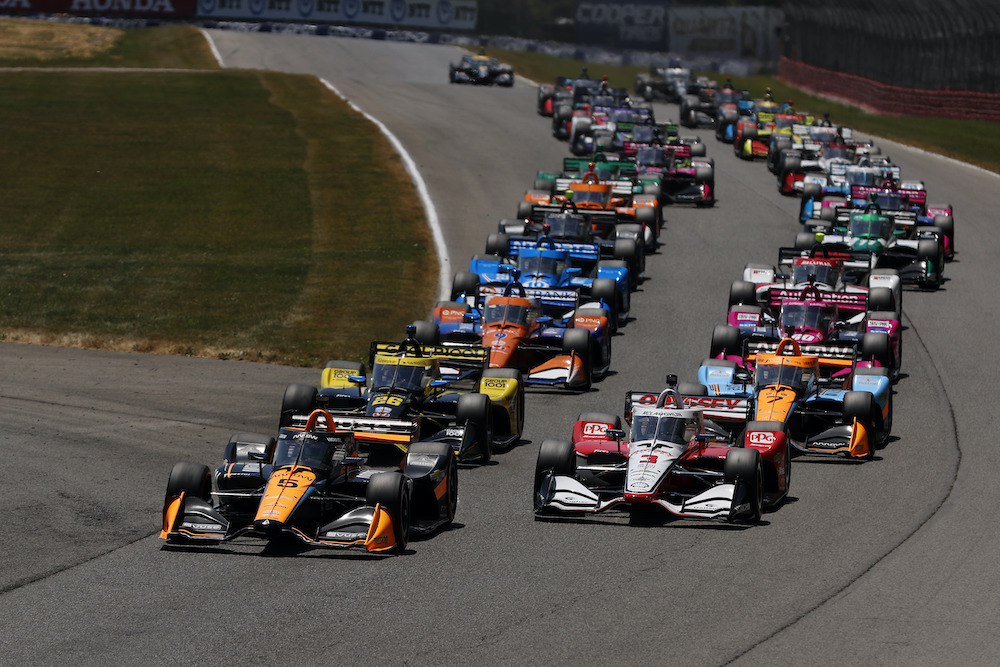
For some fans, livery lottery is part of the fun. Phillip Abbott/Motorsport Images
Q: Some may overlook the importance of being able to follow a driver in the IndyCar series, but I'd argue that with the cars being spec, fans are probably rooting for specific drivers versus the make or design of a car, more than about anywhere else. Yet, with different sponsors on the same car from week to week, following a driver is difficult for a casual fan. Why not a prominent universal name placard somewhere on the cars such as the rear wing, sidepod or nose similar to what was done in the IROC series?
This could easily be done without any real compromise for sponsor space, and besides, the sponsor in theory wants to be associated with the driver of their car anyway. (I think United Rentals would love to have RAHAL displayed prominently alongside its logo, for example).
I'd like to see a new chassis as much as anyone, but I do have to wonder what we expect it to do on its own from fan perspective. How much do open-wheel monocoques differ these days anyway? As a stopgap couldn't new bodywork be developed for the DW12? This might be retrograde, but the change from the prior batmobile bodywork to that of the current car with the same chassis was plenty dramatic. This would allow IndyCar to see what direction engine formulas move towards before investing in chassis. Not ideal and I'd rather them just replicate the old Panoz, but maybe a facelift buys some time?
George, Albuquerque
MP: A number of teams place their driver’s last names at the top of the aeroscreen, so that’s already a thing. I find it’s easiest to memorize the driver and their car number, because the numbers don’t change location, no matter what the livery might be from week to week. The No. 15 is always Graham Rahal, so among his 37 liveries for the year, I’m always looking for the car number if I get confused on colors. At the same time, it would be easy for IndyCar to mandate the use of new extensions to the roll hoop fairings on all cars that have the drivers’ names. There are solutions, if necessary.
I think the trusty old DW12 battle axe has been modified enough -- more than any known open-wheel race car during its lifespan. And you’re not going to improve upon the IR18 bodywork without going to a new tub, so I’d rather they didn’t do another nip and tuck. Having seen Sly Stallone and Madonna in recent weeks, there’s a point where enough is enough on modifying an aging vessel.
Q: If IndyCar returns to Thermal Club next year, why not try and run in conjunction with the PGA Tour event in Palm Springs, which was January 15-21 this year?
If you ran testing early in the week, you could bring over golfers, executives, etc., for two-seater rides and additional exposure for the sport. Thursday-Sunday, you could have a racer or two participating in the Pro-Am portion of the tournament.
From a coverage perspective, you could leverage the Golf Channel (an NBC property) to cross-promote during coverage of the golf tournament, and there exists the possibility of using some NBC/Golf Channel equipment to aid in streaming of the test.
I don't think this is rocket science by any means, but if IndyCar is going to return to the Thermal Club, it might as well try and maximize its exposure, even beyond this year's lack of streaming.
Bill Potter, Richmond, VA
MP: Want to be IndyCar’s new VP of Marketing, Bill?
Q: …it’s Rufus Parnell Jones. No ‘i’ at the end of Parnell. And while he was not an IndyCar driver, Lake Speed is honorable mention for best names.
Rick Gevers
MP: Oddly, he refers to himself as Parnelli and signs his name as Parnelli. I’ll let you be the one to correct him and will have an ambulance standing by.
My father’s best friend, business partner, and fellow racer Rick Sturiza (who shared driving the Lotus 23B they bought and prepped/ran) would occasionally fudge his name on the local SCCA Club Racing entry lists and write in "Rick Nifty," which was a hoot to hear mentioned over the PA system as Laguna Seca or Sears Point when I was a kid. He was tall and handsome -- fit the name -- and when asked, in over-the-top character, would tell those who asked that he was, "Rick Nifty, ace race car driver." He was a riot.
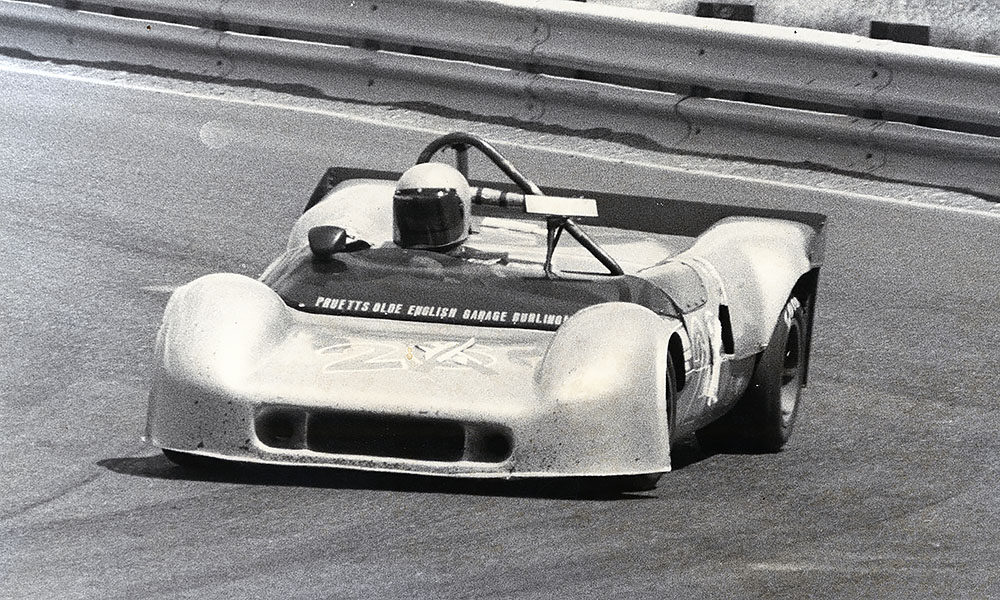
Rick Nifty, ace race car driver. MP Archive
Q: I attended the Rolex 24 At Daytona this year as a first-timer. All that was there was fantastic; fans, drivers, teams and such a clean facility.
As a new fan of IMSA, why aren't the speeds of the cars posted? I see lap times, but without a conversion chart, I don't know how fast these cars go.
I'm a longtime loyal IndyCar fan and always know the speed before the lap times. Seems like IndyCar has always been more about speed, perhaps?
Kent Noorlag, Valparaiso, IN
MP: Great to hear you had a wonderful first experience. I’ve always had lap speeds as an oval thing and lap times as a road racing thing. When we get to St. Pete, IndyCar will be publishing lap times from every session, not lap speeds, etc., so IMSA -- a pure road racing series -- wouldn’t be expected to do anything different.
Q: I don't recall complaints from IndyCar teams regarding driver cams showing steering wheel data on NBC broadcasts. With NASCAR teams getting their data redacted like it is marked TOP SECRET subject to a government Freedom of Information Request on Sunday, do you anticipate IndyCar teams pushing for the same beginning in St. Pete?
Gordon
MP: If we get visor cams back, Gordon, that would be a big deal. They went away when the aeroscreen arrived.
Q: I’d like to add my two cents to the whole discussion on "Will IndyCar/F1 eventually go all-electric?/What kind of engine are we going to use in the future?"
Even though I’m all for motorsport going green, I don’t think going all-electric is the right move. Battery technology can’t, at this moment, last a full race distance in IndyCar or F1. Maybe a possible way to do it would be to change batteries during pit stops, but since Formula E has an exclusivity contract with the FIA on the usage of all-electric powertrains, I think we might as well rule these out for now.
Here’s a crazy idea: what about hydrogen? I’m not talking about internal combustion engines with hydrogen replacing gasoline, but hydrogen fuel cells, which are greener and much more efficient. Sure, we’ll also be relying on an electric motor; but we’ll be able to use it to both power the rear wheels and recover some energy.
Here’s the interesting part. There's a French-Swiss company called Green GT which is building some sort of Hypercar capable of driving for 500km (310 miles) with a 400kW engine reaching up to 300kph. Not too bad, hey? Obviously, I’m not sure what kind of issues the engineers run into when working on a hydrogen-powered car, but to me, that definitely looks much more promising than going all-electric. So much so that not only WEC is planning on having a dedicated class of hydrogen-powered cars racing at the 2025 24 hours of Le Mans; but I also read an article back in August in which Laurent Rossi said that Alpine might start investigating it for F1.
earlier this month
stating that Honda Japan and GM are working together to produce a hydrogen fuel cell for both passengers and commercial vehicles.So if IndyCar wants to simultaneously: attract a third manufacturer, be relevant on the road car market, lead the way in motorsport going green and innovate and offer something new and exciting, hydrogen sounds like a perfect fit. If Honda and GM can join forces on a road car project, couldn’t they ask Dallara to join in and start working on a hydrogen single-seater car capable of racing at the Speedway? That would be groundbreaking!
Xavier
MP: They certainly could ask Dallara, but it would need IndyCar’s buy-in up front. Green GT had been a start-stop endeavor for a while, but the concept has become far more legitimate in recent years to the point of creating the hydrogen fuel cell-powered prototype the WEC has been using for demo runs.
Sometimes racing series announce something big like having a hydrogen class in the hope of having multiple manufacturers sign up to participate. We’d need a lot of swift announcements to take place to have enough cars for such a thing to happen at Le Mans in the coming years.
I’m all for whatever the auto industry wants. Unless we go to spec V8s just to be contrarian, every path forward for IndyCar and engines involves significant cost and that means the auto industry will need to be a central player in the series. So is that increasing hybridization from 2024-2030 -- leaning more and more on electrification -- before going full EV? Fuel cell? Something else? I don’t know, but if IndyCar wants to appeal to Chevy and Honda and whomever else, they better be ready to adapt the formula to suit their needs.
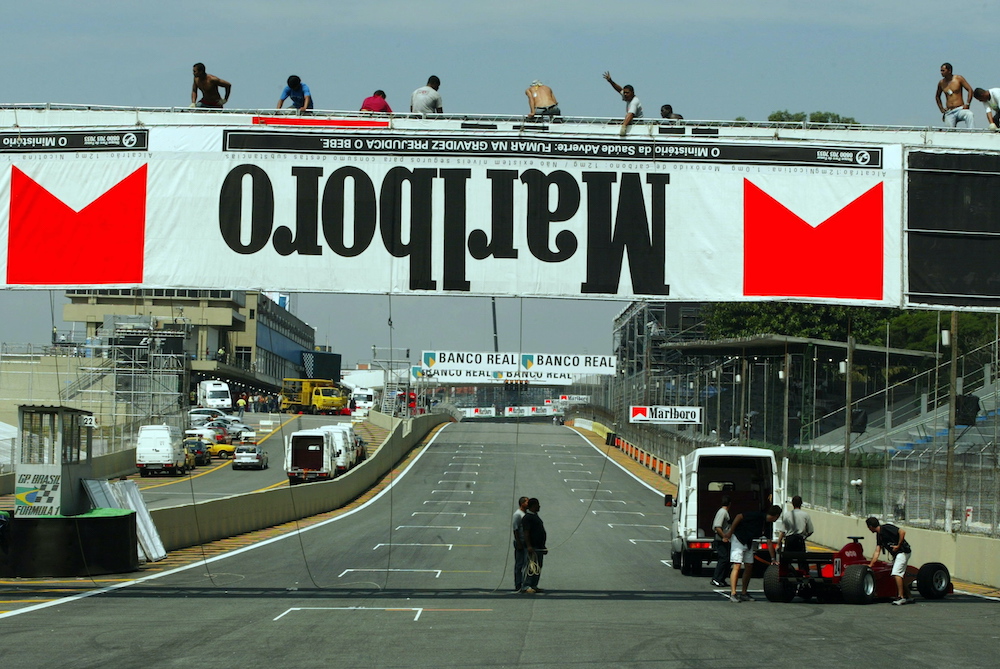
Not sure how to illustrate another "IndyCar future technology" letter, so instead let's contemplate the moment the crew responsible for track signage at the 2002 Brazilian GP stood back to admire a job well done. Motorsport Images
Q: I'm sure the answer has to do with expense, logistics, machinery etc., but why isn't the diamond surface grinding used to resurface Indy so many years ago used at a track like Texas? it seems it would solve the grip problems for NASCAR, and open a lane for IndyCar, as opposed to applying goo to the surface and ruining the upper lanes. It seemed to work well for Indy. For that matter, might this process be used to refresh track surfaces at many places. Your thoughts?
Bill P.
MP: Goo is what NASCAR asks for, and as its biggest draw, TMS heeds NASCAR’s wishes. I’ve only heard of diamond grinding and ovals. Road courses tend to repave problem sections as needed.
Q: I know it's easy to pile on Iowa Speedway and Hy-Vee, so I'm going to do just that. Our seats (Section 207, Row 23) went up from $160 in 2022 to $390 in 2023. None of the concerts appeal to us, so that made it an easy decision not to make the 650-mile trek to Iowa again. I know there's been a lot of discussion among the IndyCar community on how ticket sales are doing at Iowa this year. So, it's Presidents' Day, and who doesn't love going onto the Iowa Speedway website and counting how many tickets remain? I'm a stats guy, so this was interesting to me. (Please, no judgment!)
I looked at half of the seats -- Sections 101-110 and Sections 201-211. Here's what I found. These are two-day prices (remember, this is just half of the track, however, the sales pattern on the opposite side was very similar):
$190 seats (1,842 available) - 92% sold
$290 seats (2,760 available) - 37% sold
$340 seats (2,295 available) - 30% sold
$390 seats (2,675 available) - 12% sold
$440 seats (1.454 available) - 44% sold
Total seats (11,206 available) - 34% sold
A couple of things I found interesting:
* In the $440 seats (concert fans, bottom section, and closest to start/finish and the stage) - Sec. 110: 85% sold; Sec. 109: 37% sold; Sec. 108: 12% sold.
* The $390 seats, I break into two categories: Sec. 106 and 107 (concert fans, bottom section, not as close to the stage): 14% sold; Sec. 205-209 (race fans, top half of top section, nearest start/finish): 12% sold
* The $340 seats (lower half of top section, nearest start/finish and stage) I think are a hybrid – some concert fans, some race fans: 30% sold
* The $290 seats break into two categories: Sec. 103-105 (concert fans, bottom section, far from stage): 26% sold; Sec. 202-204 (this could be somewhat hybrid, but leaning toward race fans; top section, far from stage and start/finish): 37% sold
* The $190 seats, I'll call the "I just want to get in for either the races or the concerts" seats: Sec. 101 and 102 on bottom, farthest from stage: 88% sold; and Sec. 201 on top, farthest from start/finish: 99.7% sold.
Takeaways:
For fans of the concerts, the $440 price tag is a good deal. However, not sure how big the market is at this price judging by the sales in this price range: closest section: 85% sold, next closest: 37% sold, next closest: 12% sold.
For race fans, I would consider Sections 205 through 209 to be the prime seating area (nearest start/finish and high). At a $390 price point, with 12% of tickets sold, I would say they have priced themselves out of the market.
With 92% of tickets at the $190 price point sold, I think you've found the target price range. Unfortunately, that's the lowest ticket price available; not what you want to see if you are the venue. Obviously, a concert line-up like this isn't feasible if all tickets are $190.
I'd really like to see Iowa succeed -- we need to keep those ovals on the schedule. I'm just not sure this is the model to do that.
All that being said, we've decided to take our money and head to Mid-Ohio this summer.
Greg Warren, Little Rock, AR
MP: You and your calculator are not to be messed with, Greg. As always, I hope the event it a complete success with all tickets sold. If it isn’t, your letter will be cited, for sure, as to why the costlier sections were sparsely filled.
Q: I attended the last two NASCAR races at the LA Coliseum. The second half of this year's race was a mess. There were just too many cars on such a small track.
With the NASCAR race at Auto Club Speedway canceled for next year, there's talk of making the race at the LA Coliseum a points-paying race. I think that might be possible if they changed the format. The heat races were much more exciting than the final race, because there were far fewer cars on the track and fewer yellow flag laps.
I believe they should consider running two points paying races next year, one on Saturday and another on Sunday. NASCAR could split the total field in half, running one half on each day. This would put half as many cars on the track at one time, hopefully resolving the root problem. Do you think this could work?
Kevin P., Los Angeles, CA
KELLY CRANDALL: Let me start by saying that I’m not in favor of NASCAR making the L.A. Coliseum a points race. As you pointed out, the field would have to be split in half because there is no possible way to put 36 or more cars on track at the same time without it turning into a complete mess. Some people will like that, but in a points-paying race, I’m not sure that’s the best look. With 27 on track a few weeks ago, that even seemed too much. The Clash has been a fun exhibition race, but that’s all it should be, and it seems drivers are split on that as well.
NASCAR could theoretically split the field in half and run two races to help the problem. So, yes, it could work, and honestly, it’s the only way I see them being able to pull it off. Something that would be interesting, however, is if one race plays out differently than the other -- would you run the risk of drivers complaining they were a victim of the race they were put into? To me, it seems messy, but again, theoretically, it isn’t impossible to format the race that way. I would like to have all cars on track at the same time, with the same events playing out for everyone, when it’s a points race.
Q: Just read about Lance Stroll's cycling accident. Hope he is able to recover quickly. Didn't Alonso also suffer a cycling accident a few years back? Obviously, top level drivers need to maintain their cardio, and cycling is a great way to achieve this without building too much muscle mass. Tennis is another one, but that didn't work out well for Montoya (wink wink). Would you happen to know if teams are allowed to dictate which training activities their drivers may not take part in (similar to how many Hollywood stars are not able to ride motorcycles during filming), or are these accidents just considered acceptable risks in the quest to keep bodies in top shape?
Kyle
CHRIS MEDLAND: You’re right, Alonso did have a nasty one in Switzerland ahead of his comeback in 2021 -- he needed surgery on a broken jaw. Slightly ironic that’s both of this year’s Aston Martin drivers who have had them, plus Alex Albon did when racing in F2 as he went over the handlebars when downhilling (after Alex let George Russell take his own bike for a training ride and Alex took an old spare that hadn’t been serviced, if I recall correctly …)
Some teams do put clauses in contracts, especially with younger drivers early in their careers. It usually takes a driver to have reached a certain level to be able to demand the freedom to do other activities. If it can be deemed to be for training purposes than most fitness stuff is OK -- and cycling is a very popular one among the current grid -- but drivers have been banned from things like skydiving or riding motorbikes before. If they’re your most valuable asset, you usually have to limit the major risks to when they’re behind the wheel of an F1 car.
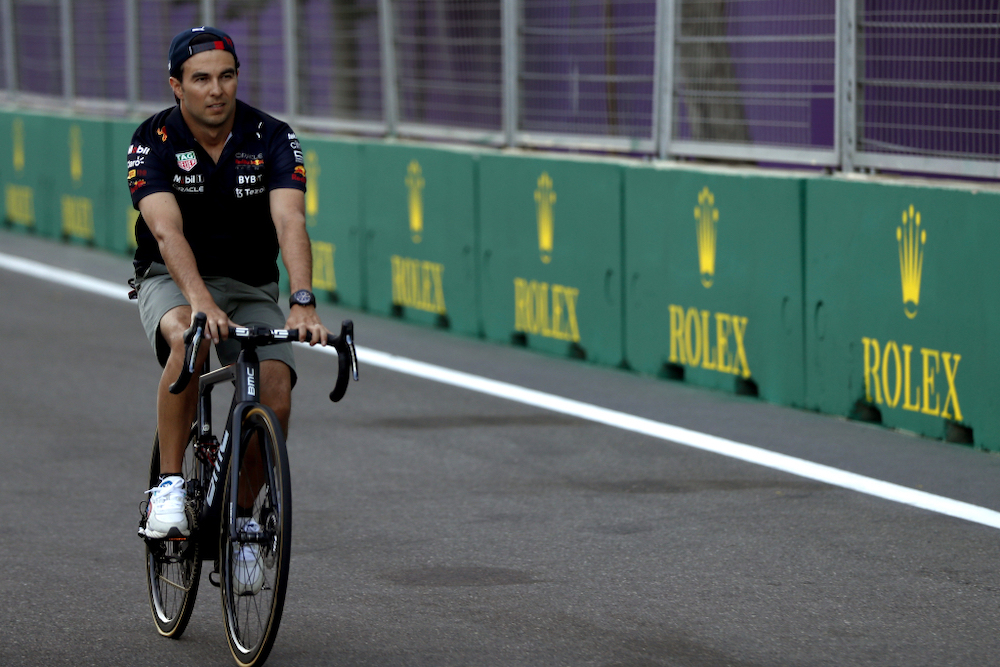
He's not even wearing a helmet! Carl Bingham/Motorsport Images
Q: I think recent comments by Horner, Domenicali and Steiner about the proposed entry of Andretti Global are pretty silly. Beyond Sauber and Haas, perhaps the only other team that might have entertained a buyout was Williams. Everyone else is firmly entrenched. But, if they were interested in selling, they could have just left Capito in place. It is patently silly for Horner to say that Andretti Global should buy an existing team when none are available. Sort a self-fulfilling prophecy if you don’t want anyone else to join.
For Domenicali, I can see his reaction about what Andretti said about “greed” but I also understand why he said it. I believe it was out of frustration and I suspect that he expected better. To me, it is just another manifestation of the Piranha Club (none for all and all for none).
Steiner’s words saddened me. I think there is a real possibility that if Andretti Global were allowed to join, Haas would look more like an also-ran than it does now. The team doesn’t seem to be really set up to march up the food chain. The way this game is played, keeping up won’t get you anywhere. It is about leapfrog, and Haas seems to be just treading water. Also, I would have to wonder what the Haas team has brought to the party. In eight years it has never finished above fifth in the championship, and has one pole and two fastest laps to its credit. That isn’t how you define “impact.”
So, the questions are:
How do you figure all this is going to turn out? And I realize I don’t have any insider information, but is my logic reasonable?
Don Hopings, Cathedral City, CA
CM: You’re not miles off but I think there’s short-termism at play on both sides of the argument. Loads of these teams nearly went to the wall just three or four years ago and nobody was knocking on the door to enter then. Then F1 blows up through initiatives these teams all agreed to and were part of, and loads want in for a slice too.
I’ll defend Haas, because what happened to the three teams before them? They don’t exist anymore. And I’d say Magnussen’s comeback and pole in Brazil were some great stories, plus Steiner is a very popular character among fans. They definitely add something, but they also came in when the sport feared losing teams and when none were profitable, so they actually strengthened the sport overall as they ensured we still have 10 teams now once Manor failed.
I think it’s going to end up with one or two teams (as 12 is the max number allowed) given the approval to enter if they pay a bigger entry fee agreed by the teams at the time, and the bit I’m unsure of is if that will be reasonable or not. Don’t forget, though, that even if it’s $500m to buy in and the same to set the team up -- so $1b total investment -- that new team would automatically be worth that much if not more given the fact there would only be one or even no slots left for new teams.
The bit I keep repeating to people is that it isn’t about Andretti, it’s about any new team. Andretti has been most vocal and public, but there are loads that want to be a part of F1 now because it’s so lucrative, and now the entry process is actually open we can see what everyone has really got.
To your first point, I personally don’t like the existing teams having so much sway either. They should be asked their opinion, and can recommend what they think is fair value for an entry (like U.S. sports franchise owners do too), but it should be down to F1 and the FIA alone to approve it. If F1 thinks it would be good for the sport, and the FIA can handle another team, then I think it should be on F1/Liberty to choose the terms.
THE FINAL WORD
From Robin Miller's Mailbag, February 25, 2015
Q: Who originated one of my favorite slang terms: "rolling chicane"? Did you first coin this pejorative label? I’d be interested in your list of some of the drivers who best fit this description?
Rick Johnson, Lynnwood, WA
ROBIN MILLER: Not sure who coined it but I know I used "moving chicane" to describe Randy Lewis, King Hiro and Bill Tempero a few times. Drivers used to bitch that they would come up to lap Dick Simon and he’d pick up a second a lap so they had another phrase: “I got Dicked again.”
Marshall Pruett
The 2026 season marks Marshall Pruett's 40th year working in the sport. In his role today for RACER, Pruett covers open-wheel and sports car racing as a writer, reporter, photographer, and filmmaker. In his previous career, he served as a mechanic, engineer, and team manager in a variety of series, including IndyCar, IMSA, and World Challenge.
Read Marshall Pruett's articles
Latest News

Comments
Comments are disabled until you accept Social Networking Cookies. Update cookie preferences
If the dialog doesn't appear, ad-blockers are often the cause; try disabling yours or see our Social Features Support.