James Black/Penske Entertainment
PRUETT: Some surprise takeaways from IndyCar's Thermal test
If the things I saw at Spring Training hold firm through the September 10 finale at Laguna Seca, we’re in for one heck of a season.
Two drivers starred at the test, and I couldn’t be happier for them as sophomore Kyle Kirkwood was the fastest person across Thursday and Friday for Andretti Autosport and rookie Agustin Canapino silenced a lot of doubters with his efforts for Juncos Hollinger Racing. Those are two outcomes I didn’t have on my Thermal bingo card.
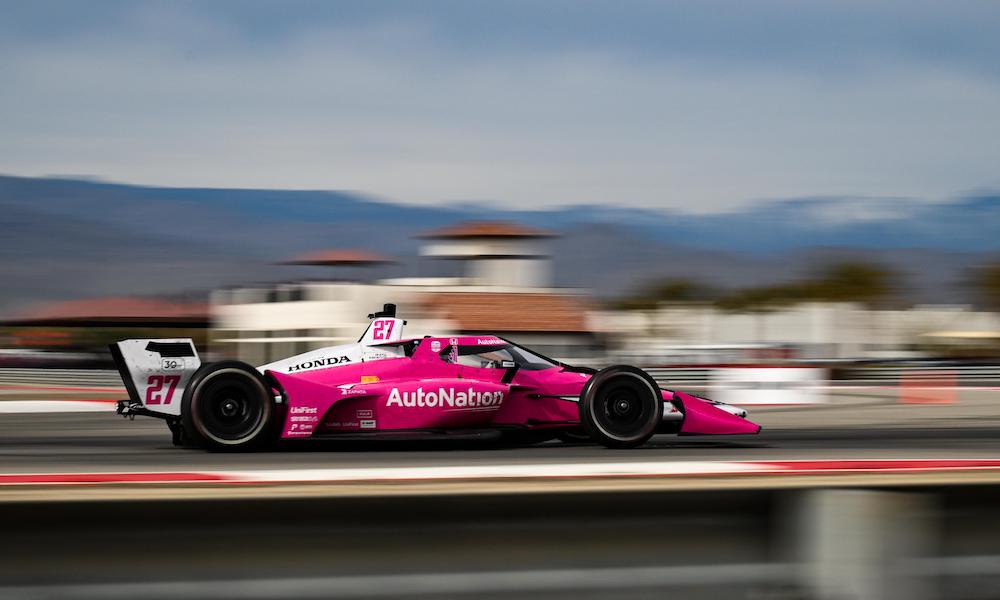
Starting with Kirkwood, the Floridian and race engineer Jeremy Milless clearly have the potential to do big things in 2023 with the No. 27 Honda. Partnered with Milless at CFH Racing/Ed Carpenter Racing from 2015-2016, Josef Newgarden captured his first IndyCar wins — three in total — and placed fourth in the championship before Roger Penske acquired his services. Paired with Alexander Rossi in the No. 27 entry, seven more wins were taken from 2017-2022, with Rossi placing as high as second in the Drivers’ standings with Milless.
The overriding message here is how Milless, a 20-plus-year veteran of IndyCar, is able to connect with young drivers and make speed. On average from the three test sessions where the No. 27 participated (the second session was lost while fixing the clutch), Kirkwood ran P2, P3 and P1.
Teammate Colton Herta was fastest in both of Thursday’s sessions with the No. 26 Honda, leaving Andretti Autosport with a 75-percent strike rate at the test. As a whole, Andretti Autosport had to be pleased with its performance at Thermal with Herta and Kirkwood going 1-2 Thursday morning, Herta and Romain Grosjean in the No. 28 Honda going 1-4 Thursday afternoon, Kirkwood leading the team in P3 during the third session and closing the test in P1.
Chip Ganassi Racing’s Marcus Ericsson was the only other driver to lead a session, taking the third outing with his No. 8 Honda.
Canapino’s JHR team was the other revelation during Spring Training as sophomore Callum Ilott placed his No. 77 Chevy inside the top 10 in three of the four sessions, topping it off with P2 behind Kirkwood on Friday afternoon. But it was the Argentinian rookie who caught my attention with runs to P22, P20, P23, and P20.
For a driver who was expected to take ownership of P27 and last due to his drastic lack of open-wheel experience, Canapino and the No. 78 Chevy were faster than Graham Rahal’s No. 15 Honda in every session, faster than Ed Carpenter Racing’s Conor Daly in three of four outings, quicker than A.J. Foyt Racing’s Santino Ferrucci in four out of four runs, faster than Meyer Shank Racing’s Helio Castroneves in half the sessions, and led all rookies, with the exception of CGR’s Marcus Armstrong, at the test.
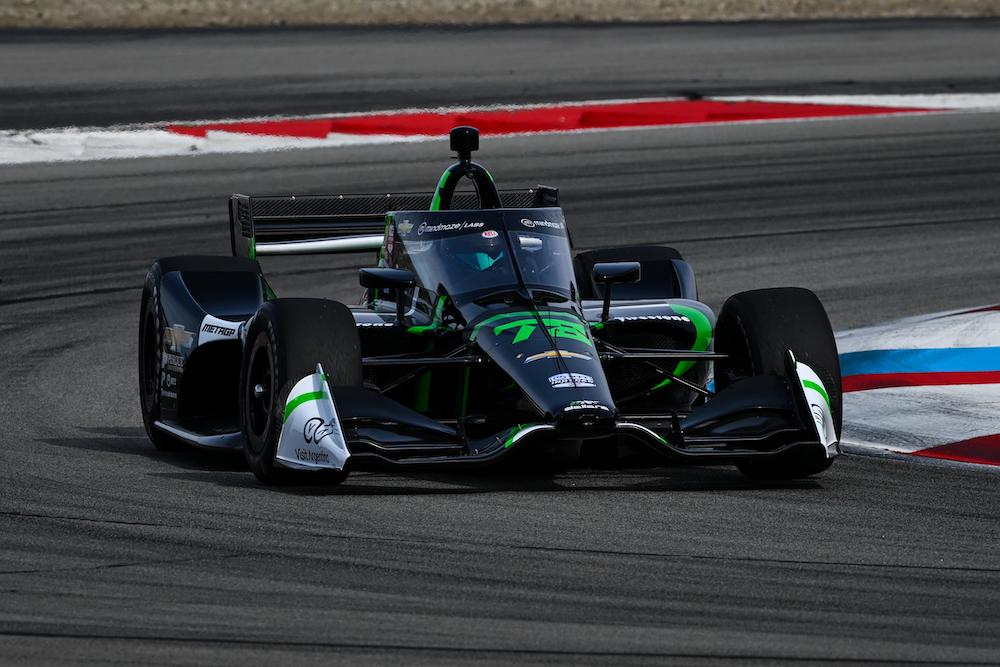
Canapino's transition from touring cars got off to an encouraging start. James Black/Penske Entertainment
We can attribute some of Canapino’s performance to the site of Spring Training; with every team and driver starting from scratch with zero circuit knowledge in an IndyCar, it was a level playground for all to figure out. When we get to St. Petersburg or Texas Motor Speedway and the other circuits where most of the field knows the tricks to extracting maximum speed each lap, the 33-year-old touring car champion will face a much tougher task. Running ahead of the series’ veterans and the rookies who’ve been to the same tracks in junior open-wheel categories and have a solid base of oval experience to draw from their time in Indy Lights is where Canapino’s real challenge is found.
Nonetheless, he more than justified the decision by Ricardo Juncos and Brad Hollinger to place him in a full-time ride. And if you like underdogs, JHR and the duo of Ilott and Canapino are the best IndyCar has to offer this season.
Elsewhere, the Ganassi team was strong throughout the test as Alex Palou and the No. 10 Honda and Scott Dixon and his No. 9 Honda featuring new race engineer Ross Bunnell spent seven of the eight sessions inside the top 10. Within their camp, Armstrong offered the best news for the team as the New Zealander was fast and comfortable in his first outing with the program; on average from the four sessions, the Kiwi had names like Josef Newgarden, Rossi, and Pato O’Ward in his rearview mirrors.
A few more drivers stood out at Spring Training throughout Thursday and Friday. Although Honda-powered drivers led every session and often took most of the top four or five positions, Team Penske’s Will Power was a vision of focus and intent as he placed between P4 and P6 whenever he strapped into the No. 12 Chevy and he was often the quickest Bowtie representative at the Thermal Club. Teammate Scott McLaughlin ran between P3 and P8 in all but one session, and with a new race engineer to jell with in Luke Mason, Newgarden did well to hold between P5 to P10 in three of the four outings.
Separated from their teammates, MSR’s Simon Pagenaud and Rahal Letterman Lanigan’s Christian Lundgaard were fixtures near the front with the Dane earning P2 in a pair of sessions and the relaxed Frenchman peaking at P3.
In the mix at Spring Training, we had a resurgent Andretti Autosport with Kirkwood suggesting he’s ready to help Herta carry the load and Grosjean showing more connection and pace in his car. We also had Juncos Hollinger as a team that’s poised to punch above its weight and collective experience, a Ganassi squad that appears to bear no lingering effects from a turbulent 2022 season, and a Terminator-esque reigning champion in Will Power who is locked into the same approach that worked so well last year.
Within MSR and RLL, bigger and better finishes are within the grasp of Pagenaud and Lundgaard, and within the frequent leaders at the Thermal Club, we had a delightful blend of young chargers like Palou, Ilott, Lundgaard, Herta, Kirkwood, and Armstrong, and IndyCar’s long-standing fixtures in Power, Dixon, Pagenaud, and more who were knocking on the door with Newgarden, Ericsson, and McLaughlin.
The test also left us wondering where Arrow McLaren will rank among its rivals in the early races after O’Ward had numerous off-track moments and never ran higher than 13th. Newcomer Rossi, who was learning to work with new race engineer Craig Hampson, had a best of 10th, and Felix Rosenqvist, who was the session leader among the trio with sixth, spent the rest of the outings hovering from 15th to 19th.
Of their 12 combined sessions, the new Arrow McLaren trio were 13th or lower on nine occasions which, based on expectations, was a surprise. Was it a case of missing the mark at Spring Training, or focusing more on test items that weren’t necessarily track-specific to the Thermal Club?
Ed Carpenter Racing was in a similar situation where the returning duo of Rinus VeeKay and Conor Daly really never factored. Other than the Dutchman’s fourth to open the test, he never returned to the top 10 and for Daly, it was two straight days of 20th or worse.
Dale Coyne Racing, with David Malukas in the sizable group of drivers who were learning to work with a new race engineer (Alex Athanasiadis), and rookie Sting Ray Robb persevering through some teething pains on the opening day, were mired in the midfield (Malukas) and the rear of the 27-car group (Robb). The rebooted Foyt team got a feel for the road ahead as its new lineup of Ferrucci and rookie Benjamin Pedersen recorded eight combined sessions with a best of 22nd by the veteran in the No. 14 Chevy.
With so many of its corners in the first- or second-gear range, it wasn’t a shock to see Honda-powered drivers stacked towards the front in each session; Honda Performance Development is known for infusing its twin-turbo V6 engines with plenty of torque to power out of slow corners.
But if we pick back up on the Arrow McLaren performance question, there’s a reason to doubt whether some of the traditional championship contenders were truly missing speed at Spring Training.
Simply put, it’s premature to say Andretti’s all the way back and Arrow McLaren and Team Penske are slightly off; we’ll need to get through a few sessions at St. Pete to identify the risers and fallers in the paddock. And for what it's worth, Chevy gave Honda the business at St. Pete, Barber, and Long Beach to open the 2022 season — circuits with more than a few slow corners — so it’s also too early to say if Honda’s found what it was missing last year.
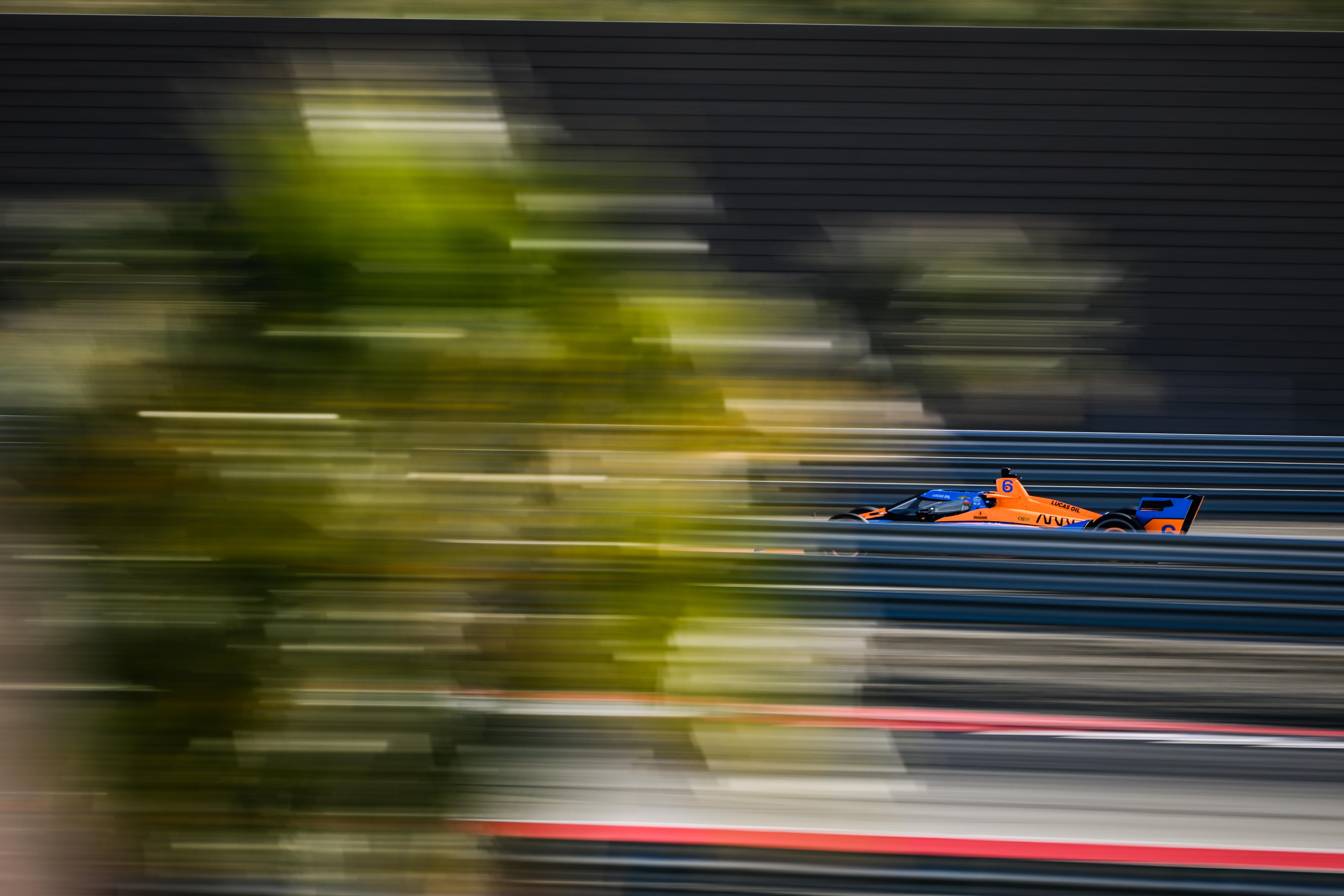
It was a low-key start for Arrow McLaren SP, but how much can we read into it? James Black/Penske Entertainment
Stemming from the results from Spring Training, there are a bunch of encouraging signs for what’s ahead, but we aren’t quite inscribing Kirkwood’s name on the Astor Cup or booking ads for Honda’s Manufacturers’ championship at this stage. And I love the mystery of it all. Had Penske or Ganassi owned the event, I’d be worried about what lies ahead. The fact that very little happened as expected is why my optimism for another wild and unpredictable season is so high.
The positives for IndyCar’s first visit to the private venue protected by armed guards were many. Surrounded by multi-million-dollar homes built around the sprawling circuit, IndyCar’s teams, drivers, and executives were awash in opulence unlike we experience at any other road course on the calendar.
From the grand welcome party Wednesday night where the series’ constituents mingled with the captains of industry who’ve bought and developed plots of land at the facility, to the chance to try something new for Spring Training in a warm climate that isn’t Sebring, the attitudes among the majority of those I spoke with were positive regarding IndyCar’s debut at the Thermal Club. But there were two big caveats.
There were no fans present to see IndyCar’s equivalent of a lone pre-season game, which is still hard to understand. Nor was the welcome to the 2023 IndyCar season live-streamed to the masses, barring my primitive attempts (with the series’ permission) to offer a look in on Thursday’s sessions by duct-taping my phone to a tripod and IndyCar’s similar efforts on Friday via Instagram. If the former was unfathomable, the latter was incomprehensible.
Bathed in feelings of importance from within the Thermal Club, a very different message was sent to IndyCar’s fans who weren’t allowed to see the season’s kickoff in person or watch it on a readily accessible platform. If IndyCar elects to return, one of the two experiential shortcomings must be fixed, if not both.
And what about the idea of IndyCar holding a race at the Thermal Club? That’s millions of dollars’ worth of SAFER barriers, tire barriers, fencing, public facilities, parking, food and drink vending, and acres of grandstands away from becoming a reality. There’s good bones within the Thermal Club to host its first-ever IndyCar race, but a massive amount of work and money are required first for it to be considered.
Good on IndyCar for trying something new, and let’s see if there’s more to the story to follow.
Marshall Pruett
The 2026 season marks Marshall Pruett's 40th year working in the sport. In his role today for RACER, Pruett covers open-wheel and sports car racing as a writer, reporter, photographer, and filmmaker. In his previous career, he served as a mechanic, engineer, and team manager in a variety of series, including IndyCar, IMSA, and World Challenge.
Read Marshall Pruett's articles
Latest News
Comments
Comments are disabled until you accept Social Networking Cookies. Update cookie preferences
If the dialog doesn't appear, ad-blockers are often the cause; try disabling yours or see our Social Features Support.
.jpg?environment=live)