Gavin Baker/Motorsport Images
Tech download: Tricks of the trade in IndyCar fuel saving
After discussing why teams will resort to fuel saving in the last column, the natural follow-up question is, how do teams go about doing this? While there are many strategic reasons that teams will turn to fuel saving during a race, in every scenario teams will try to save fuel in the most efficient way possible. That is, minimizing the lap time penalty as best they can while still hitting the fuel target.
How teams go about minimizing their lap time loss when needing to save fuel depends on several factors: the capability of the engine manufacturer to run different engine modes, the ability of the driver to adapt their driving technique, as well as the characteristics of the track and the current traffic situation. Engine manufacturers, teams, and drivers will work together and spend huge amounts of resources to optimize this aspect of performance, be it on the dyno, in simulation, or during track testing. The ability to save fuel without losing much time can be a huge differentiator throughout a race.
There are two primary techniques for saving fuel: the driver can either change engine modes, or incorporate lifting and coasting. Each has their own advantages and disadvantages, but they effectively achieve the same thing: completing the lap while saving fuel compared to running at 100%. Deciding the most efficient way to use one or both of these techniques over an entire lap however, is very difficult. Oftentimes, there are an infinite number of ways to hit the same fuel target, so teams will set about using the engineering tools at their disposal to find the best approach.
Engine modes
Changing engine modes is relatively straightforward. The engine manufacturer can load various settings into the car’s ECU, which can then be selected by the driver by adjusting a dial on the steering wheel during the race. Doing so will effectively (and without giving too much away) reduce engine power and fuel consumption in lockstep.
When it comes to fuel saving, this is where the battle between manufacturers lies. Offering reduced fuel consumption for the same power compared to the competition not only gives teams additional race pace when hitting the same fuel target, but also opens up the number of strategy options available to them.
Since fuel targets can change throughout the race, teams will always ensure there are multiple options available on the dial, each with its own compromise of power reduction and reduced fuel consumption. Teams will also use data from practice sessions to advise over the radio as to what engine mode should be used for a given fuel target. With engine modes, the driver can continue to push with their driving style while still saving fuel. Typically, when resorting to changing engine modes, acceleration is the biggest compromise to performance (though there is also an effect on top speed) due to having less power available. On the plus side, drivers can continue to attack brake zones and corner entries and they normally would.
Lift and coast
The most common fuel saving technique for a driver is 'lift and coast.' As the driver is nearing the end of a straight and approaching a brake zone, they will lift well before the normal braking point, coast without any input on throttle or brake for some distance, and then apply the brake when sufficiently close to corner entry.
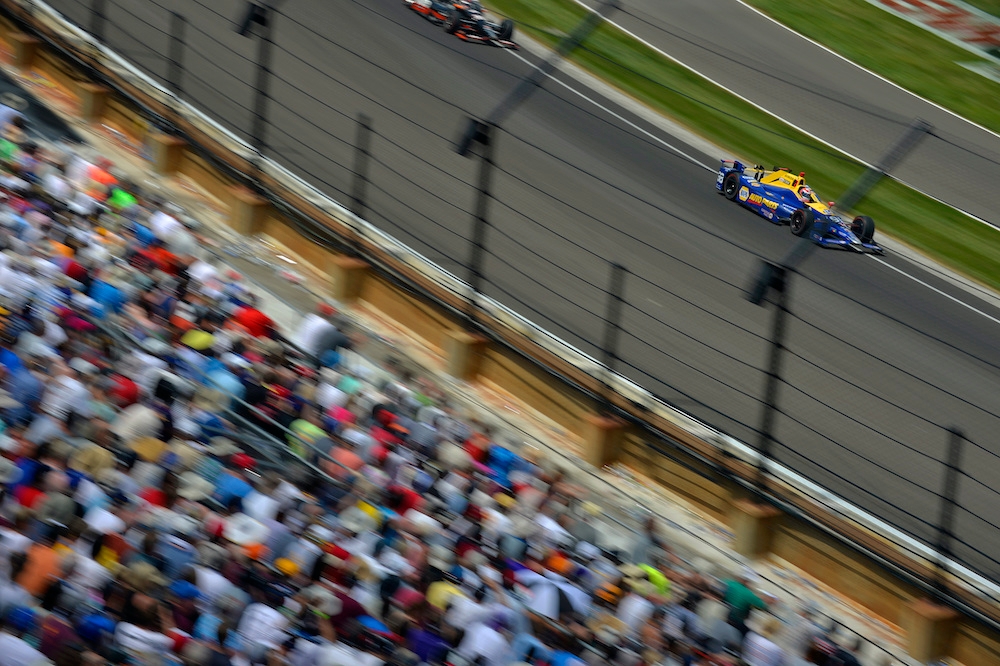
Alexander Rossi showed just how effective the lift and coast approach can be at Indy in 2016. F. Peirce Williams/Motorsport Images
The idea is that fuel consumption is closely tied to being on-throttle, so if a driver needs to reduce consumption, they will have to lift for some amount of time during the lap. Lifting towards the end of a straight is ideal because this is when the driver is closest to top speed, so they will coast farther, and therefore save more fuel. Additionally, a car is accelerating much less at the end of the straight than it is at the beginning (since acceleration begins to taper off the closer the car gets to top speed), so lifting at the end of the straight is also less penalizing on lap time. Therefore, the higher the entry speed into a corner, the better it typically is to use lift and coast to save fuel.
The main benefit to lift and coast is that there is no de-tuning of the engine: acceleration for most of the straight remains the same as it would when not saving fuel. However, the detriment to lift and coast is quite clear: all the time loss is concentrated at corner entries.
Comparing fuel save methods
To get an initial comparison between approaches, engineers will turn to a vital tool called lap time simulation. This is a software that will use a numerically modeled car, track, and driver to solve physics equations as a way of creating data for a virtual lap as if it really happened on track, but with the benefit of every single parameter being controlled by the engineer.
Lap time simulation is a hugely complex subject in its own right; one that can do everything from investigating potential setups to predicting the effect of changing ambient conditions. It is one of the most important pieces of software an engineer will use. For the scope of this article though, it allows the engineer to compare fuel saving approaches to see whether changing engine mode or lift and coast is the fastest way to hit a fuel target.
Starting with the most basic of examples, a simulation of accelerating from the apex of one corner, down a straight, to the apex of the next corner is modeled. Running at 100% burns 0.301 gallons, but say the fuel target is 0.286 gallons (5% savings). The engine manufacturer – who has been doing some work on the dyno – says that they have three engine modes to try. The first is full power and full consumption (Mode 1), the next offers 4% power reduction for a 5% savings in fuel consumption (Mode 2), and the final option offers 8% power reduction for 9% fuel savings (Mode 3). Lap time simulation can be run iteratively in order to solve for the required lift and coast distance until the fuel target is achieved. Mode 1 is going to require 135 ft of lift and coast to hit the fuel target, Mode 2 will still need 50 ft of lift and coast, and Mode 3 can be run without any driving adjustments needed to be made. With these simulations, overlays of speed, fuel consumption, and lap time (plotted versus distance) can be compared to a push lap with no fuel saving, and the results can then be analyzed.
Move your cursor over the graphs to reveal additional details
In this example, all three fuel saving approaches use the same amount of fuel, but using Mode 1 and 135 ft of lift and coast is 0.23s faster than going straight to Mode 3. That is a massive amount of time for just one corner! Also of note, using Mode 1 and 135 ft of lift and coast is only 0.02s than pushing flat-out, which is hardly any loss time at all for using 5% less fuel. When done efficiently, the lap time loss from fuel saving can close to nothing.
Optimizing for lap time
The idea of simulating potential fuel saving approaches can be expanded from a basic example of just one straight to simulating an entire lap, but doing so brings additional complexity. Distributing where the driver lifts and coasts throughout the lap increases the number of simulations by several orders of magnitude. Putting aside engine modes for this example, say that at a (fictional) street course with five corners, a push lap burns 0.742 gallons and the fuel target is 0.668 gallons (or 10% reduction in consumption). Now, the driver wants to know where the best places to lift are and how much should they be lifting in each corner. Is it faster to only do one big, long lift on one straight to save the entire 0.074 gallons in one go? Or should the driver do smaller, shorter lifts throughout the lap adding up to 0.074 gallons saved in total? Once again, lap time simulation is an engineer’s best friend. These simulations can run hundreds of thousands of laps at the click of a button, and then data analysis software can immediately point to the best solutions. Below is a typical sweep of various lift and coast distances for each corner of the track.
Move your cursor over the graphs to reveal additional details
After using lap time simulation to create this data, finding the combination of lift and coast distances in each corner that can stay under the fuel target while also going the fastest is now a straightforward data analysis problem. Code can be written to create theoretical laps for every combination of lift and coast distance in every corner (that’s 16,807 laps in this example!), and the fastest approach that hits the fuel target will become apparent. In this sweep, the engine mode has been fixed and only one fuel target has been given. But in reality, both of those parameters are also variable during the race and so the amount of pre-event simulation done by the teams and manufacturers in the weeks building up to a race weekend can become enormous, as they have to be prepared for all possible scenarios.
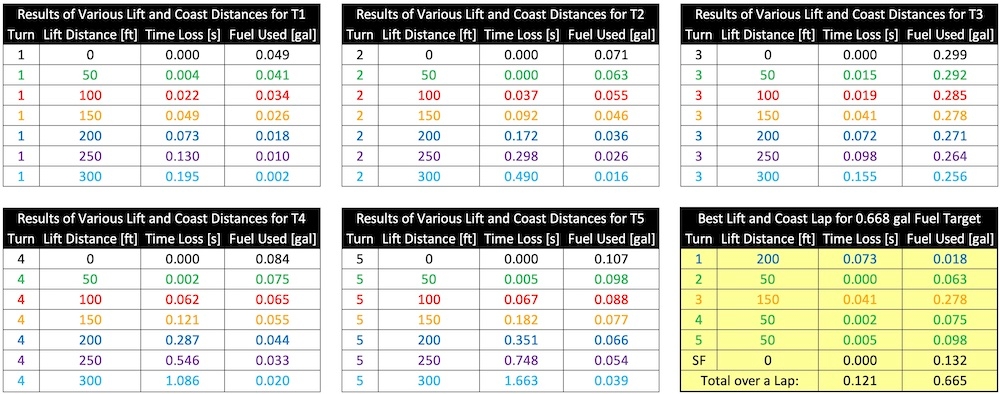
The simulations say that when fuel consumption is reduced by 10%, the lap time loss can be anywhere from 0.121s when done optimally to 1.678s if done inefficiently. Since fuel saving simulations like this are so important and are used week-in and week-out, teams have typically developed software and code to automate these tasks to immediately solve for an ideal approach.
Also from these results, something else that has already been touched on (but can now be seen in the data) is that the higher the entry speed, the better suited that corner is for lift and coast. From this, it follows that the fuel saving characteristics of each track are different from one another. Tracks with long straights and big braking zones (like Nashville) tend to be more suited for lift and coast, whereas tracks with shorter straights and flowing corners (like Barber) tend to prefer using engine modes.
Traffic and track position also plays a big factor in how teams save fuel throughout the race. Thus far, fuel saving has only been discussed through the lens of optimizing lap time. But for a track like Nashville, the end of the two long straights are also great overtaking spots. If a driver needs to save fuel but also defend their track position, a big lift and coast at the end of each straight leaves them vulnerable to being passed. In these situations, drivers will do their fuel saving in parts of the track where overtaking is impossible, like the back section of Nashville from T4 to T7. While this certainly isn’t ideal for lap time, it does allow the driver to hit the fuel target while giving them the best chance of maintaining position. The optimum fuel save approach will always depend on how much fuel needs to be saved, but the characteristics of the track and traffic are just more variables for drivers and engineers to consider as they hone in on a best solution.
The driver
A deeper look at these overlays can also begin to show why resorting to lift and coast requires a change in driving style, and why some drivers are better at it than others. Adding a lift at the end of the straight obviously lowers the entry speed compared to pushing at 100%, so drivers can actually brake later when doing lift and coast and still achieve the same apex speed. This means that braking is done over a much shorter distance when saving fuel, which changes the required peak brake pressure and the bleed-off technique that should be used. Because there is only a finite amount of tire grip to be allocated for both braking and turning, the knock-on effect of changing braking technique is that the steering technique to rotate the car on entry changes as well.
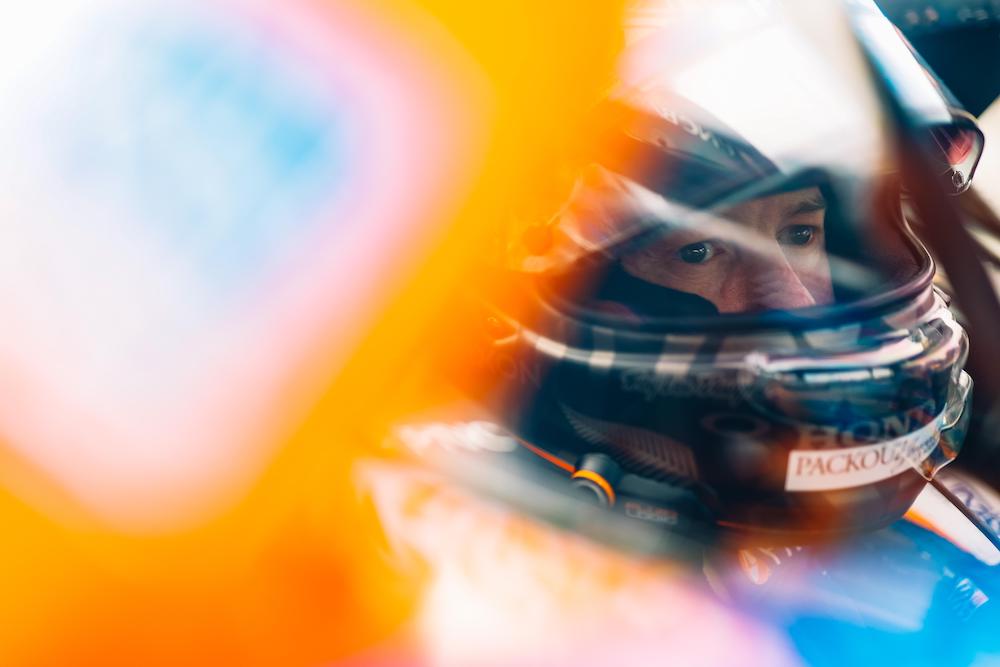
The most effective drivers are able to stretch their fuel with virtually no penalty to their lap time. Joe Skibinski/Penske Entertainment
In fact, the driving style through the entire entry phase to the corner changes when doing lift and coast: switching from a late braking, aggressive style towards being more 'efficient' in the way drivers simultaneously slow down and rotate the car in order to scrub off as little speed as possible. There is no fuel saving done whatsoever from apex to exit, so despite having to change the way they approach the entries, drivers need to be sure that minimizing time loss on entry doesn’t compromise the exit phase. Depending on a driver’s ability to adapt their style, some teams are better off using engine modes for the same fuel target that other teams might choose to lift and coast. Ultimately, each team is going to do whatever is fastest for them.
As fuel targets often change throughout the race, lift and coast distances (and thus entry speeds) will also change. Drivers that can adjust their style the quickest are at a huge advantage in these situations. If strategy dictates going directly from pushing flat-out to a massive amount of fuel saving, a driver that takes a couple of laps to settle in to such a big shift may lose heaps of time to drivers that can adapt at a moment’s notice.
Driver consistency can also make a big difference. Once a lift and coast distance is determined, a new braking point is found, and the driving style has adapted accordingly, being able to repeat this every time gives a competitive advantage over drivers who may struggle to drive the car the same way each lap. Consistency is obviously beneficial in many aspects of driving, but when it comes to minimizing losses from fuel saving, it becomes even more critical.
Finally, a driver being good at fuel saving isn’t dictated purely by their driving technique. Before each race, engineers and drivers will review the best combination of engine mode and lift and coast distances in each corner for a series of possible fuel targets. Once a fuel target is called out on the radio, the driver should know what engine mode and where/how much lift and coast to do. Still, when adjusting to a new fuel target there is always a period of feeling it out. In the heat of the moment, drivers with the ability to recall the most efficient approach to save fuel for a given fuel target can gain time on drivers that might need a couple of laps to arrive at the most efficient approach through experimenting, or drivers that may require some coaching on the radio.
All this to say, drivers can have a huge effect on race pace when fuel saving. The best drivers can save fuel and minimize their lap time loss to the point that they are almost as fast as they are when pushing. It is truly impressive to see how drivers can adapt their braking points and driving style on a moment’s notice and then consistently run lap after lap without fault.
Running it dry
There’s an old adage in race car design that because of the compromise between speed and reliability, the perfect racecar takes the checkered flag and immediately falls apart.
Ultimately, any fuel left in the car at the end of a stint is a performance loss. That fuel is weight that was carried around the track for a whole stint to eventually serve no purpose. When this happens, a higher consumption could have been used to complete the same number of laps. Every car in the paddock has an engineer dedicated to fuel strategy during the race: they are typically calculating and recalculating fuel targets in live time, updating pit windows as the race goes on, all in order to run the car as close to empty as they dare at every opportunity. While it may sound obvious, the best way to go fast while saving fuel is to save less fuel! Still, no sensor is perfect and so engineers will always want to err on the conservative side if they can’t be exact. Fuel left over in the tank is certainly better than running out on track.
The perfect stint means the car gets to pit lane, or finishes the race, practically dry. These engineers are playing the world’s scariest game of the The Price is Right: get as close to the perfect amount without ever going over. Run out of fuel and they’ll be out of the race, leave too much fuel in the tank and they are leaving performance on the table. While it’s not a particularly popular move with mechanics, when it comes to threading that needle, finishing the race – but not the cooldown lap – is an engineering gold star!
Presented by:
Stan Sandoval
Stan Sandoval is a former Race Engineer and Performance Engineer for Ed Carpenter Racing who has been working in Formula 1 since 2022. After growing up all along the East Coast, he studied Mechanical Engineering at Columbia University before attending University of Southampton to study aerodynamics. He got his start in motorsport engineering working directly for IndyCar before switching to the team side with ECR.
Read Stan Sandoval's articles
Latest News

Comments
Comments are disabled until you accept Social Networking Cookies. Update cookie preferences
If the dialog doesn't appear, ad-blockers are often the cause; try disabling yours or see our Social Features Support.