The RACER Mailbag, March 16
Welcome to the RACER Mailbag. Questions for any of RACER’s writers can be sent to mailbag@racer.com. Due to the high volume of questions received, we can’t guarantee that every letter will be published, but we’ll answer as many as we can. Published questions may be edited for length and clarity. Questions received after 3pm ET each Monday will appear the following week.
Q: I’m somewhat relieved that the IndyCar Series decided to push using the hybrid engines until 2024, because I feel that the current chassis that it is currently using would be putting the driver at risk at some of these ovals. They need a new chassis that would differentiate from the previous IndyCar chassis from the past. They don’t have to look like Formula E chassis, but something that almost looks like the turbine. Also, you may not like the idea of borrowing Formula 1 rules but they should consider using DRS in IndyCar since push to pass usually gets abused by the lead driver.
Alistair, Branson, MO
MARSHALL PRUETT: I think everyone would agree that launching a new hybrid engine formula would go well with an all-new chassis, but that just isn’t the case, Alistair. Some teams don’t want the added expense, and most of all, IndyCar has given no indicator so far that it plans to put a new car in play for 2024. If we get the full 100hp ERS boost via push-to-pass, that should make for some serious speed disparities that would bring added drama to the straights and braking zones.
Q: You have mentioned a couple times now that Rossi gambled and stayed out at that first caution at St. Pete, but that's not the case according to the Andretti Autosport website:
"Rossi showcased his knowledge of the street course gaining position after position at the drop of the green flag. The only caution of the race gave the No. 27 NAPA AUTO PARTS / AutoNation Honda an edge as Rossi was called to pit seconds before pit lane closed for the yellow flag. This allowed Rossi to lead the field for 10 laps. But in his final pit stop the front left tire wouldn’t budge. Though the crew finally removed and changed the tire the extra time in pitlane would end Rossi’s fight for the front."
CAM in LA
MP: Brother, you are welcome to believe whatever you want. All I know is when I rang to ask Andretti’s COO on how that went down, he said it was an intentional call to leave him out.
Q: How many of the 26 full-timers are on good solid funding? Are any cars on a race to race situation where they hope the funding comes through in time for the next race?
Ron, Toronto
MP: I’ve heard of one full-timer that has quite a few races that await one-off sponsorship deals, and a few others that have two or three races to sell. I’m not concerned about any of them being lost from the field as a result of those needs.
Q: In last week's Mailbag you asked about sending in some of the displays at Hy-Vee. I have some of this year's attached from one of my local (Quincy, IL) stores. I didn't see one this year, but last year there were also cardboard cutouts of both Graham Rahal and Santino Ferrucci. Some stores may even let you have one when the promotion is done, like the one hanging in my cubicle at work.
Ryan
MP: Score! So what do your cubicle mates ask the most? Is it if you’re a racing fan, Mountain Dew fan, or can’t live without fiery Cheetos burning your backside?
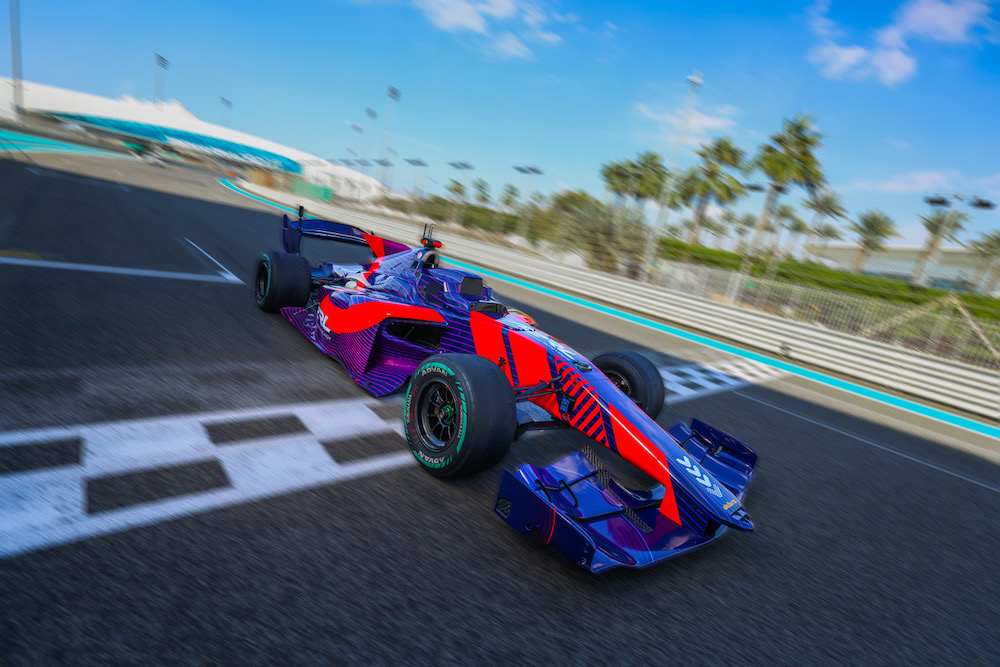
We got a great response to last week's call for photos of Hy-Vee IndyCar in-store sponsorship activations. If shots like this are any guide, it's apparently impossible to buy heavily processed pastries anywhere in the Midwest without bumping into a cardboard Dallara. And that's a good thing. Image by James Cox
Q: Since you seemed interested in Hy-Vee's IndyCar-based advertising, I thought I should mention that they're also running commercials with Jack Harvey here in Wisconsin. They have some on-track footage of his car at speed in black Hy-Vee livery. It's also on their Facebook page titled "Commitment to Excellence".
John from Madison
Q: Quite a bit of Hy-Vee Indy promo in the Rock Island, Illinois store. Plus music line up for Iowa has big names.
Jim Cox
MP: We clearly need to help Hy-Vee expand out to the coasts like 7-Eleven, turn those profits into title sponsorship -- the Hy-Vee IndyCar Series -- and make our beloved open-wheel championship a household name again after half the population becomes indoctrinated with IndyCar signage while buying their energy drinks and donuts on the way to work each morning. A guy can dream, right?
Q: I know, I know -- it’s another “why don’t we race here” or “why don’t we race there” question for the Mailbag. But before you dismiss it as such, hear me out -- this is a legitimate question. Why do we continue fighting Texas Motor Speedway politics, weather and grip when there is a perfectly acceptable racetrack sitting idle right in the heart of IndyCar country? Kentucky Speedway! It matches Texas in length and comes pretty close in design (slighter wider and not quite as banked). It used to host spectacular IndyCar races. What is the behind the scenes reason we can’t go there instead? We’re sitting around waiting for the demise of the TMS contract, so hopefully the decision makers are working on future plans to maintain another high-speed oval race. Seems to me, Kentucky might just be the answer.
Brian Seidenman, Mason, OH
MP: Back when I was a team member in the Indy Racing League, we went to all kinds of 1.5-milers, and of the many, I did enjoy Kentucky. And since we posted the story on Monday about IndyCar searching for ways to make Sunday’s race something other than a single-lane snoozer, the reaction from a lot of folks has been similar to yours: Say goodbye to TMS and hello to something similar at a different facility. I’m torn on this one. Having been there for its first IRL/IndyCar race and seen a lot of amazing action, I do hope the series can find a way to make the PJ1-coated lanes usable. My mindset is to try and fix the problem first, and if it isn’t possible, then move on. I’d love to see the "old" TMS return when we go racing this weekend, but if it’s no different than the last ones that were ruined by the PJ1, IndyCar needs to take its show elsewhere.
Q: I know winning drivers receive a ring. How about team members? Do they get rings?
Pete Jenkins
MP: It’s customary for the winning team to buy rings for the winning crew and as many of the key contributors they decide to include. On a related note, we did a story last year on how Mike Shank surprised Conor Swan with a ring after Helio became a four-timer with MSR that you might enjoy.
Q: I was amazed at the A-list line-up put together to help draw fans to the Iowa Speedway weekend. Blake Shelton, Florida Georgia Line and Tom McGraw are country music royalty (Gwen Stefani is no slouch either) and should pack the house. No disrespect to the great artists who have performed at our neighborhood race the Long Beach Grand Prix, but we’ve never had even one gigantic headliner like that in recent memory, much less four all on one weekend.
My question is about the economics of race promotion. Musical acts who play the Super Bowl halftime show don’t get paid -- they do it for the exposure, and sometimes even invest millions of their own money for stage production. Similarly, a lot of musical artists pay to perform on network TV shows or are paid a basic stipend to appear. Is the arrangement for performers at IndyCar races similar?
LA IndyCar Fan
MP: My understanding is that Hy-Vee is the financial mover behind the four big Iowa acts. And for the variety of EDM/country/dinosaurs of rock we get each year at IMS, I’m confident they’re all well paid for their services.
Q: I'm super-stoked about this season of IndyCar, and the fact that Scott McLaughlin won the first race. I really think he will factor into the championship, as will Grosjean, Pato, Palou and Colton -- it's almost like the early '90s CART days, when multiple stars from nearly every continent battled it out and the racing was spectacular.
On the note of "internationalism," I get confused about the feeder series. The FIA makes it pretty simple to know what level you're watching, with the F4-F1 ranking system. But I have no idea what the level is below Indy Lights. There's USF2000, Indy Pro 2000, etc… Can you please shed some light on the pecking order of these series?
Has IndyCar ever considered a numerical ranking similar to the F4, F3, F2 and F1 system? Or maybe a naming scheme such as IndyCar, Indy Lights, Indy Super Lights, etc.?
Mike in Tampa
MP: Not sure if or what IndyCar has considered, but I’m certain that if we can remember the names of 26 IndyCar drivers, three types of Firestone tires, and can digest how the three-stage road and street course knockout qualifying procedure works, that we can do the same with names and order of the Road To Indy series: It’s USF2000, Indy Pro 2000, and Indy Lights as the steps to IndyCar. No doubt we’re living in rich times with driver talent and diversity of origins.
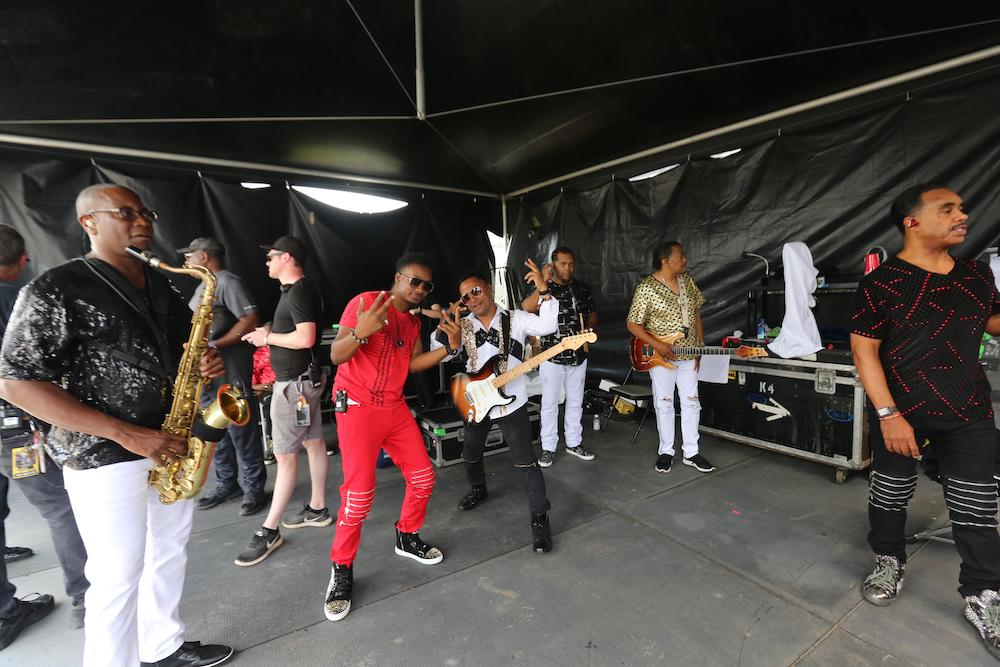
Kool & the Gang, clearly psyched about the exposure they're going to get on the Carb Day stage in 2019. Image by Penske Entertainment
Q: Just wanted to add a little info on F1 coverage based on the Mailbag question last week. I hate how the network cuts off coverage after the race, but there are great streaming options available depending on your provider. It's available on the ESPN App and ESPN.com/watch. It airs on the ESPN3 digital network, so when you click on the program it will either ask you to provide your cable/satellite provider credentials to authenticate you or it will recognize your internet provider and automatically connect you. There is a great show called F1 Chequered Flag that airs after each race and is one hour-plus.
Ed Kelly
MP: Thanks, Ed!
Q: Back in 2018 at St. Pete, Jordan King missed recording the first-ever sub-one-minute lap time at the track by 0.0477s. Rossi and Wickens also missed by 0.01s. Ever since then, I have been waiting patiently to see who would be the first driver to achieve this lap time. Saturday morning, and Scott McLaughlin breaks the barrier with a 59.7s lap. And there was much rejoicing! First round of qualifying Saturday afternoon, and 14 different drivers recorded a sub-1 minute lap time. Fourteen! And again, there was much rejoicing. At least two drivers recorded 59s-and-change laps and did not advance.
So after the race weekend was over, I watched your post-race video, read last week's Mailbag, have read your Cooldown Lap article, and all I can think is: Where is all the rejoicing?
OK, it’s not the same as Tom Carnegie's famous "It's a new track record!" at Indy, but finally breaking the one-minute barrier at St. Pete and the reaction is "meh"? I envision that Robin (and possibly fellow Mailbag readers) would have told me prior to the race weekend, that if "a driver broke the one-minute lap time" matters so much, that I should have created a big trophy, written a huge check and promote the heck out of it.
I know this makes me another of the "Get off my lawn!" aging cranks, but seriously?
FVA, another loyal Mailbag reader from Minnesota.
MP: You know, FVA, I really don’t appreciate you pointing out my utter failure here. Seriously, what gives? Kidding aside, you’re right. It was something I thought about after we did our post-qualifying video and despite realizing I hadn’t made enough out of it in print or video, it fell out of my head and never returned. I wish I could tell you that was a rarity, but it isn’t. Thanks for giving Scotty’s achievement the love that it deserves.
Q: Considering that the bulk of RE scanner sales have been to NASCAR fans over the years and I'm sure IndyCar would like those fans to come to an IndyCar race, it would be wise to make it easy for them to receive race frequencies.
Jeff, Florida
MP: As we mentioned two Mailbags ago, IndyCar is publishing the radio frequencies on its spotter guide for each races.
Q: After a team gets its doors blown off like what happened to MSR and AMSP at St. Pete, what does a team manager do to review what happened and make positive changes before the next race (or street race)?
Don Davis, Chardon, OH
MP: It’s an operational and engineering postmortem. Were mistakes made during practice that set the team back in the next session? Were there correlation issues between the expected performance shown in simulation versus the real-world data the cars generated? Did the team simply make the wrong engineering decisions leading into the weekend, which led to the cars being slow? Were driving errors, pit stop errors, or strategy errors involved?
We might use cars and tires and engines and all manner of technology to conduct our sport, but outside of random failures -- a blown engine or fried ECU, for example -- everything we do well or poorly is based on decisions made by the men and women on each team. The best among us work like crazy to root out the inconsistencies, and it’s easy to tell which teams are the best and worst in that regard each season by looking at the final Entrant standings.
Q: I forget why they changed the date, but what are the odds IndyCar keeps the earlier date for St. Pete next year given the attendance and viewership? Currently it’s scheduled for its “normal” timeframe.
Scott C, Bargersville, IN
MP: The date change was part of a network NBC opportunity. Only issues (which fans wouldn’t have known about) was the date shift dropped the Firestone GP on top of a weekend of concerts that were booked at the Mahaffey Theater which sits dead center inside the track and serves as the event’s media center. Teams and media were herded out of the track at early-ish hours on Friday and Saturday to accommodate the Il Divo and The Music of Star Wars concerts (not kidding), and adding to the fun, there was a giant gymnastics competition in the area that weekend which made finding hotels a real problem. The Super 8 I found charged insane prices as a result of the demand, but were kind enough to throw in the cockroaches and crack parties for free (also not kidding).
I was late getting to the track Saturday morning because of the ambulance blocking my rental car in as the poor EMTs were attending to someone who tried to meet their maker (once again, not kidding). But other than that, all went smoothly from this end!
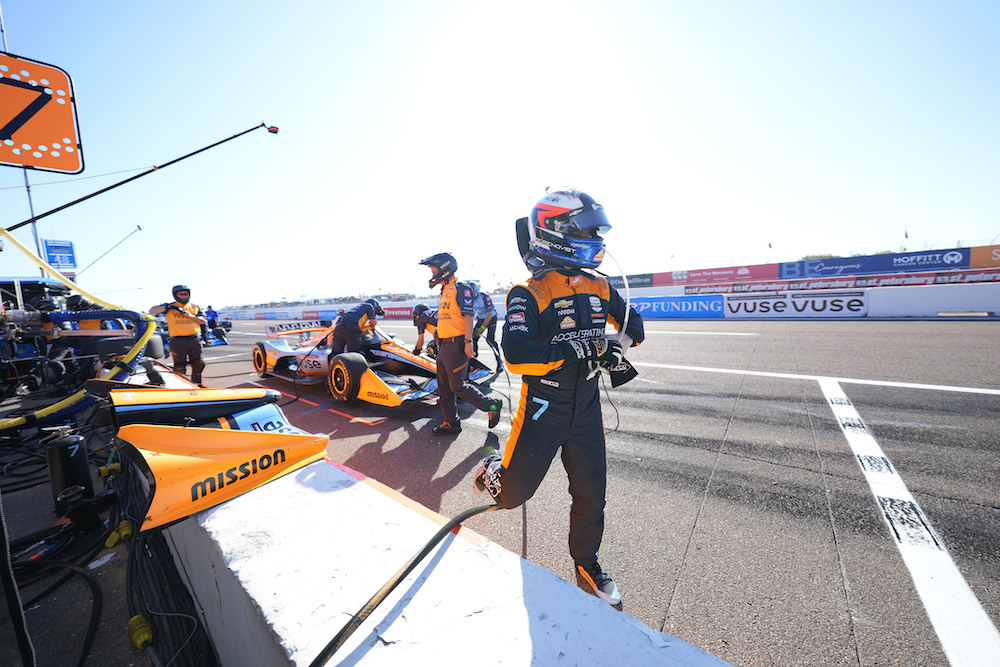
Safe to say there's been a whole lot of post mortem-ing at AMSP since St. Pete. Richard Dole/Motorsport Images
Q: Short of bringing the USAC Silver Crown and Midgets in under the Road to Indy umbrella, how’s this for an idea to reconnect IndyCar to its roots?
IndyCar rocks up at somewhere like IRP or Oswego and puts on a full afternoon or evening show of short track racing. Everybody has three short, sharp qualifying races with only six or eight cars on track at a time, two semi-finals, a mad dash LCQ and a 40-lap Main Event with the best eight or 10 cars that have fought their way through. Is that beyond IndyCar to try that, even do it under the lights on a Wednesday night for TV?
As for the new chassis, am I the only one who wishes IndyCar would just adopt Chris Beaty’s original Velocity concept that got him the DW12 redesign gig in the first place? I also wish most of us could see IndyCar over here in Britain.
Peter Kerr, Hamilton, Scotland
MP: Please report to 16th & Georgetown, Mr. Kerr. You’ve been hired as IndyCar’s new VP of Common Sense. Sadly, the job is paid with pork tenderloin sandwiches, 10 signed Gene Simmons hero cards, and all the Clabber Girl baking powder you can consume. Sound like a deal?
Q: As a big fan of RACER, both the magazine and online, I would like to make a suggestion. I appreciate your reports post-race and realize you cannot possibly interview every driver or team to find out what their post-race comments are. There is a website for Formula 1 that provides a brief post-race paragraph from each driver and team principal. I assume this is compiled from the press releases provided by the individual teams PR folks. I have not been in a media center for 35 years but do recall the race teams PR folks providing printed updates throughout the weekend to the press. A lot has changed since then, I am sure. Any chance RACER might try to provide an online post-race report such as this?
F1 has a media pen where all drivers meet the press after the race is done. Does IndyCar do something similar? With 24+ full-time drivers, it might make it easier to get their word out.
David, Fort Wayne
MP: Thanks for your membership, David. IndyCar did the quotes-for-every-driver routine up until a few years ago. Since then, the practice stopped and has been replaced with relying on the PR reps from each team to film and upload short video clips from the drivers. To achieve today what was once kindly provided by the series, it would require me to wait for the 26 videos to arrive and transcribe each one. And since Marshall and Gail Pruett didn’t bring me into this world to transcribe 26-plus IndyCar post-race videos at every round, and since you’re the first and only person to ask for it, we’re stuck with a lack of resources to make it happen.
Q: OK, I’ll make it four Mailbags delving into the starting command. “May the spiritual energy that drives our love of this sport start these engines.”
Then we wait.
And wait.
Samuel Beckett
MP: May the ghost of Brian Barnhart wake you with four good ones upside the head, Samuel.
Q: I’ve operated the starter for an IndyCar probably between 30 and 50 times. I can assure all those concerned that no matter how long I pushed the button to turn the engine over, the car would not start until the driver flipped the ignition switch. The driver, therefore, starts the engine. The guy operating the starting motor is doing just that, but he does not flip the ignition switch and start the engine!
Peter Jack, Calgary, Canada
MP: But how many times did you flip the ignition switch and then fire up the car to warm it up without the driver? See, this stuff is like the movie "Inception"; it’s all a dream inside a dream inside another dream. I’m so confused.
Q: Scott P asked about accidents in the paddock and you responded. It reminded me of crewing back in the days of ASA with Paul Dallenbach as our driver. Toledo, Ohio: The weekend started with us getting to the hotel and one crew room was ‘used’ when they walked in, as in, soiled underwear and a No. 2 in the bathtub.
The next day was practice and qualifying. That was interrupted by massive thunderstorms. So there we were, crews sitting in their trailers waiting the storm out, tornado sirens going off all around us, funnel clouds outside the track. Rain coming down so hard the track drains couldn't keep up. Everything started flooding. A couple of us ran out in the rain to warn one crew that the water was up to the bottom of their car that was sitting on jack stands. Gas cans were floating away, tires floating everywhere. We had to finish the day in soggy shoes and wet shorts. Tents got tossed around, etc.
The next day, they started the race under caution to try to get the mud and dirt off the track so we could go green. They took a break and all the drivers ran to the portajohns. ASA started calling for the drivers to get to their cars so we could get started again. I radioed to the crew chief that that won't happen since there was a line of over 20 drivers hopping around waiting for their turn with the portajohns. That weekend is also where we learned it really sucked to be garaged next to the portajohns when they were being emptied.
I'm sure everybody who ever crewed a race has their stories. From the time we used bubble gum the same color as the primer paint to make a broken body strut look like it was welded to get past the NASCAR inspectors, to using a pickup and a race car chained to a 150-year-old oak tree to straighten a bent frame. That's what makes having cold beverages with old racers so much fun.
John
MP: I love these stories, John. One that came to mind was back in the early 1990s when we were racing at Firebird Raceway outside of Phoenix and it was a hot but gorgeous and sunny end to the day in the paddock. Had our cars up on tall stands on the asphalt, sitting on our rolling seats doing nut-and-bolt checks, and in the heat haze coming up off the black tarmac beneath us, it looked like small pieces of the asphalt was coming up and moving around. By the time I realized what was happening, a herd -- if that’s the right term -- of scorpions started to overtake us. They’d crawled over from the cooling sand behind the open paddock and decided the steamy-hot pavement was more to their liking. Picture a bunch of supposedly tough and manly race car mechanics jumping up into the cockpits of our cars, yelping like children who were scared and peeing their pants. You can’t make this stuff up.
Q: Racing Electronics is now owned by NASCAR, so it does not surprise me that they do not support IndyCar anymore. That red radio they sell is tied to them and them alone since the connector is proprietary and the programming software has never been available. Manual entry of frequencies for that radio is unfortunately the only option.
There is a precedent: RE sold a previous programmable scanner (RE2000) and stopped supporting it at the track years ago for all series. Their logic? The software was old and would only run on Windows XP or earlier. That a cheap computer with XP could be used to program the radios did not matter.
An inexpensive and better option is the Bearcat BC125AT, which is computer programmable. My wife and I have used this model for 10 years with great results. RE does not sell this unit, likely because they can't lock you into their programming service ($) for those series they still support.
What model do you use?
PS: I've been using scanners at the track since 1982 and wanted to do it before then, but a handheld programmable scanner was not available.
David, Waxhaw, NC
MP: Thanks for the info, David. I haven’t used a scanner for many years.
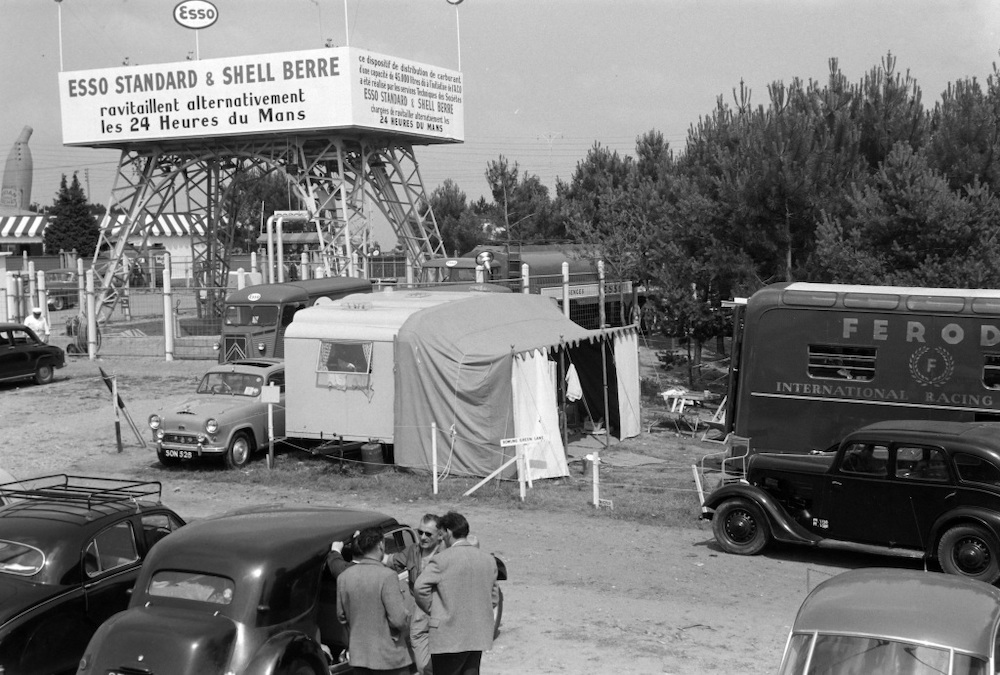
Couldn't find any photos of paddock shenanigans, but check this out: the Ferodo hospitality tent at Le Mans in 1957. No expense spared. Motorsport Images
Q: I'd pay to see Roger Penske shout, "Drive, you magnificent bastards!"
Robert
MP: Things I’d pay to hear Roger Penske shout:
1. “C.R.E.A.M., Cash Rules Everything Around Me.”
2. “It's a long way to the top, if you wanna rock n roll.”
3. “Sippin' on gin and juice, laid back, with my mind on my money and my money on my mind.”
4. “Living in a fish-eye lens, caught in the camera eye, I have no heart to lie, I can't pretend a stranger is a long-awaited friend.”
5. “I love it when you call me Big Poppa, throw your hands in the air if you's a true player.”
Q: I have a couple of thoughts -- perhaps too radical -- but meant in the spirit of furthering IndyCar’s appeal by making some races "pass-worthy." My home track used to be the Milwaukee Mile, where passing was common, with two and sometimes three lanes available.
I attend midget (Badger and USAC) and sprint races here in Wisconsin, and what is interesting with some of the races are the fast qualifiers may not necessarily start on the front row, and may have to start as far back as the third or fourth rows. This provides the crowd with the chance to see the fastest work their way through, while at the same time offering some great racing for the others. I also watch F1, but some of those tracks do not allow much passing. The fastest just take off.
My crazy thought is for IndyCar to have a point system for qualifying that rewards the fastest with meaningful points, but then to invert the top six (or eight) for the actual race. Though the racing in IndyCar has been spectacular at some tracks, this may open up the competition to separate itself from parade racing that is based on mileage and pit strategy -- and to reward passing. I also find the mileage and pit strategies interesting. I just wonder if this approach would overall help the series by promoting passing on tracks that have historically been high-speed parades.
I don’t see this thought applying to Indianapolis, or at tracks like Long Beach, Gateway, Road America… but there may be other tracks where fans would find this appealing and interesting? Could it help grow the sport? Would sponsors like this? Perhaps too gimmicky. Thoughts?
Dennis Manthey, Middleton, WI
MP: As a fellow lover of chaos, I’m all in with the grid inversions and any other randomness we can bring to shuffle the deck and watch as the series’ best tear through the field. Sadly, none of the drivers, teams, or sponsors would get on board with this because they don’t do this to win under the hardest circumstances.
Q: All right, so instead of "start your engines," what if there was revolutionary war re-enactor with a trumpet. In a super-duper cool posh accent, he could say, “prepare for battle!” Also, the safety car should be replaced by the same guy but he has to ride a horse, which would subsequently leave bombs all over the racing line.
Ian Craddock
MP: Sadly, when the new hybrid formula arrives in 2024, all cars will be started with the push of a button on an app. Roger Penske’s nephew Trevor will be in charge of the IndyCar Start Phone, but there will be routine delays -- sometimes lasting hours to days -- as the phone updates to the latest iOS software and then refuses to connect to WiFi or the Bluetooth receiver in the ERS systems.
Q: I read something that caught me off-guard -- Gene Haas's ability to find his F1 team in precarious sponsorship situations, and the possibility of damaging the team's reputation. With the energy drink fiasco, and now with Uralkali, how is it his team is not able to find partners to support him? Does his team not properly vet potential clients? He is partners in NASCAR of a four-car operation with tons of sponsorship; how is the F1 team not as successful in securing the same level (stable) of commitments?
Do you think the Haas' reputation is damaged? We know he personally can fund the team, but that is bad business. And I’m going to stay away from the Andretti question because we all know that’s not going to happen.
Tom Ross, Morro Bay, CA
CHRIS MEDLAND: To be fair to Haas, those are the only two sponsors they've had trouble with, and only one of them was particularly risky. Rich Energy came at a time when there was no budget cap and Gene wanted to see a greater return on his investment, so Guenther Steiner went out and secured a title partner that a number of teams -- including McLaren and Williams -- were chasing. It turned out to be a mistake, but it's hardly the first too-good-to-be-true deal an F1 team has seen, and it moved on quickly. When it came to Uralkali, the team was in a position where COVD-19 meant there was every chance it would shut down due to lost revenues, so it was a case of needs must, and it was very good money for the team. But I don't think anyone could have foreseen Russia invading Ukraine more than a year ago, and Ferrari also had to drop Kaspersky as a result of that.
I think the way the team has reacted quickly has been commendable, with Gene increasing his contribution again to keep it stable while it talks to new partners who are far more likely to get involved now Uralkali is off the car and Kevin Magnussen is back. Paying a quality, experienced driver rather than taking another pay driver is a good sign, and I think its reputation has been boosted by the way its handled the past month. I do think you're onto something in terms of vetting clients, though -- Steiner does some deals, but has a lot on his plate and probably could do with an expanded marketing and partner team.
Q: With F1 in full testing mode, I've been wondering why the wheel cover design changed from the original smooth, slightly bowled shape seen on the wind tunnel model and initial renderings to something that more closely resembles a stamped wheel without a hubcap? Props to Alfa Romeo for being the only team to add some much-needed color to their rims.
Michael, Halifax, Nova Scotia
CM: The initial model was far less developed than what we now see on the cars, and part of the regulations also brought a change from the wheels themselves being open for development to a standardized wheel across the grid. That saves the teams up to $1m per year, so was a sensible move, but also meant the wheel covers didn't need to be open to interpretation either and F1 could define the detail more. The gaps you see on these covers still allow some cooling from the brakes -- much less than was available previously -- without ruining the impact of the new rules, which was to prevent turbulent airflow coming out of the wheels.
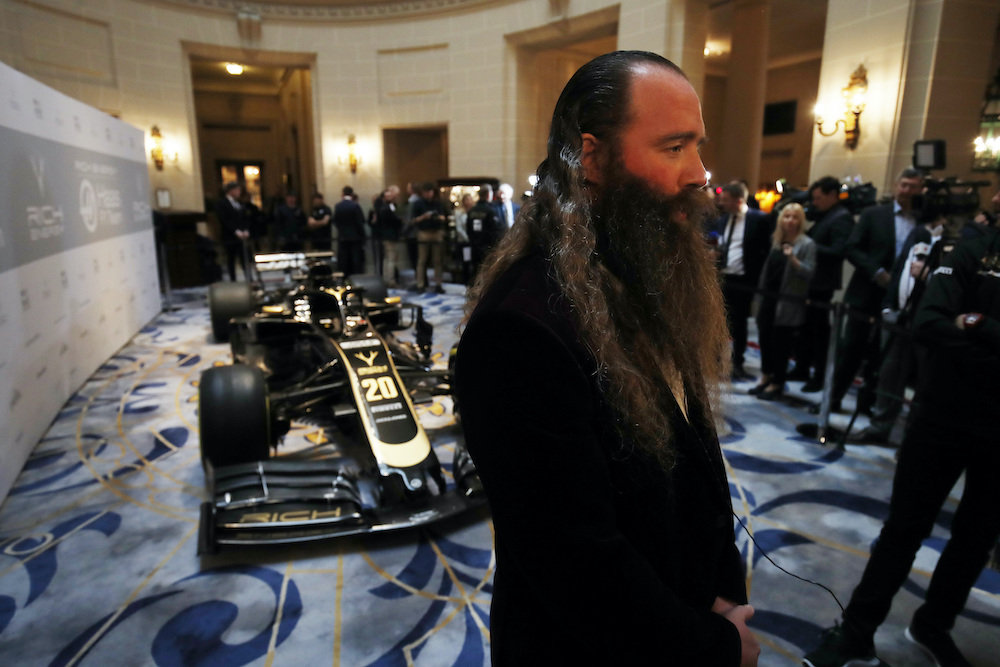
Former Rich Energy CEO William Storey started his Haas relationship by getting sued for stealing a logo, and ended it by comparing the team's car unfavorably to a milk cart. The team's next title sponsor was aligned with a country that decided to launch a brutal invasion of its neighbor. What's in store for Act III? Joe Portlock/Motorsport Images
Q: What happens to the old NASCAR Cup car now that the new Cup car is here? Will the Xfinity car be replaced in the near future? How does the new Cup car compare to the Supercars from Australia? How does the Xfinity car compare to the Trans Am TA2 car?
Jeff Koopmaan, Campbell River, BC, Canada
KELLY CRANDALL: The old Cup Series car is obsolete, so teams emptied their inventory as soon as the 2021 offseason hit. Those cars were either tossed aside, or interested Xfinity Series teams had the option to buy some parts and pieces and recycle them into their cars. As for the Xfinity Series, I do not expect a change anytime soon and NASCAR has not given any indication that it is looking to make any changes. NASCAR moved to composite bodies in the series in 2018 and since then, there has been a lot of praise for how well the cars hold up when battle-tested.
As for it comparing to a TA2 car, that chassis was based off a super late model.
Now, as for Next Gen comparing to an Australian Supercar, who better to ask than Joe Gibbs Racing crew chief James Small, who has now worked on both?
“They aren’t very similar. They do have some things in common like the braking packages, independent rear ends and the transaxle is from the same family -- NASCAR is a five-speed and differential, Supercars has a six-speed and a spool (locked differential).
“Otherwise, they’re very different in terms of geometry, weight, center of gravity, driver adjustability within the cockpit, etc.
“A Supercar has far more mechanical things that you can do that are still open in terms of design (until they change the rules for next season) and they’re a lot lighter.
“A NASCAR is way more aero sensitive with the underbody and diffuser.” – James Small
Q: I still can't help but wonder what's going on with the Petty team. Already they have third and fourth this year, and were headed for another good finish – seventh – before crashing in Vegas.
Richard
KC: What’s going on here is that Richard Petty’s car is in the right place at the right time, starting with being under a new banner when Maury Gallagher bought a majority stake in the Petty team. Gallagher and his GMS operation have more resources and people than what the Petty camp did, so that plays a part. Money and people = speed. There is also the new car, which is clearly bringing some parity into the Cup Series right now as every team is learning the machine and no one seemingly has the advantage. I don’t think the talent of Erik Jones was ever in question, but he’s got the people and resources around him and he’s taking well to the new car. So too it seems is his crew chief, Dave Elenz, who moved into the Cup Series from the Xfinity Series and seems to have a good start on Next Gen.
THE FINAL WORD
From Robin Miller's Mailbag, March 19, 2014
Q: If what I’ve read on Facebook is true, it looks like Texas World Speedway is facing what seems to be the nemesis of all abandoned open-wheel venues: developers with armloads of cash. Do you have any good stories about Indy cars at TWS?
Dan Wildhirt, CO
ROBIN MILLER: I saw that and it’s amazing it’s taken this long. At Texas in the mid-’70s with Bill Finley’s team and Bentley Warren driving. Had a problem in qualifying and only went quick enough to be the first alternate. But Bobby Unser blew up and didn’t qualify so USAC came along and asked Finley if they could buy his spot. He said sure. Then they paid the slowest qualifier to give up his spot to Uncle Bobby. They took the money and left. We were loaded up but I suggested we wait until warm-ups were over the next morning in case somebody crashed. As fate would have it, Bob Harkey hit the wall and we were back in the race. A double payday for Finley and the only contribution I ever made to one of the last true chief mechanics.
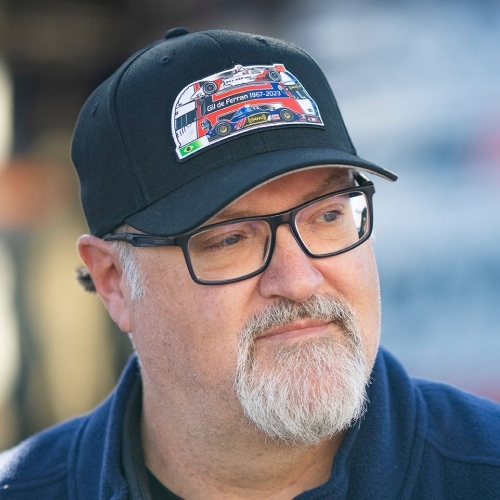
Marshall Pruett
The 2026 season marks Marshall Pruett's 40th year working in the sport. In his role today for RACER, Pruett covers open-wheel and sports car racing as a writer, reporter, photographer, and filmmaker. In his previous career, he served as a mechanic, engineer, and team manager in a variety of series, including IndyCar, IMSA, and World Challenge.
Read Marshall Pruett's articles
Latest News
Comments
Comments are disabled until you accept Social Networking Cookies. Update cookie preferences
If the dialog doesn't appear, ad-blockers are often the cause; try disabling yours or see our Social Features Support.