The RACER Mailbag, February 23
Welcome to the RACER Mailbag. Questions for any of RACER’s writers can be sent to mailbag@racer.com. Due to the high volume of questions received, we can’t guarantee that every letter will be published, but we’ll answer as many as we can. Published questions may be edited for style or clarity.
Q: I am reading My Checkered Past and I have to say I am very disappointed in Al Unser Jr. I loved to watch him race, and I was a big fan of his during the day (I have been going to IndyCar races since 1967). But his revelations in the book – I am only halfway through it – are amazing. It seems he was very self-destructive, self-centered and made a lot of not very smart decisions. I have lost all respect for him. He had a negative impact on a many people; some he professed to love. As a driver he might have been even more impressive than he was, given some better life decisions. Squandering that natural talent is not only a waste, it is a slap in the face to those who may have similar talent but not the wherewithall to realize their ambitions.
I'm writing this just to get it off of my chest, and maybe get some insight. Am I missing something?
Mark Hamilton
MARSHALL PRUETT: I had the opposite reaction to his book; I appreciated his honesty. Yes, Little Al won two IndyCar championships and two Indy 500s, which is a remarkable thing. But he also left another two or three CART titles behind due to his demons and addictions.
Learning more about how an elite talent rises to the occasional challenge but comes up short more often than expected is where I found the greatest value in the book penned for Al by my pal Jade Gurss. How many promising draft picks fail to live up to their potential in stick and ball sports? More than we’d hope, which is why I don’t share the same negative opinion here. I also keep in mind that without the same challenges Little Al faced or created for himself, his top rival, Michael Andretti, became a one-time champion and has zero Indy 500 wins. So if I compare the two, Unser Jr. might’ve overachieved.
Q: Last year after RC Enerson failed to qualify for the 500, Bill Throckmorton said, “I guarantee we’ll have a car in the 500 next year, and R.C. will be the kid driving it.” That no longer appears to be the case, even though it appeared to be a symbiotic relationship with the Enersons owning the chassis and spare with Throckmorton having the budget. Are both really going to risk sitting on the sidelines? What happened?
John, Del Rio, Tennessee
MP: I continue to root for both to succeed here, but the Throckmortons and the Enersons seem to suffer from the same lack of budget, so there’s nothing to risk. I can’t speak to what went sideways between them, but there are one or more Indy 500 hopefuls with money in hand who want to get the Enersons’ cars and go racing. As for RC, that kid never appears on the short lists of paying IndyCar teams when they’re looking for new drivers and it’s a shame. I bet someone would be pleasantly surprised if they went testing with him.
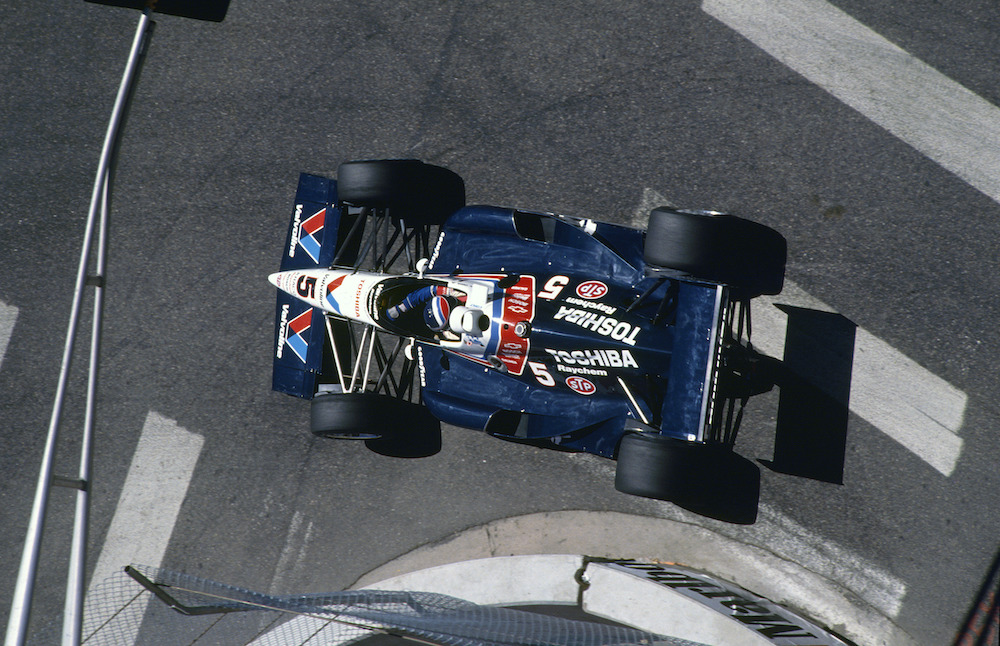
Not all of Al Unser Jr.'s story makes for comfortable reading, but he deserves maximum respect for sharing it as candidly as he did. Motorsport Images
Q: Now that RP has owned the Speedway a few years, what changes have made an impact on experts like yourself?
Pete Jenkins
MP: I honestly can’t think of anything that stands out for folks like me who write the stories, take the photos, or shoot the videos, but I think it’s supposed the be that way. R.P. doesn’t need to waste his money on our side of the sport; it’s better spent on making the fan experience better, cleaner, and more upscale.
Q: I am excited about Michael Andretti’s intention to join F1. Do you have a sense of the barriers he is facing from the existing F1 hierarchy? Given their clear desire to expand in the U.S., it would seem a no-brainer. But, I am sure they are worried about diluting their product, a la baseball/NHL expansion.
Jeff
MP: If Michael has the money and supply contracts and infrastructure ready to go, I can think of no logical reason why the FIA or F1 teams would stand in the way of Andretti Global or any other new prospective entrant with everything in place to do a proper job. It’s the protectionism part that worries me. That being said, with F1 undergoing a healthy growth spurt in viewership and awareness, there does seem to be a desire to ensure nobody else gets in while the getting is good. It’s a gang mentality being practiced by zillionaires and auto manufacturers.
Haas F1 has been an embarrassment for years, and yet, due to the timing of Gene Haas joining the grid, his annual s***show deserves to be safeguarded from being demoted from P19 and P20 by Andretti Global (or similar) to P21 and P22?
Q: Been watching Winter Olympics on our local West Palm Beach NBC station and there has been constant commercials from RP Funding who apparently is a sponsor of the St. Pete race and the Firestone Grand Prix logo and dates are clearly displayed though not prominently but still visible. Nice to see some promotion this far away and in a different local station area. Have you heard of any other promos regarding the race? St. Pete always gets the live crowd, but the tune-in crowd is important.
Jeff, Florida
MP: I haven’t, and if you think you’re far away, I’m 3000 miles to the west…
Q: If Toyota does enter one of its brands as the third engine manufacturer in 2024, do you think there’d be a push to get IndyCar back to Japan? Toyota fought tooth and nail to get the Japanese GP to go to Fuji when it started its F1 program; would it use its track to get IndyCar international again?
Rikki, UK
MP: I do. Considering how the idea of Toyota (through a sub-brand) returning to IndyCar came from the mothership in Japan, and how there’s a tie-in with wanting to use the same motor in Japan’s top open-wheel series, Super Formula, it would be strange to think of a big new program commissioned out of Japan without some component involving a home race at some point.
Q: I have a question about what you think the best way to rank Formula 1 greats across the history of the sport. In F1's first 10 years, the average number of races was 8.4. In the past 10 years, the average number of races was 19.9. In addition, the number of points awarded has changed several times since 1950. Clearly, raw numbers such as races won, poles, laps led and points are not valid methods of comparison. My suggestion for comparison would be percentage of races won. Using this metric, the top three F1 driver are: Fangio (47%), Ascari (41%) and Clark (35%). By comparison, Schumacher (30%) and Senna (25%) lag behind. In addition, both Schumacher and Senna were involved in several incidents where they crashed out their championship rivals.
Also, while Fangio and Ascari were both great professional racing drivers, many places in the early F1 fields were filled with rich, playboy drivers who were talented amateurs at best. I would submit that Jim Clark drove against seriously accomplished professionals who won across the spectrum of motorsport: Moss, Hill, Brabham, McLaren, Hulme, Gurney, Andretti. I would submit that Clark is the greatest F1 driver of all time.
Would love to hear your thoughts on this, and thanks for your time!
Bob Isabella, Cleveland, OH
MP: I’ve always rejected the mathematical approach with all-time rankings. It’s like trying to apply a formula to decide which food tastes the best or which band made the best music. How on earth can an equation do a better job of ranking what I’ve seen firsthand or heard, etc.? Numbers don’t account for nuance, nor do they speak to style, talent, difficulty, or any other human factor that played a critical part in why one driver had more or less of something than the other.
The NBA just honored its 75 greatest players during last weekend’s all-star game. Transport any of today’s players who made the list back to George Mikan’s 1950s era with the Minnesota Lakers, and our current greats utterly destroy the legends of old. Different times, different skills, and different rules.
If there’s any area of rankings that I place value in, it’s listening to the old drivers, owners, or reporters who saw Moss, Hill, Brabham, Clark, etc., and all the greats who’ve followed, and hearing what they have to say.
CHRIS MEDLAND: I think you highlight why it’s always so tough to define, because people can’t agree on the method of ranking let alone whether the results are then trustworthy.
Personally, I think you’re on the right track, because it’s the combination of success and results but allied to wider skillset across regulations, and that really tough thing to pinpoint which is just gut feeling.
We’ve all seen drivers pull out incredible performances that do nothing for their actual stats but stick in the mind. Of the modern crop, think Hamilton holding off Alonso in Indianapolis as a rookie more than one of his dominant wins in later years, or Verstappen in the wet in Brazil when he was only third.
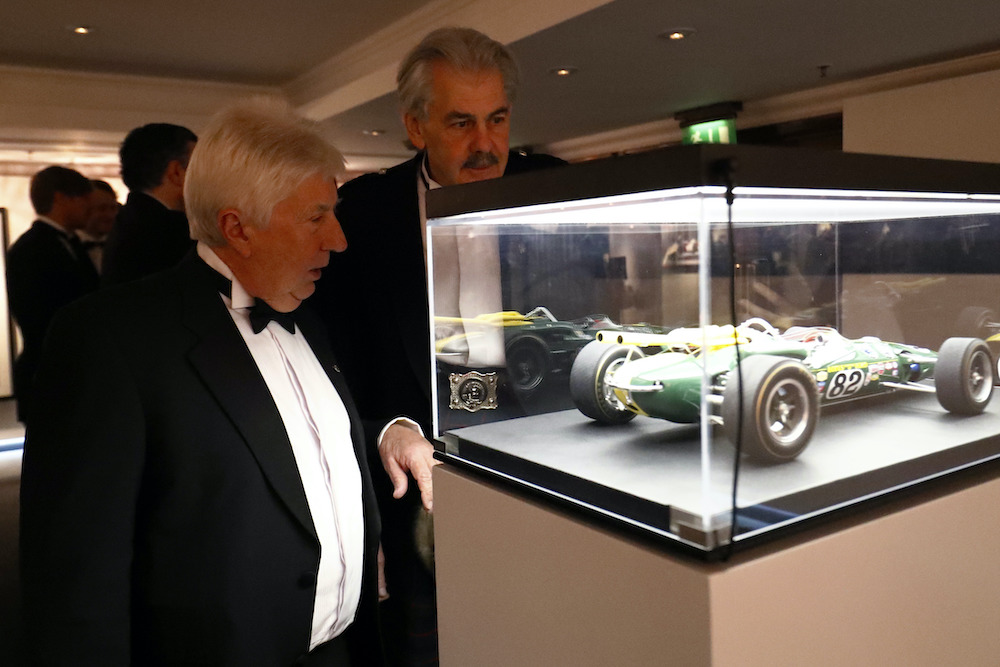
It's impossible to compare champions across eras. For starters, the cars that Clark drove were absolutely tiny. Zak Mauger/Motorsport Images
Mario’s my favorite driver because of the different disciplines he raced and won in, and how regularly he did it, but that’s also me being romantic because it’s something that isn’t replicated at the top level anymore.
To be really boring though, I’d argue there’s not a GOAT in F1, and there’s not in many sports. Because the world evolves so quickly – be it directly related to the sport itself or not – that the environment and challenges these athletes face change rapidly.
For example, the Senna and Schumacher crashing point you mention is a valid one, but they raced in a time when contact with a rival was far less dangerous than it was for Clark, Fangio and Ascari, and the sport so much more professional that the demands and pressures were different. I’d say neither Senna or Schumacher would drive the same way if they were racing in the 1950s and '60s.
So many drivers would probably be completely ill-suited to the sport in a different age compared to when they were great, but the main thing is they were all great.
Q: Let me preface this by saying I am a fan of the amazingly talented Colton Herta and Andretti Autosport has done many great things for the sport. However, it has been nearly 10 years since Andretti last won a championship in IndyCar. To win a championship you need amazing consistency which is a prerequisite in F1. When I think of CART/Champ Car/IndyCar drivers that go to F1, I think of Villeneuve, Zanardi, Montoya, da Matta, and Bourdais. All of these men dominated the sport prior to making the flip. Even Pato has tempered his expectations about going over the pond. It really seems like Andretti is forcing this move.
I would much rather they focus on an IndyCar championship. I really would celebrate a Herta championship (or Rossi). If this was Ganassi trying to get Palou to F1, I wouldn't have written in because Alex has hit the pinnacle of IndyCar racing and Ganassi is a championship organization. For the past nine years it really has just been Penske versus Ganassi. And if Andretti is not careful, they no longer will be in the Big 3 of IndyCar with McLaren and Rahal doing everything they can to be in that conversation while Michael seems focused across the pond.
I wish everyone luck, but I think they need to take a deep breath.
Bob
MP: Michael wanting to become an F1 team owner is not the same as Colton wanting to become an F1 driver. I know Herta has an interest, but he’s not a slave to Michael’s business decisions, and if he doesn’t like what he sees, I can’t imagine he’d give up on IndyCar. And if Michael were to give Colton an ultimatum of moving to F1 or losing his IndyCar seat and Herta didn’t want to go, Penske, Ganassi, and all the other big team owners would sign Colton in a heartbeat.
Q: 1. Thanks for IndyCar's hybrid-electric (KERS) planning information.
2. Will the proposed IndyCar electric motors be powering the front or rear wheels?
3. The IndyCar racers previously indicated they do not like using a push-to-pass method of implementing hybrid electricity. What is the current concept for IndyCar to deploy the harvested electricity?
4. I currently drive a Ford hybrid-electric. It integrates using the throttle pedal to command when electricity is harvested and deployed. Furthermore, the shift lever is used to command how aggressively electrons are gathered and deployed. What is the related IndyCar concept for controlling harvesting and deployment of electrical propulsion?
5. It's suggested the current push-to-pass system be kept as currently implemented with the combustion engine.
6. Controlling the electrical harvesting and deployment of electrons should be separate from push-to-pass control of the turbocharger. How is IndyCar planning to control the copied KERS functionality?
7. FYI, Ferrari has torque vectoring to assist with vehicle directional control.
8. Since the original mission of IMS was to experiment with and showcase evolving automotive vehicle technology, it is (strongly!) suggested that IndyCar consider adding torque vector steering augmentation when it implements hybrid electricity. Now that would be automotive news (in keeping with the mission and function of IMS)!
9. Small individual (unsprung) electric generator/motors could be added to the front of IndyCars (maintaining a reasonable front-to-back vehicle weight distribution) while the traditional push-to-pass combustion engine augmentation remains as currently configured to the rear wheels.
10. Thanks for your ongoing IndyCar technical news. Us gearheads appreciate your technical coverage. Please share my compliment with Pfanner & thank him for his great magazine and staff!
11. I too, miss Robin Miller. Send a note of love and thoughts to his sister. Can we still make blood donations, to help repay for that cost? My blood bank needs to know how to identify that account.
Bill in CA
MP:1. You’re welcome.
2. Rear-wheel drive.
3. Not true. They didn’t like its use during a test at the Speedway where P2P was tried. P2P is the plan for ERS deployment, but like everything about the 2023 project, it’s subject to change.
4. I wrote about what I know on this subject at length in the latest issue of RACER magazine. Well worth buying a print copy or downloading the digital version.
5. Yes.
6. Turbo P2P is meant to be replaced by ERS P2P.
7. OK.
8. OK.
9. Could? Yes. Will? Not a chance.
10. You’re welcome once more.
11. People are always able to donate blood and can do so in honor of whomever they choose. There’s no "Robin Miller account" to be credited for such donations.
Q: When did the podium for the top three finishers in IndyCar, or F1 for that matter, become a thing? I remember when only the winner of a race got celebrated. The second and third finishers were just the the first and second losers. Is it to appease sponsors, or just a way to add to the show?
Greg, Mt. Prospect, Il
MP: It’s the only thing I’ve known for IndyCar since I was a kid growing up in the '70s, with the superspeedways as the regular exception where the winner is the sole focus of the celebrations. I’ve seen gorgeous F1 podium shots from the 1960s as well where the top three were featured, so if anything, it’s a really old tradition, and not exactly an oddity. Haven’t the Olympics been doing a three-person podium forever?
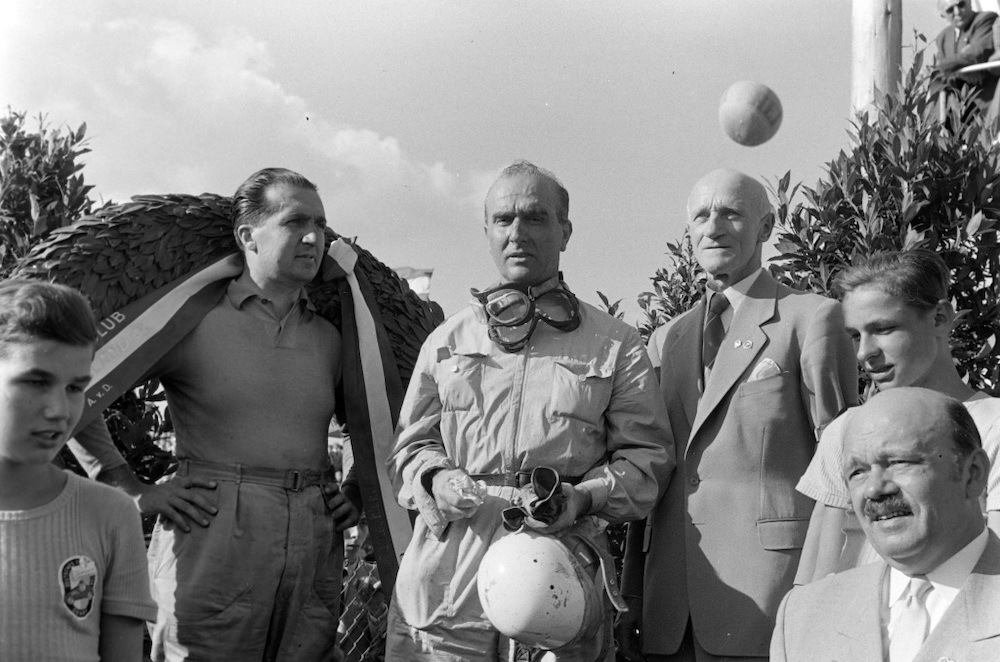
Not sure this is an official multi-driver podium, but second-placed Nino Farina joined Alberto Ascari on the German GP podium in 1952 after the pair led a Ferrari 1-2-3-4 in the race, and Ascari became the first driver to seal the championship with two races to go. They look stoked. Motorsport Images
Q: Grosjean jokingly suggested racing ovals at a doubleheader on day two in the opposite direction. I know the cars are set up to turn left, but it seems like an interesting idea. Is it at all feasible as an interesting added attraction?
Oliver Wells.
MP: I’d think the counter-clockwise layout where SAFER barrier placement and the rest of the safety infrastructure is designed for cars turning left, rather than right, is where the idea comes to a swift end.
Q: I wanted to follow up on last week's letter from Heather Streets about Peacock coverage of IMSA, particularly when she mentioned "the amount of dead air for the commercial breaks."
A couple of years back, the World Challenge races were streamed live while at the same time, they were creating a program for broadcast on a one week delay. Greg Creamer and Calvin Fish understood they had a dual purpose, and after sending their broadcast into a commercial break, they would take a brief pause and say, "And for our live audience..." and return to commenting on the action happening during the break, which was not going to be a part of their TV broadcast in a week. It was really well done too, as they could throw out facts for diehards, have a little more freedom with their comments and joke around a bit. Then when the time was right, they'd come out of their commercial break and return to crafting their broadcast show.
I've heard many people say they enjoy hearing the ambient sounds on Peacock during the commercial breaks, but I lost count of how many times something of real significance would happen while the commentary team had gone silent. Overall or class leading cars pitting, having flat tires, spinning, crashing or passes for the overall lead.
There's no reason for them to have to stay so silent for so long, especially during a Michelin Pilot Challenge race. The silence ends up being such a large percentage of the event. I'm sure they need to shut off their mics and have an off air production meeting about what they are going to talk about when they come out of the commercial break, but once that's done, I'd really like for them to return to the commentary Creamer/Fish style, or at least have the freedom to speak up when something is worth talking about.
During the NBC Gold era, this happened one time – during the Road Atlanta 6 Hours held in September when A.J. Allmendinger was a part of the team. And it was great! Race commentary, off the cuff remarks, jokes, interesting facts and stories. I suspect A.J. couldn't stop talking or didn't know about the blackout period when they were traveling around the dark side of the commercial breaks.
So, with the push by NBC to have fans watch their Peacock broadcasts, I don't understand why we don't count enough to have them take us into account when the race is happening by telling us what is going on, particularly when it has major significance to the race and how its strategy is playing out.
Jeff Barak, Minneapolis, MN
MP: Good to hear from you, Jeff. Hope to see you and more of your homemade racing shirts at Road America. If we’re down to complaining about how we don’t get live commentary during live commercial breaks on a streaming platform, holy cow, we’ve come a long way from the Mailbag being loaded with hate mail about Eddie Cheever putting people to sleep during the broadcasts.
What can I say? NBC has had a policy for a while now to pipe down during the commercial breaks. When I was doing a number of the Indy Lights broadcasts a few years ago, I made the mistake at Road America of saying something to one of my co-hosts during a commercial and was both reminded to be quiet and got a few inbound Tweets from people who were catching the NBC Gold stream who caught my mistake. It’s how they want things done, so that’s how it’s done. And if that’s the worst thing about today’s broadcasts, we are living in amazing times.
Q: NASCAR's Cup Series used the Los Angeles Coliseum for the Busch Light Clash this year for only one race only. Will the IndyCar Series use any stadium or a street to convert in to a racetrack for one race only, and after that race they tear down that race track?
Chris Fiegler, Latham NY
MP: Not totally clear on all that’s being asked here, but in the case of streets, they all get torn down after the last race of the weekend is over. As for IndyCar looking to do a similar Coliseum event, it feels like they’d get slammed for simply copying NASCAR’s idea.
Q: I noticed some comments regarding NASCAR's Clash in LA in last week's Mailbag. I think it's worth noting that NASCAR engaged a crowd full of first-timers that otherwise may have never even considered watching the sport. Same goes for F1's "Drive to Survive." Both of those creative ideas ignited a new fanbase, despite being gimmicky and purely for entertainment. While I'm not suggesting IndyCar copy these ideas (dare I bring up IndyCar's ripoff of "Cars," "Turbo"?), I am saying that I can't recall the last time IndyCar made any real attempt to truly expand its fanbase.
We've been beating the "most competitive series in the world" drum for a while now. And while I beat that drum too, it's not enough to move the needle on its own. Although I don't have any revolutionary ideas myself, it always stings to see racing's big brothers whip out a wild idea and execute to reinvigorate their sport while IndyCar gets involved in eSports 20 years late.
Michael, Halifax, Nova Scotia
MP: So you’re saying IndyCar’s ‘Defy Everything’ marketing campaign hasn’t done the trick? (Kidding.) I’ll keep beating the same drum and say that if IndyCar wants to make new fans, take the series to places where those people live and drop a street race in their laps.
Nashville is a perfect example of this formula, which was used to great effect by IMSA, and IndyCar to a slightly lesser degree in the 1980s, when both series were ragingly popular. NASCAR’s idea of taking its product to a solid market and make it easy for people to attend is the same exact formula, but trading streets for a downtown coliseum.
IndyCar has an amazing product to offer, and for those who see it live, the hooks are set. The location of where IndyCar tries to set those hooks is where there’s room for growth, and going to the same tracks every year isn’t making much of a difference.
I always think of my home track of Laguna Seca as an example when this question comes up. When racing was a much bigger deal, fans would stream into Monterey to watch the major races. From where I live in the Bay Area, where there are millions of us, Laguna’s about a 90-minute drive south.
Since our favorite kind of racing has decreased in popularity, there aren’t many who know or care about a sporting event that’s 90 minutes away, buried in the hills, and offers almost no modern amenities like you’d find at a MLB/NFL/NBA/NHL game. I wish it weren’t the case, but IndyCar’s return has been a ghost town. Same for IMSA.
If IndyCar wants to grow, let’s hear about the Unser Family 200 on the streets of Albuquerque. Let’s race around the Oklahoma Thunder NBA arena. When do we load in for Chip Ganassi’s Pittsburgh Grand Prix that sprints around the Pirates and Steelers stadiums? Go to where the people are and let them rejoice in IndyCar. Amen.
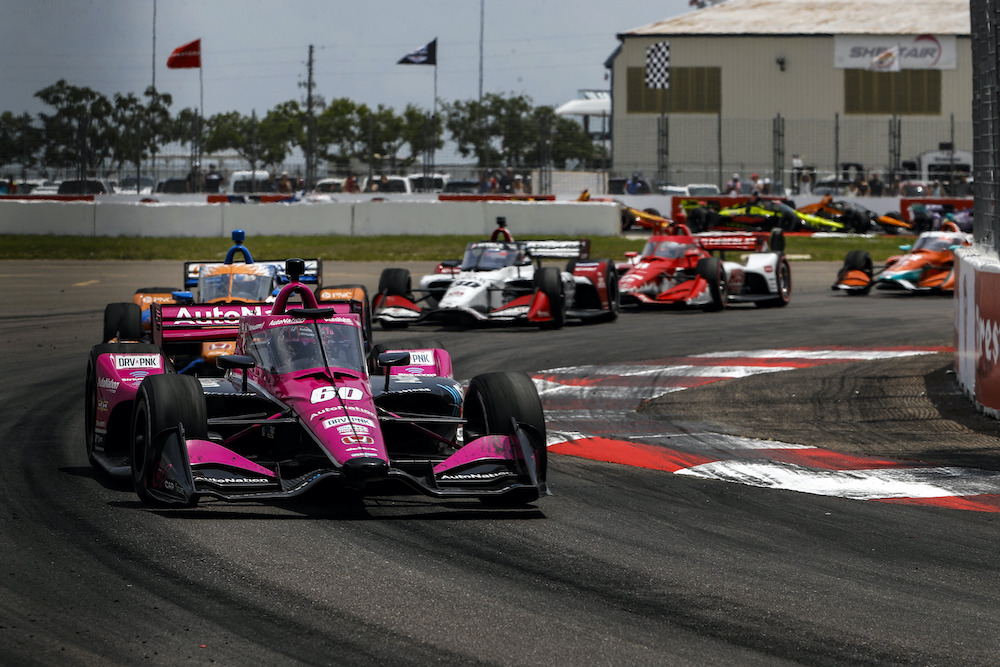
Like all street races, the St. Pete track infrastructure will be taken down immediately after the event. Phillip Abbott/Motorsport Images
Q: Why the change from "Gentlemen Start Your Engines"to "Drivers Start Your Engines"? And please don’t use the lazy excuse that there are more women in racing; I’m sure those in charge are smart enough to realize when a women is in the field and to say "Lady/Ladies."
Hard to call them the most famous words in racing if they are not the same words!
I hope this isn’t the racing industries attempt to appease the PC crowd. History of the sport means something.
Chuck Ney
MP: Come on, man. I thought email was invented in the late 1980s, but you’ve somehow managed to send this from the 1950s. Not exactly sure what the thought process was when assembling this ode to old-timey thinking where casual sexism was cool and women "knew their place." It doesn’t belong in IndyCar, or anywhere else. But while we’re here, this is what Paretta Autosport owner Beth Paretta had to say:
"It was changed over a decade ago to reflect who they are addressing more appropriately. Also, it’s still wrong to say Drivers Start Your Engines but for another reason. Not to “ladysplain,” but in IndyCar the driver does not, in fact, start the car. The crew member standing behind the car does with the mechanical starter, and sometimes, that crew member is a woman. If we want to be accurate we could say “Teams,” but we’ve settled on “Drivers,” which is used in most forms of motorsport around the world. Welcome to the show."
Q: Has brand identity in IMSA and WEC gone too far? I get it – brand identity brings the big manufacturers and that ensures healthy starting fields and sponsorship. But, I'm having trouble seeing the similarity between the Peugeot 9X8 and any of their production vehicles or the coolest looking sportscar ever – the 905.
To a certain extent, the same could be said of the Cadillac GTP. While I applaud both makes exploration of new aero approaches, it appears the stylists have won the battle. The 9X8 and Cadillac GTP look like set props for a Transformers movie. Tell me these cars will look better after homologation.
On a completely different subject, it seems Multimatic has become a genuine competitor to Dallara in the sportscar arena. The fact that Porsche chose them for their GTP entry says a lot. Does Multimatic fabricate its monocoques using its own autoclaves?
Jonathan and Cleide Morris, Ventura, CA
MP: I like what I’ve seen so far of the 9X8 and the Caddy GTP car, so I hope they don’t change. I’m pretty simple that way; I love it when IndyCars and prototypes and GTs look radical or like they’re from the future. Acura’s ARX-05, while being a fine motor racing machine, does nothing for me. Same with the looks of the current Caddy DPi-V.R. They aren’t unpleasant to view, but they are miles away from being iconic designs.
Oh yes on Multimatic. They have a few giant facilities throughout the globe and the race car manufacturing side is tiny compared to everything else they do. To my knowledge, all the big stuff is done in-house.
Q: Just finished John Oreovicz's excellent Indy Split book. It lays out in perfect detail the fact that neither side won that stupid war. It was obvious to all of us who lived through those mostly dark times that CART/Champ Car was not going to be able to survive without racing at Indy and the IRL was not going to be successful in forcing an all oval, all-American driver series down the public's throat.
One of the things that really struck me were the comments by Dario Franchitti, who said how much he hated the pack racing the IRL encouraged, but obviously ran in them anyway. Do you know if that was a prevailing thought in the paddock and were you aware of any drivers who showed genuine fear about participating in those races?
Rod, Houston
MP: I was fortunate to work in both series in the 1990s, and yes, there were some pack races back then -- more so in the 2000s -- that were not for the faint of heart. You’re always going to have the daredevils who plunge headfirst into the insanity, and you’ll have the thinkers like Dario who used healthy doses of fear -- call it a self-preservation gene -- to keep from driving like a lunatic at all times. And then you had the ones, more often in the IRL than CART, who were decent in Indy Lights (or something similar) but didn’t belong in a dogfight with 10 cars stacked on top of each other. In those instances, we’d see them back out of the pack and take consolation in surviving to finish a few laps down.
Q: I’ve been an IndyCar fan since A.J. was tearing it up in a roadster. Question for you: what do you think is going to be the biggest positive event in IndyCar this year? Anything relative to IndyCar – drivers, facilities, venues, major announcements, etc. I’m a Minnesotan, that’s why I’m only asking for the positive!
Wally, Eden Prairie, MN
MP: Since 2021 was an insane year with amazing stories and dramas that unfolded, and since I don’t expect any of that to change this year, the only real difference that comes to mind that would be positive is our return to Iowa for a doubleheader. As Mailbag readers have noted, the prices are steeper than in the past, but I do hope IndyCar and its promoters can pack the stands. Fixing the Iowa Speedway problem with a big and positive return would make me smile.
Q: I think I've finally hit my limit and am ready to receive my AARP card. I've run out of patience for the gimmicks of managed competition, whether it be green/white checker, soft/medium/hard tires, or even hip-hop/rap concerts between "heats"... and now we're talking about electric race cars. I realize that my "just qualify, run the damn race the published length, and if it finishes under a yellow, well, you should have been prepared for that" mentality is as outdated as rotary phones and Swanson TV dinners, and no amount of "get off my lawn you damn kids" fist-shaking is going to accomplish anything. Motor racing seems to have passed me by. So can you point me out to where I might find a comfortable cardigan to wear, or tell me where the nearest early-bird dinner buffet is?
Brad in Seattle
MP: Have you seen the show BattleBots on the Discovery Channel, Brad? Highly entertaining, no managed competition, and hey, it’s 250-pound fighting robots that race around the cage and chop, cut, flip, and slam into each other for our amusement. Some even shoot fire. So, maybe that’s the easiest way to make you like all-electric motorized competition, and from there, throwing 100 electric horsepower into an IndyCar with motor generator units won’t feel so strange.
All we need at that point is a robot that can rap, and my job is done here.
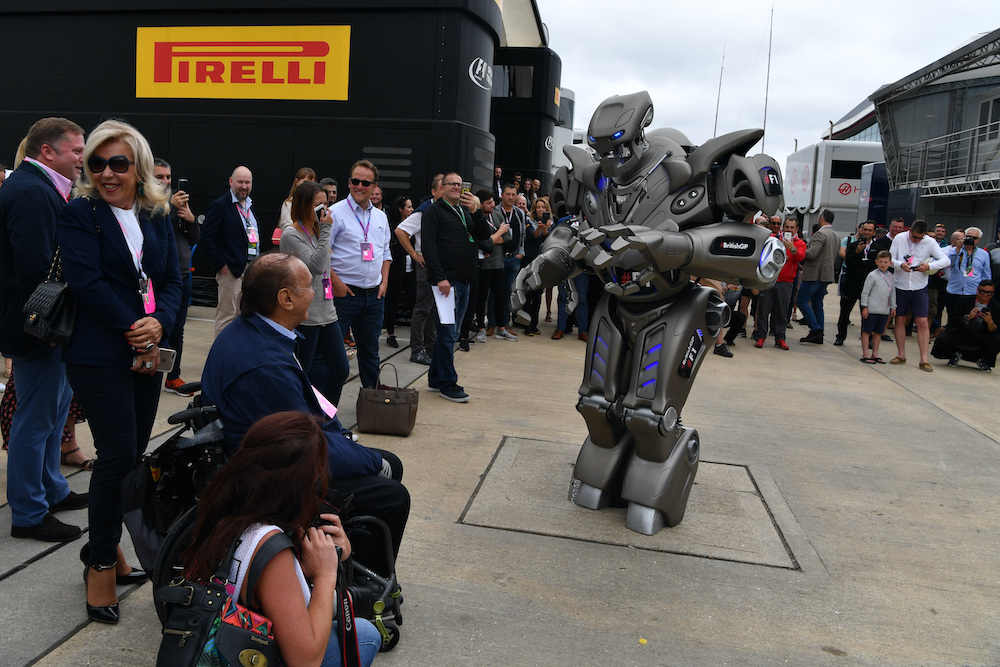
This thing can definitely rap. Motorsport Images
Q: I wanted to say I greatly appreciate you stepping in to keep the Mailbag going. I also appreciate that there are many new peeps to IndyCar and the letters are reflectively newbie-ish, at times. As someone who has been in racing for close to 55 years, I sometimes forget that we all have to learn the basics before we can understand the complexities and nuances of racing anything from shopping carts to IndyCars. That said, I am unclear on the damper rule for IC, even after reading the rules at 14.10. Is the fact they don't mention that you have to use certain damper a license to use any damper? Also, is it budget, alone, that limits insane spending on custom/prototype shocks?
Randall
MP: Oh, trust me, insane spending takes place on custom shocks. The rules are fairly open here where teams can buy off-the-shelf dampers from a variety of vendors, or manufacture large portions of the dampers in-house, which has become a common practice. It’s all still mechanical and fluid-based stuff; no electronics allowed like the adaptive dampers found in many road cars these days.
Q: I'm slightly confused... In the last Mailbag, you said IndyCar doesn't use BoP. Now, I understand that IndyCar doesn't place air restrictors or weight penalties on the last car to win a race. But aren't the engine specs for Chevy and Honda basically identical? IndyCar specifies the allowed bore and stroke, fuel flow, compression ratio, cylinder count, boost pressure, camshaft specs, and many more engine specs, right? Or am I mistaken?
The aero kits are identical. Basically the only thing that is not regulated is the dampers, correct? I totally understand that's technically not BoP, but it is spec racing, which, in my opinion, is almost the same thing.
Formula 1 doesn't use BoP, but it's getting closer and closer. The reverse grid idea was basically a form of BoP – thankfully it didn't happen but the regulations are becoming ever more spec with each set of F1 regulations.
WEC also doesn't use BoP and, in my opinion, the days of the LMP1 non-hybrid cars (2000-2011) were the best racing on the planet and nothing has come close to matching the awesomeness of those cars.
I'm not really a fan of BoP either, but Formula 1 is the only series that can afford to have anything close to the "run what you brung" racing everyone craves. The fact that they had to place budget limits and reduce spending to $150 million per year just proves that formula isn't sustainable in any other type of motorsports. If it weren't for BoP, the manufacturers in other series would spend $5 million on developing new canards to shave two-tenths off of lap time, or spend $25 million developing pneumatic valve trains like are used in F1. It's not sustainable.
The death of LMP1 via the hybrid regs is a good example. Audi, Porsche and Toyota all built multi-million dollar cars that privateers simply couldn't compete with, and we suffered through four years of having Toyota win literally everything. It got boring. The ACO and WEC finally figured out that wasn't the way to go, lowered costs, introduced a version of BoP, and now we have Audi, Porsche, Honda/Acura, BMW, Cadillac, Peugeot, Lamborghini, McLaren, Ferrari, etc., all coming into top class sportscar racing.
If you yearn for the days of 1980s and early-'90s GTP/Group C cars then the new LMH /GTP regulations are going to be just as good, if not better. All because the sanctioning bodies finally got their heads out of their butts and introduced cost-effective regulation. The ACO is by far the best at screwing things up, and even they realized that cost caps and a form of BoP was the answer. I miss the 962s, Jag XJRs, Spices, Lancias, Nissan NPTs, Dan Gurney and his Eagles, and 1000hp Buick Hawks just like you, but the truth is that the racing wasn't that close. Half the cars blew up within the first 50 laps anyway.
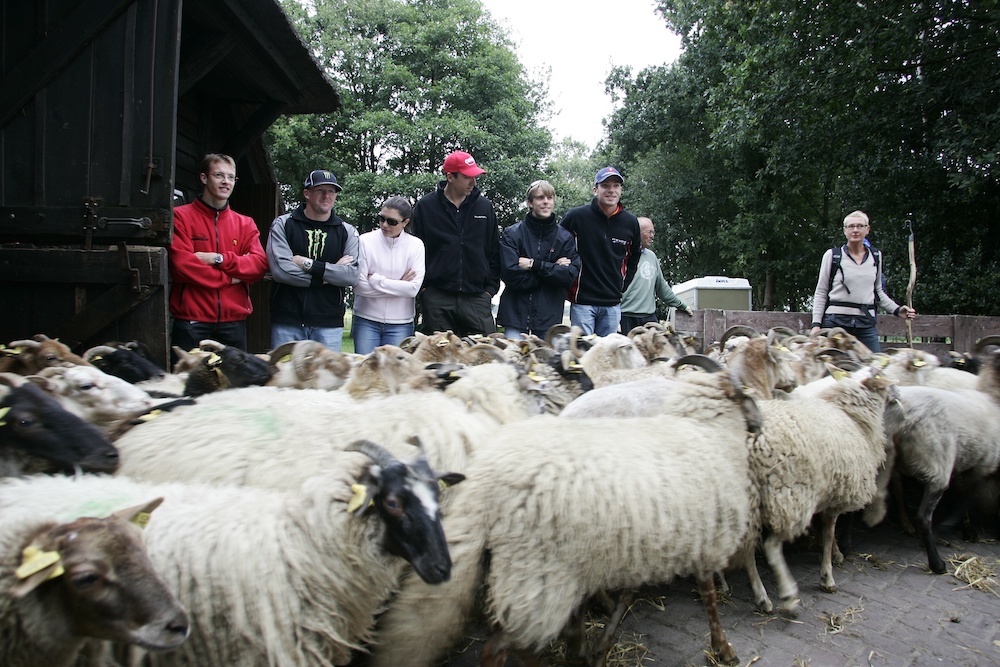
If you need a break from this very long question and answer about BoP, here's a shot of Sebastien Bourdais, Paul Tracy, Katherine Legge, Justin Wilson, Jan Heylen and Robert Doornbos planning to kill their PR reps for signing them up to spend a day at a farm freezing their bits off and looking at sheep. Phillip Abbott/Motorsport Images
Only the top 10% of fans even know or care what BoP is. The other 90% just want to see close racing, and they want to see the car they have on their driveways out racing in the Daytona 24 or Le Mans GT field. Literally every racing series that's enjoyed long-term success has BoP. It is the only way to ensure close racing that's still (relatively) affordable.
Spec racing is BoP, because the regulations that force the teams to use spec parts ensure that performance is balanced. BoP is the way to go, as much as I don't like it, I realize it's still the onlu way to keep racing alive and healthy.
Mike in Tampa, Low on performance and lacking balance
MP: Well, IndyCar has been around for 111 years and hasn’t needed BoP to survive. F1 is 72 years old, and has never used BoP. So, there’s that. I also wouldn’t equate close racing to great racing. NASCAR puts on dozens of races each year where the cars run within inches of each other at all times, and I can’t stay awake for more than a few laps.
On a related note, I spoke with one key IndyCar team member this week about whether they’d like to see IndyCar delay its new hybrid engines to 2024, which would mean the current motors were kept for one more season, and he said no. Reason why? Despite all the things that are highly regulated by IndyCar inside the current motors, one manufacturer has an advantage over the other at most tracks and there’s no BoP to take the advantage away.
As I said last week, I don’t care if BoP helps a series or class race forever, or if it brings close racing. I want to watch Steph Curry raining three-pointers while 50 feet away from the basket and torching the other team. I want to watch knockouts in the UFC, not five-round snoozers that are left to the judges to pick a winner. I want 70-yard touchdown passes and kickoffs returned to the end zone, not four quarters of two-yard runs and a final score of 10-7. I want to watch Pato/Dixie/Josef/Colton/Rossi/etc. put on clinics by destroying the field in ways we’ll never forget.
If the racing is close, that’s great, but who says we need BoP for the drivers in second and third, or 12th and 13th, to put on an epic show for our amusement?
Q: I saw the Nissan Ariya Single Seater Concept in person last weekend. It has combined the engine of a production car (Ariya) and the chassis of a racing car (Formula E) to represent the mutually beneficial relationship between production cars and spec racing series. I hope that IndyCar engine manufacturers can do their own version of what Nissan has done; combining the hybrid engine of production vehicles from respective manufacturers and the IndyCar chassis with the freedom in appearance to make it "looks a tiny bit like a road car" (excerpt from the Feb 9 edition of Mailbag) and showcase these cars during the race weekend. Could it be something valuable, or just waste of money?
Mitsuki Matsuura, Kanagawa, Japan
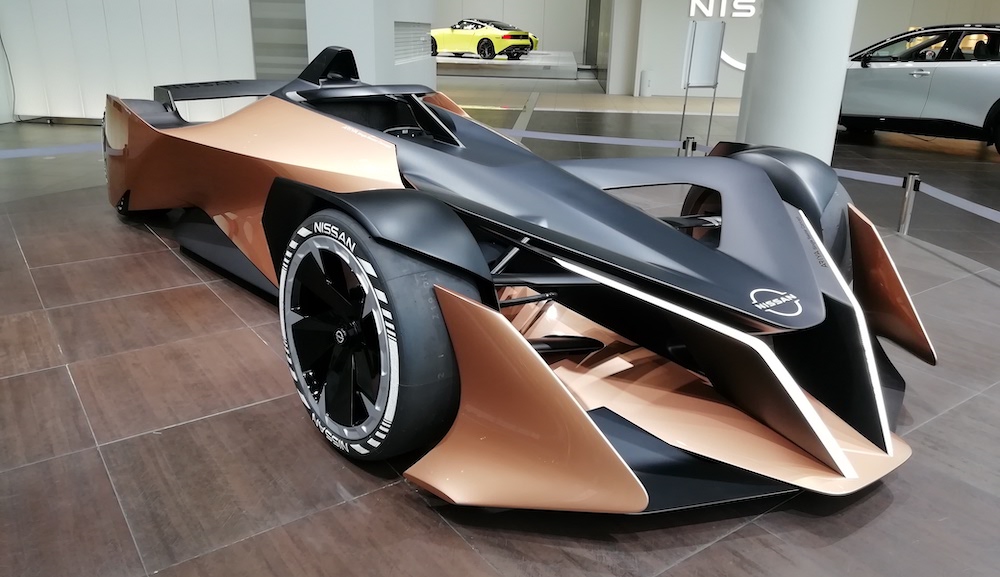
MP: Well, that looks like something that’s come to life from outer space. I dig it. As much as I’d like to see Chevy and Honda do IndyCar-themed concept cars, the only way it would happen if the production car side spent the money to make it happen. Everything I hear out of the racing sides involves sparing every penny these days.
Q: As a long-time ticket holder for the Indy 500 (and avid reader of the Mailbag), today (February 18) I received an email under the signature of Doug Boles announcing, among other things, that as of today we are now only 100 days away from the 106th running of the Indianapolis 500, that the Speedway is anticipating a capacity crowd and several other announcements about the other activities which will occur at the Speedway during race weekend. A bit later in the email, Doug excitedly describes that during this evening's broadcast of the Olympics on NBC, there will be a special "Back Home Again" spot about the 500 shown ostensibly to promote the race to NBC viewers in Indiana only. Really?
I realize that buying airtime on national television costs a lot of money, but considering that NBC is the broadcast partner of the NTT IndyCar Series as a whole and the Indy 500 in particular, that there are probably less than 1000 people in the entire state of Indiana that have not heard of or are aware of the Indy 500 and that the NTT IndyCar Series has been trying for years to attract a broader audience, what could have possibly been the rationale for deciding to limit the prime time viewing of the "Back Home Again" piece to Indiana residents rather than to a national television audience? Yet another opportunity lost/passed by to promote the most competitive motorsports series on the planet and the most famous race in the world to the exact target market the Series and the Speedway are trying to reach.
This email will reach you well after the airing this evening of the piece, but I do hope you will be able to find out what the thought process was to not put the "Back Home Again" segment before a national audience.
Steve L., Chicago
MP: I’d imagine Doug and the IMS team have a solid understanding of where their ticket buyers live, which ones renew, and which ones don’t. If I were in his position (which would be a sad day for the Speedway), I’d do the same exact thing and target the home audience since the majority of buyers are in the home market. With no fans in 2020 due to COVID and a limited number last year, I’d put all of my promotional effort behind getting Hoosiers to come back to the Speedway. Smart call.
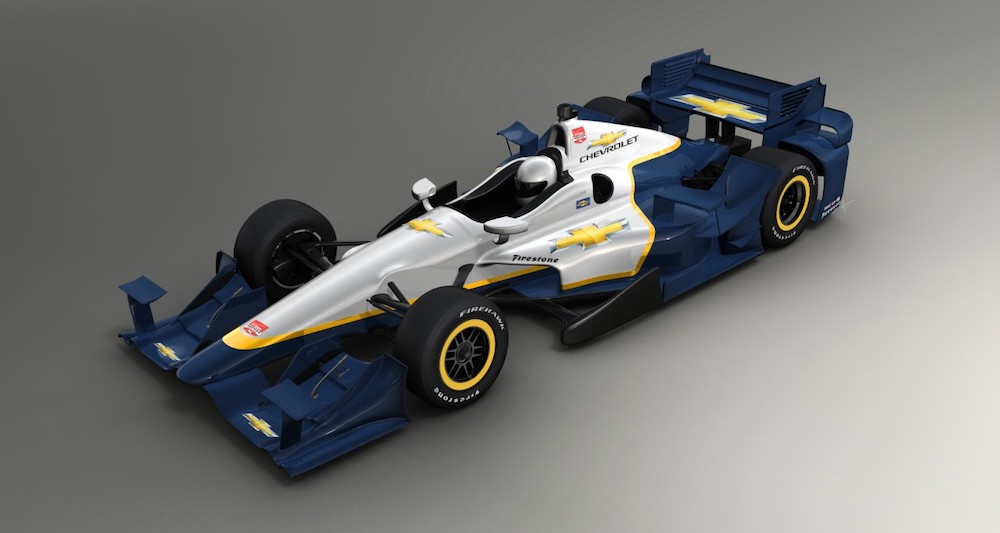
Hey look, it's the early rendering of Chevy's IndyCar aero kit from 2015. And the reason we're running the shot will make sense when you get to the bottom of the page.
Q: Can you explain or clarify if F1 is a closed shop of only 10 teams? Or do they welcome additional teams as well? The news after Andretti's announcement is not clear.
What is the $200m fee for? Is it an entrance bond? In the past the team was supposed to get this back. Has this changed? What are the feelings among the 10 teams about any new entrants in the future?
Steve
CHRIS MEDLAND: So, it’s not a closed shop in the sense that new teams are welcomed if they’re going to add to the sport. The reason they can’t simply show up one weekend is that the logistics are so big you have to actively plan to accommodate an extra team (or two or even three) at certain venues. If we reached that level of entrants then it would impact the space and setup the existing teams could have at a track.
But more than that, it’s the way that F1’s revenues are distributed. The teams all get a chunk of money from F1 split far more equally now than in the past, but any new entrant would also be entitled to that money and therefore dilute how much the existing 10 teams get. Basically: the current teams would lose money. So the $200m fee is to be split among the teams to compensate for this, and show that it’s a serious entity coming into the sport to race with a solid business model, and not just a team that would show up for a couple of years and disappear.
Of the teams I’ve spoken to so far, they’re more than happy to have new teams. It means more competition, a financial bump when they arrive but also potentially more customers too if they’re an engine supplier. And if it brings more eyeballs to the sport, even better.
THE FINAL WORD
From Robin Miller's Mailbag, February 25, 2015
(ED's note: In case a little extra context is needed for newer readers, the following letter was one of many we received that week in response to Chevy's newly-unveiled aero kit ).
Q: I didn’t think they could make the Dallara uglier, but Chevrolet has gone and done it. The rear bumper is so enormous! It may perform better, but it sure is hideous. Look no farther than Ferrari’s F1 concept to get an idea how stylish the rear bumper area could be. How fragile will the front wing be? I see a lot more full course cautions in our future.
Don Dahler, Minneapolis
ROBIN MILLER: But it’s got a great personality.
Marshall Pruett
The 2026 season marks Marshall Pruett's 40th year working in the sport. In his role today for RACER, Pruett covers open-wheel and sports car racing as a writer, reporter, photographer, and filmmaker. In his previous career, he served as a mechanic, engineer, and team manager in a variety of series, including IndyCar, IMSA, and World Challenge.
Read Marshall Pruett's articles
Latest News

Comments
Comments are disabled until you accept Social Networking Cookies. Update cookie preferences
If the dialog doesn't appear, ad-blockers are often the cause; try disabling yours or see our Social Features Support.