The RACER Mailbag, December 8
Welcome to the RACER Mailbag. Questions for Marshall Pruett or any of RACER’s other writers can be sent to mailbag@racer.com. Due to the high volume of questions received, we can’t guarantee that every letter will be published, but we’ll answer as many as we can. Published questions may be edited for style or clarity.
Q: Let’s pretend TGBB was the steward at Jeddah last weekend. How would have Robin reacted?
Jamie Carr
MARSHALL PRUETT: You delightful anarchist, Jamie… Extra points for you with the excellent callback of "The Great Brian Barnhart." Seemed like Miller angrily wrote about "TGBB" at least once a week when Brian was in charge of the IRL/IndyCar or the boss in race control.
Robin wasn’t much for modern F1, and really couldn’t stand constant bitching and moaning by drivers or team leaders in any series. I suspect it would have left him cursing at the screen on Sunday and a post-race phone call at least 60 minutes in length to curse out Hamilton, Verstappen, Horner, Wolff and race director Michael Masi with ninja-like precision.
After that, he probably would have penned an opinion column that torched F1, praised IndyCar, but also noted how IndyCar lacks anything close to the passionate rivalries between F1 teams and drivers that has every F1 fan fully engaged. Miller, as we’ll always remember, was the practitioner of "Hate is good" when it comes to racing needing rivalries. The Saudi GP was a total ****show, but wow, what I wouldn’t give for IndyCar to generate 10 percent of that heat among its fans.
Q: Marshall, I was wondering if you could expand on your NHRA career? What team, who was crew chief and driver? I was flabbergasted when I read that you worked in the series. I read RACER daily, but having nitromethane flowing through my veins makes me a minority.
Bob the Nitro Fiend
MP: It was a brief thing in 2003 or 2004, with the factory Subaru ESX Motorsports team in the former NHRA Sports Compact Series. Through a friend I hired as a weekend tire changer with our TKM/Genoa Racing IRL team, I was connected to ESX, which was in dire need of team management and overall organization at the NHRA events. The driver was team owner Ali Afshar, and the crew chief was Australia’s Jamie Montesalvo.
Afshar was winning everything in one of the lower, production-based Sport Compact classes with a 2000hp WRX STi and had grown bored, so he got Subaru to fund the build of an all-wheel-drive STi Funny Car! I think it was in the 2500-3000hp range. It was an overly ambitious thing that didn’t work well, and caused a lot of stress on the relationship with the factory. I knew nothing about drag racing, but it was a blast to learn on the fly and attempt to bring some structure to the team. We’d do more together, building a World Challenge GT WRX STi on pennies that did a race or two and some 25-hour endurance races.
Funny story: I hadn’t seen Montesalvo in forever, had no reason to expect to see him again, and while at a bar at Surfers Paradise – a block or two away from the final corner – with Leigh Diffey and Mick Doohan (that blew my mind, BTW) during the 2012 or 2013 Gold Coast 600 Australian Supercars event, in walks Jamie! Had no clue he wasn’t with ESX in Los Angeles, much less back home in Australia, and yet, there he was, halfway around the world, and at the same random bar Diffey had chosen for some beers and yarns.
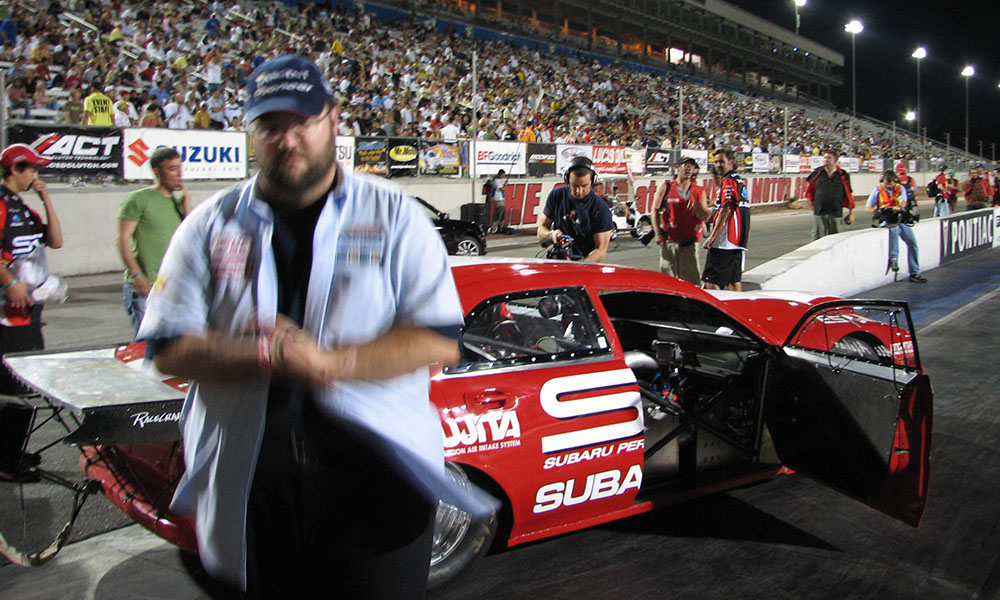
NHRA-era Pruett moved so fast that regular camera lenses couldn't keep up with him, but the all-wheel-drive Subaru STi Funny Car behind him proved to be an interesting – if not entirely successful – footnote in drag racing history. Image via Marshall Pruett
Q: Any truth to the rumor that F1 is going to two-seaters next year so that the team lawyers can ride along in the race? I have never heard so much bitching and whining from drivers as during this F1 season. Whether it's track limits, blocking, tactics or yellow flag pace, Hamilton, Verstappen and company are an embarrassment. As more F2/F1 drivers find their way into IndyCar, what can be done to ensure that they leave their F1 mindset behind?
Bill Carsey, North Omsted, OH
MP: We started to see it last season, especially in qualifying when seemingly every team was firing messages into IndyCar race control to cry about blocking. I recently told IndyCar president Jay Frye I’d like to see the series’ open-door messaging policy in this area change. Maybe follow what the NFL, NBA, and MLB have done with giving teams one or two "challenges" per game.
In our case, give teams two SMS messages to race control per entry each weekend. Or model it off Chris Rock’s routine about curbing gun violence by charging $5000 per bullet. Swipe your credit card, approve the $5000 transaction to IndyCar, and then the SMS window opens up to send the message to race director Kyle Novak and co.
It’s a culture thing. If IndyCar chooses to allow teams and drivers to complain at every opportunity, it’s on them to change the behavior or accept it and deal with the miserable ramifications. I hope they’ve been watching the last handful of F1 races to see how much fun it isn’t.
Q: I am by no means a follower of NASCAR, but when I read that they are looking to have a race at the Nashville Fairgrounds, along with bringing back North Wilkesboro and Rockingham, it made me think of the Iowa Speedway.
Ever since NASCAR purchased this track, Iowans have been wishing for a Cup date. However, with NASCAR possibly adding these additional events, one must wonder if this is a nail in Iowa Speedway's coffin? I don't believe that facility can survive with just an IndyCar race and an ARCA race. Unless of course, The Captain saves it.
Pat Rizk, The Woodlands, TX
MP: I don’t know if I have a ton to offer here, but I do know NASCAR has been very strapped for cash since reacquiring ISC. With that in mind, I can’t imagine NASCAR can afford to keep Iowa Speedway sitting on its books as a yearly income drain, so if it isn’t going to send some of its money-making series there to turn a profit, I’d guess the track will be sold off once a buyer believes the terms are favorable. Penske Entertainment has an interesting lease deal where it runs all aspects of the upcoming IndyCar events there, but clearly, something more sustainable to keep the track safe and strong when IndyCar isn’t there is necessary.
Q: What are Hunter-Reay's plans for next year? He has to get an IndyCar ride, right? My seven-year-old daughter won't stop asking me. She needs an answer! Thanks for the hard work.
Eric D, St. Louis, MO
MP: Since we don’t want your daughter to feel like she’s been visited by the Grinch, let’s tell her that RHR is working hard to make sure he can keep racing for her in IndyCar, but we probably won’t know until after the holidays if he’ll be on the grid. RHR at the Indy 500, at minimum, seems like something to plan for.
Q: Dear Marshall,
Last week you led off the Mailbag with this: "Also, bring back …Milwaukee, … Jason Priestley, … Trenton, Mexico, mechanical pop-off valves…"
Let's look at those items:
• Milwaukee always drew nice crowds;
• Jason Priestly: I was at Kentucky on August 12 working as a photojournalist for RaceFax DotCom (since ceased production) when Jason had a near-fatal crash in practice for the Infiniti Pro Series. Somewhere, I have photos of both the skid marks and where he T-boned the concrete retaining wall embedding chunks of carbon fiber into it; and also the IRIS transponder data showing he was traveling 130mph, not 180mph as was reported. RaceFax, at the time, was the only member of the press to have access to this data, as it was reserved for the teams and League. Unlike today's celebs who walk the F1 grid with their bodyguards (winking at Martin Brundle), Jason put his money where his and actually got behind the wheel. By the way, the day before, Sarah Fisher scored pole, the first time a woman did so in a Champ car. As my editor Forrest Bond quipped to me on the phone before we knew Jason survived, "It's a hell of a weekend where they put a woman on the pole and killed a movie star."
• Trenton Speedway: Throughout the 1970s, Trenton drew well, being only about 40 miles from Philly and 50 miles from NYC. What happened is that it was attached to the Trenton Fairgrounds; and like nearby Langhorne, the property was becoming more and more valuable. In the summer of 1980, when I was working for my uncle, his company's owner Sid Sussman bought the fairgrounds, and in so many words, it was more profitable for Sid to turn all that land into something else.
• Mechanical pop-off valves: OK, with better technology today with CFD (computational fluid dynamics) software, we don't need this rule enforcement device, but in fact teams have been trying to circumvent it since the '70s. My senior memory is kicking in, but in the mid '70s one of the teams installed a gigantic turbo for Indy qualifications to literally overload the popoff valve and illegally raise intake manifold pressure. When they went to change it out for a smaller turbo for the race, USAC said, "Nope, you need to run the race with what you qualified with" vand although the car started high up in the field, because of the bigger turbo, it ran out of the allotted fuel midway through the 500.
Yours truly,
Dan Schwartz
MP: Thanks for the storytelling, Dan.
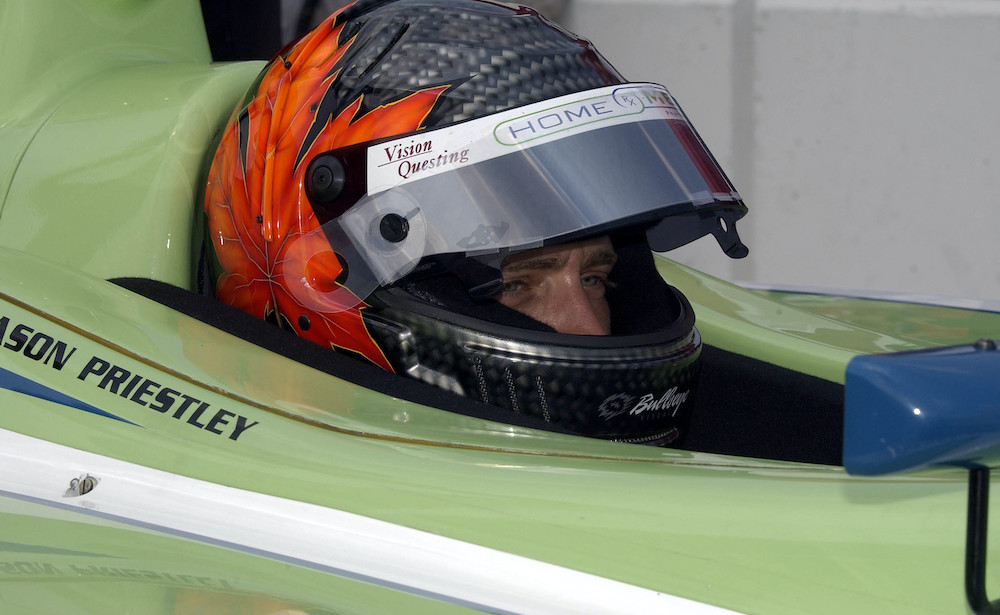
Priestley wasn't alone in making the transition from garden-variety celebrity to racer, but he did it more comprehensively than most. He'd already built up a decent resume before tackling the Indy Pro Series, and remained involved as a team co-owner in the years after his crash at Kentucky. Bob Kozel/Motorsport Images
Q: I saw a RACER article last year saying that JR Hildebrand taught engineering in his off time for a university in Northern California. After reading that article, I sent a question in to Robin asking what some drivers do in their off season, and he sarcastically answered, “taking their girlfriends on vacation, skiing, etc., just like normal people.”
I loved the answer – perfect Robin sarcasm – but I would still like to know if any drivers run their own business, teach, write, work for their families, etc., in their offseasons or between rides. Just a couple of the more interesting occupations. I’m familiar with Emmo’s OJ groves, Will Power’s line of karts, and TK’s triathlons.
Sean Raymond
MP: I recently joked with Graham Rahal about needing to dial it back a bit with all of his various business moves, to which he said he was actually thinking of adding yet another new business venture to his growing vehicular empire… His new pride and joy is a Ducati dealership, which adds to his wildly popular Graham Rahal Performance shop. Marco Andretti is all about the business these days with real estate and more. Last time we spoke, Felix Rosenqvist was trying to create a line of "Fox Piss" coffee. Alex Palou and his girlfriend own a cafe in Spain. Ryan Hunter-Reay runs his Racing For Cancer charity with his wife Beccy and Tom Vossman.
Q: Tech question for the off-season. With limited testing allowed, I know a lot of work is done on testing rigs, simulation programs, etc. How much work is done using wind tunnels, or is the use of wind tunnels restricted like actual testing is? Are there other restrictions that limit what the teams can/can't do?
Keep up the great work and thank you to all the RACER staff. RACER.com is my daily lunchtime go-to for racing updates.
Sincerely, Jon
P.S. I have this distinct memory of Al Jr. running down the main straight of a street course at something like 190mph using one of his hands to emphatically refer to another competitor as No. 1. Does anyone remember what year and race? It's been bugging me for a couple of years now. I think the straight had a curve to the right. Long Beach maybe?
P.S. II Sports cars. I love racing of all types as long as it's fast and is loud. I've crewed local,ASA, NASCAR Trucks, etc. But sports cars and its classes confuse me. I'm sure all the changes over the last decade or two has even the participants scratching their heads. Could someone on RACER's staff do an off-season article/primer on sports cars, the classes, and the differences? Same for Trans-Am. What's Trans-Am 1, Trans-Am 2?
MP: For the first question, Jon, I’ve asked Tino Belli, IndyCar’s director of aerodynamic development to assist:
"Scale model wind tunnel testing is not restricted, but because the aero rules are pretty tight, scale model testing has limited use. For teams, full scale wind tunnel testing and straight line testing (coast down) is considered a test day, so they would have to forfeit a track test day to do this. So teams rarely do this type of testing (on their own).
"But for Honda and Chevy, full scale wind tunnel testing and straight line testing is not restricted. Therefore, most of the full size wind tunnel testing and straight line testing is done by the manufacturers, and they share the information with their teams. Both Honda and Chevy do a significant amount of full scale wind tunnel testing and straight line testing.
Shaker rig, gearbox dynos, brake dynos, driver in the loop (DIL) simulators are not restricted, so teams put a lot of effort into these areas."
On P.S. 1, hopefully a Mailbag reader will chime in with the answer for next week’s edition. On P.S. 2, we’ll have something comprehensive to offer next month as the Rolex 24 At Daytona approaches. But for now, here’s a few basic things to process.
Sports car racing comes in two forms: Sprint and endurance. The series formerly known as World Challenge (SRO Americas, today), and Trans-Am do the sprint racing thing, most contests are an hour or less, with one driver. The endurance series like IMSA and the WEC tend to race for a minimum of 1h40m, but are usually in the 2h40m, 4-6-8-10-12-24hr range, and have anywhere from 2-4 drivers, depending on the length of the race.
Here’s something open-wheel fans can appreciate: Whether it’s the prototypes or the GT cars, there’s a solid ladder system in place. If we look at IMSA, you could start out in LMP3, step up to LMP2, and if you’re good or wealthy, their version of IndyCar – the DPi class – is at the top of the ladder. In GT, you can start in a lot of places, but if we go by IMSA’s path, you’d start in TCR (that’s where Bryan Herta’s team runs), then graduate to GT4, then GT3 (called GT Daytona), and if you’re really good or rich, maybe the new GTD Pro class is where you’ll end up.
The last main item to know, which is very different than IndyCar and the Road to Indy, is sports car racing has two different lanes of opportunities for drivers. For those with the youth/talent/budget and desire, sports car racing has a number of professional classes for them to aspire towards. And for those who might be a little older, or lack the talent to run with the pros, and often have s significant amount of cash at their disposal, there’s the pro-am classes geared toward giving sportsmen/sportswomen and businessmen/businesswomen a place to race and learn from pro teammates.
Of the many things that make sports car racing different from IndyCar, the ability for non-pros to get onto the playing field with pros is unlike almost anything else in sports.
Q: Read your article and another that indicates the Paretta team is coming back. Thrilled to hear that, and that it looks like Simona De Silverstro will be back driving. Based on her desire to partner with a team like she did last year, who do you see her working with? Penske seems out, what with gearing up the Porsche program. Andretti has a deal with MSR. That leaves Ed Carpenter and McLaren as options. Both have bad-fast hotrods for Indy….
Rick
MP: Beth was Team Chevy in 2021, and I’m guessing there’s a desire to stay with the Bowtie. At the same time, every Honda engine is accounted for at the Indy 500, so I’m not sure there’s much of an option beyond Chevy for 2022. AMSP, ECR, Foyt, Juncos, and Dreyer & Reinbold are all potential destinations, with AMSP and ECR as the clear favorites in terms of proven competitiveness. And based on what I’ve been hearing of late, it’s a seller’s market, with both teams getting plenty of inquiries about fielding Driver X or co-entering for the big race.
Hard to say where Beth ends up, but the better the team, the greater potential for big and positive publicity for the series.
Q: I hear a lot of talk about "Honda only has so many engines available." I know a little about engineering and fabrication. If Honda have the tooling to produce one engine assembly, why can’t they build more? Just wondering.
Mark, Niagara Falls, NY
MP: Profit, loss, and being smart with money. IndyCar is headed into a new engine formula in 2023 with brand-new motors being utilized; it would be anything but wise for Chevy or Honda to burn piles of cash to make new 2012-2021-era engines for one season and then stuff them in a dark basement along with 50 other mothballed motors.
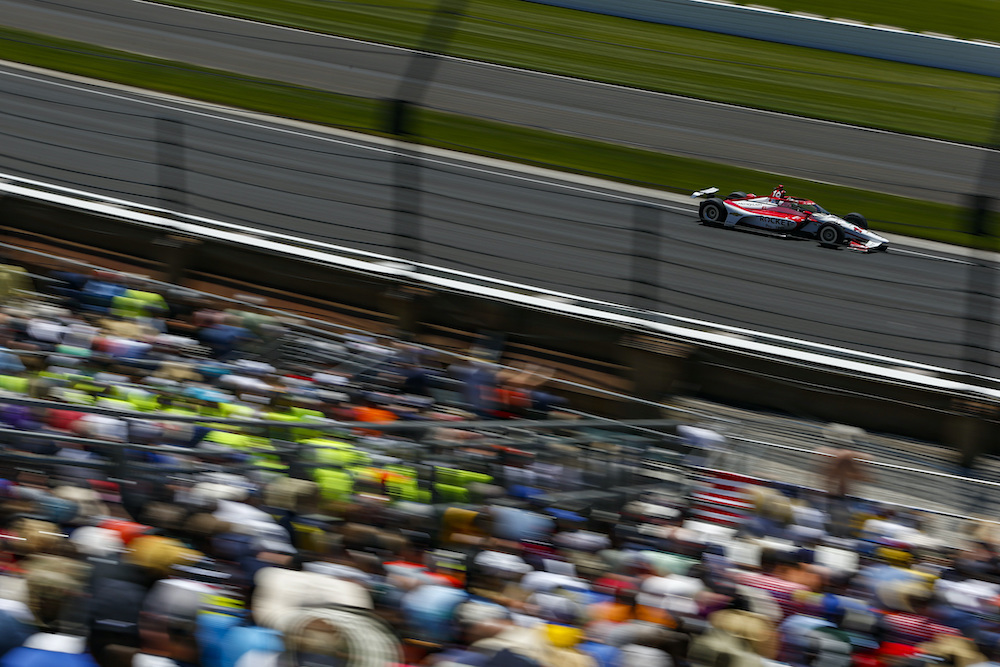
Expect the Paretta Autosport car to show up wearing a Bowtie again at Indy next year. Jake Galstad/Motorsport Images
Q: Hoping you can shed some light on this annoying "23-year-old F1 car destroys new IndyCar’s lap time at Laguna Seca" propaganda I recently came across online. I kept seeing this – F1 good / IndyCar bad – story popping up on my phone, so I did a search on it. Depending on what web browser you use, there are several versions of this same repackaged story out there.
If the story was only being pushed by one online magazine I wouldn’t think much of it, but this looks like a concerted effort. With IndyCar gaining momentum again, are the powers that be in F1 feeling threatened and pushing this story?
The whole premise of the article is actually pretty silly, as IndyCar’s current speeds have everything to do with cost control and safety. I’m pretty confident all the engineers that work for and with IndyCar haven’t somehow forgotten how to make race cars go fast.
On a final note: Know who holds the lap record at Road America? Alex Zanardi in an Indy car (CART) back in 1998 – 23 years ago.
Spike, Ventura, CA
MP: Like you, I wish I understood why so many American auto and racing websites absolutely love to **** on IndyCar. It’s boring and predictable with some outlets; one site which has been around forever seems to delight in writing the crappiest IndyCar headlines and stories possible – even when the premise makes no sense.
And with F1 on the rise here, the snobbish attitude toward IndyCar is also growing. I listened to one American with media credentials at the recent Velocity Invitational event in Monterey, where McLaren brought some F1 cars like the aforementioned 1998 machine, who couldn’t help himself from reinforcing that lame stereotype: Everything in F1 was cool; he didn’t really follow or care about IndyCar… yawn… "a series for peasants" type of attitude.
But in this instance, the main piece you reference, written by Bradley Brownell, doesn’t fit this scenario. The headline isn’t inaccurate. The people who conceived the Dallara DW12 formula aimed low, hit their target, and here we are a decade later where a 23-year-old F1 car can torch our cars. The truth hurts. I wish it wasn’t the case, but it is. The next IndyCar formula is meant to address the low-ambition DW12. Count me among those who’d be just as happy if the last Champ Car, the Panoz DP01, was copied and modernized for use starting in 2023.
I’d step away from the F1-is-pushing-this-story conspiracy theory; Pato driving an old McLaren isn’t where the war will be won. As for the other outlets regurgitating Bradley’s piece, that’s fairly common.
INDYCAR UNIVERSITY
ED’s note: A few weeks back, reader Jack Cook sent the Mailbag a letter explaining that he is new to IndyCar and trying to learn about the series. Marshall invited him to send further questions, and Jack responded this week with no fewer than 10 in one email. Rather than taking over the entire Mailbag by hitting them all at once, we’re going to answer one per week for the next 10 weeks. By the time the 2022 field assembles in St Pete, Jack, and any other new fans, will be primed and ready. (We’ll know we’ve really done our jobs if they’ve also taken sides in The Split, and staked out a position with regard to the 2002 Indy 500).
Q: Who are the biggest (fame, history, ability, etc.) teams currently in IndyCar?
Cook family, MI
MP: Off we go, Jack.
Team Penske is IndyCar’s equivalent of the New York Yankees or Los Angeles Lakers in terms of longstanding success and consistency over the decades. With more Indy 500 wins and championships than any of its current rivals, there’s Team Penske, and then everyone else.
Chip Ganassi Racing is second on that all-time list among today’s active teams. Chip started his team more than 20 years after Penske, but has wasted no time in racking up IndyCar titles and 500 wins.
Andretti Autosport would be next, and was formed from the Team Green CART team as Michael Andretti transitioned out of the cockpit to team ownership with Andretti Green Racing. A few years later, he bought the team outright, and renamed it as Andretti Autosport. The team has been more successful at the Indy 500 with numerous wins, but is comparatively light on championships next to Penske and Ganassi.
After IndyCar’s Big 3, it’s a matter of opinion and arguments as to whether Rahal Letterman Lanigan Racing, which got its start in the early 1990s and has gone through a number of name changes, is fourth on the depth chart. It has a healthy collection of Indy 500 wins, but no championships since the '90s when Bobby Rahal was still driving.
Based on how Pato O’Ward performed last season, Arrow McLaren SP sure acted like it was part of the Big 3, but one season of excellence doesn’t bring admission to the club. If AMSP can beat Andretti’s team in the standings in 2022, we might need to ask whether AMSP has displaced Andretti in the Big 3, or if the club should be expanded to include all four teams.
Behind this group, you have Coyne, Carpenter, Foyt, Shank, and the rest of the teams aiming to disrupt the establishment.
Q: Will there be any transparency as to how F1 teams got to the budget cap, perhaps by just major categories – aero vs sim work, etc, etc.?
Doug Farrow, Plymouth MN
CHRIS MEDLAND: Sadly, that's not on the agenda at this point, as teams can be audited by the FIA but are still allowed to keep their accounts private. It would be very cool to know how the allocation works but it's one of those where teams won't want to give away any potential competitive advantage, so won't want to tell each other how they split up their budgets. And some teams won't even reach the cap for a little while. Plus there are some gray areas where it would be hard to define what counts as aero versus mechanical etc. so almost all of it would simply be called 'car development'. All that said, some teams might be willing to tell us in general terms, so for you Doug I'll make sure to ask the question each season!
Q: My question is regarding Red Bull’s decision to continue to run Honda engines through 2024. Not being a true auto manufacturer, where the old adage is "race on Sunday, sell on Monday," it baffles me as to what Red Bull stands to gain outside F1? Certainly it has the vast resources (money and intellectual) to bring the program in-house, and calling upon rival Mercedes, or relying on less-reliable Renault, is unfathomable, but I am failing to see the bigger picture.
Bob Frankish, Macedonia, OH
CM: The only thing Red Bull stands to gain immediately is the brand recognition for excellence if it wins, and it thinks this is its best chance of winning. F1 is still a marketing exercise after all, and winning the best chance of that, so with the engine freeze until new regulations it's a more economical time to run a PU department than before. Aside from the energy drinks company it does have an arm called Red Bull Applied Technologies which isn't just F1, so that business would also be boosted by success on the track when it's all Red Bull controlled.
Longer-term, though, the bigger picture is it makes it a very attractive proposition for an auto manufacturer looking to enter F1. For example, if the VW Group wants to come in, then Red Bull could sell its engine program, or look to amalgamate the two. It is also a much more valuable asset as a team when it has the whole program and isn't reliant on an engine manufacturer, so if it ever wanted to sell, it's worth even more. (That's not the plan, but is a smart insurance policy). One of those "takes money to make money" scenarios, and Red Bull has the money.
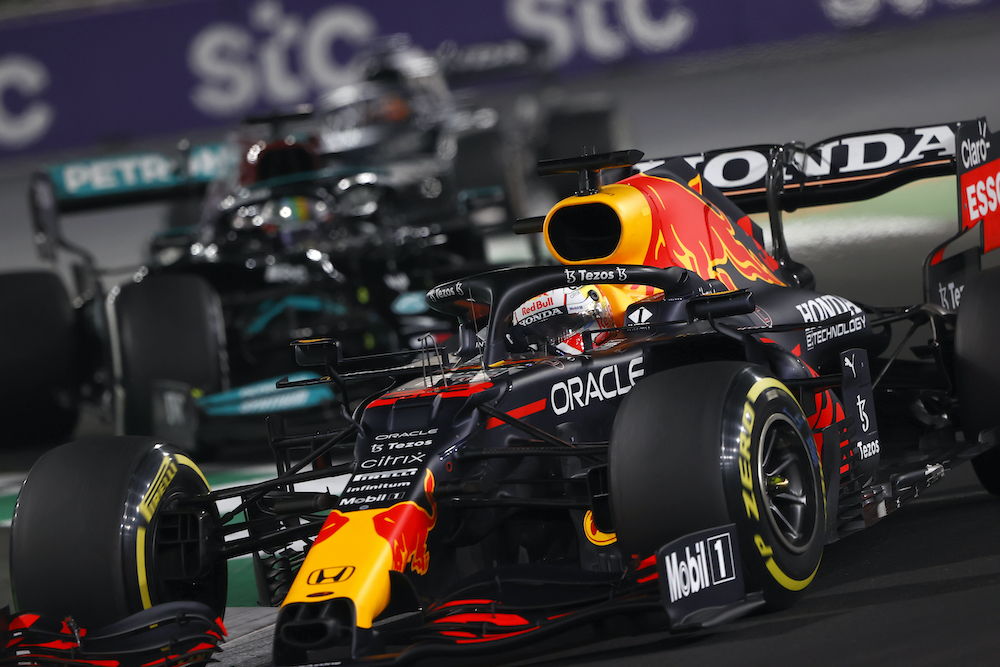
Red Bull's battle plan is to take the most efficient route towards being a title contender, and if that means using somebody else's powerplants, so be it. Andy Hone/Motorsport Images
Q: Was Saudi Arabia the first F1 circuit to use the SAFER Barrier, or something like it?
Robert Keith, Washoe Valley, NV
CM: Actually, it's not, but I'll give you one guess as to a similar place it was used already this year... That's right, Zandvoort. Banked corners and SAFER Barriers work well together, so they were used at the final corner as part of the remodelling in Zandvoort. But it's true that they were also used in Jeddah, where there was another banked corner at Turn 13. We've had different barrier configurations and there was still Techpro in the places where a big stop was likely (such as Turn 22 - where Charles Leclerc and Mick Schumacher crashed) but SAFER Barriers allow solutions where there is little space for run-off.
THE FINAL WORD
From Robin Miller’s Mailbag, December 9, 2015
Q: Watching Jeff Gordon run his final race, how is it that CART could have totally overlooked this guy's talent? I watched the video again of him driving Montoya’s F1 car at Indy several years back and he was immediately fast. Imagine how many Indy 500s he might have had if Penske instead of Hendrick had signed him in 1992?
I read an article about F1 and how much trouble they are in. Has any interest been shown by a Lotus or a Force India-type team to join IndyCar? I think they would look at the cost comparisons and be shocked. They could run a three-car team in IndyCar with a chance to win every week. Finally, I think racing continues to fade away in 2015.
My last question: If we had a time machine, took the CART series from 1995 and dropped it in 2015, would people come?
Rick, Charlotte
ROBIN MILLER: John Bickford tried to get an audience with Ganassi in the CART paddock at Cleveland in the early '90s and I don’t know if he also reached out to Penske but, obviously, nobody gave Gordon any encouragement. Would he have been just as good in an IndyCar as he was a stock car? No doubt, providing he got with Penske or Newman/Haas or Ganassi. But his career turned out OK. Considering the TV money, if you are an F1 team in trouble I can’t imagine how or why you would look to IndyCar. There’s no financial incentive to come here. As for your last question, all I know is that the crowds and sponsors were never bigger than in the mid-'90s, Indy was a sellout and CART was neck-in-neck with NASCAR.
Presented by:
Marshall Pruett
The 2026 season marks Marshall Pruett's 40th year working in the sport. In his role today for RACER, Pruett covers open-wheel and sports car racing as a writer, reporter, photographer, and filmmaker. In his previous career, he served as a mechanic, engineer, and team manager in a variety of series, including IndyCar, IMSA, and World Challenge.
Read Marshall Pruett's articles
Latest News
Comments
Comments are disabled until you accept Social Networking Cookies. Update cookie preferences
If the dialog doesn't appear, ad-blockers are often the cause; try disabling yours or see our Social Features Support.