REWIND: Miller on Jim Clark at the Indy 500
Jim Clark and Robin Miller never crossed paths at Indianapolis Motor Speedway. In fact, Robin’s rocky tenure as Jim Hurtubise’s gofer at the 1968 Indy 500 came just weeks after Clark’s death in a Formula 2 race at Hockenheim.
Had he lived, the legendary Scot was set to make his sixth attempt on the biggest, richest race in the world, his turbine-powered Lotus 56 sharing the same rickety Gasoline Alley garages as Hurtubise’s Mallard and Miller and his polishing cloths.
In the five years before that, Clark had earned the respect and friendship of the Brickyard’s brightest, toughest stars, and entranced a young Miller, whose lifelong love of Indy and its signature race was forged in those wild, daring days of the early 1960s.
With his Lotus boss and mentor Colin Chapman lured by the treasures Indy offered, Clark made his first 500 start in 1963, finishing a controversial second to Parnelli Jones. He earned a dominant win in ’65 (and $166,621 to split with Chapman), came second again in ’66 – or was it really first? – and, after an ill-starred ’67 race, was enthused by the wedge-shaped 56 and his prospects for ’68.
Robin’s RACER story was written in 2015, a half century after Clark’s ’65 win. It’s liberally sprinkled with recollections of the home-grown heroes Clark raced with at Indy and, in his trademark style, it’s an evocative, entertaining look back on events that entranced the young Miller and helped determine his future path.
Laurence Foster, RACER Editor-in-chief
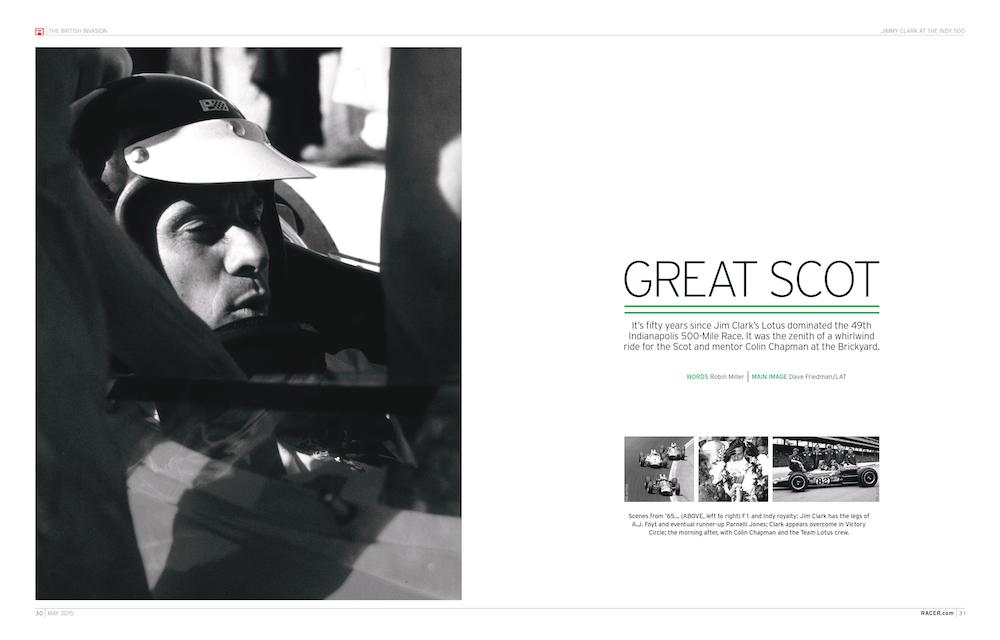
A wispy little sheep farmer with a flimsy car painted green and its engine in the wrong place. Jim Clark and his Lotus-Ford were hardly imposing figures when they unloaded at the Indianapolis Motor Speedway for the first time in 1963.
The Indianapolis 500 was the richest, deadliest and most prestigious motor race in the world, and had a reputation for sending drivers back home, into retirement or to the morgue.
It required muscles, balls, focus and unwavering confidence to horse around a roadster for four hours, and was certainly no place for “gentlemen racers.” So the slight-built, introverted Scotsman hardly drew any second looks, let alone concern, from the USAC brigade in Gasoline Alley.
“I didn’t give those Formula 1 guys a lot of respect and neither did A.J.,” declares Parnelli Jones, who along with A.J. Foyt ruled USAC racing in the 1960s. “We were the rough, backyard bullies and they were those polite road racers with funny accents who thought they were better than everyone else.
“But he was a nice guy and he caught on to oval racing pretty quick,” he adds. “I was impressed because he was a helluva talent.”
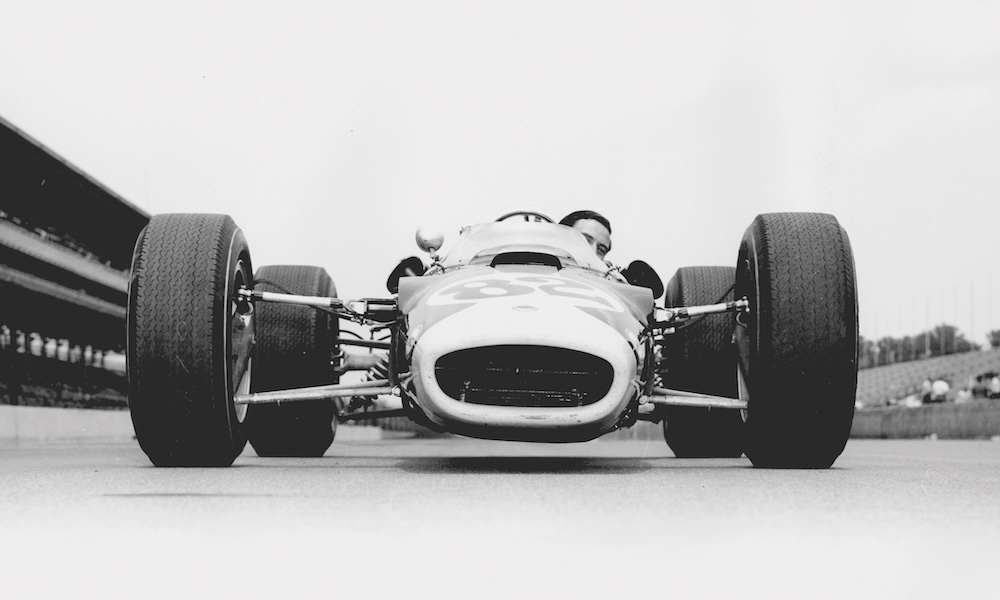
Fifty years ago, Clark put his stamp on the history books by demoralizing the competition and leading 190 of the 200 laps on the way to capturing the 1965 Indy 500. It was his lone win in five starts from 1963-’67 yet, with just a little extra nudge from the racing gods, he could easily have been a two- or even three-time winner at the Brickyard.
But it wasn’t just that dominating drive in ’65 that makes the quiet Scot so revered five decades later.
It was his adaptability to big speeds and concrete walls.
It was his respectful attitude towards Indy and the competition.
It was his ability to handle the ragged edge, lap after lap after lap.
It was the changing philosophy he helped introduce to U.S. racing.
It was his classy demeanor, both on and off the race track.
It was everything.
“Clark was a nice guy, he wasn’t cocky like Graham Hill or (Jackie) Stewart,” says Foyt, whose disdain for English engineers is racing folklore. “He drove hard, but clean, and I had a lot of respect for him because he raced at Milwaukee and Trenton, too. He also drove a terrible stock car at Rockingham and I took my hat off to him.
“I guess we were rivals but, like I said, I liked the guy and I wasn’t real fond of the Brits in general.”
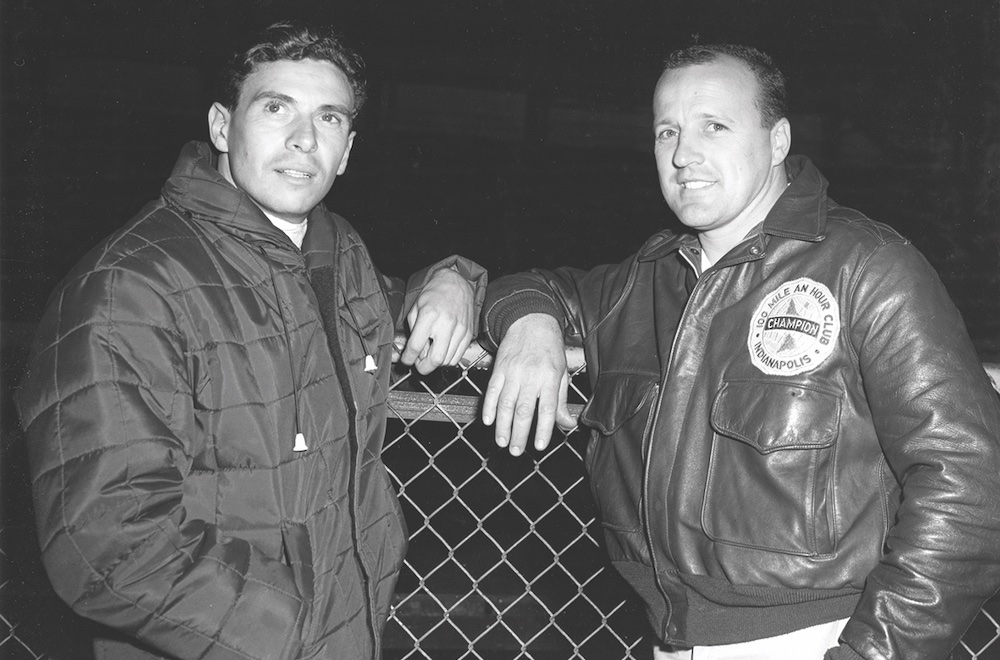
In five years of racing against Jimmy Clark at the Indy 500, A.J. Foyt’s take on the quiet Scot moved from disdain, to respect, to affection. But his stance on Formula 1 never shifted. That remained disdain... “I had a chance a couple times to drive in Formula 1,” he says. “I was never that interested, because I never cared to wear a necktie each time I went to eat breakfast. I’m a Texas boy and I just loved racing in the Indy cars and sprint cars.” IMS Archive
In what became the line of demarcation in American motorsports, Clark was the face of the rear-engine revolution and the overthrower of the status quo in open-wheel racing. His profile was on the rise in 1962 as he scored three grand prix victories for Chapman before testing his F1 Lotus at IMS in October. He would make his Indy 500 debut in ’63 – the same season he earned the first of his two Formula 1 World Championship titles.
“Well, he was willing to do it,” recalls Dan Gurney of his friend, teammate and rival’s decision to go with Lotus to Indy that May. “I think no matter who you are, the first time you go there it’s a pretty daunting situation. You have to be damned determined. Initially, he wasn’t sure, and it took a while for him to get dialed in. But he loved to race and he wasn’t worried about protecting his reputation. If he drove a car that wasn’t very good, he made it look good anyway.”
Jackie Stewart, still three years away from his own sensational Indy 500 debut, was sharing a London apartment with his soon-to-be-rival and marveled at Clark’s swift adaption to the Speedway’s sustained high speeds, left-hand turns and those unforgiving cement walls.
“I think Jim’s style – smooth, clean and gentle – was a good fit for Indianapolis,” says the three-time World Champion, who came within 10 laps of winning Indy as a rookie in 1966. “And because he was in a rear-engine car, that familiarity helped him a little, but ovals were an entirely different style of racing. He laid the groundwork for us other F1 guys going to Indy, showed it could be done. Yet we all still knew we were going over there as amateurs with a big learning curve.”
The 1963 race was soaked in controversy as a result of spilled oil from Parnelli’s cracked tank and the almost-black flag that would have elevated Clark into victory lane as a rookie.
“I was a couple mph faster than he was all day, and he really wasn’t a thorn in my side,” recalls Jones, who led 167 laps to Clark’s 28. “I made three pit stops to his one and the Lotus wasn’t in the same ballpark in the race but, of course, there was the big controversy after the race about me leaking that oil.
“I had no idea that they were thinking about black-flagging me. My oil tank had cracked in the middle and I about spun because the oil poured onto my left rear tire. But it stopped after a while, and I still had quite a bit at the end of the race. The track was greasy all day, but with two laps to go I ran my fastest lap of the race, so how bad could it have been?
“Clark came up after the race and congratulated me,” he adds, “and I thought that was very classy.”
Still, Gurney figures the lack of a black flag was a geographical decision...
“The Americans didn’t want to see some Limey come over here and win the race,” chuckles the eighth-place finisher in ’63, “and I imagine if it had been in England, the decision would have gone the other way.”
In 1964, Clark broke the Speedway record in winning the pole, but only made 47 laps before being sidelined with left-rear suspension failure on his Lotus 34 caused by the vibration from a chunking tire. On lap 100, teammate Gurney was withdrawn as a precaution.
A year on, the revolution was full bore, with even Foyt and Jones joining the march to the rear. But there was no Welcome Wagon anymore for Team Lotus.
“The only way to say it is that there was a lot of effort made to throw us out,” says Bob Sparshott, a fabricating whiz who worked for Chapman in ’65, but would surface again in 1980 after building Johnny Rutherford’s Indy-winning Chaparral 2K for Jim Hall. “USAC made us re-make the suspension and wheels, and it was very difficult to keep going because there were only a couple of us. It was a very interesting month.”
But Clark wasn’t going to let such trivial matters divert him from his task. In fact, he wasn’t going to let anything divert him, even pulling out of the Monaco GP to concentrate on Indy.
In qualifying, he set another track record in his new Lotus 38, only to have Foyt better it in the ’64 Lotus he’d acquired from Ford.
“I said over the P.A. system that I brought the track record back to the USA and got a huge ovation from the fans,” says Foyt with a chuckle. “Clark came over and shook my hand and I thought that was pretty damn nice.”
In the ’65 race, nobody had anything for Clark and he made it look effortless, something Gurney is quick to expound on.
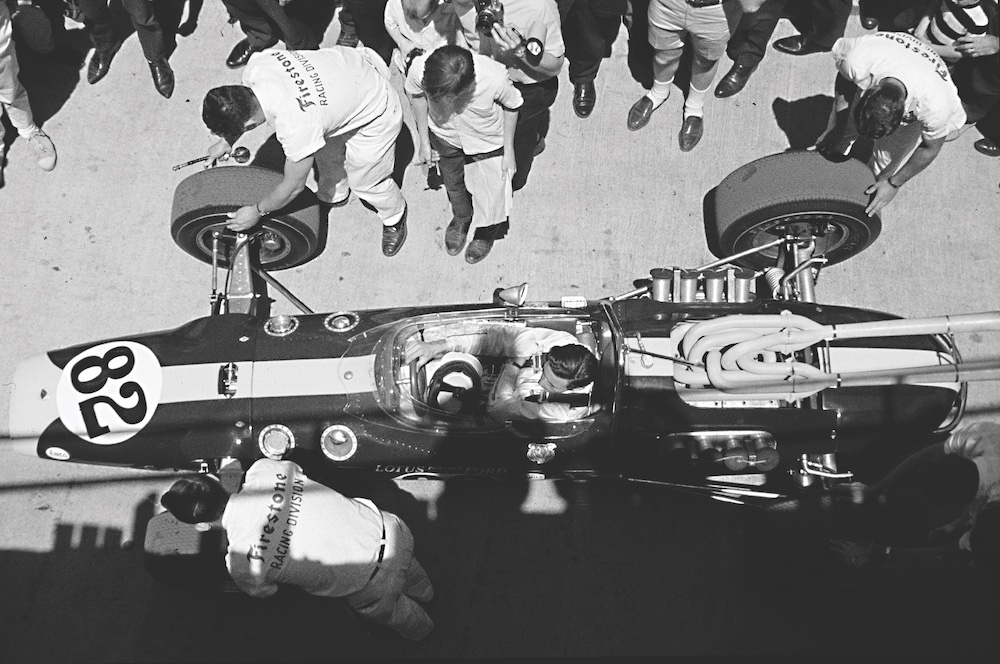
Clark’s 1965 Indy 500-winning Lotus 38 was effective as it was stunning. Image by Dave Friedman/Motorsport Images
“People always said he was so smooth, but Jimmy ran it on the ragged edge and extracted the maximum out of the car,” says the only driver Clark feared, according to Jim’s father. “Jimmy was an edge man, his tail was out a lot of the time. He wasn’t so calculating; he was more the hell-bent-for-election kind of guy. And if you were a spectator, you wouldn’t take your eyes off him.”
Despite the fact he’d galvanized Gasoline Alley and it was all about the “Yanks vs. The Brits” now, Clark’s victory was met with respectful adoration.
“He was shy, polite and a little uncomfortable with the fame,” says British-born IMS historian Donald Davidson, who befriended Clark in 1964. “And he was always amazed how popular he was during May. He thought the Americans would be hostile toward him, but they never were. They adored him.”
Not a surprise, according to Stewart.
“Jim was still a Scottish border farmer and he was always a quiet, modest, very dignified man,” he says. “His demeanor was different from A.J., Rufus [Parnelli], McCluskey, and those great characters like Jim Hurtubise. I think the American drivers and fans respected him for what he did and how he conducted himself.”
All eyes were on the ’65 winner and F1 king the following May, but it turned out to be a month of enormous frustration.
“In 1966 the Indy car was cobbled together because we spent all our time on the H-16 Lotus,” recalls Alan McCall, a lead mechanic for Clark in F1 and Indy. “It was the previous year’s Indy car and BRM was supposed to make us the motors, but they never turned up. I remember Al Unser jumped in the second car and thought it was wonderful, but Jimmy kept complaining. He kept changing the car, but he was struggling and needed to pick up the pace.
“One night Chapman sat us in a circle and put Jimmy in a chair in the middle. He said: ‘All of these boys are giving their best, what about you, James?’ Jimmy got redder and redder, but never said a word. He was livid. But he got with the program and qualified second quick.”
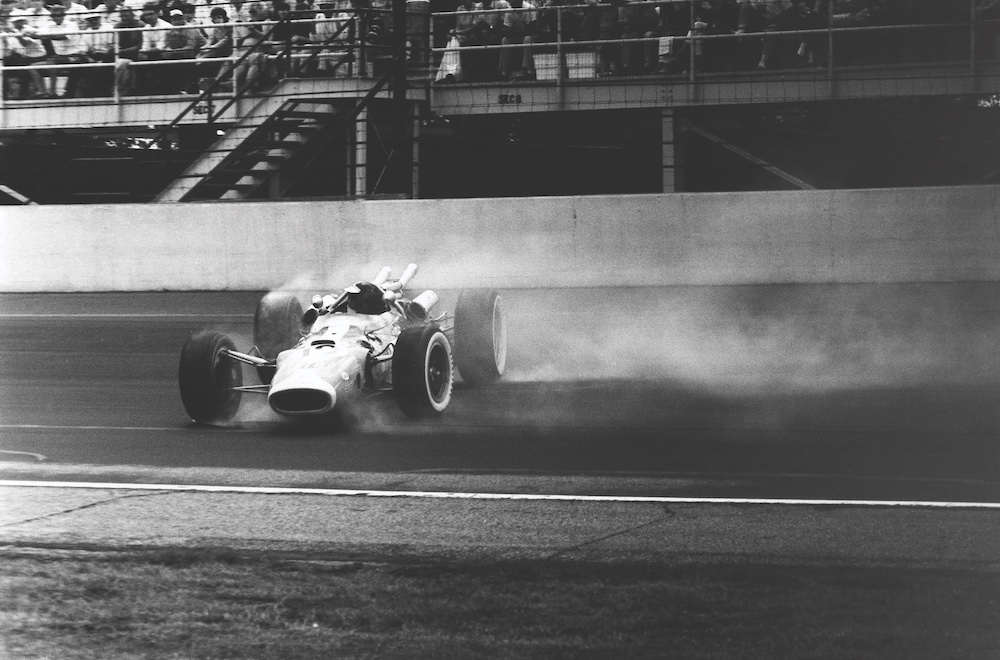
Despite spinning twice (both times without flat-spotting his Firestones), Clark finished second in the ’66 Indy 500. Or was it first? Controversy still reigns... IMS archive
The ’66 "500” started badly and ended in confusion. A 15-car pileup as the 33 starters charged to the green flag took out Foyt and Gurney. After the restart, Clark had his hands full with Lloyd Ruby, Jackie Stewart and his own ill-handling Lotus.
“Jimmy spun twice in the race, but caught both of ’em and didn’t stop either time for tires because there were no flat spots,” says McCall.
Ruby led for 68 laps, but his engine seized up and that put rookie Stewart in front from laps 151-190, before his car lost oil pressure. That supposedly left Graham Hill in first place, where he stayed for the final 10 circuits, although it’s been widely disputed that the wrong driver’s face is on the Borg-Warner Trophy.
“Graham Hill got lapped and then un-lapped himself, but there’s no way he beat Jimmy,” continues McCall. “We ran down to victory lane and when we got there Graham was already in the box. We were pissed because we had the official RAC scorer in our pit and USAC had a little old lady, and our lap charts clearly showed we finished ahead of Graham.
“Clark did win the race. There’s no doubt in my mind, and he thought so as well.”
For 1967, what turned out to be Clark’s last Indy 500 was easily his worst.
“It was the same car from 1966, we never got to tire test, the engines kept blowing up, and the changes we made didn’t work,” says Eamon “Chalkie” Fullalove, the wing commander of Indy cars for 30 years, whose initial Indy appearance in ’67 came as a wrench with Team Lotus. “All the other teams had caught up and we were behind the 8-Ball. Never got the car working to Jim’s liking. He qualified 16th and burned a piston early in the race to end a miserable month.”
Of course, Clark was ticketed for the Andy Granatelli/Chapman collaboration on the turbine-powered, wedge chassis Lotus 56 in 1968. He’d tested the car in the spring and was enthused by its potential, but lost his life in a Formula 2 race at Hockenheim, Germany, just a month before Indy opened for practice.
Still, it surprised some that he’d kept coming back to the Speedway.
“He kept coming back for money,” states McCall. “I don’t think he necessarily liked it, but he liked the money. And Chapman never paid Jimmy proper money. I think he got 7,000 quid [$19,000] for winning the World Championship in 1965, so he could make five or six times that amount by winning Indianapolis.
“It wasn’t that Chapman was mean,” he adds. “The money just wasn’t there. We were always struggling financially.”
Stewart agrees, to a point.
“No question there was a lot more money to be made at Indianapolis than in F1 back then,” he says. “When I got my offer to come drive for John Mecom, Jimmy encouraged me. He said it was quite a challenge, but that I would enjoy it. I did, and I think he did as well.”
When asked if he thought Clark enjoyed racing at Indy, Gurney ponders a moment.
“That’s a hard question to answer,” he says. “He was very proud of having won it and it ended up being a priceless arrow in his quiver. But there’s an element there – and I don’t care if you were A.J., Parnelli or Mario – the morning of the race and you’re looking in the mirror saying to yourself, ‘I wonder if I’m going to be able to do this forever.’ That element existed in those days.”
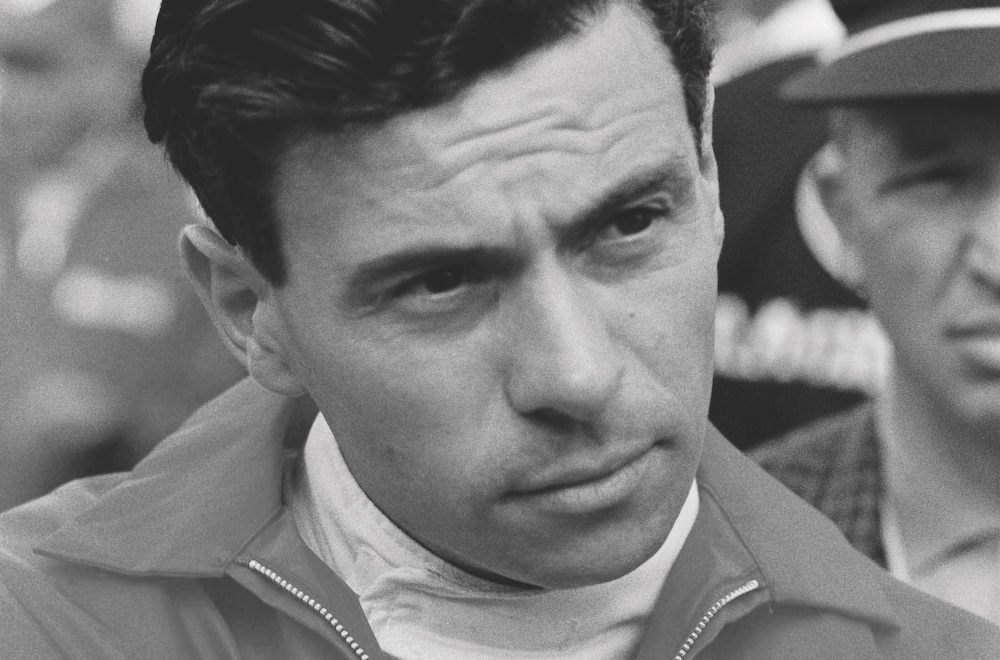
Clark in contemplative mood in 1966. Naturally shy and reserved, he did become more comfortable with the frenetic Indy 500 vibe with each visit. Motorsport Images
Looking back, the mechanics still have awe in their voices when talking about Clark.
“Jim’s feel was incredible and he was so sensitive to what was going with the chassis,” says McCall. “You didn’t have to give him a good car, just a car that would repeat itself. I worked with 75 racecar drivers and there was nobody like him.”
Sparshott simply states: “We had the right man in the cockpit,” while Fullalove adds: “There was nobody better, ever.”
Asked to rank Clark at Indy, Jones reponds: “He’s right there at the top. With Foyt, Sachs, Ward, Herk and Branson. He was as natural a racer as I’ve ever been around and had all the talent in the world. He didn’t grow up on ovals like me and Foyt, but he sure was a quick learner.”
Stewart still speaks of his old friend with reverence, which is how Clark always approached the Indianapolis 500.
“He treated it like any other race; he went there to win it,” says JYS. “But he had great respect for the track and the American drivers and always thought he was lucky to be there.
“Jim came to Indy in a modest way, with no idea of how to race there and made an immediate impact. And what people loved about him was that, win or lose, he was always the same Jim Clark. There was never any bitterness about 1963 or ’66, just a great deal of satisfaction and humility from winning in ’65.
“He was very special, and his legacy at Indy will be that he’s forever remembered.”
COLIN CHAPMAN’S SEVEN-YEAR ITCH
In the seven years that he competed at the Indianapolis 500, Colin Chapman created cutting-edge cars that changed the face of the race and how American open-wheel teams thought about power-to-weight ratio, pit stops, charging into a corner and going fast on an oval.
All thanks to Daniel Sexton Gurney.
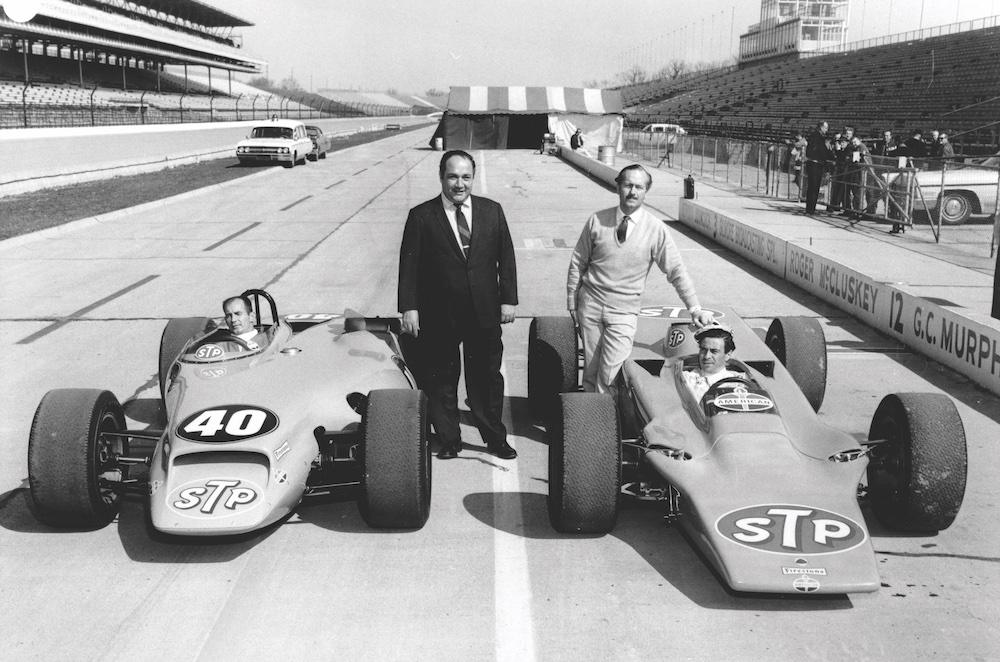
Colin Chapman’s take on a turbine, the wedge-shaped Lotus 56 (RIGHT), with Andy Granatelli’s version during Indy testing, spring 1968. Jim Clark (in car) was excited by the 56’s potential, but didn’t live to race it. IMS archive
Gurney, the only American to ever drive his own creation to a Formula 1 victory (the 1967 Eagle), flew Chapman to the 1962 Indy 500 to get the lay of the land before convincing Ford to build them an engine for 1963.
“I could see at that time that Colin was the raciest designer and the cleverest, and he was willing to create a car with a better chance of winning than the rest of ’em,” says Gurney, who teamed with Jimmy Clark and Lotus at Indy in 1963 and ’64.
From the first Lotus 29 that Clark raced to second place in ’63, followed by his pole-winning Lotus 34 in ’64, came ’65’s stunning Lotus 38 – a full monocoque car with a special off-set layout designed by Len Terry and Chapman.
“He fancied Indianapolis because it was so open and so ripe for the taking,” says Bob Dance, one of Chapman’s best mechanics throughout the ’60s and ’70s.
Following his Indy runaway in ’65, Clark finished second in ’66 with a modified Lotus 38, but struggled mightily with it in ’67. For ’68, he’d have raced the radical, 4-wheel-drive, turbine-powered, wedge Lotus 56 at that year’s “500,” having been enthused by its potential in a test at the Speedway, but was killed in a Formula 2 race just weeks before Opening Day at the Brickyard.
Mario Andretti began May of ’69 in Chapman’s modified Lotus 56, the 64, but totaled the car and suffered flash burns on his face in a big accident in practice.
“Colin was always looking for the advantage, and we had one that month because our cornering speeds were so much greater,” says Andretti, who went on to win that race in a backup Hawk chassis. “But he was designing the car for F1 loads, and the uprights failed because it was so weak. Had it held up, I think it would have been a cakewalk.”
And that was that. Following Mario’s accident, Chapman withdrew his remaining entries, departed IMS and never returned.
“He loved Indy, but he said he’d never come back without his own engine,” recalled former Lotus mechanic Eamon “Chalkie” Fullalove. “And he left before Cosworth developed its Indy engine, which would have been a perfect match.”
Presented by:
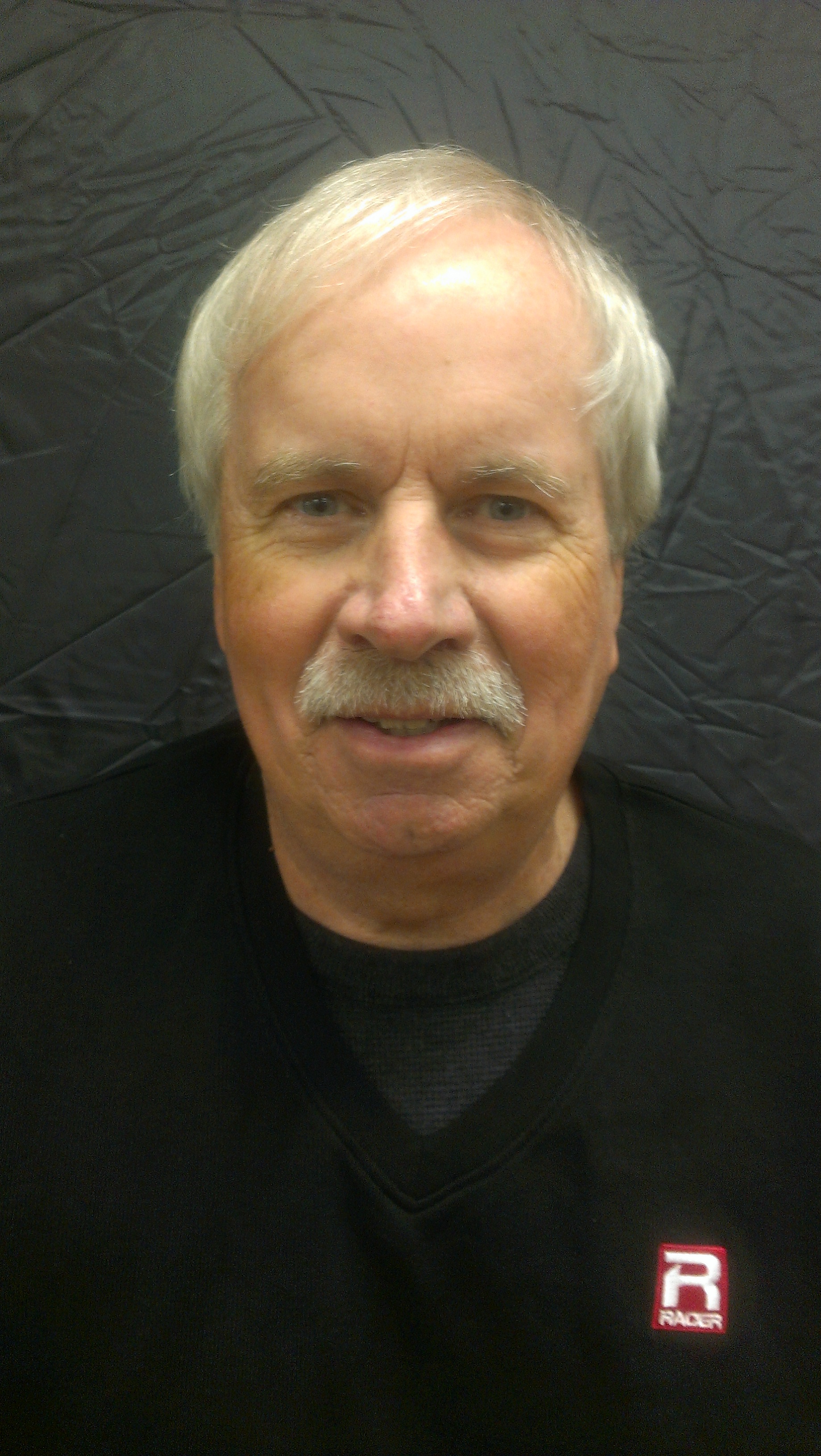
Robin Miller
Robin Miller flunked out of Ball State after two quarters, but got a job stooging for Jim Hurtubise at the 1968 Indianapolis 500 when Herk's was the last roadster to ever make the race. He got hired at The Indianapolis Star a month later and talked his way into the sports department, where he began covering USAC and IndyCar racing. He got fired at The Star for being anti-Tony George, but ESPN hired him to write and do RPM2Nite. Then he went to SPEED and worked on WIND TUNNEL and SPEED REPORT. He started at RACER when SPEED folded, and went on to write for RACER.com and RACER magazine while also working for NBCSN on IndyCar telecasts.
Read Robin Miller's articles
Latest News
Comments
Comments are disabled until you accept Social Networking Cookies. Update cookie preferences
If the dialog doesn't appear, ad-blockers are often the cause; try disabling yours or see our Social Features Support.