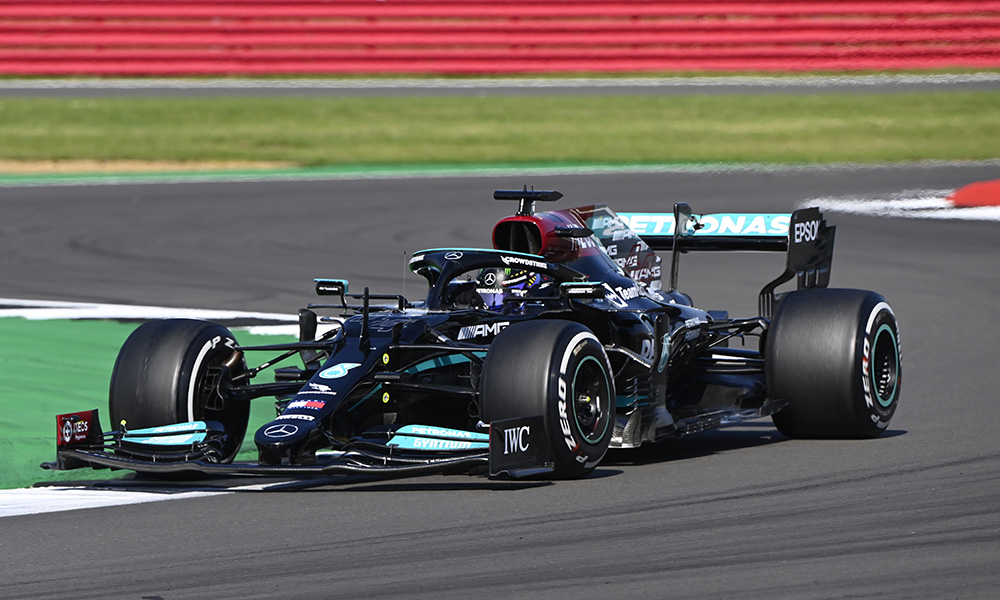
Mark Sutton/Motorsport Images
FIA explains why consequences didn't factor into Hamilton penalty
FIA race director Michael Masi has explained Lewis Hamilton's penalty in the British Grand Prix, noting that all of the teams previously agreed not to judge incidents on their consequences.
Hamilton was handed a 10-second time penalty for a collision with Max Verstappen that ended with the Dutchman requiring precautionary checks in hospital. Red Bull team principal Christian Horner criticized the decision, saying “putting a fellow driver in hospital, writing off the car, and receiving a menial penalty and winning the grand prix doesn’t feel like much of a penalty.” However, Masi noted that what follows the collision has never been a consideration.
“I think one of the big parts has been a mainstay for many, many years, and this came through discussions prior to my time between all teams, FIA and F1 and team principals,” Masi said. “(The teams) were all quite adamant that you should not consider the consequences in an incident, so when they’re judging incidents, they judge the incident itself and the merits of the incident, not what happened after as a consequence.
“That’s been something the stewards have done for many years and have been advised to do from the top down. And I’m talking team involvement and so forth, that’s the way the stewards judge it, as if you start taking consequences into account there’s so many variables rather than judging the incident itself on its merit.”
The race director agreed with the penalty Hamilton was given based on the incident, and said taking the outcome into account would make for an impossible task for the stewards because you can’t predict the future.
“Looking at the incident, I agree with the stewards and the penalty that they applied, when you look at the incident and don’t consider the consequence, which are two very separate scenarios," Masi added.
“If you look at it on that basis (including consequences), you’ll never find a penalty that would address an imbalance like that, if you look at it in that particular circumstance. That’s why, going back a few years, the team principals made a very clear distinction that they did not want consequence taken into account.
“They wanted it based on the incident itself. I completely understand their perspective; that’s a general held view across all stewarding, to not look at consequences, for that exact purpose.”
https://twitter.com/F1/status/1416874046403252226
Masi said that Hamilton was not told how he could have avoided a penalty in the incident, but believes the car’s positioning played a part in him being handed a greater portion of the blame than Verstappen.
“I don’t know that they express a view on what he should have done, but having looked at it all their view was he was predominantly to blame," Masi said.
“I haven’t had the opportunity as I’ve been going through a whole load of other things to read their decision in full, but the big part was similar to what happened with Charles (Leclerc) later on that he could have tucked in closer to the apex, and I think that’s found in the wording that he was predominantly to blame, not wholly to blame. He could have tucked in further, and that may have changed the outcome but we don’t know, we judge it on the incident itself.”
Presented by:

Chris Medland
While studying Sports Journalism at the University of Central Lancashire, Chris managed to talk his way into working at the British Grand Prix in 2008 and was retained for three years before joining ESPN F1 as Assistant Editor. After three further years at ESPN, a spell as F1 Editor at Crash Media Group was followed by the major task of launching F1i.com’s English-language website and running it as Editor. Present at every race since the start of 2014, he has continued building his freelance portfolio, working with international titles. As well as writing for RACER, his broadcast work includes television appearances on F1 TV and as a presenter and reporter on North America's live radio coverage on SiriusXM.
Read Chris Medland's articles
Latest News
Comments
Comments are disabled until you accept Social Networking Cookies. Update cookie preferences
If the dialog doesn't appear, ad-blockers are often the cause; try disabling yours or see our Social Features Support.