Getty Images via Texas Motor Speedway
INTERVIEW: Eddie Gossage, signing off
It’s the end of an era for Eddie Gossage and Texas Motor Speedway.
The only president in the track’s history, Gossage has been a forward-thinking showman that, at times, has been perceived as over-the-top and bombastic. However, the proof of his influence is in the legacy he's created since TMS broke ground in April 1995.
Although his tenure came full circle with the NASCAR All-Star Race on June 13, it reaches its full conclusion tomorrow, with July 1 officially signaling his final day at the helm before moving on to new pastures.
The ride has been a roller coaster for Gossage, a Tennessee native who held motorsports public relations roles at Miller Brewing Company, among other stops, prior to joining Speedway Motorsports in 1989 as vice president of PR for Charlotte Motor Speedway. Bruton Smith, founder of Speedway Motorsports, appointed Gossage vice president and general manager of TMS in 1995. Gossage officially took on the role of president at TMS in 2004.
As he prepared to turn off his office lights for the final time, Gossage sat down with RACER to reflect on the past 28 years.
EDDIE GOSSAGE: Well, I knew that this would be on my tombstone. I've spent almost half my life doing this, and what I didn't know when it started was how long that run would be. It's 27 and a half, 28 years since Bruton called. I knew this would be the defining mark in my career and probably my life, because how many people build a stadium of any size, much less one that was 150,000 seats to start with?
I think if I had actually understood the gravity of it all and the near-impossibility of it all, that it would have just intimidated the heck out of me. But it's like the old deal of, "How do you eat an elephant? One bite at a time." It's just one day at a time, one thing at a time, and over time, it becomes this unbelievable place.
I say 'near-impossible' – if you weren't of Bruton's personality, to build something like this is just virtually impossible because there are so many people that insert themselves in the process that you have to either work around or run over. That's everybody from politicians, to business leaders, to community leaders, and none of them are helping you build it. They're all just in your way, and they don't want to get out of your way. So, you got to go around them or over them, and we did some of both. There were just so many people that were in the way, and they'll tell you that they were instrumental in building this place.
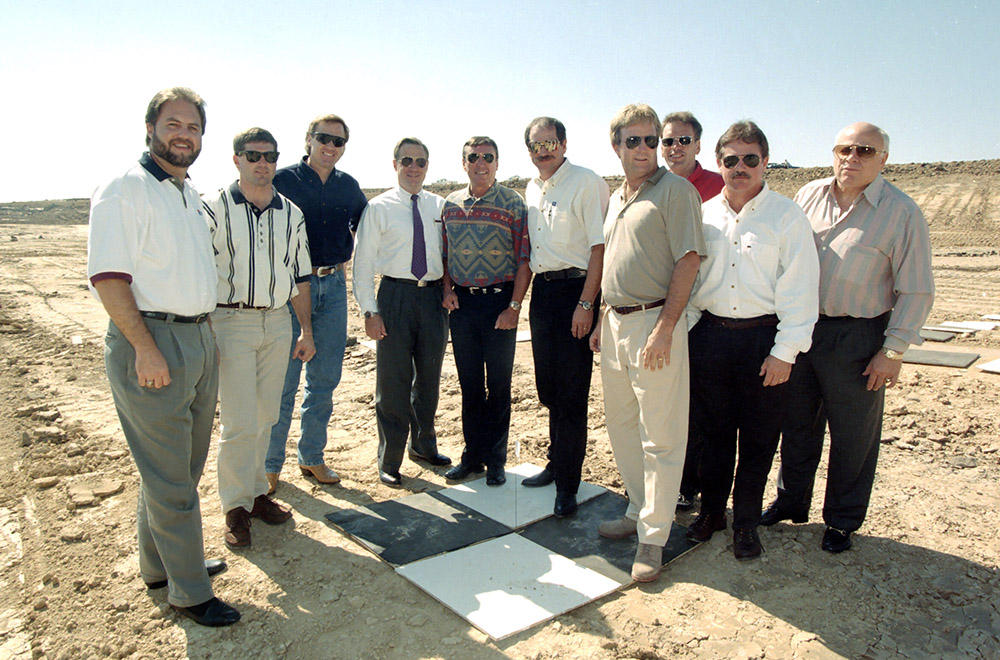
The proposed site of TMS victory lane in October 1995, with (left to right) Eddie Gossage, Bobby Labonte, Rusty Wallace, Ross Perot Jr., Johnny Rutherford, Dale Earnhardt, Sterling Marlin, Ted Musgrave, Terry Labonte and Bruton Smith. Getty Images via Texas Motor Speedway
EG: Bruton's not big on studies. He's big on your gut feeling. And he's told me repeatedly, "If you don't feel it in your gut, the answer is no." We, in our gut, felt like we were in exactly the right place. When we announced this place, it was 70,000 seats. As each day went on, things occurred in the community. You could feel the support and feel the interest, and it was just at a time when the sport was in a straight-up vertical climb. I talked to Bruton all day, all night and it did seem like almost every night he'd go, "Hey, let me ask you a question, kid." What's that? "Could you build 75,000 seats? Can you sell 75,000 seats?" Yeah, we can sell 75,000. You bet we can. Then one night I realized we're at 150,000 seats. What if we throw a party and nobody comes? 150,000 is a big hole to fill.
So I said, "Hey, you know, let's just stop here. Let's do this and leave it here." And he was fine with that. So that first race sold out instantly, and the second year sold out instantly. The third year we added 16,000 temporary seats right over here (points over towards Turn 2) which was a mistake. We shouldn't have done that, but we did and sold them out. We were killing it. There was monstrous demand. It was a very heady time. The momentum we had and the success we were having... nobody had ever built a speedway with that many seats to start with, because the only thing bigger is Indianapolis. We obviously felt great about it because we put the money into it to do it and we built it and it worked. Man, we were proud. It was awesome. It was a great time.
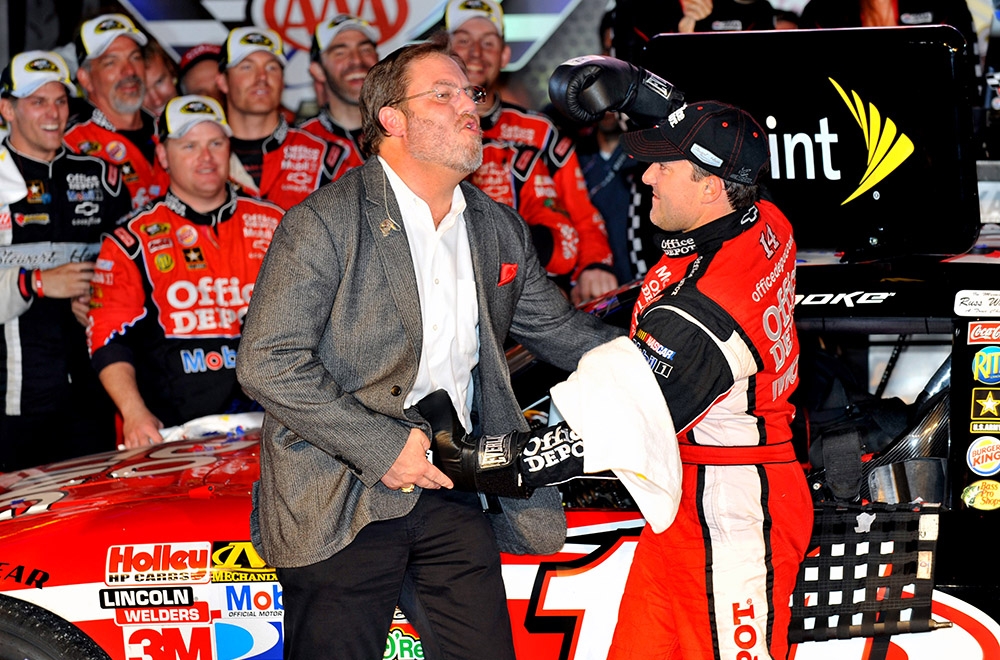
Tony Stewart celebrates his win at TMS in 2011 by delivering a punch to the gut of Gossage, who presented him with the gloves in victory lane. Motorsport Images
EG: The season finale for NASCAR. No question. We earned it. If you can earn it on merit, we did. I hate that we never got a crack at that. Market size, crowd size, purse size... we were way ahead of everybody else, and we never got the special race. Now, I say that with tremendous appreciation for the fact that we got a special race (with the All-Star Race). Having the All-Star race is a great exclamation point to our 25th season. For me, personally, it's a great exclamation point to end with, because the All-Star Race isn't just another race. If you'd asked me that three years ago, I'd have been much stronger on (the subject of never getting the championship finale). It's all good.
EG: Turn 2 is a handful. I don't think you apologize for that. They didn't apologize for the tunnel turn in Pocono. You don't apologize because the track is so narrow at Darlington. There's bumps in Turn 4 at Charlotte. There were weepers at Richmond. There were weepers at Kansas. That's unfortunately not unique to us. The tough one was those first couple of years. The geometry as you'd come off of (Turns) 2 and 4, and then the water coming through the track, had to be addressed. People that don't live here don't have a full appreciation for how much the earth moves in North Texas.
Ultimately, we had to build a bridge. People don't realize the track sits on a concrete bridge underground now so that it won't move and so that it has a way to drain. I'm not an engineer. I did not design this place. To this day, I don't have anything to say. I'm not involved in the paving or the mix, it's not what I do. No track president does.
EG: Well, it's where my experience served me well. I don't know. There's a few things that I look at and I feel that this is the time to do this. It is really something I started to do two years ago. I thought I'd be done in '19, and then some things happened and I thought, "No, I'm not going to leave yet. It's not quite time." Maybe I should have, because COVID hit in the spring of '20 and I could have avoided that. The COVID thing is really a gut shot. I had to fire a lot of people, and that is something that I really struggle with because they were good people. They didn't deserve to lose their job. They lost their job for things way beyond their control. These are people I care about and their families, and some of them haven't found jobs and that just kills me. But, leaving just seemed like the right thing to do at the right time - 25 years.
I will say this: I'm not moving anywhere. My grandkids live 10 minutes from me. I'm not moving anywhere, so that limits what I could possibly do. I don't have a desire to travel a ton. I've done 40 races a year and been on the road and lived out of a suitcase, and I don't want to do that now. But if something comes along that's fun, I'm in. If it's not fun, I'm not in. If it's in racing, great. If it's in something else, great. I haven't gone knocking on doors because Marcus and I agreed that we needed to sit on this and keep it quiet until it was time.
What I do... does it apply to a job in college sports, a job in the NFL, a job in whatever? I don't know. I'm a marketing guy. That's the truth, and the promoter thing is just part of being a marketer. But, I don't know. We'll see. Right now, I don't have any desire to do anything.
EG: Not at all. It's weird. I've worked since I was in the sixth grade. I've been in racing in Cup and IndyCar for 42 seasons. I'm looking forward to doing nothing and hanging out with my grandkids. No matter how much time I spend with my grandkids, it's never enough. I want more. They entertain me, and they're fun and they're smart. It's just an awesome experience.
But the thing about this place is that since that (first) phone call, it's been 24/7. I've been 110 percent committed. There's been nothing else, unfortunately, in my life, really, except do this. Even when I'm not here, you're thinking about it. Ask the staff, they'll get an email from me at 2 a.m. or 9 p.m. or whatever. I don't stop because I'm constantly thinking about it. That's the only way I know to do what we've done here. I'm not asking them to answer my email at 9 p.m. or 2 a.m. It's just, that's what I'm thinking is I need to tell them, ask them whatever it is and they can answer the next day. They all know that, but the brain is engaged all the time. I don't want to be that engaged.
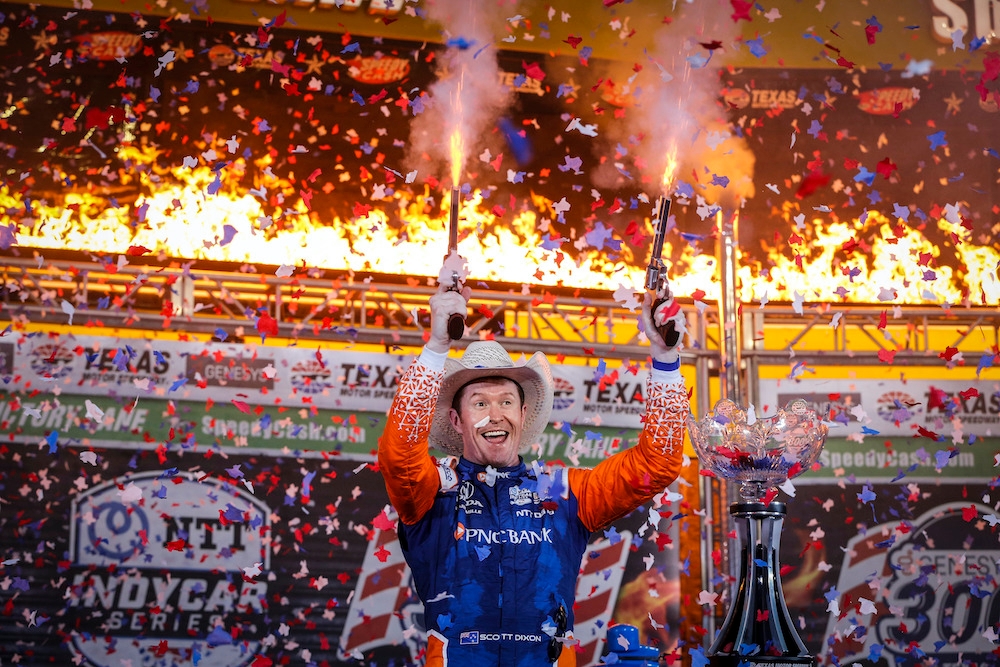
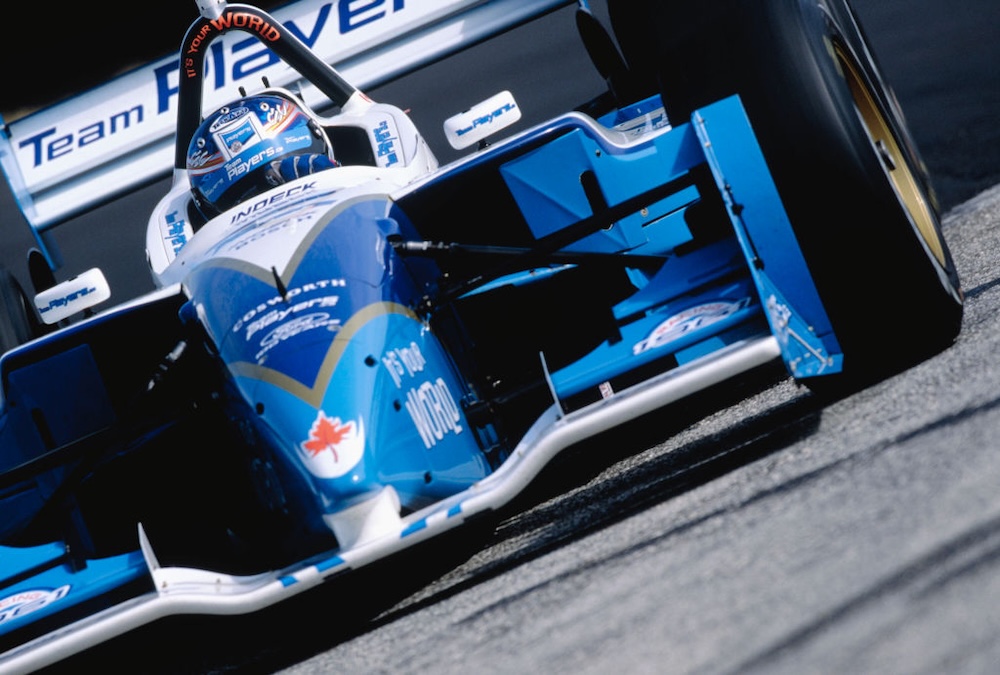
There's no danger of confusing that victory lane for the one at Laguna Seca. Cantrell/Motorsort Images
Maybe I'm not as smart as others, so I got to work harder. I've never felt like I was a smart guy. I felt like I had tons of common sense, way more than most people. Common sense isn't common, but I've always felt like if I thought about things long enough, I could figure it out.
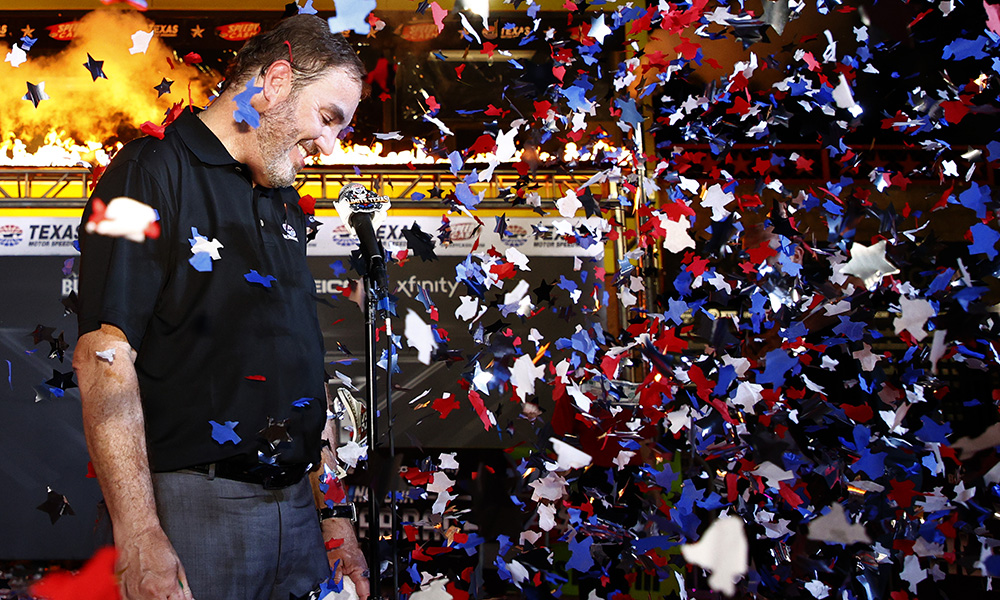
On the creative side of things around here, you're always looking and seeing things. Our victory lane has become this thing. There's flames, and there's those truck exhaust pipes with smoke coming out of it, and confetti shaped like the state of Texas, six shooters and the cowboy hat. If it comes down to caution and restart with seven or eight laps to go, you're going to hear the crew chief or the driver say, "Okay, guys, let's go get us some cowboy hats." You know, that means more than the money does.
There's music playing in victory lane. If you've listened to the music, it's all about winners. For the longest time, I toyed with victory lane. For a while I had a waterfall backdrop. Victory lane is a backdrop where you put your race sponsor on it and the series on it and tells you where you're at in the picture. But it tells you that you're in Texas or you're in Pocono or you're in Sonoma or whatever. It tells you where it's at. And so I'm like, 'What's a waterfall got to do with anything Texas?' Then I played with doodling with Spanish mission architecture. I was like, "Well, it's not the freaking Alamo, so that's not it." I never could come up with it.
For a while, I toyed around with the idea of Terminator. There's this fight at the end of Terminator, where he was in a factory and there's beams and there's wires are sparking and all this kind of stuff. I even looked into Tesla coils, and realized that it is very dangerous, probably not a good thing. ZZ Top played here, pre-race concert. They did a sound check the night before and I'm here at the sound check. I'm looking and I was like, "Oh, that's badass." The microphone stands are exhaust pipes from a semi-truck with the heat deflector on it. There's some tires stacked up over here and there's just a macho setup. Hmm. Next thing I know, I got this fire and smoke thing going on, exhaust pipes from ZZ Top and the fire, because why not? Fire makes everything better. The six shooters and the cowboy hat, you know, you're not going to sit there and go, 'Is that Kentucky?' You know, "Looks like Martinsville to me." No. Don't mistake it, we've got these great icons.
To me, it's one of the two coolest victory lanes, the other one being Indianapolis. What do they do in Indianapolis? They got a cool trophy with your face on it and a bottle of milk. That's their cool thing. Our cool thing is these six shooters and cowboy hats and fire, because Texas is tougher and macho than every other state in the union.
Then I sit there and go, "Well, why don't the other tracks do this?" I don't know. It took me a while, but I figured it out, and I think we've figured it out better than others. The whole process of everything just took a while.
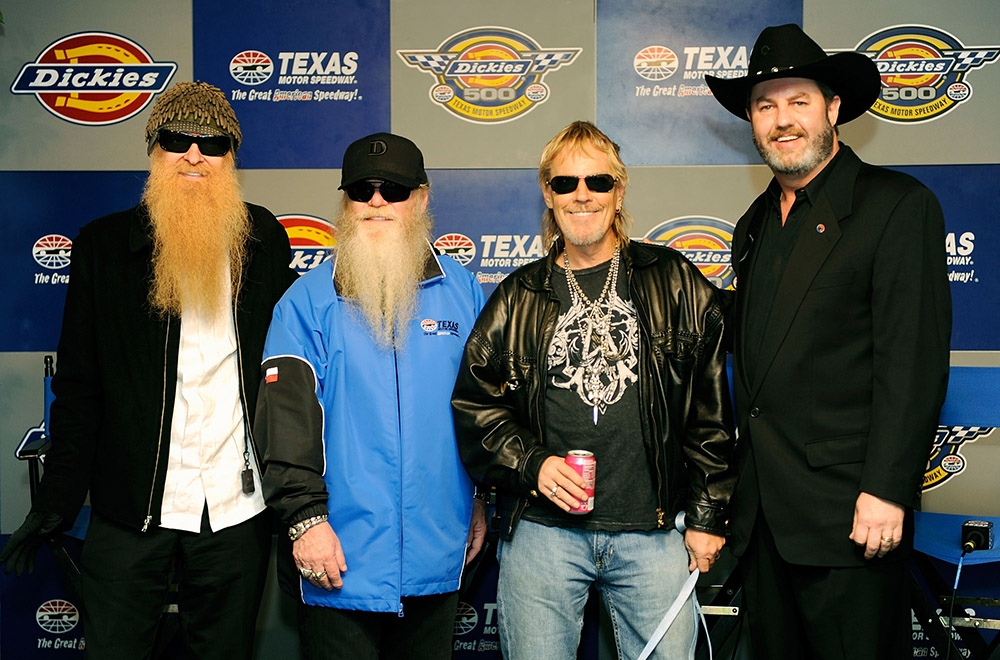
Gossage (far right) received some victory lane inspiration from musicians (left to right) Billy Gibbons, Dusty Hill, and Frank Beard of ZZ Top. Getty Images via Texas Motor Speedway
EG: Well, the emotion has to do with people, not so much the place. The place is cool, but it's the people that give it character and personality. So the emotion that I have, the bittersweet thing that obviously exists, it has to do with the people. That's in two ways. One is the people that I work with. I enjoy working with these people. They're my friends, and I talk to them and I see them every day.
But I think the fans know that I'm one of them in that I've always thought about them first. Marcus (Smith, president and CEO of Speedway Motorsports, and son of Bruton Smith) even said that in the press release when it was announced that I was leaving, and I thought that's interesting because he and I never really had this conversation. But I've always been the one, I think, that when we discuss something I go, "Well, let's look at it from the fan's standpoint. How are they going to like it?" It's not about a sponsor. It's not about a race team. It's not about a race car driver. It's not about a race track. It's about the fans, because they're the ones that buy the tickets. They're the ones that buy the sponsor's product and let them know that they buy it because of their sponsorship of this or that. It all starts and stops with them. If you handle that, everything else falls into place. That's how I've always seen it in racing.
I think they know and that's kind of cool. It's been touching, the number of emails and cards that fans have sent in since the announcement, social media comments, things like that. People that I don't know.
The people that want another picture together at a race... it happens every race. Like, we've had a picture made for 20 years together, and they want another picture. Or, they bring me a gift, which is always surprising because they got it wrong. It's the other way around. I appreciate them, and they bring me a gift or they'll just tell me they're praying for me. You sit there and go, "I run a race track," but so many good people are race fans. It just amazes me when I hear those things from people. So, it's the people. Whether it's the ones that buy the tickets or the ones that work here. That's the hard part of not doing that again. But it has to end sometime. I'm happy. I'm going to do the grandkids thing and the family thing, ride my motorcycle and not lose sleep. That'll be fun. But I'll still be watching races on Sunday. That’ll be for sure.
Presented by:
Joey Barnes
A regular on the motorsports scene since 2013, Joey Barnes’ career has taken him coast-to-coast from the garages of NASCAR to the paddocks of IndyCar and Formula 1. In addition to founding Motorsports Tribune, his work has appeared in outlets including Autoweek magazine and IndyCar.com. In 2017, he was recognized with an award in Spot News Writing by the National Motorsports Press Association.
Read Joey Barnes's articles
Latest News
Comments
Comments are disabled until you accept Social Networking Cookies. Update cookie preferences
If the dialog doesn't appear, ad-blockers are often the cause; try disabling yours or see our Social Features Support.